The first litter of Cesky Terriers was born in 1949. František Horák, who hunted outside Prague, wanted a terrier that could go underground after rats, work alongside other dogs and settle easily into family life. He crossed the Scottish Terrier with the Sealyham Terrier. The resulting breed kept its interest in tracking quarry and proved a willing companion on walks. Its low outline is a good place to start when learning to recognize it. [1][2]
An adult Cesky stands about 10 to 13 inches (25 to 33 cm) at the shoulder. The body is longer than it is tall, with short, sturdy legs and a slight rise in the back toward the loin and rump. The clipped coat reveals the muscle along the back. Lower down, gently wavy hair on the chest, belly and legs hangs almost to the feet. Adult coats commonly range from charcoal to pale silver. Look also for triangular ears folded against the cheeks and long hair falling from the forehead and down either side of the muzzle. [1][2]
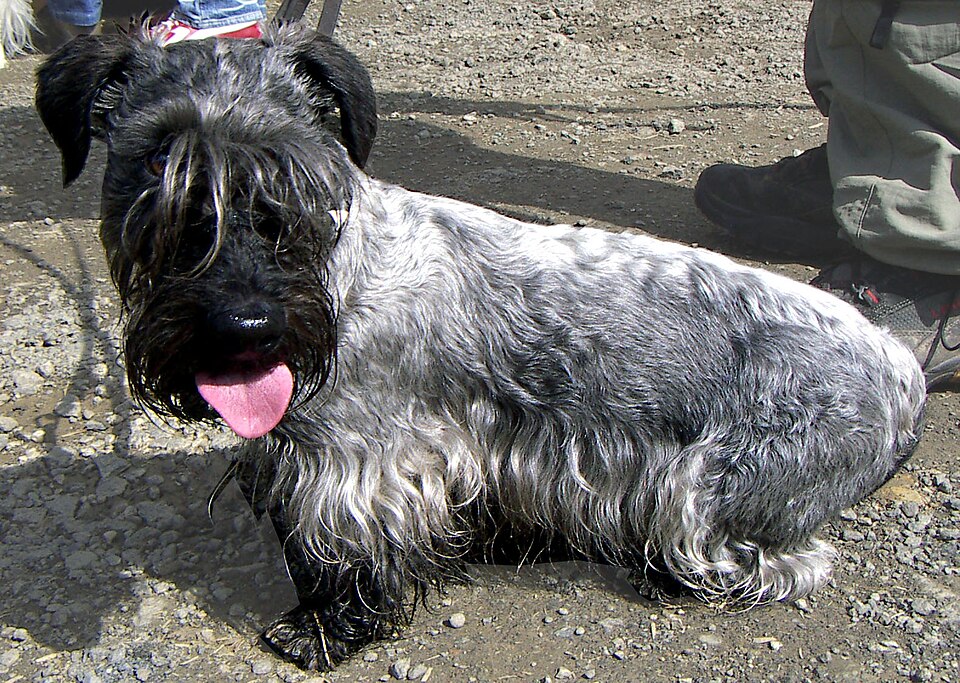
The Cesky Terrier has a long, low outline. Steffen Heinz, Wikimedia Commons[6]

Leave time to sniff on leashed walks
A Cesky may catch a scent in the grass before you see the small animal dart away. A dog that comes readily when called at home can still give chase in that instant. For a daily walk, choose a stretch where you can stop without hurrying. Clip on the leash before you leave, give the dog time to investigate and change direction together when you reach a crossing or the end of the verge. Keep the leash on in open areas. For a game that lets your dog run after a toy at full stride, use a securely fenced space and close the gate first. [1][2]
Ceskys need daily activity, and playing with someone is part of it. Alongside a walk, find a time when someone is free to roll a toy for the dog to chase. If the dog brings it back, roll it again. One Cesky may spend much of a walk following scents, while another will happily play a few more rounds of fetch. Whether you live in an apartment or a house with a yard, think through an ordinary workday. Who has time to take the dog out? Who enjoys playing with it? If you have a yard, check that the gate latches and consider where the dog will be as people come and go. [1][2]
Teach your Cesky to look back at you
Ceskys are generally willing partners. Short, enjoyable sessions can teach them to turn their attention back to you when something catches their eye. Start in a quiet room. Say the dog’s name once. As soon as it turns toward you, praise it, offer a small treat and let it go back to what it was doing. Once the response is familiar, practice on leash somewhere quiet outdoors. If your dog is already staring at an animal under a tree, walk a little farther away. Reward the turn when you reach a distance where the dog can respond again. Harsh scolding can discourage a Cesky from trying. Set aside the day’s small training treats in advance so you can keep track of how much this food-loving terrier eats. [1][3]
The same exercise comes in handy when visitors arrive. Ceskys can be reserved with strangers, and puppies need time to get used to people coming and going and to everyday household sounds. When someone comes in, keep the dog beside you, off to one side, with room to watch the newcomer. Reward it when it can calmly turn back to you. Agree as a family on the word you will use and the action you will reward. Children can take part with an adult alongside them. Each time the dog hears the familiar cue, it has something it already knows how to do. [1][2][3]
Check where the front legs meet the chest
In the show photograph, the coat lies close over the Cesky’s shoulders and back, while the longer hair around each front leg looks almost like a fluffy sleeve. That change in length is a handy landmark. You can run a hand the length of a smooth back and miss a knot tucked between a front leg and the chest. After a walk, check the legs and belly for bits of grass. While the dog is standing, gently part the hair with your fingers where each front leg meets the body. Even if the hair looks loose on the surface, a small mat may be forming underneath. As it tightens, it can pull with each step. [1][4]
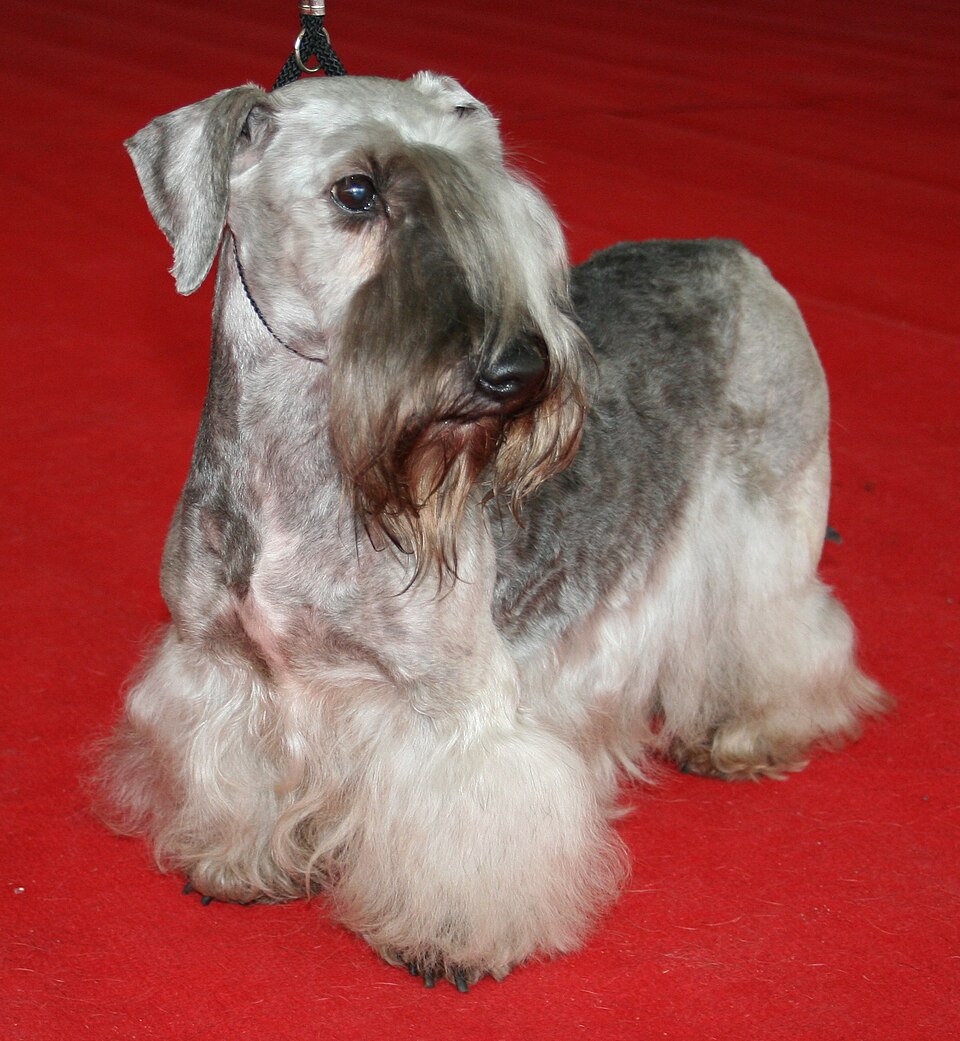
Long leg hair meets the clipped coat at the shoulders. Pleple2000, Wikimedia Commons[7]

Part the coat a small section at a time so the comb reaches the hair close to the skin. Hold the section as you gently tease out a loose knot. Leave a tight mat to a groomer if it sits against the skin or the dog pulls away when you touch it. A puppy’s coat can feel like cotton wool and tangle easily. The American Cesky Terrier Fanciers Association recommends combing it daily. Once the adult coat grows in, plan on a thorough combing two or three times a week. A muddy walk still calls for attention to the parts that got dirty that day. The fine, soft hair holds dirt, so regular baths are part of the routine between trims. [1][2][4]
When booking a groom, ask whether the groomer has clipped a Cesky before. The body coat is trimmed with electric clippers, leaving the long fall of hair over the brow and the beard around the muzzle. The hand-stripping used for some wire-coated terriers is unnecessary. The breed club suggests a full groom about every eight weeks for a family dog. If your usual routes are muddy, ask about keeping the belly fringe and beard a little shorter. Have the groomer show you where to part the hair and how to reach the layer underneath when you comb at home. A trim is also a chance to check the hair around the ears. Between visits, look for wax or debris on the visible inner surface of each ear flap. [1][2][4]
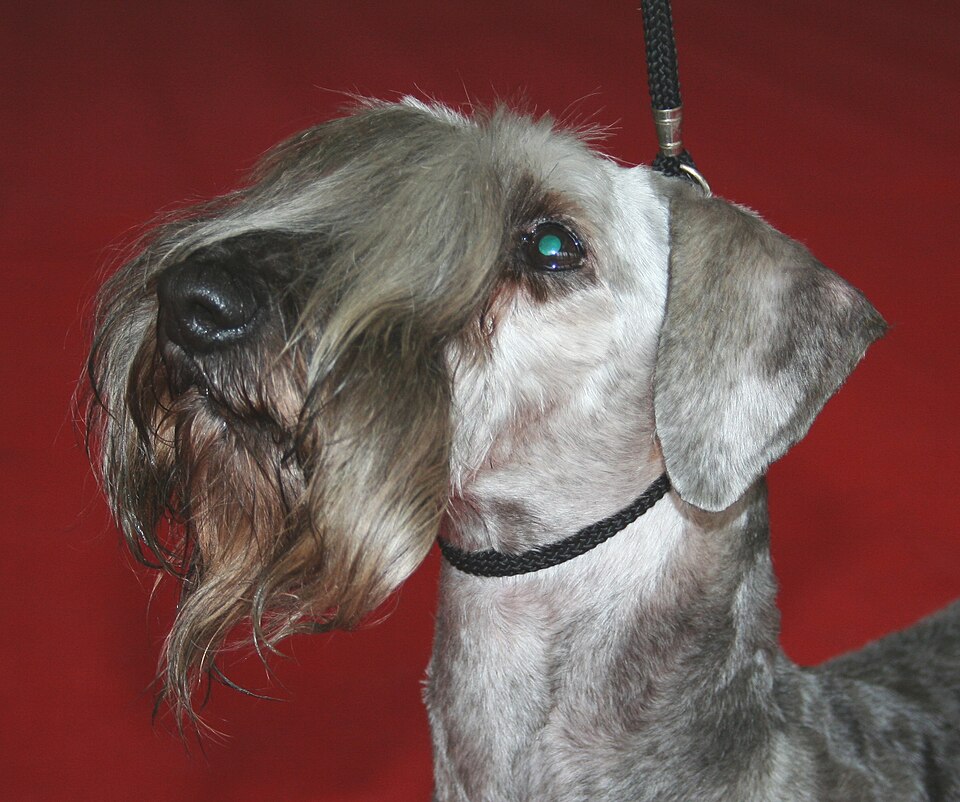
The folded ears frame the Cesky’s bearded face. Pleple2000, Wikimedia Commons[8]

Ask for both parents’ screening records
Before bringing home a puppy, ask the breeder for the screening reports for both parents. The American breed club’s 2021 health statement lists a cardiac evaluation, an assessment for slipping kneecaps (patellar luxation) and a veterinarian’s check for a full set of teeth. It lists an examination by a veterinary ophthalmologist as optional. Match each report to the dog’s name and look at what was examined and what the examiner found. The AKC identifies patellar luxation, heart problems, progressive retinal atrophy and cataracts as health concerns in the breed. The parents’ results give you information about the family line. Your veterinarian can assess your puppy’s own health as it grows. [1][5]
Walking a familiar route together every day also gives you a feel for your Cesky’s usual stride. A neurological condition called Scotty cramp can occur in the breed. During an episode, muscles may spasm and the dog may move differently. If you repeatedly notice an unusual gait on walks, stop the activity and note what the dog was doing when it started and how long it lasted. If possible, take a video to show your veterinarian. Even if you find a mat beside the leg, describe the change in movement separately. [1][3][4]
References
-
[1] American Kennel Club. Cesky Terrier Dog Breed Information.
-
[2] American Cesky Terrier Fanciers Association. Czech out your New Cesky Terrier!. 2024.
-
[3] LifeLearn. Cesky Terrier. VCA Animal Hospitals, 2014.
-
[4] CeskyTerrier.co.uk. Grooming.
-
[5] American Cesky Terrier Fanciers Association. AKC Official Breed Club Health Statement for the Cesky Terrier. September 14, 2021.