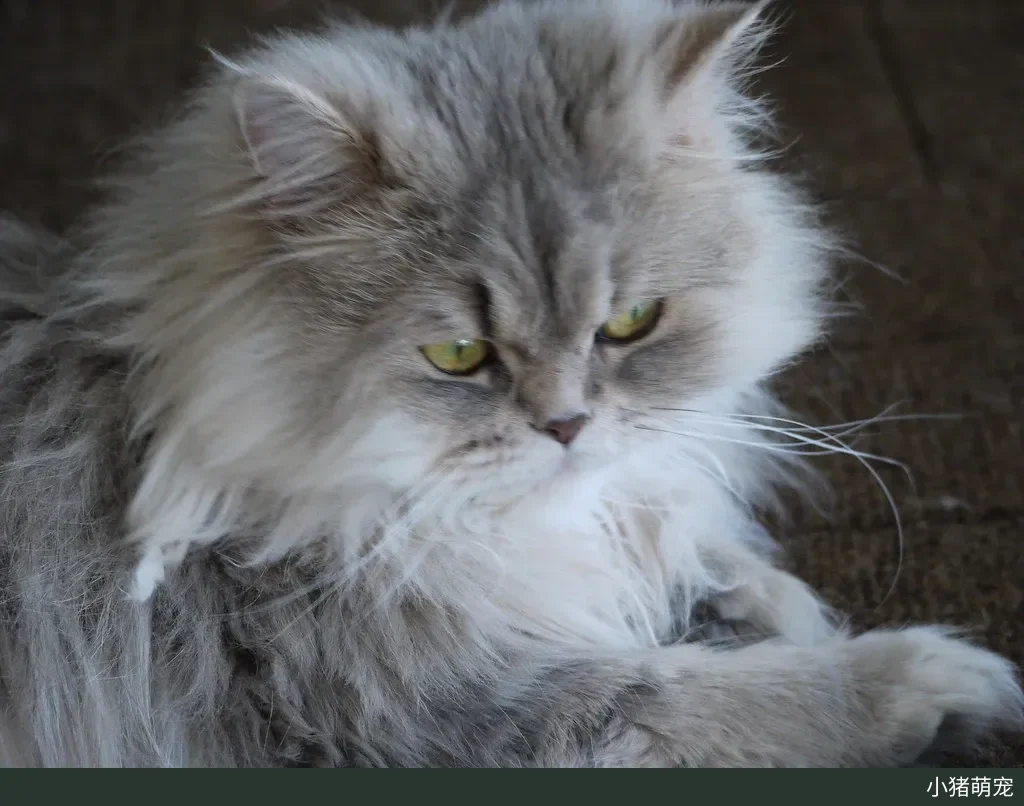
A gray-and-white longhaired Persian; the fluffy cheek and chest fur are trademarks of the breed. Figure: Magnus Bråth; source: Flickr; license: CC BY 2.0.
The Persian is among the oldest and most recognizable longhaired cat breeds: a round face, large eyes, a short nose, and a full coat of long fluff. CFA, TICA, and FIFe all recognize the breed. Temperament is quiet and gentle, but the long coat needs daily grooming; the flat face is also linked to tear overflow, breathing, and dental issues, and sits at the center of breed-health debate. Drawing on association standards and veterinary research, this article covers origins, looks, temperament, health, and care.
Origins and history
The Persian’s name comes from the presumed homeland—Persia (today’s Iran)—but there is no firm record of how it reached Western Europe, and TICA acknowledges that most of the breed’s early history left little writing. CFA’s breed profile notes that in 1626 the Italian traveler Pietro della Valle brought from Persia a longhaired cat with a dense coat, clearly different from the Turkish Angora that entered Europe around the same time; later the two longhair types were crossed, gradually producing a solid-bodied cat with a shorter nose and a silky, thick coat.
Per TICA, Persians appeared at Britain’s earliest cat shows, where enthusiasts set a standard for a round head, short face, short nose, round cheeks, and a short, sturdy body. From the late nineteenth century onward, breeders kept selecting for rounder heads, smaller ears, shorter noses, larger eyes, and heavier bone—so much so that TICA states outright that “today’s Persian looks quite different from Persians of the past.” CFA records that the first Persians reached the United States in the late 1880s; when CFA was founded in 1906, the Persian was one of six founding breeds and has since stayed among CFA’s top ten by registration. In Europe, FIFe has recognized the Persian since its founding in 1949.
Appearance and temperament
Every major association’s standard hammers one word: round. CFA requires a round, massive head with a broad skull; large, round eyes set well apart; small ears with rounded tips; a “cobby” (short and stocky) body with a broad chest, short thick legs, and a short tail; and a long, thick, fine-textured coat with a very full “ruff” around the neck. FIFe’s 2026 standard is similar: medium to large, short and muscular, with a long, dense coat that is soft and silky rather than woolly. Colors are astonishingly varied; CFA divides show Persians into seven groups: solid, tabby, silver and golden, shaded and smoke, parti-color (such as tortoiseshell), calico and bi-color, and Himalayan (pointed cats with a light body and darker legs and face).
Standards say only “medium to large” and give no weight figures. A British VetCompass study of 3,235 Persians seen in veterinary clinics in 2013 found an adult mean of 3.9 kg, with males (mean 4.3 kg) heavier than females (mean 3.4 kg). TICA also notes that Persians look larger than they are, largely thanks to that thick coat.
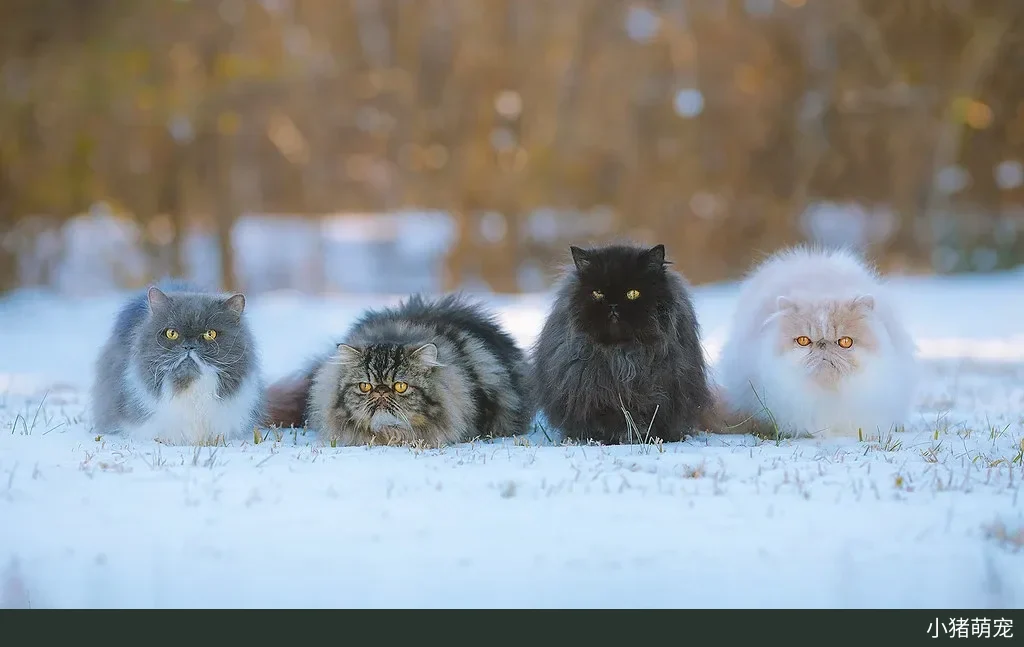
One breed, very different colors: from left to right, gray-and-white, tabby, black, and pale cream Persians. Figure: Reba Spike; source: Flickr; license: CC BY 2.0.
On temperament, CFA and TICA agree closely: quiet, easygoing, and gentle. They will chase a wand toy, but they prefer company and petting; they like to keep their feet on the ground and seldom jump onto kitchen counters or climb curtains; their voices are soft, and they more often “speak” with those large eyes. TICA adds that Persians are creatures of habit who prefer a calm setting and gentle handling; they will happily let children brush and stroke them but are less likely to join rough play; usually quiet and languid, they may still suddenly tear around the house like kittens. These are association descriptions of breed tendencies; individual cats still differ.
Common health issues and the flat-face debate
Persian health discussion centers on the signature flat face—brachycephaly in veterinary terms. The VetCompass authors note that all Persians are brachycephalic, only to differing degrees: more extreme “Peke-face” (also called Ultra-type) lines and milder “Doll-face” (traditional) lines. That skull shape is linked to eye, facial, dental, respiratory, neurological, and reproductive problems, and the flatter the face, the more severe problems may become. For example, kinked nasolacrimal ducts can cause chronic tearing that irritates facial skin; deformed facial bones can crowd and misalign the teeth.
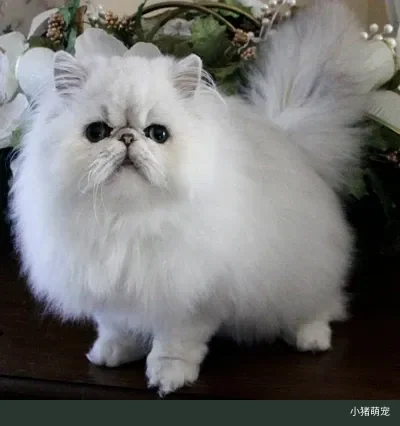
A modern silver shaded Persian: an extremely short nose with a “stop” almost level with the eyes—a classic brachycephalic face. Figure: Wyndcreste; source: Wikimedia Commons; license: CC BY 3.0.
Breathing draws the most attention. A 2016 PLOS ONE study of 1,000 owner questionnaires and photos found that the shorter the muzzle and the farther back the nose, the more owners reported noisy breathing in sleep and labored breathing after activity, and the more common tear staining was. The study relied on owner reports and photo measurements, not clinical exams, and was not Persian-only, but its conclusions align with brachycephalic-dog research. Breed associations also acknowledge the problem: CFA writes that past pursuit of “refined features” once left some Persians with nostrils too small for easy breathing, after which breeders removed affected cats from breeding programs; FIFe’s 2026 standard explicitly requires a nose that is “short and broad… but not snub,” with nostrils “well open to allow free and easy passage of air.” The VetCompass authors do not call for banning the whole breed; they urge cooperation among breeders, veterinarians, and the public to reduce health problems from extreme flat faces.
What do clinic data show? In the VetCompass study, 64.9% of Persians in 2013 had at least one recorded problem; the most common were coat disorders (12.7%), periodontal disease (11.3%), overgrown nails (7.2%), and ocular discharge (5.8%); by broad category, skin/coat, ophthalmology, and dentistry topped the list. Median age at death was 13.5 years, close to the previously reported all-cat figure for the UK (14.0 years); among known causes of death, kidney disease was most common (23.4%). Note that TICA’s page lists Persian “life expectancy” as 8–11 years, which disagrees with this clinic-based study; populations, eras, and methods all affect lifespan figures. The authors also flag limits: records were not written for research, data came only from the UK, and some owners may treat brachycephalic breathing sounds as “normal for the breed” and not seek care, so respiratory problems may be undercounted.
Another focus is hereditary polycystic kidney disease (PKD), in which fluid-filled cysts gradually form in the kidneys and can progress to kidney failure. A 2004 study in the Journal of the American Society of Nephrology identified the causative PKD1 mutation and reported that about 38% of Persians worldwide were then affected, making genetic testing possible. Screening’s effect is clear: the VetCompass paper cites Langford Veterinary Diagnostics data showing UK Persian carriers of the mutation fell from about 28% in 2005 to about 2% in 2016; in 2013 clinic records, PKD appeared in only 0.7%. CFA also says PKD is being controlled through genetic testing and neutering of affected cats. TICA advises Persian owners to confirm with breeders and veterinarians the status of checks for PKD, breathing issues, eye diseases such as progressive retinal atrophy (PRA), and hypertrophic cardiomyopathy.
Care essentials
- Brush every day. TICA recommends a daily metal comb to prevent mats and reduce hairballs; CFA favors a steel or Teflon-coated comb with both long and short teeth, and jokes that you will also vacuum more. Mats are not only unsightly—they pull on skin and hurt; forcing them apart hurts too, so work patiently when you find them. Coat problems were the single most common issue in the VetCompass study.
- Bathing from an early age. CFA advises thorough combing and nail trims before occasional baths; TICA suggests building a bathing habit from kittenhood, towel-drying first, then blow-drying while combing. Many owners use professional groomers.
- Wipe eyes and clean the face daily. Large eyes tear easily and leave tear stains; CFA recommends a soft damp cloth, TICA daily wiping and careful cleaning of tear tracks on the flat face. Ocular discharge was among common VetCompass findings; seek veterinary advice if discharge increases or looks abnormal.
- Trim nails and brush teeth. TICA suggests roughly weekly nail trims for kittens and every 2–3 weeks for adults, plus regular tooth brushing as for any cat. Overgrown nails and periodontal disease both ranked high in VetCompass; the authors also call for stronger preventive dental care.
- Manage weight and encourage activity. TICA notes that cats gain weight more easily after neutering—watch food quality and portions; many Persians do better with water fountains that keep chin and chest fur dry. They are not highly motivated to exercise, so daily interactive play helps. The questionnaire study also linked poorer respiratory scores with sedentary lifestyles—correlation only, not causation.
- Ask more when choosing a cat. Confirm parents’ PKD genetic results and respiratory and eye health with the breeder; you can also use FIFe’s “well open” nostril requirement as a guide and watch whether kittens and parents breathe quietly without obvious noise.
References
-
The Cat Fanciers' Association (CFA). Persian (breed profile and standard; page undated; accessed 2026-10-17)
-
The International Cat Association (TICA). Persian (page undated; accessed 2026-10-17)
-
Fédération Internationale Féline (FIFe). FIFe Standards: Category 1 (EXO / PER), version 01.01.2026
-
O'Neill DG, Romans C, Brodbelt DC, Church DB, Černá P, Gunn-Moore DA. Persian cats under first opinion veterinary care in the UK: demography, mortality and disorders. Scientific Reports 9, 12952 (2019).
-
Farnworth MJ, Chen R, Packer RMA, Caney SMA, Gunn-Moore DA. Flat Feline Faces: Is Brachycephaly Associated with Respiratory Abnormalities in the Domestic Cat (Felis catus)? PLOS ONE 11(8): e0161777 (2016).
-
Lyons LA, Biller DS, Erdman CA, et al. Feline Polycystic Kidney Disease Mutation Identified in PKD1. Journal of the American Society of Nephrology 15(10) (2004).