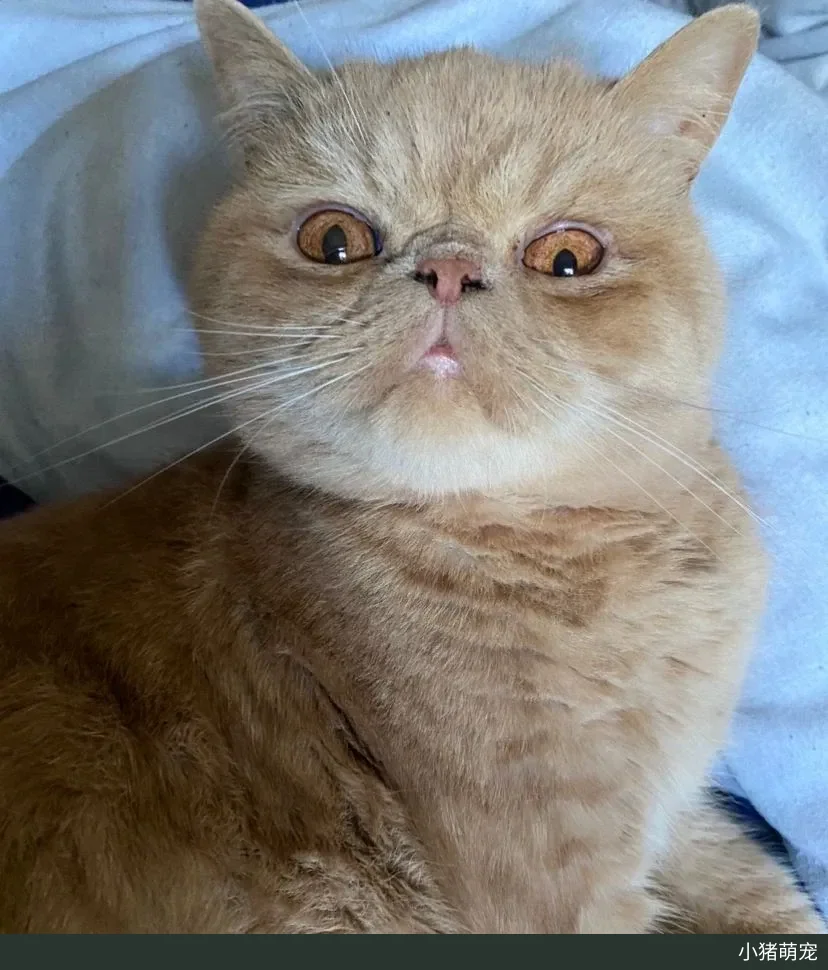
A ginger Exotic Shorthair lying on a pale blue blanket, facing the camera, with a round face, short nose, and large copper eyes. Photo: Tcm1707, file metadata dated 20 November 2022; source: Wikimedia Commons; license: CC BY-SA 4.0.

The Exotic Shorthair (CFA now simply Exotic) is often called a “Persian in pajamas”: the same round face, large eyes, and short, sturdy body as the Persian, but in a short, dense coat. It arose from mid-twentieth-century U.S. hybrid breeding, is typically gentle and quiet, and is easier to groom than a Persian; still, tear staining and breathing issues from a flat face, plus hereditary polycystic kidney disease risk, are worth knowing before you bring one home.
Origin and breed recognition
Per The Cat Fanciers’ Association (CFA), in the 1950s several West Coast Persian breeders crossed Persians with American Shorthairs. Short hair is dominant over long, so litters produced short-coated kittens that kept Persian round heads, round eyes, and compact builds. The crosses were controversial yet popular; CFA established them as a new breed in 1966. Early cats were often silver shaded or chinchilla—colors then unavailable in any shorthair—so the breed was named Exotic Shorthair; later, to avoid confusion over “Shorthair,” CFA shortened it to Exotic.
The International Cat Association (TICA) adds another thread: American Shorthair breeders first sought Persian silver and green eyes; Jane Martinke noticed the kittens’ appeal and proposed a new breed called “Sterling”; it was later renamed Exotic Shorthair and opened to all colors. Besides American Shorthairs, some breeders used Burmese or Russian Blues for short hair, then backcrossed to Persians. TICA granted championship status from June 1979; Fédération Internationale Féline (FIFe) current standards record recognition in 1983. Associations emphasize different origin details, but agree on one point: after short hair was introduced, Exotics kept being backcrossed to Persians, so today’s standards differ almost only in coat.
Appearance and temperament
CFA’s ideal Exotic is heavy-boned, well proportioned, and softly rounded: a large round head, short broad nose with a clear stop between the eyes, large round eyes set well apart; a short, solid, muscular body, short thick legs, and a short tail. The main difference from the Persian is coat: much shorter, dense with a plush feel, a thick undercoat that lifts the hair so the cat looks like a teddy bear. Colors and patterns match the Persian—solid, tabby, silver and golden, tortoiseshell, bicolor, and pointed. TICA notes a medium build that dense fur makes look larger than it is, with males usually bigger than females. A quirk: CFA places Exotics in the longhair division because structure matches the Persian exactly.
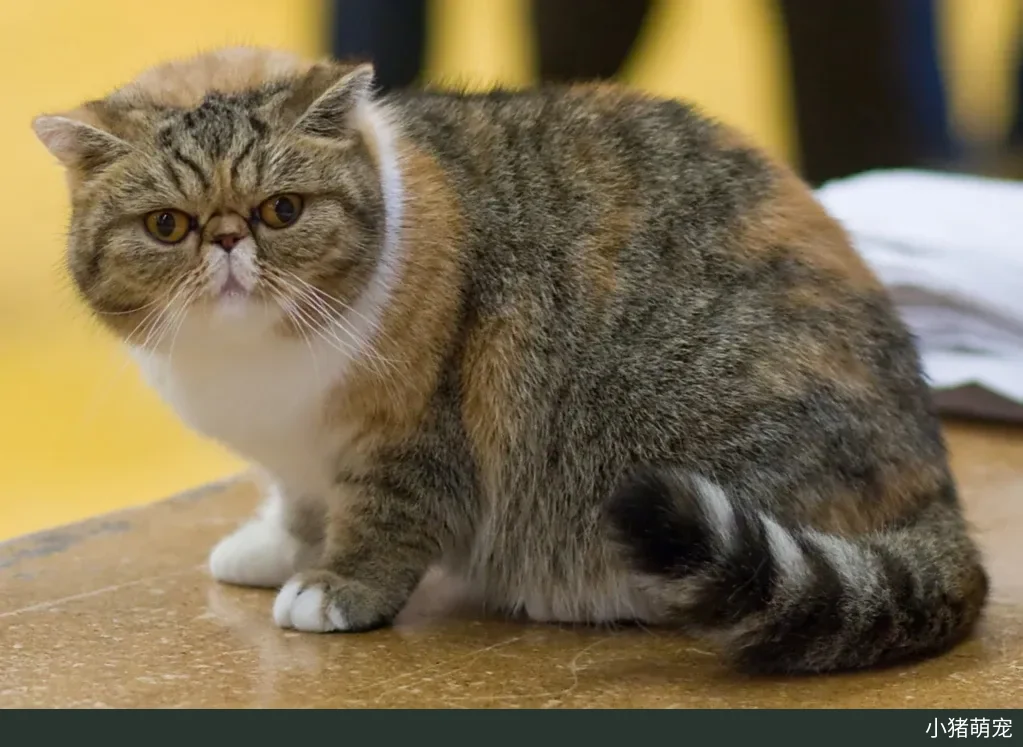
Show queen Noidankattilan Bellatrix, photographed October 2008 at a Helsinki, Finland cat show; color black tortie spotted tabby and white (FIFe code EXO f 03 24); profile shows a short solid body, short thick limbs, and a ringed short tail. Photo: Heikki Siltala (catza.net); source: Wikimedia Commons; license: CC BY 3.0.

On temperament, CFA and TICA largely agree: Exotics are gentle, people-oriented, and quiet; they like staying near owners and follow from room to room without forcing their way into whatever you are doing. They rarely meow, preferring to “talk” with large eyes and occasional soft purrs or chirps. Both associations say they are often more playful and curious than Persians—TICA credits shorthair ancestors—and small games like chasing paper balls or watching a dripping faucet keep them happy. CFA also sees them as adaptable for homes with children; they may be shy with other animals at first but usually learn to coexist. These are breed-level summaries; each cat still depends on individual temperament, socialization, and environment.
Common health issues and the flat-face debate
The health topic that draws most attention is the breed’s signature flat face—brachycephaly. International Cat Care notes that flat-faced breeds such as Persians and Exotics often tear excessively: a shortened muzzle hinders tear drainage through the nasolacrimal duct, leaving tear tracks; altered skull shape also makes the eyes protrude and lids hard to close fully, exposing the cornea more and risking pain and keratitis. Materials on Persians (same head type as Exotics) also mention that severe brachycephaly can bring stenotic nares, elongated soft palate, and other brachycephalic obstructive airway syndrome (BOAS) signs, plus dental malocclusion and skin infection in facial folds.
On flat faces and breathing, a 2016 PLOS ONE study (Farnworth et al.) collected 1,000 owner questionnaires and measured facial proportions from owner photos. Flatter faces correlated with more owner-reported sleep respiratory noise and post-exercise breathing difficulty; higher respiratory scores also linked significantly to tear staining and a more sedentary lifestyle. The sample included 30 cats Chinese owners reported as Exotics. Limits matter: breathing came from subjective owner reports, not veterinary exams; photo measurement has error; and overall, most owners reported little respiratory abnormality.
So “how flat is too flat” is itself contested. International Cat Care’s position on breeding and conformational health urges active discouragement of extreme shapes that harm welfare—naming folded ears, chondrodysplasia (short legs), hairlessness, and extreme brachycephaly. Standards also draw lines: FIFe requires a short, broad nose “but not snub,” nostrils open enough for free airflow, with the stop between the eyes—neither above the upper lid nor below the lower; CFA disqualifies a stop level with or above the upper rim of fully open eyes. For households, that means not chasing “flatter is cuter”: check whether nostrils are open, tearing is constant, and quiet rest brings obvious snoring.
The hereditary disease most worth knowing is polycystic kidney disease (PKD1). UC Davis VGL notes it is common in Persians and Persian-related cats, and Exotics are among breeds recommended for testing: cysts often appear before 12 months of age, with kidney failure usually later. Inheritance is autosomal dominant—one mutant copy is enough—and about half of offspring of a positive cat typically inherit it. International Cat Care notes that when screening began in the 1990s, more than one-third of Persians and Exotics tested positive for PKD; breeders have since worked to reduce it. The organization also lists hypertrophic cardiomyopathy and progressive retinal atrophy among Persian risks. On lifespan, TICA calls the breed “very healthy” with an expected 8–11 years; this article found no independent epidemiology to verify that figure—treat it as an association claim.
Care essentials
Daily care is easier than for Persians, but not hands-off. CFA notes Exotics shed more than Persians (mainly seasonal): a steel or Teflon-coated comb once a week is enough most of the year; a bath may help clear undercoat in heavy molt, and neglected coats can still mat. They usually inherit Persian patience for brushing and baths. Eye care is also daily: TICA suggests wiping eyes as needed because large eyes are easily irritated by dust; International Cat Care notes flat-faced cats with ongoing tearing may need regular wiping. If tearing increases, discharge turns yellow or green, or eyes redden or squint, see a vet promptly—overflow from brachycephaly often cannot be cured, but secondary inflammation and infection need treatment.
When choosing and seeking care, International Cat Care advises asking Persian breeders for PKD-negative proof; Exotics, continually backcrossed to Persians, are also on the PKD1 recommended list, so ask the same. The organization also recommends at least annual exams for pedigreed cats. Watch for persistent snoring in sleep or heavy panting after activity, and have a vet assess clear abnormalities. Do not let “quiet” fool you—they love to play: the study above linked sedentary habits with higher respiratory scores (correlation, not causation); daily wand play and paper-ball games help body and mood.
References
-
The Cat Fanciers' Association: Exotic (includes breed standard; page undated, accessed 2026-10-17).
-
The International Cat Association: Exotic Shorthair (page undated, accessed 2026-10-17).
-
Fédération Internationale Féline: FIFe Standards: Category 1 (EXO/PER), 2026-01-01 edition.
-
International Cat Care: Feline Conformational Health and Welfare in Cat Breeding (accessed 2026-10-17).
-
International Cat Care: Persian cats and brachycephaly, updated 2025-09-26.
-
International Cat Care: Runny Eyes, updated 2025-09-26.
-
UC Davis Veterinary Genetics Laboratory: Polycystic Kidney Disease (PKD1) (accessed 2026-10-17).
-
Farnworth MJ, Chen R, Packer RMA, Caney SMA, Gunn-Moore DA: Flat Feline Faces: Is Brachycephaly Associated with Respiratory Abnormalities in the Domestic Cat (Felis catus)?, PLOS ONE, 2016, 11(8): e0161777.