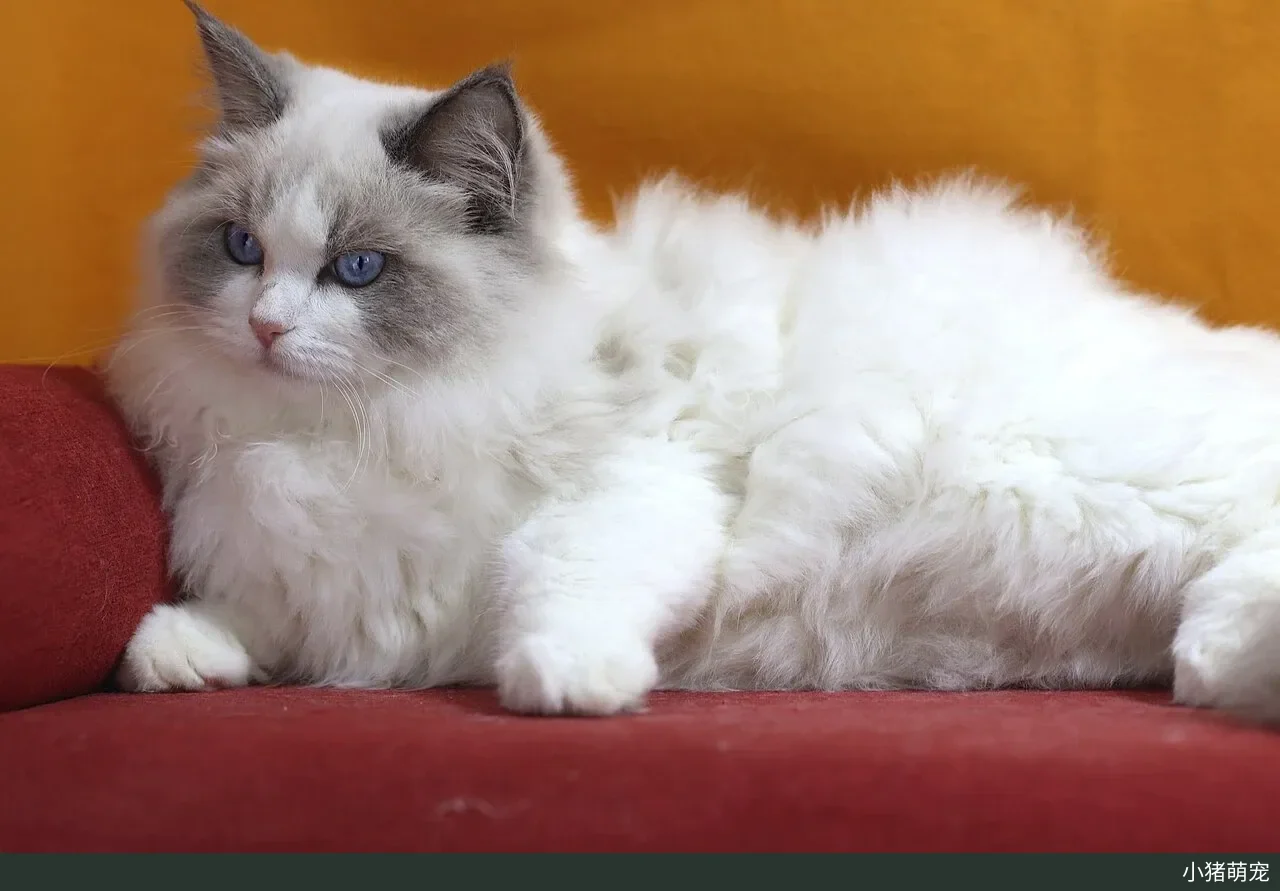
The Ragdoll is a large semi-longhaired cat: the body is light, while the face, ears, legs, and tail are darker, and the eyes are always blue. It was developed in California in the 1960s by Ann Baker; the name comes from the claim that they go limp when held. Drawing on CFA and TICA official pages and veterinary research, this article covers origins, appearance, temperament, and care points such as cardiomyopathy genetic testing and urinary stones.
Breed origins and legends
Per CFA’s breed page, the Ragdoll was developed in the 1960s by Riverside, California, breeder Ann Baker from selected domestic longhairs. The foundation queen was Josephine, a white longhair carrying the pointed gene. TICA’s breed page places the work in the early 1960s and lists other early foundation cats: the seal-mitted male Daddy Warbucks, the solid black Blackie, Josephine’s daughter Buckwheat, and Buckwheat’s half-sister Fugianna. Offspring of Daddy Warbucks with Buckwheat and Fugianna formed the breed’s foundation.
The Ragdoll’s most famous story is also the one that most needs a question mark. TICA records that Baker insisted Josephine was hit by a car, taken to a nearby medical center, and had her genes “changed” there, so later kittens were especially soft and affectionate. That is Baker’s own claim; both associations only retell it, offer no evidence, and it is best treated as breed lore. CFA also notes Baker’s claim that Josephine went limp when picked up—hence “Ragdoll”—while adding that this trait is not typical of most Ragdolls today.
Formal recognition was not Baker’s work alone. TICA writes that Baker licensed a few breeders in a franchise-like way; later some parted ways with her, and Denny and Laura Dayton did much to push major registries to accept the breed. When TICA formed in June 1979, Ragdolls were already accepted for championship; CFA accepted registration in 1993 and championship status in 2000. CFA’s page also says that by its registration counts, the Ragdoll is the world’s most popular cat breed.
Pointed color, blue eyes, and large size
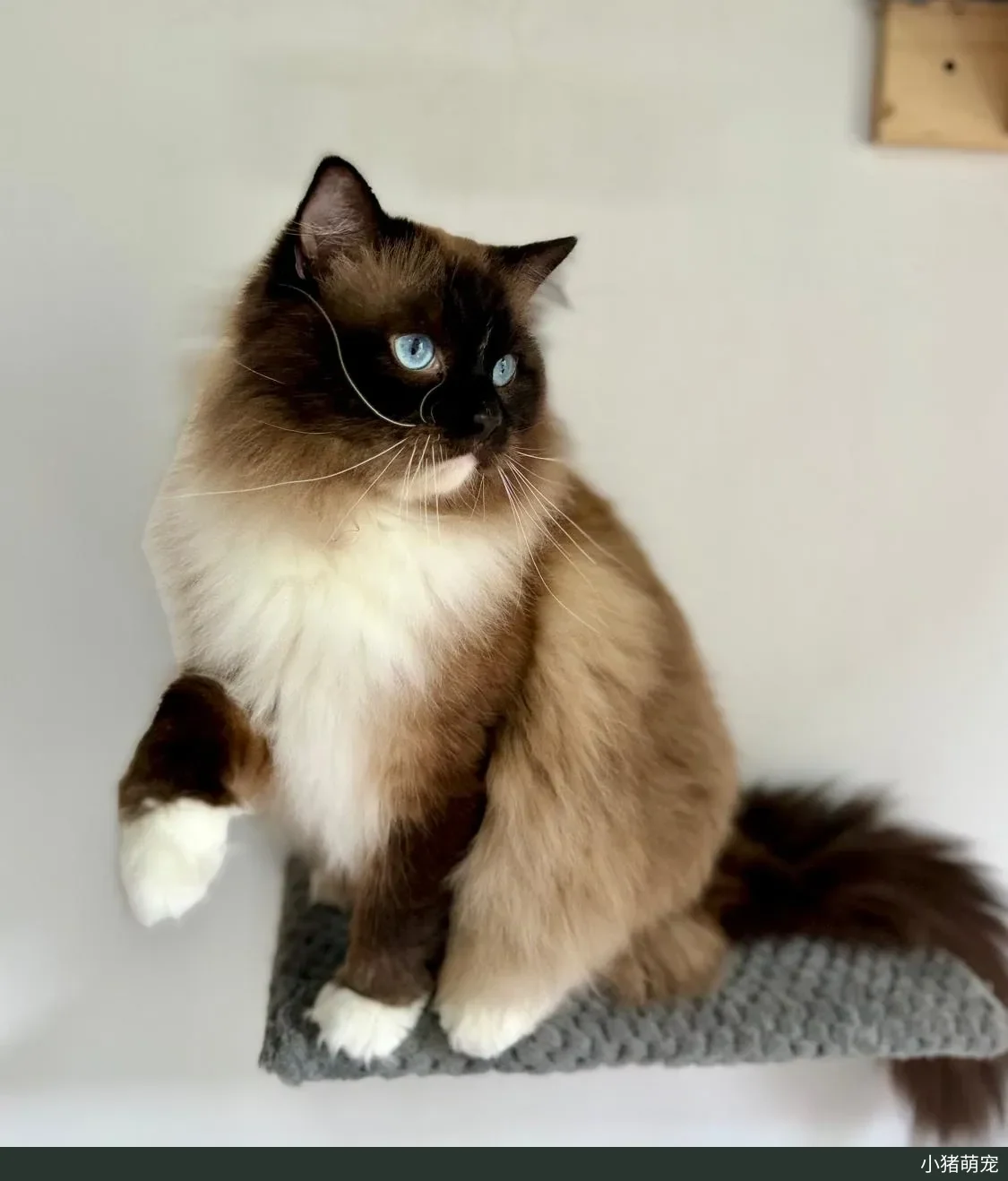
CFA notes that all Ragdolls carry the pointed gene: body color is always lighter than the head, legs, and tail. The standard calls for large, oval eyes of vivid blue. TICA lists point colors seal, blue, chocolate, lilac, red, cream, cinnamon, and fawn, plus tortie and lynx (tabby) variations. On pattern, TICA describes three: colorpoint with no white; mitted, with white “gloves” on the front paws and white on the hind legs to the hock; and bicolor, with an inverted white V on the face and large white areas on chest, belly, and limbs. CFA’s standard also includes van, with color only on the ears, tail, and face.
Ragdolls are a large breed: broad chest, long body, solid muscle, and heavy bone. TICA’s reference weights are 15–20 lb (about 6.8–9.1 kg) for adult males and 10–15 lb (about 4.5–6.8 kg) for females. They mature slowly; both associations say full size arrives around age four. On when color settles, CFA’s breed profile says age two, CFA’s standard about three, and TICA three—so pale kitten coats are not surprising. The coat is semi-long, mostly guard hair with little undercoat, smooth to the touch and not especially tangle-prone. A small fat pad on the lower abdomen is allowed by the standard, but the body overall should be solid, not obese.
Gentle, people-oriented temperament
CFA describes Ragdolls as affectionate without being clingy or demanding—gentle, quiet, and social; they often meet owners at the door, follow people around, and can learn to fetch toys and come when called. Their voices are soft, activity is moderate, and they like play without constant demands for it. TICA also notes that kittens and young adults can be quite lively; if you want a highly active or chatty cat, a Ragdoll may not fit. On going limp when held, TICA says many Ragdolls do; CFA says it is not typical of most individuals today—something to hope for, not a guarantee. CFA also notes Ragdolls are rarely aggressive and get along with children and other animals, but because they trust so readily, introductions to resident cats and dogs need extra care.
Daily care and health risks
Day-to-day grooming is manageable. CFA suggests a steel comb once or twice a week; TICA suggests at least weekly, down to the skin rather than only the surface, watching underarms in shed season. TICA also suggests monthly nail trims and dental checks at annual exams. Weight matters: CFA notes Ragdolls like to eat and can become overweight; TICA recommends interactive play and feeling along the spine and ribs to judge condition, with ideal body condition confirmed by a veterinarian. For water, TICA suggests fresh water daily, trying a fountain, or placing the bowl at least 3 feet (about 1 meter) from food.
The cardiac issue to know is hypertrophic cardiomyopathy (HCM). The UC Davis School of Veterinary Medicine explains that HCM thickens the ventricular walls abnormally, is the most common heart disease in cats, can lead to heart failure, clots, or sudden death, is currently incurable, and is diagnosed by echocardiography. Ragdolls have a breed-specific related mutation: R820W in MYBPC3, reported by Meurs and colleagues in 2007. The campus Veterinary Genetics Laboratory (VGL) notes that cats with two copies face high risk of severe HCM, often with signs by 1–2 years; cats with one copy usually do not become ill and may have a normal lifespan. A 2014 UK questionnaire study of 236 genetically tested Ragdolls found median survival of 5.65 years in 12 homozygous mutants, while heterozygous and clear cats exceeded 15 years. Homozygous numbers were small, and data came from breeder and owner surveys.
The test uses a cheek swab of cells from the inner cheek and gums. VGL advises against breeding homozygous mutants and notes that two heterozygous parents yield about 25% high-risk kittens. TICA also recommends breeders who HCM-test all breeding cats. Note that the test checks only the R820W locus: UC Davis stresses that for most HCM-affected cats the causal mutation is still unknown, so a negative result does not mean HCM cannot develop; heart status still needs veterinary exam and, when indicated, echocardiography.
The urinary system is another risk to watch. A 2000 case–control study of Minnesota Urolith Center cases from 1981–1997 found that, after adjusting for age, sex, and neuter status, Ragdolls had significantly higher risk of both calcium oxalate and magnesium ammonium phosphate (struvite) stones than other breeds. In a Swedish life-insurance study of cats from 1999–2006, urinary disease was the most common cause of death in Ragdolls, and their age-standardized mortality for “upper urinary tract problems” was 141 per 10,000 cat-years—the highest among breeds listed; the authors also caution against casually extrapolating to other populations. A 2023 Royal Veterinary College study of 11,431 referral cats over ten years likewise listed Ragdolls among five breeds at higher risk of kidney and ureteral stones, noting such stones are mostly calcium oxalate and cannot be dissolved by diet or drugs. These are population-level risks, not a prediction for every Ragdoll; watch drinking and urination, seek care promptly if anything is off, and discuss diet and screening with a veterinarian.
References
-
The Cat Fanciers' Association. Ragdoll (breed profile and standard)
-
The International Cat Association. Ragdoll
-
UC Davis Veterinary Genetics Laboratory. Hypertrophic Cardiomyopathy (HCM) in Ragdolls
-
Young A, Stern J. UC Davis School of Veterinary Medicine (2021-04-29). Hypertrophic Cardiomyopathy
-
Borgeat K, et al. (2014). Association of the myosin binding protein C3 mutation (MYBPC3 R820W) with cardiac death in a survey of 236 Ragdoll cats. Journal of Veterinary Cardiology, 16(2), 73–80.
-
Lekcharoensuk C, et al. (2000). Association between patient-related factors and risk of calcium oxalate and magnesium ammonium phosphate urolithiasis in cats. Journal of the American Veterinary Medical Association.
-
Egenvall A, et al. (2009). Mortality of Life-Insured Swedish Cats during 1999–2006: Age, Breed, Sex, and Diagnosis. Journal of Veterinary Internal Medicine.
-
Royal Veterinary College (2023-03-02). RVC research finds cat breeds at highest risk of kidney stones; study: Geddes RF, et al. J Vet Intern Med 2023, doi:10.1111/jvim.16659
-
小猪萌宠 · Welcome to my pet planet