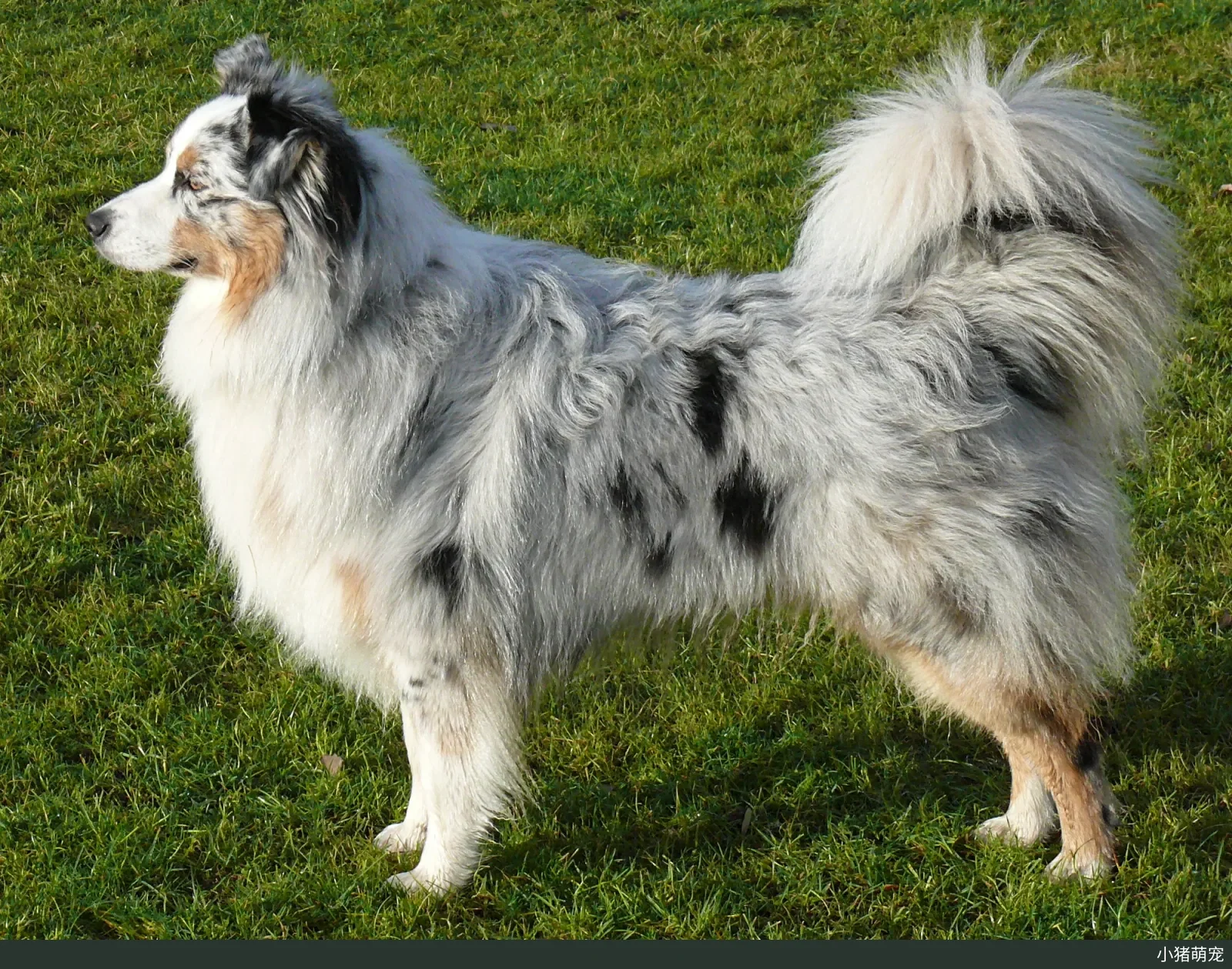
A 12-month-old blue merle Australian Shepherd. Photo: Martin Voss, source: Wikimedia Commons, license: CC BY-SA 3.0.

The Australian Shepherd (nicknamed “Aussie”) is a medium herding dog developed on ranches in the western United States; the FCI also registers the country of origin as the United States, not Australia. It is smart and enduring, often shows merle coats and varied eye colors, and needs substantial daily exercise and mental work. Drawing on AKC, FCI, The Kennel Club, and breed-health sources, this article covers origins, appearance, temperament, training needs, and common health issues.
Origins and the name
Per the American Kennel Club’s breed-history article updated in August 2026, the Aussie was developed in western U.S. states such as California, Colorado, Wyoming, and Idaho, first to manage large flocks of sheep. Mid-nineteenth-century Gold Rush California and post–Civil War demand for mutton and wool meant the West needed more sheep and herding dogs: flocks moving from the Midwest and East brought British-blood herding dogs; Merino sheep shipped from Australia later in the century also brought working dogs called “little blue dogs.” AKC notes that people in Australia did not call them “Australian Shepherds”—Americans coined the name.
What role Basque shepherds played is contested. From the 1870s through the 1970s, many Basque immigrants from northern Spain herded sheep in the American West. A popular account says they brought dogs to the U.S. via Australia, and another AKC explainer adopts that story; AKC’s history article, however, treats whether they brought dogs—and from where—as still unsettled. Genetic work offers another clue: AKC reports a 2017 Cell Reports study placing Aussies in a “British rural” clade with Collies, Shetland Sheepdogs, and Border Collies. Internationally, the FCI granted provisional recognition in 1996 and full recognition in 2007, placing the breed in Group 1, Sheepdogs and Cattledogs.
Appearance and coat
The Aussie is a medium dog. FCI Standard No. 342 states that body length from sternum to the rear of the thigh is slightly greater than height at the withers, with moderate bone—solid but not coarse; ideal height is 51–58 cm for males and 46–53 cm for females, with quality never sacrificed for size. AKC’s common weight range is 40–65 pounds (about 18–29 kg), lighter for bitches and heavier for dogs, with typical lifespan 12–15 years.
It has a medium-length double coat. AKC’s standard colors are black, blue merle, red, and red merle. Merle means darker patches of the same color family scattered on a lighter ground; the FCI standard also notes that merle can deepen with age and allows white markings on the neck, chest, legs, and similar areas. AKC’s explainer notes that heterochromia is fairly common—eyes may be brown, blue, hazel, amber, or green in various combinations—and about one in five Aussies is born with a naturally bobbed tail. They shed a fair amount; The Kennel Club recommends brushing more than once a week.
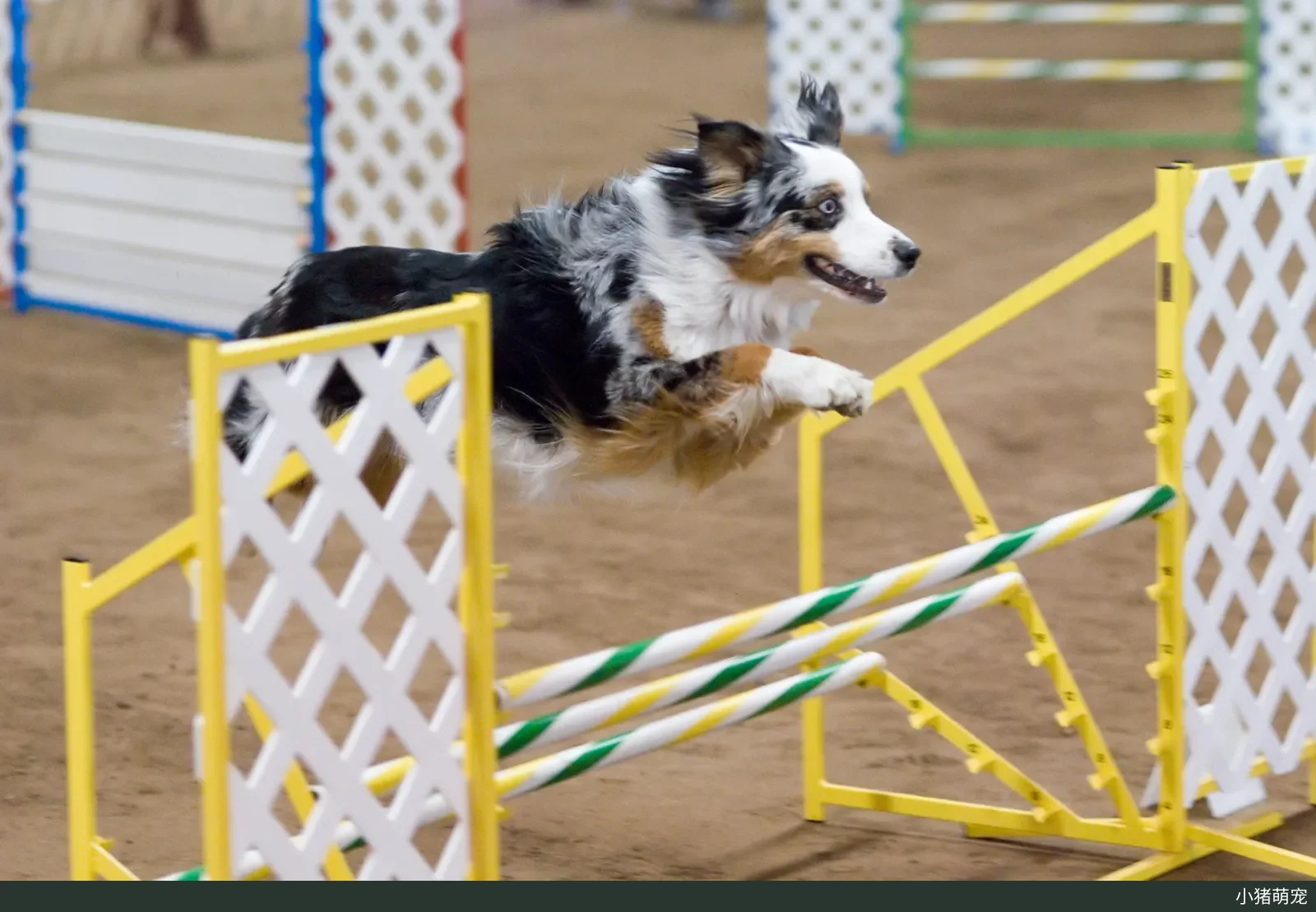
Blue merle Australian Shepherd competing in agility, April 2007. Photo: Ron Armstrong, originally on Flickr, source: Wikimedia Commons, license: CC BY 2.0.

Temperament, exercise, and training
The FCI standard describes Aussie temperament as that of an intelligent working dog with strong herding and guarding instincts, loyal, with stamina for a full day’s work; steady and friendly, rarely quarrelsome, and possibly a bit reserved on first meeting. AKC also notes they do not instantly trust strangers, but are open to friendly people and dogs; well-socialized Aussies usually get along with other dogs. Herding instinct can show at home: when children run about, an Aussie may try to “gather” them, and birds or other dogs may become its “flock.”
Exercise is the first thing to weigh before getting an Aussie. The Kennel Club marks the breed as needing more than two hours of exercise a day, suited to large homes, large gardens, and rural settings. AKC notes Aussies learn quickly—including by watching—and will remember accidental cues from their people; they need heavy mental stimulation and ideally a “job,” with agility and similar dog sports as good outlets. Because of that energy and the need for ongoing training and socialization, AKC sees the breed as a possible challenge for novice owners: not impossible, but it demands a large time commitment.
Common health issues and screening
Kennel-club breeding-health advice shows what to watch. The Kennel Club’s health standard lists Collie eye anomaly / choroidal hypoplasia (CEA/CH) DNA testing as a pre-breeding minimum, and further recommends DNA tests for hereditary cataract (HC-HSF4), multidrug resistance (MDR1), and progressive retinal atrophy (prcd-PRA), plus hip and elbow dysplasia and ophthalmologic screening. The United States Australian Shepherd Association (USASA) health statement lists hip and elbow evaluation and annual eye exams by a certified veterinary ophthalmologist as required, with HSF4, MDR1, and CEA testing strongly recommended.
MDR1 ties directly to drug safety. Washington State University College of Veterinary Medicine notes that dogs carrying an MDR1 (ABCB1) mutation may have severe reactions—tremors, disorientation, blindness, severe weakness, even death—to some common drugs; AKC’s history article also notes Aussies carry the mutation and may be sensitive to substances such as ivermectin. A safer approach is DNA testing first and telling the veterinarian the result before any medication.
Another risk is coat-linked: “double merle.” The Australian Shepherd Health & Genetics Institute (ASHGI) explains that when two merle Aussies are bred, about one in four puppies statistically inherit two merle alleles; such dogs are often excessively white, may be deaf in one or both ears, and often have severe, frequently blinding eye defects. Not breeding merle to merle avoids this. Families welcoming an Aussie can ask breeders for the parents’ health-screening results. This article is educational only; consult a veterinarian for individual health questions.
References
-
Denise Flaim. Australian Shepherd History: Behind the Breed’s Herding Heritage. American Kennel Club, updated 2026-08-18.
-
AKC Staff. Is the Australian Shepherd a Good Fit for You?. American Kennel Club, updated 2026-08-18.
-
Facts About the Australian Shepherd That You May Not Know. American Kennel Club, updated 2026-08-18.
-
FCI-Standard N° 342 Australian Shepherd. Fédération Cynologique Internationale, current standard published 2009-03-26.
-
Breeds A to Z (Pastoral group). The Royal Kennel Club, accessed 2026-10-17.
-
The Royal Kennel Club Health Standard. The Royal Kennel Club, accessed 2026-10-17.
-
Australian Shepherd Health Statement. United States Australian Shepherd Association, accessed 2026-10-17.
-
MDR1 Testing for Dogs & Cats – Test Before You Treat. Washington State University College of Veterinary Medicine, accessed 2026-10-17.
-
Double Merle. Australian Shepherd Health & Genetics Institute, accessed 2026-10-17.
-
Understanding Merle and the Science Behind It. Australian Shepherd Health & Genetics Institute, accessed 2026-10-17.