In its native Malta, the Pharaoh Hound is known as the Kelb tal-Fenek—literally “rabbit dog.”[1][2] For generations, Maltese farmers and hunters relied on this agile hound to work rough limestone fields and dry-stone walls in pursuit of wild rabbits, and in 1979 Malta formally named it the country’s national hound.[1] Internationally, the Fédération Cynologique Internationale (FCI) classifies the Pharaoh Hound under Group 5 (Spitz and primitive types, Standard No. 248), while both The Royal Kennel Club in the UK and the American Kennel Club (AKC)—which recognized the breed in 1983—place it in the Hound Group.[1][2][3]
Visually, the Pharaoh Hound is built for speed over rocky ground. Under the AKC standard, it is a medium-sized, clean-cut hound standing 23 to 25 inches at the shoulder for males and 21 to 24 inches for females, weighing roughly 45 to 55 pounds.[1] The head is long and chiseled with oval amber eyes that blend with the coat and large, fine, highly mobile ears carried erect when alert; a lean, slightly arched neck flows into a deep brisket reaching nearly to the elbow, moderate tuck-up, and a whip-like tail that hangs below the hock at rest and curves upward in motion.[1] Its short, glossy coat comes in shades from tan to rich chestnut; a white tail tip is strongly desired, and small white markings on the chest, toes, or center of the face are permitted, whereas white on the back of the neck or body is a disqualification.[1][4]

A Pharaoh Hound in side profile showing its sleek tan coat and erect ears. Canarian, Wikimedia Commons[8]

Ancient Egyptian Lore Versus Genetic Evidence
The English name “Pharaoh Hound” naturally conjures images of temple guardians surviving unchanged from antiquity. Both the AKC and The Royal Kennel Club recount the traditional narrative: dogs resembling today’s breed appear on ancient Egyptian tomb reliefs, and Phoenician seafaring traders roughly 2,500 years ago are often credited with carrying Egyptian hounds across the Mediterranean to Malta, where they became island rabbit hunters.[1][2] While the visual resemblance and Mediterranean maritime history make an appealing story, physical similarity alone cannot establish an unbroken genetic descent from ancient Egypt.
Molecular genetics paints a more grounded picture. A 2009 study in Proceedings of the National Academy of Sciences (PNAS) analyzed 318 African village dogs from Egypt, Uganda, and Namibia alongside putatively African purebreds and found that Pharaoh Hounds did not cluster with indigenous African dogs; instead, they grouped with non-native modern breeds, pointing to predominantly non-African genetic origins.[5] Later genomic studies published in Genetics (2016) and Ecology and Evolution (2018) placed the Pharaoh Hound of Malta closest to two fellow Mediterranean island sighthounds—the Ibizan Hound of Ibiza and Sicily’s Cirneco dell’Etna—rather than North African sighthounds such as the Sloughi or Azawakh.[6][7] Haplotype-sharing estimates dated the divergence between the Pharaoh Hound and Cirneco dell’Etna to around 1950, mirroring their mid-twentieth-century FCI recognition.[7] While regional Mediterranean lineages share deeper roots, today’s Pharaoh Hound is best understood as a Maltese rabbit-hunting breed shaped into its standardized form in modern times rather than a direct relic of Pharaonic Egypt.[5][6][7]
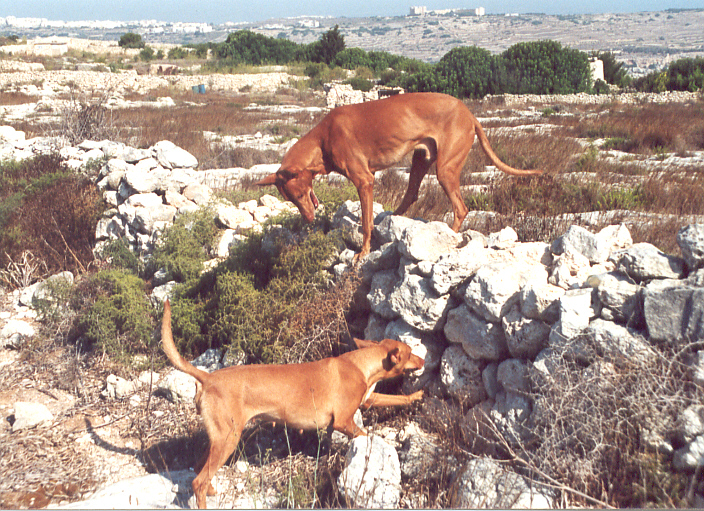
Two Maltese Kelb tal-Fenek hunting rabbits along a dry rubble wall in Malta. Jan Eduard at English Wikipedia, Wikimedia Commons[9]

The Blushing Ears and Nose and Unyielding Prey Drive
Even without royal Egyptian ancestry, the Pharaoh Hound has unmistakable traits of its own—most famously its habit of “blushing” and sometimes flashing a toothy “smile.” As the Pharaoh Hound Club of America (PHCA) explains, not every individual smiles on greeting, yet every Pharaoh Hound blushes: when happy or excited, the nose and the inside of the large ears flush a vivid rosy pink.[1][4] The explanation is straightforward biology rather than mystique—Pharaoh Hounds carry no black pigment in their skin, so the flesh-colored leather on the nose, eye rims, and inner ears clearly shows increased blood flow during excitement.[1][4]
Indoors, the breed is affectionate and settles comfortably with its family, yet outdoors its rabbit-coursing instincts remain sharp. Both sight and scent trigger high-speed pursuit.[1] According to the AKC, dogs that enjoy running on their own benefit from 15 to 20 minutes twice daily inside a securely fenced area of at least 50 by 50 feet with a six-foot fence; otherwise, owners should plan on at least two 20-minute leashed walks per day, while The Royal Kennel Club notes the breed’s broader appetite for more than two hours of daily activity depending on the individual.[1][2] Above all, recall cannot be trusted in open spaces: the AKC warns that no level of obedience training reliably overrides a Pharaoh Hound’s hunting instinct once it is free, and dogs that bolt after movement risk getting lost or struck by traffic, making a leash or tall, secure fencing non-negotiable.[1]

Head portrait showing amber eyes, unpigmented nose, and rosy inner ears. kallerna, Wikimedia Commons[10]

Daily Upkeep, Health Screening, and Household Fit
Coat maintenance is minimal: a quick daily wipe or weekly brushing keeps the short coat tidy, with occasional baths as needed. The AKC notes that Pharaoh Hounds normally lack a noticeable “doggy odor,” so any sudden smell warrants checking the ears, skin, or teeth; routine care focuses on ear cleaning, regular tooth brushing, and keeping nails trimmed short enough that they do not tap on hard floors.[1] Mentally, Pharaoh Hounds are quick learners who enjoy interactive problem-solving alongside a streak of independence. The PHCA stresses using positive, game-based reinforcement—harsh or purely negative corrections tend to make this sensitive hound shut down rather than cooperate.[4]
Pharaoh Hounds have an average life expectancy of 12 to 14 years and are generally resilient.[1][4] Recommended AKC health screenings include Patella Evaluation, Hip Evaluation, Ophthalmologist Evaluation, and Thyroid Evaluation, while PHCA CHIC certification also incorporates elbow dysplasia screening; age-related cancers such as hemangiosarcoma, mast cell tumors, and mammary cancer are monitored through routine veterinary care rather than breed-specific guarantees.[1] Altogether, the Pharaoh Hound suits active households that value a clean, family-oriented companion, embrace positive training, and will reliably commit to leashed walks or tall-fenced play areas—whereas homes hoping for off-leash park freedom or keeping free-roaming small pets such as rabbits need to weigh its coursing heritage carefully.[1][2][4]
References
- American Kennel Club. Pharaoh Hound Dog Breed Information.
- The Royal Kennel Club. Pharaoh Hound Breed Information.
- Fédération Cynologique Internationale. Pharaoh Hound (FCI Standard No. 248).
- Pharaoh Hound Club of America. Frequently Asked Questions.
- Boyko AR, Boyko RH, Boyko CM, et al. Complex population structure in African village dogs and its implications for inferring dog domestication history, PNAS 2009;106(33):13903-13908.
- Dreger DL, Davis BW, Cocco R, et al. Commonalities in Development of Pure Breeds and Population Isolates Revealed in the Genome of the Sardinian Fonni's Dog, Genetics 2016;204(2):737-755.
- Talenti A, Dreger DL, Frattini S, et al. Studies of modern Italian dog populations reveal multiple patterns for domestic breed evolution, Ecology and Evolution 2018;8(5):2911-2925.
- Canarian. File:Faaraok1.jpg, Wikimedia Commons.
- Jan Eduard at English Wikipedia. File:Klieb tal-Fenek hunting.jpg, Wikimedia Commons.
- kallerna. File:Pharaoh Hound headshot.JPG, Wikimedia Commons.