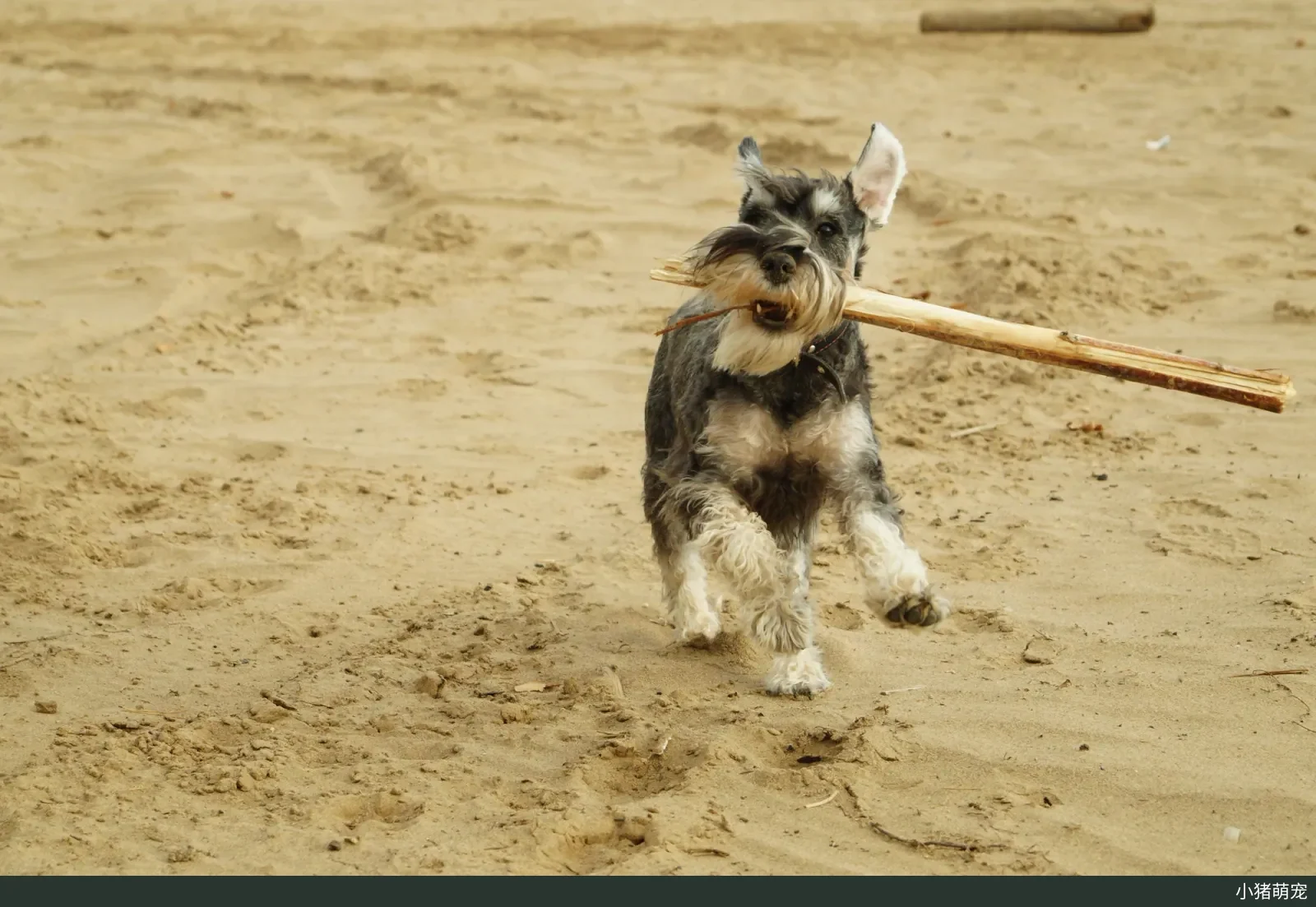
A young Miniature Schnauzer (photographed 16 October 2016). Photo: Шнапс; source: Wikimedia Commons; license: CC BY-SA 4.0.

The Miniature Schnauzer is a small German breed whose heavy brows, beard, and square build make it look like a bearded little gentleman—while its temperament is clever and lively. It began as a farm and house ratter and is mainly a companion today. Drawing on FCI, AKC, and The Kennel Club breed materials and veterinary research, this article covers origins, appearance, temperament, exercise and training needs, and common health issues.
Origins and history
The Miniature Schnauzer’s homeland is Germany. The FCI breed standard records that around the turn of the nineteenth to twentieth century a small schnauzer appeared in the Frankfurt am Main area, then still called the “wire-haired Miniature Pinscher”; early dogs varied widely in size, type, and coat, and breeding a small dog that matched the “big brother” Standard Schnauzer in looks and character was not easy. AKC breed-history writing adds the purpose: farmers wanted a more compact dog to hunt mice, voles, and other small rodents in house and barn, so smaller Standard Schnauzers were crossed with Miniature Pinschers, Affenpinschers, Miniature Poodles, and similar breeds. VCA Animal Hospitals materials also mention possible fox terrier and Scottish Terrier blood; such claims differ by source and are only background.
Per AKC, the earliest registered Miniature Schnauzer in Germany was a black bitch named “Findel,” born in 1888; a Pinscher Club formed in Germany in 1895 and held its first show in 1899. The breed entered the United States from 1924 and began to be bred there; AKC recognized it in 1926. On the name, VCA derives it from German Schnauze (muzzle), while AKC glosses it as “bearded”—both tied to the signature whiskers.
Interestingly, major kennel organizations place the breed in different groups: FCI puts it in Group 2, Pinscher and Schnauzer type, with formal recognition in 1955; AKC places it in the Terrier Group; The Kennel Club lists it in Utility. That reflects each body’s classification traditions, not different dogs in different countries.
Appearance and coat
The Miniature Schnauzer is a “scaled-down” schnauzer. The FCI standard calls it small and sturdy, sturdy without being refined, with body length nearly equal to height at the withers—overall square—without looking like an underdeveloped puppy. Size: FCI sets both sexes at 30–35 cm at the withers and about 4–8 kg; AKC calls for 12–14 inches (about 30–36 cm); The Kennel Club’s ideal withers heights are 36 cm for dogs and 33 cm for bitches. Standards describe ideals; pets a little larger or smaller are common.
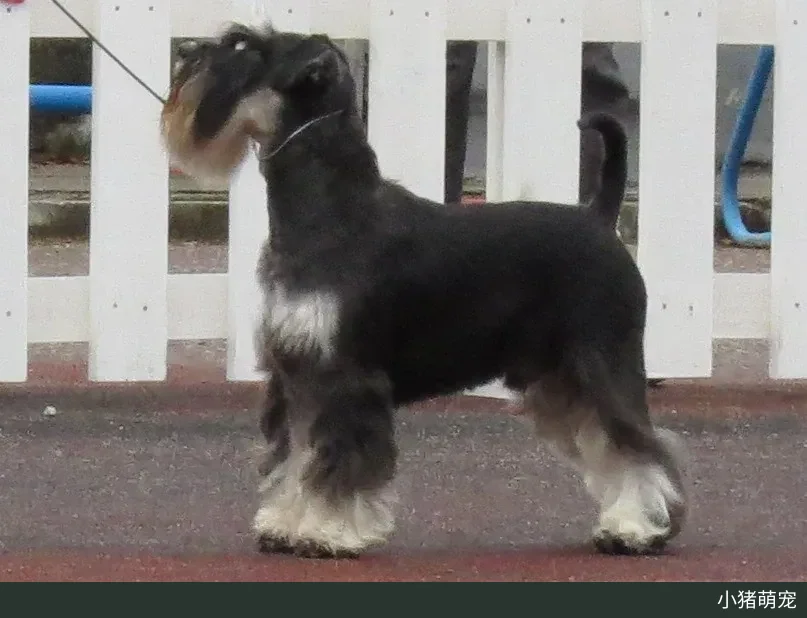
A black-and-silver Miniature Schnauzer standing in profile at a dog show; the square outline and silver-white beard and leg furnishings are clear (Tallinn CACIB, Estonia, August 2013). Photo: Томасина; source: Wikimedia Commons; license: CC BY-SA 3.0.

The face stands out most: a not-soft beard at the muzzle plus heavy brows that slightly veil the eyes. The coat is double—harsh, wiry outer coat (“wire”) over dense undercoat. Colors: FCI recognizes pepper-and-salt, solid black, black-and-silver, and solid white; AKC recognizes only pepper-and-salt, black-and-silver, and solid black—white is a disqualification under the AKC standard. Ears and tails also differ in wording: FCI describes naturally dropping V-shaped ears and a natural tail; AKC covers both cropped and uncropped ears and treats docking as the standard show presentation.
For day-to-day care, VCA suggests brushing once or twice a week; many households have a groomer trim a manageable clip about every two months, while show dogs need hand-stripping. The Kennel Club labels the breed “non-shedding”; VCA says shedding is below average. That means less loose hair, not that the breed cannot trigger allergies—none of these sources claim hypoallergenic status.
Temperament, exercise, and training
The FCI standard summarizes the breed as intelligent, fearless, enduring, and alert—a pleasing family dog that can also watch and accompany, even in a small flat. The AKC standard says a typical Miniature Schnauzer is alert and spirited yet obedient, friendly, smart, and eager to please, without undue aggression or shyness. VCA’s description is more everyday: bold, observant, restless, often a bit mischievous; wary of strangers at first, then friendly once acquainted; most get along with other dogs and pets.
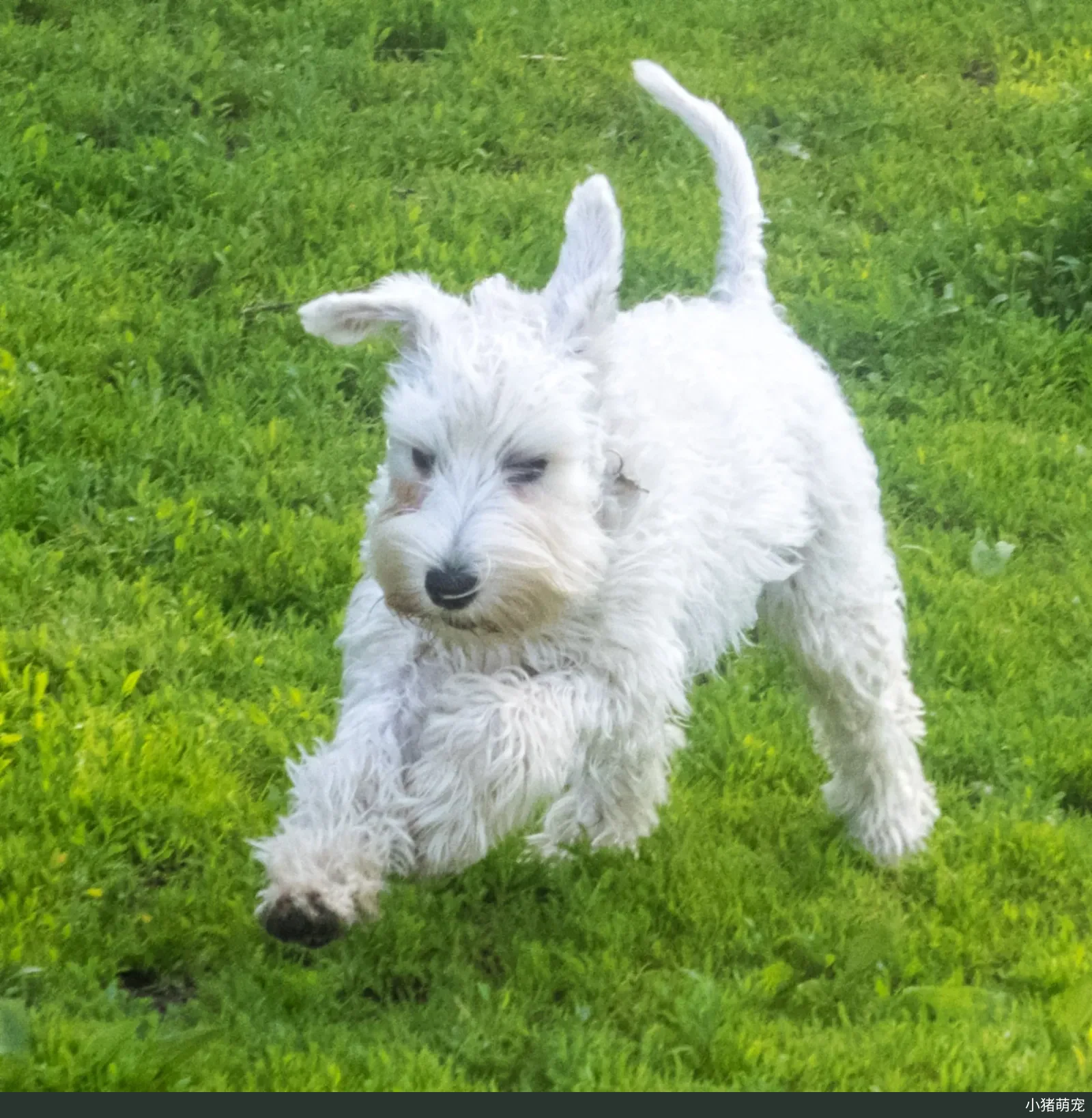
A white Miniature Schnauzer puppy running. White is an FCI-accepted color; the AKC standard does not recognize it. Photo: Kotivalo; source: Wikimedia Commons; license: CC0 1.0 (public-domain dedication).

On exercise, The Kennel Club suggests up to about one hour a day; VCA finds one longer walk or short run plus a good play session usually enough, plus chances to sniff and explore on a secure property or lead, with games and tricks for mental work. AKC notes the breed can compete in earthdog, scent work, rally, agility, obedience, and other dog sports.
For training, VCA recommends food or play rewards: the breed learns fast but also tires of repetition and may “decide for itself.” Barking is another point to address early; some individuals are quite vocal. On VCA’s trait scores, barking is a 4 out of 5—toward the high end.
Common health issues
Lifespan: VCA cites about 12–14 years; The Kennel Club marks 10 years and over. The American Miniature Schnauzer Club (AMSC) lists breed health topics including cataracts, hyperlipidemia, Mycobacterium avium complex (MAC) infection, pancreatitis, portosystemic shunt, and urolithiasis. A few frequently mentioned points follow; this is general information, not a substitute for veterinary diagnosis.
Hyperlipidemia is the breed’s best-known health topic. A 2007 U.S. study in the Journal of Veterinary Internal Medicine (JVIM) tested 192 healthy Miniature Schnauzers; 63 (32.8%) had serum triglycerides above the reference range, versus 2 of 38 (5.3%) healthy dogs of other breeds; both the share and the degree of elevation rose with age. A veterinary lecture posted on the AMSC site notes that hyperlipidemia readily predisposes to pancreatitis. Such figures depend on region and study design: a 2022 Murdoch University master’s thesis in Australia tested 215 locally healthy Miniature Schnauzers and found fasting triglycerides high in 18.6%, most of whom were diagnosed with hyperadrenocorticism; the author argued primary hypertriglyceridemia was uncommon in that cohort. So “about one-third” is a U.S. sample result and should not be applied wholesale to dogs everywhere.
Urolithiasis means stones forming in the urinary tract. AMSC notes struvite is most common in Miniature Schnauzers and usually fairly treatable; calcium oxalate, urate, and ammonium stones also occur. The AMSC page does not give incidence rates; seek veterinary checks promptly if urination looks abnormal.
On genetic screening, AMSC board health recommendations approved in July 2024 include yearly eye exams by an American College of Veterinary Ophthalmologists (ACVO)–boarded ophthalmologist, cardiac evaluation, and recommended (not mandatory) DNA tests for congenital myotonia, MAC, and progressive retinal atrophy Type B (PRA Type B, HIVEP3). When choosing a puppy, ask breeders for relevant parent test records. Watch weight day to day: VCA notes the breed is often normal or slightly overweight; if weight climbs, control calories on a balanced diet; dogs with known hyperlipidemia need feeding plans set by a veterinarian from bloodwork.
References
-
FCI. FCI-Standard N° 183 ZWERGSCHNAUZER (Miniature Schnauzer), English version 2007-04-18 (official valid standard published 2007-03-06). https://www.fci.be/Nomenclature/Standards/183g02-en.pdf
-
FCI. ZWERGSCHNAUZER (183), breed nomenclature page. https://www.fci.be/en/nomenclature/MINIATURE-SCHNAUZER-183.html
-
American Kennel Club. Official Standard of the Miniature Schnauzer, approved 2012-07-10, effective 2012-09-04. https://images.akc.org/pdf/breeds/standards/MiniatureSchnauzer.pdf
-
Gewirtz, E. W. Miniature Schnauzer History: From Fearless Barnyard Ratter to Charming Companion. AKC, 2024-11-26. https://www.akc.org/expert-advice/dog-breeds/miniature-schnauzer-history/
-
The Kennel Club. Miniature Schnauzer | Breeds A to Z. https://www.royalkennelclub.com/search/breeds-a-to-z/breeds/utility/miniature-schnauzer/
-
The Kennel Club. Miniature Schnauzer | Breed Standards. https://www.royalkennelclub.com/breed-standards/utility/miniature-schnauzer/
-
VCA Animal Hospitals. Miniature Schnauzer. https://vcahospitals.com/know-your-pet/dog-breeds/miniature-schnauzer
-
American Miniature Schnauzer Club. Canine Health Topics (health recommendations approved 2024-07-09). https://amsc.us/general-health/canine-health-topics/
-
American Miniature Schnauzer Club. Urolithiasis. https://amsc.us/general-health/urolithiasis/
-
Giger, U. AMSC MAC 2016 (lecture slides). https://amsc.us/wp-content/uploads/2022/07/MAC-Giger-Presentation-2016.pdf
-
Xenoulis, P. G. et al. Investigation of hypertriglyceridemia in healthy Miniature Schnauzers. Journal of Veterinary Internal Medicine, 2007, 21(6). https://pubmed.ncbi.nlm.nih.gov/18196730/
-
Bunn, T. A. Fasting hypertriglyceridaemia in healthy Australian Miniature Schnauzers. Murdoch University master’s thesis, 2022. Murdoch University Research Portal