Once known in English as the Russian Wolfhound, the Borzoi hunted wolves across open country with the Russian nobility. The hound had to spot moving prey, close the gap at a gallop, and have the strength to hold a wolf when it caught up. That eye for movement still matters in family life. The same dog that spent the afternoon resting quietly in the living room may see a cat dart from beneath a parked car and spring after it before the person holding the leash has time to speak. [1]
A runner’s outline beneath the coat
Look at a Borzoi in profile and follow the line from chest to belly. The rib cage reaches well down, then the belly draws sharply upward toward the hind legs. Above it, the back arches gently over the loin. A slightly curved neck leads to a long, narrow head with little change in angle between forehead and muzzle. For all its slender lines, this is a substantial dog. The American Kennel Club (AKC) gives a shoulder height of at least 28 inches (about 71 cm) for an adult male and a weight of 75 to 105 pounds (about 34 to 48 kg). Females are usually smaller. It is worth deciding who can comfortably handle a dog of that size on a leash before bringing one home. [1]
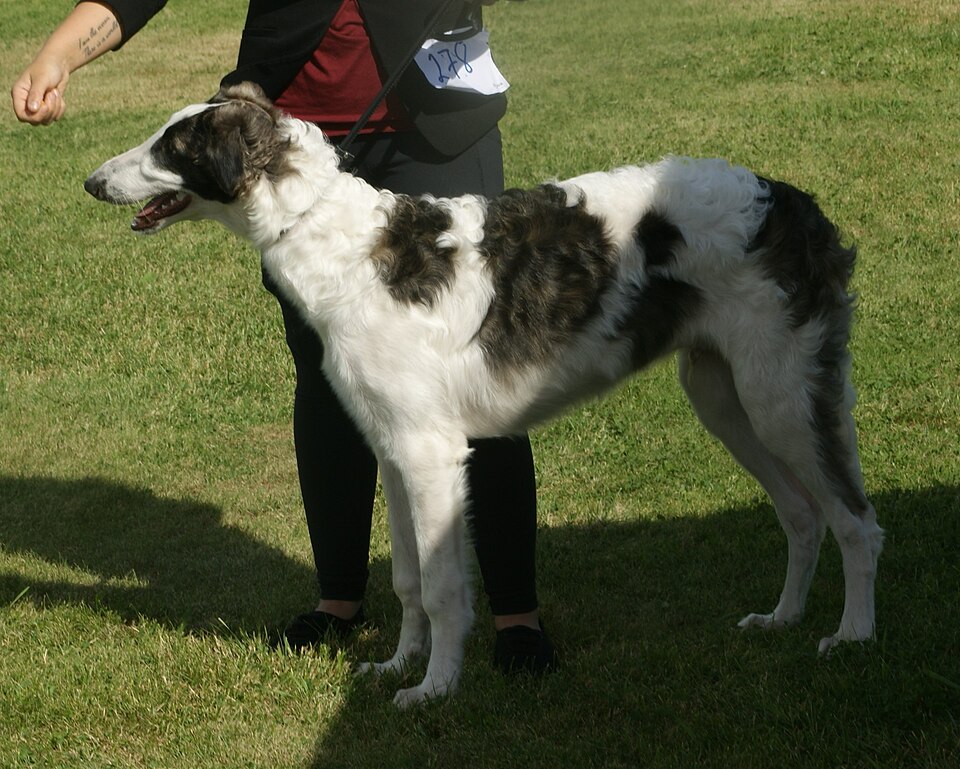
图:The Borzoi’s chest and tuck-up. Canarian, Wikimedia Commons[3]

From the front, the narrowness of the muzzle is easier to see. The small, thin ears fold back along the neck when the dog is relaxed and may lift when something catches its attention. The three dogs pictured here range from white with dark patches to almost pure white to gold and white. Across those colors, the long head, deep chest, and long legs give them a recognizable shape. The silky coat on the body may lie flat or fall in waves. On the face and the fronts of the legs, the hair is short and smooth. [1]
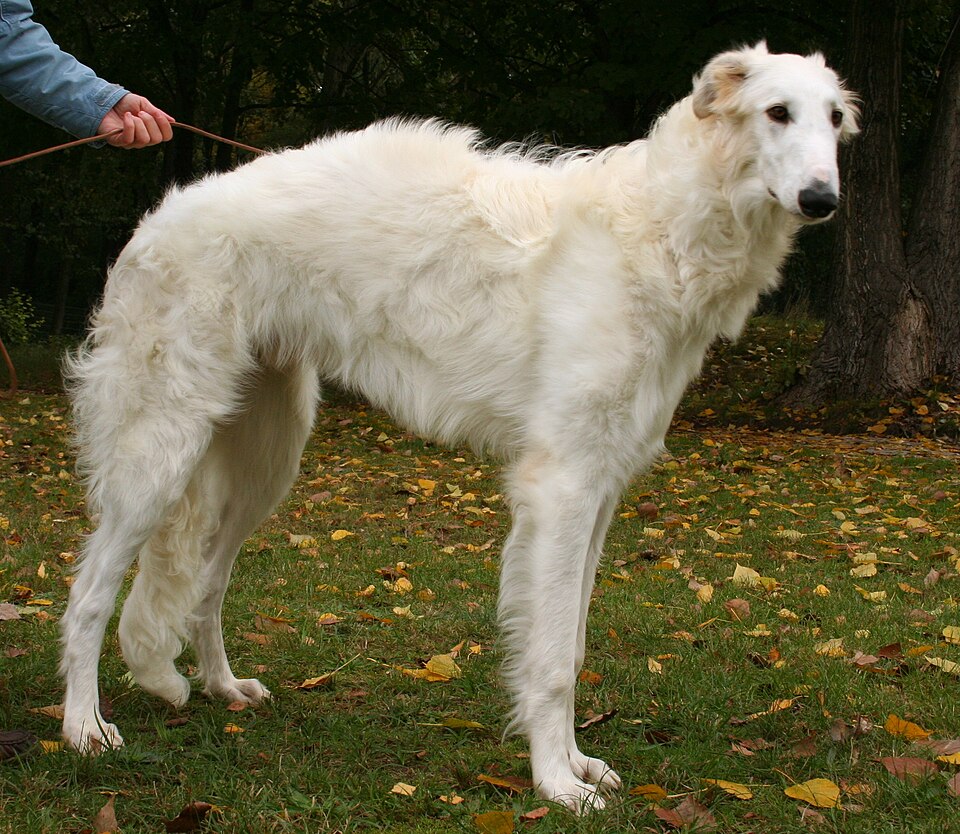
图:The Borzoi’s long muzzle. Pleple2000, Wikimedia Commons[4]

Where can a Borzoi exercise each day?
Plan around an ordinary workday. The AKC gives long walks on a leash and runs in a securely fenced area as examples of daily exercise. Pick a walking route close to home and think through who has time to take it in the morning and who can take over after work. The same question applies to a household with a yard. Alongside those quick trips outside to relieve itself, the dog needs time set aside for exercise. Adjust the length of a walk to the dog’s age, physical condition, and how comfortably it is moving that day. [1]
A place that works for a walk may be a poor place to let a hound run loose. A quiet riverbank can have clear views in every direction, but if a dog can run straight onto a cycle path or a road, keep the leash on. At a fenced field, walk the perimeter together first. Check that the side gate latches and that there are no gaps in the fence before unclipping the leash. For families who enjoy dog sports, lure coursing gives a sighthound a moving artificial lure to pursue on a course. On everyday outings, let the boundaries of the space guide the decision about where the dog can run. [1]
Training starts at the front door
Borzois are often affectionate with their families and have minds of their own. Patience helps, especially when everyone teaches the same routine in the same way. Start at the door the dog uses every day. Pick up the leash, wait for the dog to stand quietly beside you, clip it on, and then open the door and walk out together. Practice while the hallway is quiet and reward the dog for waiting calmly. Once the sequence is familiar, add ordinary distractions a little at a time, such as a family member moving about or a neighbor walking past. Take the same gradual approach when introducing a puppy to new people and places. [1]
If children or small pets share the home, picture how each of them moves through it. A gentle Borzoi may have little taste for tight hugs or wrestling. With an adult present, a child can call the dog over, let it choose to approach, and leave it a clear path back to a quiet resting place. For a family with a cat or rabbit, consider what happens if the smaller animal startles and runs. Does the dog have a clear path to follow? Before bringing the hound home, arrange separate spaces with doors that close. Decide who will watch the animals when someone is carrying things inside or a guest leaves a door open. Even a dog that usually comes when called needs a leash or a secure barrier when sudden movement could set off a chase. [1]
Brush the feathering every day or two
On the gold-and-white female pictured below, long strands hang from the neck and chest and down the backs of the legs. The hair on the muzzle lies close to the skin. Those longer fringes, called feathering, need regular attention. The AKC recommends going over the coat every day or two with a pin brush, slicker brush, or comb to lift out loose hair and dirt. After brushing the back, work through the feathering behind the legs and along the tail. About once a year, heavier shedding lasts for several weeks and calls for more frequent brushing. Regular nail trims, ear checks, and frequent toothbrushing can also be shared among family members. [1]
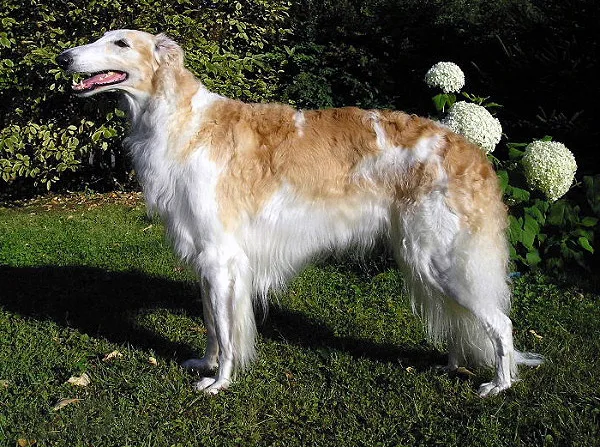
图:The Borzoi’s long feathering. Taru T Torpström, Wikimedia Commons[5]

What veterinary care should a Borzoi family plan for?
The deep chest that helps identify a Borzoi also points to an emergency the whole family should recognize. In a large, deep-chested dog, the stomach can swell and may twist, a condition called gastric dilatation-volvulus. When planning meals, the AKC advises keeping strenuous exercise away from feeding time, both before and after the dog eats. Know the warning signs. If the dog suddenly tries repeatedly to vomit and nothing comes up, or develops signs such as a swollen abdomen, restlessness, or drooling, call an emergency veterinary clinic and take the dog in immediately. Save the clinic’s number and route in advance so whoever is with the dog at night can leave promptly. [1][2]
When speaking to a breeder about a puppy, ask which tests each parent has had and request reports that identify the dogs by name or registration details. The AKC lists a cardiac exam, an evaluation by a veterinary ophthalmologist, a thyroid evaluation, and a DNA test for a variant associated with degenerative myelopathy. These records tell you about the parents. As the puppy grows, its own signs and veterinary exams will guide decisions about its health. If it ever needs anesthesia, discuss sighthounds’ sensitivity to certain anesthetic drugs with the veterinarian beforehand. [1]
Before deciding, walk the route your family would use most often. From opening the front door to crossing the street and entering a fenced field, work out who would hold the leash and where the dog could safely run. Back home, find a spot where the hound could rest undisturbed and decide who could sit down with a brush every other day. How those arrangements fit into a working week will tell you more about life with a Borzoi than an occasional day out in the countryside.
References
-
[1] American Kennel Club. Borzoi Dog Breed Information.
-
[2] American College of Veterinary Surgeons. Gastric Dilatation-Volvulus.