
An owner in Arizona, U.S., feeding Shiba “Taro” raw food with a fork so he would not gulp it down (August 2010). Photo: tar0 (Taro the Shiba Inu) / Flickr, CC BY 2.0.
U.S. trade outlet PetfoodIndustry published an article on 8 October 2026 summarizing multiple surveys and market figures, arguing that raw, frozen, freeze-dried, and fresh pet foods are growing far faster than kibble and moving from niche toward mainstream. Those figures, however, mostly come from retailer questionnaires, consulting reports, and company forecasts, and mainly reflect the U.S. market; higher prices and pathogen risk in raw diets remain practical concerns for pet owners.
What happened and the core claim
The piece ran in PetfoodIndustry’s “Adventures in Pet Food” column, written by editor Debbie Phillips-Donaldson. It is industry commentary, not a new study. The topic grew out of the August 2026 SuperZoo pet-products show, when a pet-food manufacturer’s representative asked the outlet’s Lisa Cleaver whether categories that are selling better and better—raw, frozen, freeze-dried, fresh—should still be called “alternative.”
The author’s view: kibble still “rules” the global cat-and-dog food market, but its share has flattened or slipped, and canned food’s growth also lags these newer categories; with large companies such as General Mills, Hill’s, and Nestlé entering the space, the “niche” label will eventually come off. She also notes that higher prices may limit how large a share these categories can ultimately take.
The article also cites two companies’ upbeat forecasts. Chewy CEO Sumit Singh said on an earnings call that the fresh category could reach $8–12 billion in the next few years; Chewy launched its own fresh dog-food brand, Get Real, in the same period. General Mills announced in June 2025 that Blue Buffalo would enter fresh dog food, saying the segment was then about $3 billion and expected to grow to $10 billion within a decade. Its Love Made Fresh refrigerated dog food, according to the company’s 17 September 2025 earnings call, began shipping that week; the blog says a “October 2025 launch,” so the two accounts differ slightly.
Data sources and evidence limits
We traced the blog’s cited figures one by one: where an original source was findable, we checked the release date and wording; where no public original was available, we treat the numbers as paraphrase only.
- eTailPet, State of Independent Pet Retail 2026 (released 6 October 2026): eTailPet builds POS systems for independent pet stores. The report surveyed 189 U.S. independent pet retailers and combined anonymous transaction data from more than 200 stores. The report’s own wording: 55% of surveyed retailers said raw was the fastest-growing category, frozen 53%, freeze-dried 46%. That is “what share of store owners think so,” not “sales grew 55%”; the blog writes it as “growth rates,” so read carefully. The report also gives no comparison for kibble or canned food.
- Cascadia Capital, Pet Industry Report – Summer 2026 (released 6 July 2026), citing NielsenIQ (NIQ) data: in the 2025 U.S. “dog food + dog treats” supercategory, fresh and frozen (NIQ combines them) were about 8%, roughly $1.2 billion (about 11% if treats are excluded and only main food is counted); ambient wet food 15%, dry 46%, treats 31%. From 2021–2025, fresh and frozen grew at a 24.5% compound annual rate versus 5.7% for the supercategory overall; in 2025 about 10% of U.S. households had bought fresh dog food, versus 61% that had bought any dog food. In NIQ’s 2026 survey, 38% of pet owners expected to increase fresh spending and 58% expected to hold steady. The full Cascadia report requires a request; we checked its release page and PetfoodIndustry’s 9 July 2026 coverage; the blog’s “fresh grew 24.5%” wording matches the report’s CAGR framing.
- Kansas State University Lonnie Hobbs Jr. pet-owner survey: the blog says it surveyed more than 1,000 U.S. pet owners, with 68% feeding kibble, 17% canned, and 9% fresh (multiple answers allowed). We found no public original report or release date for this survey; these figures can only be treated as the blog’s paraphrase.
- Packaged Facts 2025 pet-owner survey: the blog says 15% add refrigerated fresh or gently cooked food to kibble, 11% add frozen fresh, 11% add raw, 9% add freeze-dried or air-dried food, and another 25% use mixers or toppers. Packaged Facts Pet Food in the US, 19th edition, is indeed based on its January and September 2025 pet-owner surveys and discusses “supplemental/flexi feeding,” but the specific percentages sit behind a paywall and we could not verify them directly.
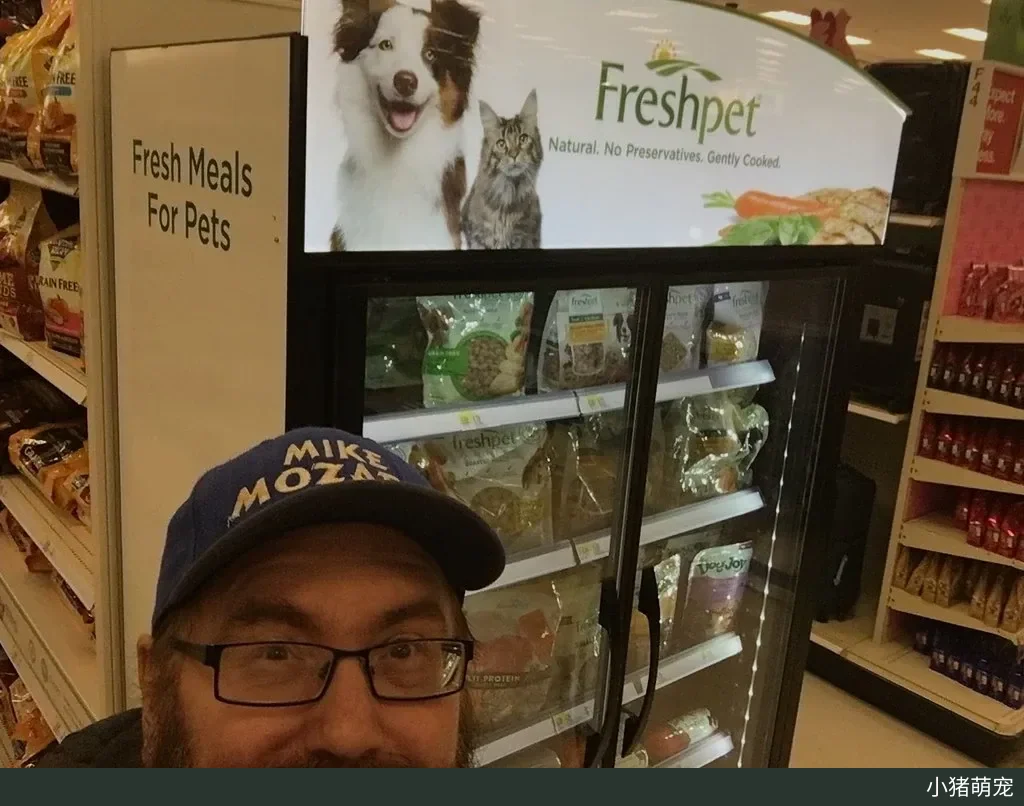
Freshpet refrigerated fresh pet food on display at a U.S. Target in January 2020—scene illustration only, not an endorsement. Photo: Mike Mozart (JeepersMedia) / Flickr, CC BY 2.0.
Taken together, several limits are worth remembering. First, almost all of this is U.S. data and does not transfer directly to other countries. Second, the evidence comes mainly from retailer questionnaires, investment consulting reports, and executive forecasts—not independent academic research—and the firms making forecasts, Chewy and General Mills, sell fresh food themselves. Third, definitions of “fresh,” “raw,” “frozen,” and “freeze-dried” vary by source; NIQ combines fresh and frozen. Fourth, fast growth also reflects a small base—fresh and frozen are still only about 8% of the dog-food supercategory. Finally, these numbers speak to “how much is selling,” not whether such diets are healthier or less healthy for cats and dogs; the original piece does not discuss nutritional or health evidence.
Implications for pet owners
For ordinary owners, the most visible change is more choice: big brands are putting fresh food into supermarket and pet-store coolers. Price gaps remain large. Per Cascadia figures as paraphrased by the blog, fresh runs about $5.50–7.75 per pound (depending on whether it is a direct-to-consumer brand), dry about $2.75, and ambient wet about $3.50. Many households therefore keep “kibble as the base, fresh as a topper”—what the industry calls “flexi feeding”; General Mills executives have also said roughly eight in ten fresh users also feed dry. If you mix that way, count the topper’s calories in the daily total.
Also separate “fresh” from “raw.” “Fresh” in the statistics above usually means lightly cooked then refrigerated or frozen products (Packaged Facts’ survey wording is fresh/gently cooked); raw is not heated, and freeze-dried products made from raw meat, without an extra kill step, are essentially raw as well. In FDA sampling of 196 commercial raw pet-food products in 2010–2012, 15 tested positive for Salmonella and 32 for Listeria monocytogenes, while dry, semi-moist, and jerky-type treats tested in the same period were almost all negative. The American Veterinary Medical Association (AVMA) does not recommend feeding dogs and cats raw or undercooked animal-source protein and supports foods whose pathogen risk is reduced by heat or other scientifically validated methods. FDA also requires manufacturers of cat and dog food that use uncooked poultry or bovine ingredients to address H5N1 avian influenza in food-safety plans, and reiterated that reminder on 30 September 2025.
If you are considering switching to or adding raw or freeze-dried, talk with a veterinarian first—especially if the household includes young children, older adults, pregnant people, or anyone immunocompromised; AVMA especially flags higher risk for those groups. Day-to-day handling can follow FDA advice: wash hands with soap for at least 20 seconds after contact with raw food; thaw in the refrigerator or microwave, not on the counter or in the sink; promptly cover leftovers and refrigerate or discard them; wash then sanitize bowls, utensils, and surfaces; and do not let a dog that has just eaten raw food lick your face.

Washing hands with soap at a kitchen sink. FDA advises at least 20 seconds after contact with raw food. Photo: rawpixel (uncredited), CC0 1.0 public domain.
References
-
Debbie Phillips-Donaldson. Raw, fresh, freeze-dried pet food: On the march to mainstream?. PetfoodIndustry, 2026-10-08.
-
eTailPet. The State of Independent Pet Retail 2026. 2026-10-06.
-
eTailPet. New Data From eTailPet Finds In-Store Services Increase Foot Traffic, Aiding Customer Retention. PRWeb, 2026-10-06.
-
Cascadia Capital. Pet Industry Report – Summer 2026. 2026-07-06.
-
Lisa Cleaver. Report: Fresh, frozen dog food outpaces category growth. PetfoodIndustry, 2026-07-09.
-
Reuters. General Mills introduces 'fresh' Blue Buffalo dog food. 2025-06-23.
-
Pet Food Processing. Cat food, treats propel General Mills. (publication date not verified)
-
Investing.com. General Mills at Barclays Conference: Strategies for Growth. (conference date not verified)
-
Futu News. Earnings Call Summary | Chewy (CHWY.US) Q2 2025 Earnings Conference. (third-party summary; publication date not verified)
-
Packaged Facts. Pet Food in the US, 19th Edition. (paid-report landing page)
-
U.S. FDA. Get the Facts! Raw Pet Food Diets can be Dangerous to You and Your Pet.
-
American Veterinary Medical Association. Raw diets for dogs and cats.
-
U.S. FDA. Cat and Dog Food Manufacturers Required to Consider H5N1 in Food Safety Plans. Updated 2025-09-30.