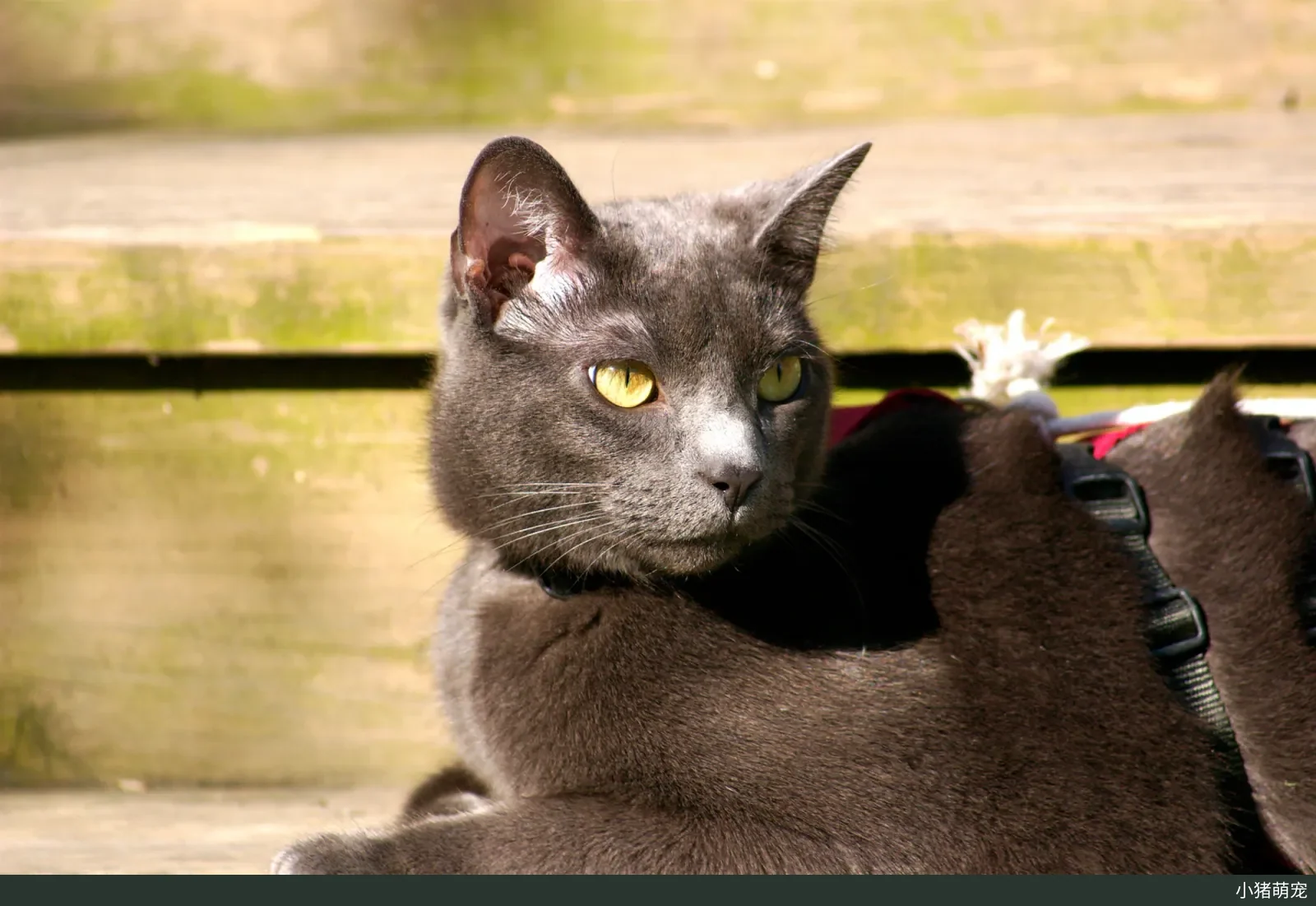
Russian Blue Ramone; per the uploader, photographed July 2004 in Cincinnati, Ohio, USA. Photo: Kabir Bakie; source: Wikimedia Commons; license: CC BY-SA 2.5 (this site converted format and size).

The Russian Blue is a short-haired cat known for a silver-tipped blue-gray coat, emerald-green eyes, and a faintly “smiling” face. Breed-association materials say they may originate around Arkhangelsk in northern Russia and were already on British show benches in the 1880s. They are smart, reserved with strangers, and affectionate with family; overall they are considered a healthy breed, but Swedish insurance data flag elevated diabetes risk, so weight control is a care priority.
Origins and breeding history
On Russian Blue origins, association accounts all carry a “believed” caveat. CFA introduces them as thought to come from the Archangel Isles in northern Russia, with almost no written record before the late nineteenth century; TICA places the start at the White Sea port of Arkhangelsk and says the cats traveled on sailors’ ships to other parts of Europe, so early on they were also called the “Archangel Cat.” Stories about “the tsar’s beloved cats” or “Queen Victoria’s favorites” both associations mention only as folklore or rumor; no reliable historical sources confirm them.
Per TICA, Russian Blues appeared at some of Britain’s earliest cat shows in the 1880s, at first competing with other blue short-hairs; in 1912 these large-eyed, large-eared cats gained a separate class as “Foreign Blue.” War disrupted breeding; afterward British breeders introduced blue British Shorthairs or blue-point Siamese to rebuild lines, while Scandinavian breeders developed their own strains. CFA notes that from the early twentieth century through World War II, Scandinavian breeders led breed development; after the war U.S. breeders imported from Europe and gradually blended British and Scandinavian lines into the Russian Blue commonly seen today. Europe’s FIFe recognized the breed as early as 1949.
Looks and breed standard
The Russian Blue has one color and one coat length: blue short hair. CFA’s standard calls for even bright blue over the body, lighter shades preferred, with guard hairs clearly silver-tipped so the whole cat shimmers; FIFe’s 2026 standard describes an even, pure blue-gray, medium to light, with a clear silver sheen. The coat is short, dense, and fine—a double coat that “stands up”—soft and silky to the touch. Draw a finger across the fur and a “footprint” remains until smoothed away.
Eyes are the other hallmark: standards require vivid green; CFA notes eye color usually deepens with age. The head is a wedge; CFA requires no break in the nose line in profile. Ears are large, broad at the base, and rather pointed at the tip, with skin thin enough to look nearly translucent. The body is long and fine-boned to medium, with long legs and small feet. Size is medium; CFA says males rarely exceed 10 pounds (about 4.5 kg) and females about 5–8 pounds (about 2.3–3.6 kg). That trademark “smile,” per TICA, comes from where muzzle and cheekbone lines meet.
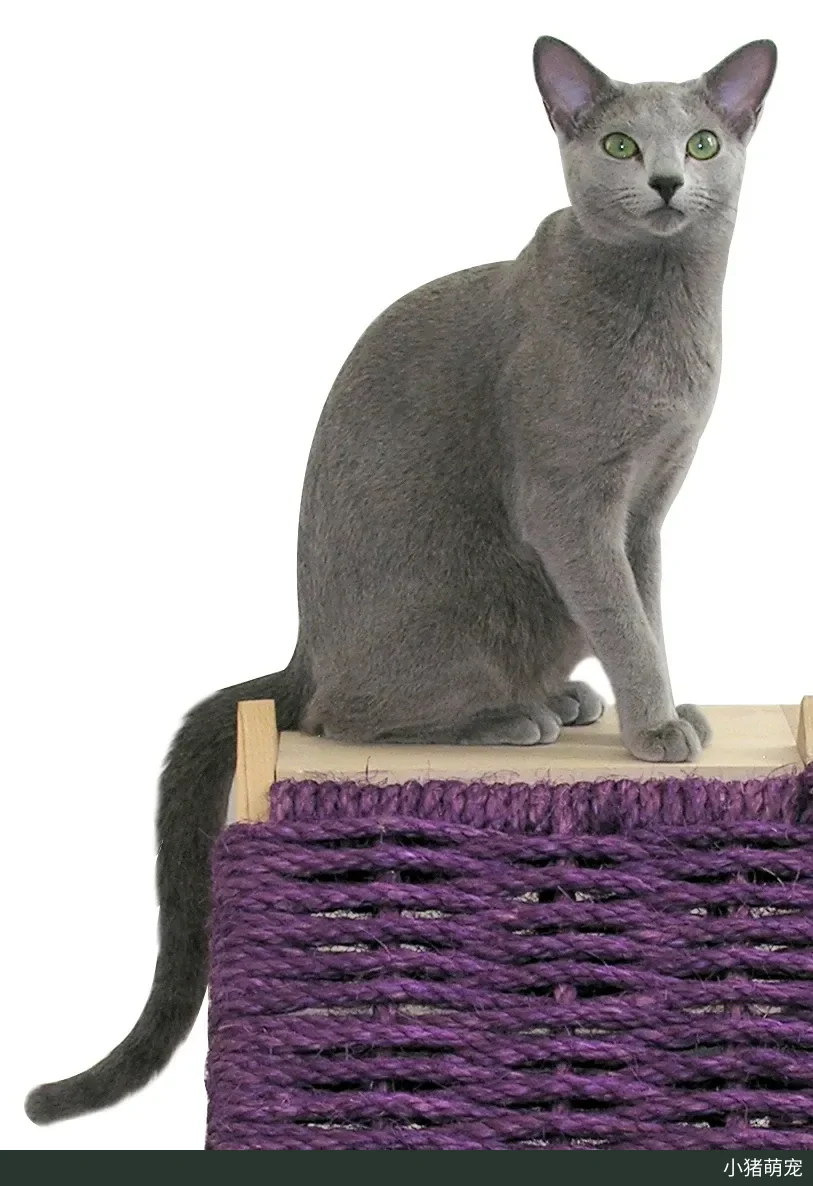
A one-year-old Russian Blue tom on a cat tree—useful for matching the standard’s blue-gray short coat, green eyes, large ears, and long limbs. Photo: Tkeiger (English Wikipedia user); source: Wikimedia Commons; license: CC BY 3.0 (this site converted format).

Temperament and living with one
CFA and TICA both put “smart” first in temperament descriptions. CFA says closed cabinet doors, drawers, even sealed jars are inviting challenges for a Russian Blue—do not be surprised to find doors or drawers opened; TICA also notes they can learn to fetch toys and open doors and drawers. Rather than matching wits, provide puzzle toys and interactive play so that curiosity has somewhere to go.
With strangers they usually watch first. CFA says hiding under the sofa when guests arrive is common, but curiosity usually brings them out soon; TICA frames this as “assess, then accept,” not true aloofness. Once familiar, they stick close to family, love laps, and may even ride a shoulder around the house. They are quiet day to day, but will answer when you speak to them. TICA adds that they like routine, can entertain themselves alone, and suit apartment life; CFA finds them better in quieter homes and with older children willing to let a cat warm up slowly. Of course these are association-level breed summaries; each cat still varies with genetics, early socialization, and household environment.
Health risks and care basics
First, the genetic conformation debates many people watch. Folded ears, short legs, and flat faces that get frequent discussion today are not in mainstream Russian Blue standards: CFA requires a medium wedge head, no nose break in profile, and long fine-boned legs, and lists a kinked or abnormal tail as a disqualification; FIFe likewise requires a straight nose and legs that are “fine and high.” In short, the breed is not selected for extreme type. CFA calls it a “healthy natural breed” with no known breed-specific hereditary diseases, while acknowledging concern that a relatively small gene pool may leave them more prone to some conditions.
The clearest health signal so far comes from a Swedish study. Öhlund et al., publishing in 2015 in the Journal of Veterinary Internal Medicine, analyzed 504,688 cats insured by one Swedish company from 2009–2013. Russian Blues had a diabetes incidence of 44.1 cases per 10,000 cat-years (one insured cat for one year equals one cat-year), versus 11.6 for all cats; compared with all other cats the incidence rate ratio was 3.8 (95% confidence interval 2.1–6.4), and age-adjusted risk remained elevated. Limits are clear: only 14 new Russian Blue cases, a wide confidence interval, and a sample of Swedish insured cats only. Cornell’s Feline Health Center notes that Burmese cats show higher diabetes risk in some countries but not necessarily in the United States—breed risk can shift with regional populations.
Tied closely to diabetes is obesity. CFA and TICA both note that Russian Blues have healthy appetites and can gain weight without interactive exercise. Cornell’s Feline Health Center says obese cats may be up to four times as likely to develop diabetes as cats at ideal weight; iCatCare’s obesity complications also include lower urinary tract disease, greater joint load, and hepatic lipidosis (fatty liver). Well cared for, they often live long: TICA’s lifespan range is 10–20 years, and living past 16 is not rare.
Everyday care points
- Scheduled meals, limited treats: TICA advises fixed feeding times and not too many treats; iCatCare suggests weighing each portion on a kitchen scale, because measuring cups easily over-serve.
- Body condition, not just weight: iCatCare uses a 1–5 body-condition score; 3 is ideal and 5 is obese (ribs covered by thick fat and hard to feel). Do not crash-diet an overweight cat on your own—losing weight too fast can trigger fatal hepatic lipidosis; ask a veterinarian for a gradual plan.
- Mind and body: wand toys, fetch, and puzzle feeders all raise activity; Russian Blues love opening cabinets and can learn to retrieve—use play to satisfy curiosity.
- Simple grooming: CFA suggests brushing 2–3 times a month; TICA suggests 1–2 times a week, adjusted for shedding; check ears weekly and wipe with a soft cloth or cotton ball—do not push cotton swabs into the canal; brush teeth weekly and trim nails about every two weeks.
- Fresh water: provide clean water daily; TICA relays feline behaviorists’ advice to place the water bowl at least 3 feet (about 0.9 m) from food, or use a filtered fountain.
- Watch for diabetes signs: Cornell’s Feline Health Center notes the two changes owners most often notice at home are “good appetite yet losing weight” and “clearly more drinking and urinating”—seek veterinary care early if these appear.
References
-
The Cat Fanciers' Association (CFA). Russian Blue (breed introduction and standard). Page undated; consulted 2026-10-17.
-
The International Cat Association (TICA). Russian Blue. Page undated; consulted 2026-10-17.
-
Fédération Internationale Féline (FIFe). Russian Blue (RUS) Breed Standard. Version dated 2026-01-01; consulted 2026-10-17.
-
Öhlund M, Fall T, Ström Holst B, Hansson-Hamlin H, Bonnett B, Egenvall A. Incidence of Diabetes Mellitus in Insured Swedish Cats in Relation to Age, Breed and Sex. Journal of Veterinary Internal Medicine, 2015, 29(5): 1342–1347. doi:10.1111/jvim.13584
-
International Cat Care. Obesity in Cats. Updated 2025-09-26; consulted 2026-10-17.
-
Cornell Feline Health Center. Feline Diabetes. Updated 2024; consulted 2026-10-17.