One of the sharpest surprises for new fancy mouse (Mus musculus) keepers is how differently females and males must be housed. Female pet mice are strongly social and need female companions, whereas intact adult male mice frequently engage in severe territorial fighting and are often housed individually—or neutered under veterinary care before living with females. The explanation lies directly in the natural social organization of the species.
From Commensal House Mouse to Domestic Companion
Pet fancy mice belong to Mus musculus, the house mouse, thought to have originated between the Mediterranean region and East Asia before spreading worldwide alongside human settlements. The IUCN Red List classifies the species as Least Concern, and it has no CITES appendix listing. Adults measure 65 to 95 mm in head-and-body length with a 60 to 105 mm sparsely haired, scaly tail and weigh just 12 to 30 g; domestic fancy lines share this delicate build while displaying white, black, brown, spotted, and bicolor coats.
In the wild, house mice are primarily nocturnal and crepuscular omnivores that run swiftly (up to roughly 8 mph), climb with agility, and excavate multi-exit burrows or build soft insulated nests near reliable food. Equipped with broad hearing that includes ultrasonic communication, keen smell, and tactile whiskers, they rely heavily on urinary pheromones and glandular scent marks to signal identity, rank, and reproductive status. As prey for cats, foxes, mustelids, snakes, and birds of prey, they stay close to vertical walls and cover and find open, barren spaces stressful.

Figure: Side profile of a wild-type house mouse displaying its gray-brown coat, rounded ears, and nearly hairless tail. Dion Art, Wikimedia Commons

Why Female Groups Coexist While Intact Males Fight
Animal Diversity Web describes the house mouse mating system as polygynous and territorial: a single dominant adult male typically defends an area containing a family group of several females and their young. Within that territory, females maintain a loose, low-aggression hierarchy, huddling and grooming together while collectively defending the nest against outsiders. Rival adult males, by contrast, are driven away through scent signaling and overt attacks, and maturing young males are usually forced to disperse.
Inside a pet enclosure where subordinate males cannot escape, that territorial drive turns dangerous. The Merck Veterinary Manual states that female mice are generally compatible in groups—occasionally showing non-wounding dominant whisker-nibbling called barbering—whereas male mice generally fight fiercely when housed together, inflicting severe bite wounds over the rump, tail, and shoulders unless they are littermates raised together with no female scent nearby. Compared with pet rats covered elsewhere on this site—where male littermates usually coexist well—intact male mice are far less tolerant of same-sex cagemates. Merck also warns never to house mice with or near rats, because rats normally carry Streptobacillus moniliformis in their nasopharynx, which causes fatal septicemia in mice.
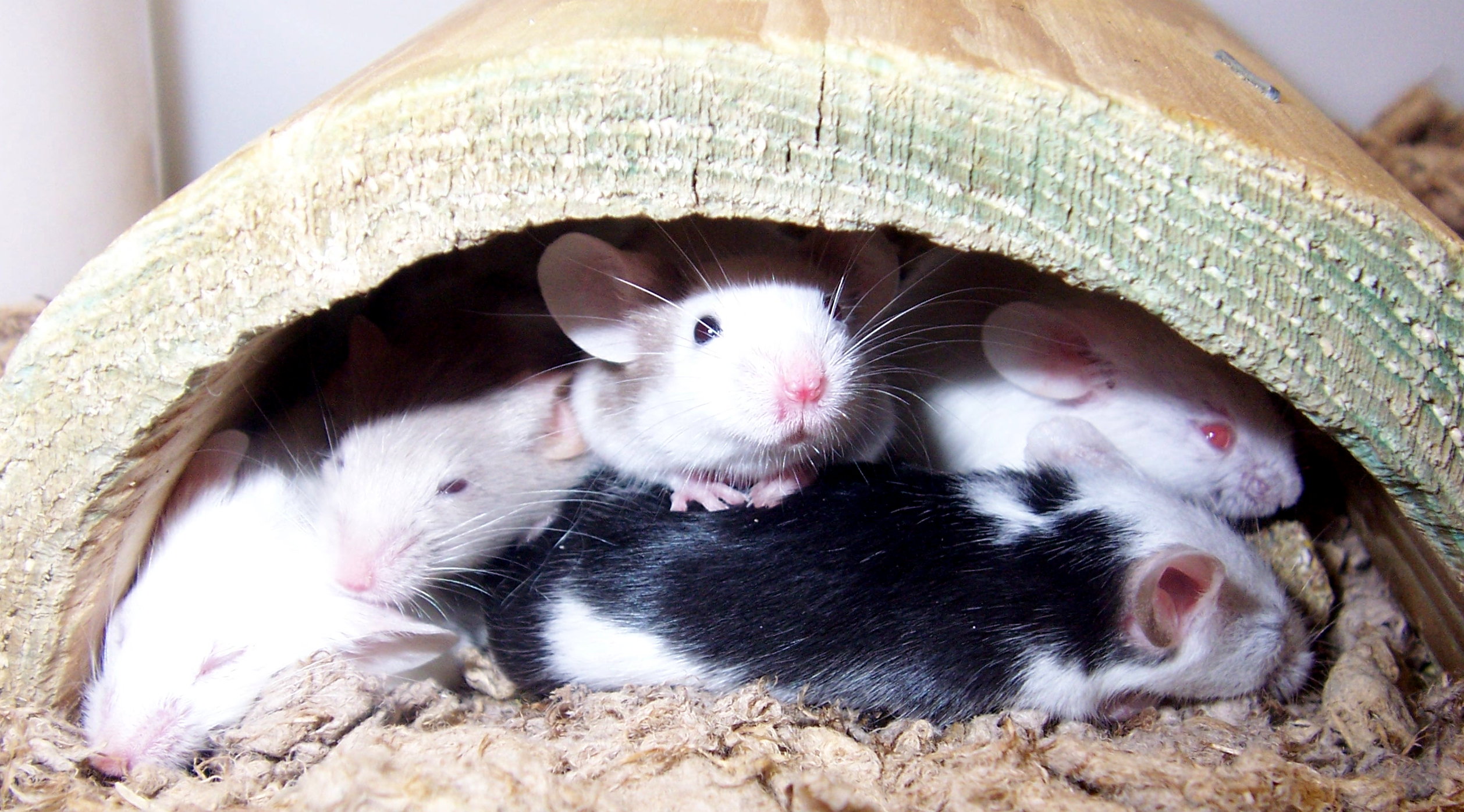
Figure: Four multicolored pet mice resting together under a wooden hide, illustrating social huddling in compatible groups. Polarqueen, Wikimedia Commons

Even among pre-weaned male littermates, behavioral research by Van Loo et al. (2001) showed that intermale aggression and escalation increase with age and larger group sizes, and full cage cleanings that erase familiar scent marks can trigger fresh conflict. Consequently, household keepers face two realistic choices: start with a bonded same-sex group of two or three female mice, or—if keeping an intact male—be prepared to house him singly with extra enrichment and gentle daily interaction (or consult an exotic veterinarian about neutering before pairing him with females, as RSPCA Australia suggests). Never keep unneutered opposite sexes together: mice reach sexual maturity at five to seven weeks, have a 19-to-21-day gestation with postpartum estrus, and can produce a new litter every three to five weeks.
Ventilated Enclosures, Strong Odor, and Short Lifespans
Good mouse housing balances tight escape prevention with brisk airflow. Although mice squeeze through remarkably small gaps, the Merck Veterinary Manual specifically warns against glass aquariums because poor ventilation lets ammonia from urine accumulate and damage delicate airways. Use a chew-resistant, solid-floored, finely spaced wire cage tall enough for upright stretching and vertical climbing, furnished with shelves, suspended ropes, fruit-tree branches, multi-exit cardboard tunnels, a solid axle-free wheel, and dust-free paper or cellulose bedding plus shredded tissue for nest building (never untreated softwood shavings, scented litter, or fluffy cotton). Spot-clean daily and full-clean every one to two weeks, returning a small handful of unsoiled nesting material for calm groups—or washing everything thoroughly if aggression has flared, as the RSPCA advises.
Two practical realities surprise many first-time owners. First is odor: intact male mice produce pungent, persistent territorial urine marks, and over-cleaning every trace of scent can actually prompt heavier re-marking. Second is their brief lifespan and rapid medical decline. Both Merck and Animal Diversity Web report an average pet lifespan of only 18 to 24 months. Because an adult weighs just 12 to 30 g, the RSPCA notes that losing 20% of body weight (as little as 6 g) can be fatal, and Merck cautions that even one to two hours without water in high heat can kill a mouse. Common health concerns include respiratory infections (notably Mycoplasma pulmonis and Sendai virus, often heard as clicking or chattering sounds), fur mites or ulcerative dermatitis, overgrown incisors, and mammary or subcutaneous tumors that are nearly always malignant in aging mice.

Figure: A two-year-old black-and-white female pet mouse standing upright at a sipper nozzle, highlighting vertical space and daily hydration checks. Tiia Monto, Wikimedia Commons

Gentle Handling and Boundaries of Suitability
Feed a measured, pet-formulated rodent pellet diet (avoiding unlimited high-fat laboratory chows that cause obesity) supplemented with small portions of safe vegetables while excluding toxic items such as grapes or rhubarb, and verify twice daily that water nozzles are clear and leak-free. Keep the cage at 18 to 26°C and 30 to 70% humidity in a quiet room out of direct sunlight and away from ultrasonic noise from televisions, computers, or vacuums. Rather than lifting by the tail tip or scruffing, guide mice via a familiar tunnel onto cupped hands close to a secure surface. Seek an exotic-capable veterinarian immediately for refusal to eat, hunched posture, ruffled fur, respiratory clicking, skin sores, head tilt, or lumps, and always wash hands afterward because pet mice can asymptomatically carry dermatophytes or lymphocytic choriomeningitis virus (LCMV).
Pet mice suit attentive adult keepers who accept an 18-to-24-month lifespan, enjoy designing climbing and burrowing setups, handle frequent spot-cleaning, and can accommodate either a bonded female group or an enriched solitary male. They are not suited to households sensitive to strong male urine odor, anyone expecting a multi-year lap pet or wishing to house two intact males together, homes with unisolated cats or dogs or summer heat extremes, or areas without veterinarians willing to treat 20-to-30-gram patients. Before acquiring pet mice, review local ownership and quarantine rules, choose healthy legally captive-bred companions, and never release domestic mice outdoors.
References
- Animal Diversity Web: Mus musculus (house mouse)
- Merck Veterinary Manual: Mice and Rats as Pets
- IUCN Red List: Mus musculus
- RSPCA UK: Keeping Mice Together
- RSPCA UK: Creating a Good Home for Mice
- RSPCA Australia Knowledgebase: What company do my pet mice need?
- Van Loo et al. (2001): Modulation of aggression in male mice: influence of group size and cage size