Anyone browsing international reptile videos or English-language husbandry sheets quickly encounters a compact, olive-brown tortoise called the Russian tortoise, steppe tortoise, or Horsfield's tortoise (Testudo horsfieldii, placed by some authors in the genus Agrionemys) [1][9]. Because it appears regularly in European and North American pet markets, many readers assume it can be bought and kept casually at home. In China, however, Horsfield's tortoise is a native species listed as National Class I Protected Wildlife, making unauthorized private purchase, possession, or breeding illegal [4][5]. This overview explains the tortoise's wild biology, conservation status, and legal boundaries rather than offering a pet-keeping tutorial or sourcing guidance.
Steppe Habitat and Extreme Annual Dormancy
According to The Reptile Database, Testudo horsfieldii ranges across arid plains and foothills of Kazakhstan, Uzbekistan, Turkmenistan, Kyrgyzstan, Tajikistan, northeastern Iran, Afghanistan, northern Pakistan, and northwestern China, reaching elevations up to 2,400 m in parts of Afghanistan [1]. Within China, its natural range is confined exclusively to Huocheng County in Xinjiang's Ili region, where it occupies loess hills and semi-desert steppe between 600 and 1,100 m [7]. Morphologically, the species has a noticeably flattened, yellowish-brown carapace marked with dark blotches and sturdy scaly limbs bearing only four claws per foot—a hallmark reflected in its Chinese name, 'four-clawed tortoise,' and specialized for digging deep burrows in compact soil [1][7].
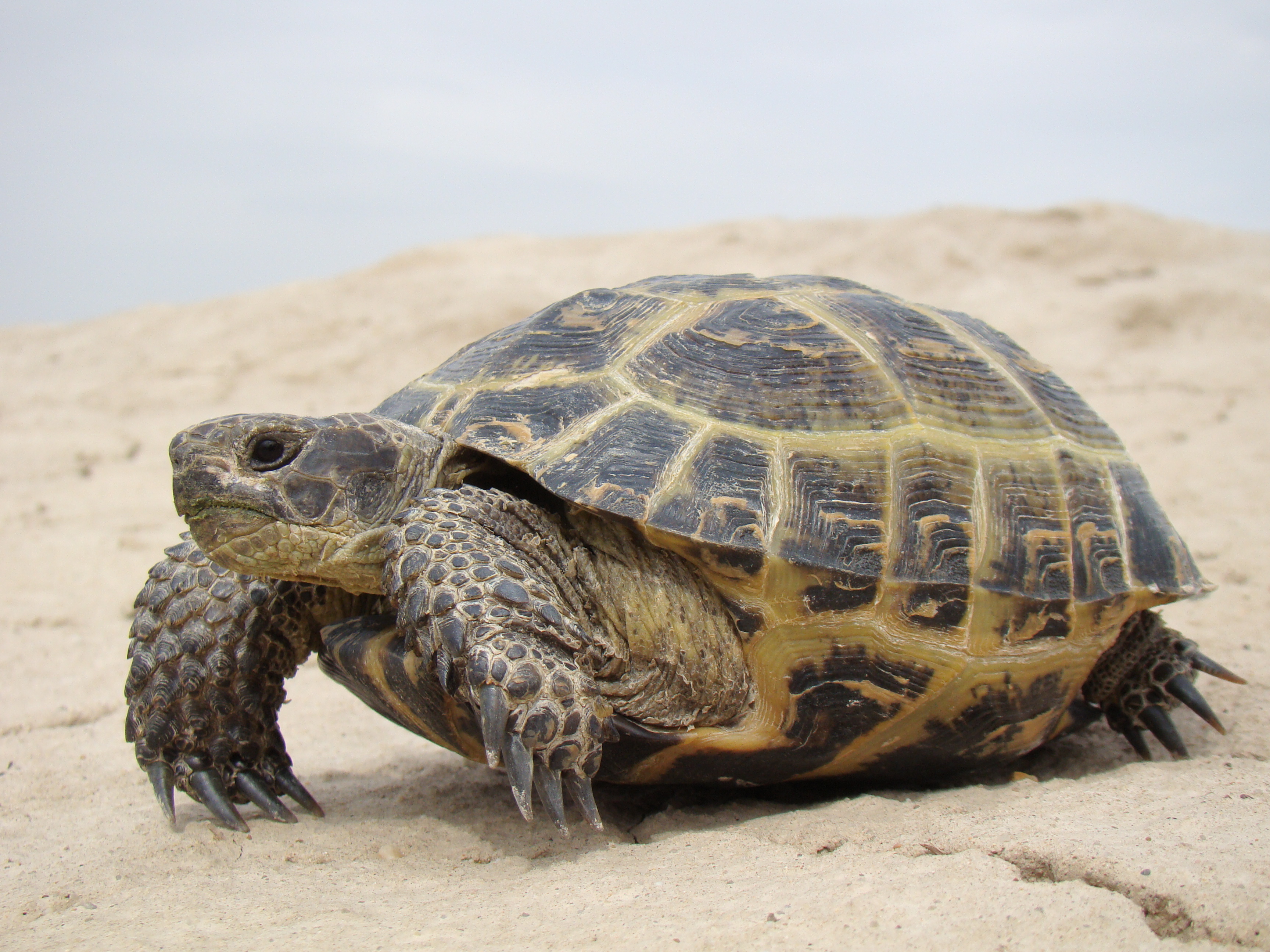
Figure: Wild Horsfield's tortoise on sandy ground in Kazakhstan showing its flattened carapace and four digging claws. Yuriy75, Wikimedia Commons

The harsh continental climate of Central Asia enforces one of the shortest active seasons known among tortoises. Field research by Lagarde et al. (2003) demonstrated that freezing winters and scorching, desiccated summers restrict surface activity to roughly three months each spring—around early March to late May for males and mid-March to mid-June for females—coinciding with the brief flush of annual plants [6]. Even during that short spring window, tortoises spend about 90 percent of their time inactive in shelter and devote very little time each day to active foraging, while still needing to eat, mate, lay eggs, and store energy reserves for the long fast ahead [6].
Once summer heat dries out the steppe vegetation, the tortoises retreat deep into burrows to aestivate, and across much of their range summer aestivation merges directly into winter hibernation, keeping them underground for approximately nine months each year [6]. Field observations in Xinjiang's Huocheng reserve mirror this rhythm: tortoises emerge around April as spring herbs sprout, feed on wild stems, leaves, flowers, and fruits during cooler morning and late-afternoon hours while sheltering from midday heat, enter summer aestivation in July and August, and continue into winter dormancy from September or October until the following spring [7]. Such tightly evolved burrowing and dual-dormancy biology makes year-round indoor keeping fundamentally mismatched with their wild physiology [6][8].

Figure: Armored forelimb of a wild Horsfield's tortoise in Tajikistan displaying the four stout claws built for burrowing. Alexander A. Fomichev, Wikimedia Commons

Why Private Keeping Is Prohibited in China
The apparent contradiction between Western pet visibility and China's strict ban comes down to regional population crisis and national law. Globally, the IUCN Red List has listed Testudo horsfieldii as Vulnerable (criteria A2d) since 1996—an assessment noted as needing an update—while CITES places all non-Appendix I tortoises in Testudinidae under Appendix II to regulate international trade [2][3]. Inside China, however, past over-collection and heavy grazing reduced Huocheng's wild population to barely over 200 tortoises, leading China's national Red List to classify it as Critically Endangered [7]. After a regional reserve was established in 1983 and upgraded in May 2016 to the 35,000-hectare Huocheng National Nature Reserve, strict patrolling and habitat protection helped numbers recover past 1,300 individuals, with conservation-oriented artificial hatching achieving its first success in 2021 [7].
Reflecting that fragile domestic status, China's 2021 List of National Key Protected Wild Animals places all native tortoises in family Testudinidae—including Testudo horsfieldii—in Class I, administered by forestry and grassland authorities [4]. Crucially, the entry carries no 'wild populations only' exemption, which means captive-bred individuals are not carved out for casual private pet trade under the current statutory schedule [4][5].
China's revised Wildlife Protection Law (enacted December 2022 and effective May 1, 2023) spells out clear restrictions and penalties [5]. Article 25 requires a provincial-level artificial breeding license to breed any National Key Protected species, while Article 28 prohibits selling, purchasing, or utilizing such animals except under special approved purposes—such as scientific research, licensed breeding, or public exhibition—with official authorization and traceable special markings [5]. Under Articles 51 and 52, unauthorized breeding incurs confiscation and fines of one to ten times the assessed value, whereas unlicensed buying, selling, transport, or shipping carries confiscation and fines of two to twenty times the value, escalating to criminal prosecution in serious cases [5]. Claims by online sellers that a tortoise is 'captive-bred' or 'common overseas' do not make private ownership lawful in China.

Figure: Wild Horsfield's tortoise moving through sparse dry steppe vegetation in Uzbekistan. Alexander A. Fomichev, Wikimedia Commons

Husbandry Demands and Legal Welfare Boundaries
Even outside China where captive-bred individuals may be legally traded with proper documentation, or inside authorized conservation centers, Horsfield's tortoises have demanding welfare requirements. The Merck Veterinary Manual emphasizes that temperate tortoises need spacious, well-ventilated enclosures—ideally secure outdoor pens where climate permits—with a clear thermal gradient rather than glass aquariums, which insulate poorly, restrict airflow, and increase stress [8]. They require unfiltered sunlight or properly calibrated UVB lighting (290–300 nm) for vitamin D3 synthesis and calcium regulation, plus high-fiber, calcium-rich leafy weeds and plants rather than sugary fruits or dry commercial diets; RSPCA reviews specifically warn that relying on dry pellets drives excessively rapid, unhealthy growth in Horsfield's tortoises [8][9].
Microclimate humidity and dormancy management are frequent sources of clinical disease. As Merck notes, even arid-zone tortoises rely on humid retreat microclimates to reduce shell pyramiding while still requiring dry, well-ventilated ambient air to avoid respiratory and skin infections [8]. Restricted exercise, excess calories, and uninterrupted year-round warmth contribute to obesity and hepatic lipidosis, while poorly controlled hibernation risks dehydration and organ failure [8]. Warning signs such as nasal discharge, sunken eyes, shell softening or pyramiding, beak overgrowth, prolonged refusal to eat, post-hibernation weakness, or cloacal prolapse require prompt evaluation by an experienced reptile veterinarian rather than home remedies [8].
The boundary is therefore straightforward. In mainland China, Horsfield's tortoise belongs in protected wild steppe and licensed conservation programs, and private citizens should never purchase, accept, or keep one [4][5][7]. In jurisdictions where documented captive-bred tortoises are legal, only keepers who verify CITES and local regulations, provide large ventilated indoor-outdoor enclosures with calibrated UVB and seasonal cooling, commit to decades of care, and have access to exotic veterinary medicine can meet the species' needs [3][8][9]. Wild-caught specimens should never be bought, and captive tortoises must never be released into the wild.
References
[1] The Reptile Database. Testudo horsfieldii GRAY, 1844. https://reptile-database.reptarium.cz/species?genus=Testudo&species=horsfieldii
[2] Tortoise & Freshwater Turtle Specialist Group. Testudo horsfieldii. The IUCN Red List of Threatened Species 1996: e.T21651A9306759. https://www.iucnredlist.org/species/21651/9306759
[3] CITES. Testudo horsfieldii (Appendix II listing under Testudinidae spp.). https://cites.org/eng/taxonomy/term/4664
[4] National Forestry and Grassland Administration & Ministry of Agriculture and Rural Affairs of China. List of National Key Protected Wild Animals (2021 Revision, Notice No. 3 of 2021). https://wjorg.com/fagui/国家重点保护野生动物名录-2021年调整/
[5] Standing Committee of the National People's Congress. Wildlife Protection Law of the People's Republic of China (Revised Dec. 30, 2022; effective May 1, 2023). http://www.npc.gov.cn/npc/c2/c30834/202212/t20221230_321016.html
[6] Lagarde, F., Bonnet, X., Corbin, J., Henen, B., Nagy, K., Mardonov, B., & Naulleau, G. (2003). Foraging behaviour and diet of an ectothermic herbivore: Testudo horsfieldi. Ecography, 26(2): 236–242. http://russiantortoise.org/russian tortoise diet.pdf
[7] Huocheng County Forestry and Grassland Bureau. Profile of the Huocheng Horsfield's Tortoise (June 2023). https://www.xjhc.gov.cn/xjhc/lgjj/202306/4ea25a9369404307ac5264de731a701a.shtml
[8] Divers, S. J., & Comolli, J. R. Management and Husbandry of Reptiles; Clinical Procedures for Reptiles. Merck Veterinary Manual (updated Jul 2026). https://www.merckvetmanual.com/exotic-and-laboratory-animals/reptiles/management-and-husbandry-of-reptiles
[9] RSPCA. Handle with care: Spur-thighed, Hermann's, marginated and Horsfield's tortoises. https://www.rspca.org.uk/documents/1494939/7712578/Spur-thighed%2C+Hermann's%2C+marginated+and+Horsfield's+tortoises+(PDF+124KB).pdf/a072c67f-ebce-a7cf-542c-c7a4061182f8?download=true&t=1559143357538&version=3.0