The Chinese Crested is a toy companion breed with a history of working at sea. Chinese traders carried these small dogs aboard their ships to catch rats, and sailors traded them in ports along the way. The breed’s earlier ancestry is harder to trace. Its name can also give a misleading first impression of what one looks like today. The familiar dog with a tuft on its head and bare skin along its back is the hairless variety. A dog covered from head to foot in soft hair can be just as much a Chinese Crested. That variety is called the Powderpuff.[1]
Look at a hairless Crested in profile and you can follow the outline of its neck and body below the crest. Hair around the ankles resembles little socks, and a plume marks the end of the tail. On a Powderpuff, silky hair falls along the flanks and can hide the point where the legs meet the body. Both varieties typically stand 11 to 13 inches (about 28 to 33 centimetres) tall, measured from the ground to the shoulder. A full coat makes the Powderpuff look more substantial, but underneath it is the same fine frame, apparent in the dog’s light, graceful movement.[1]
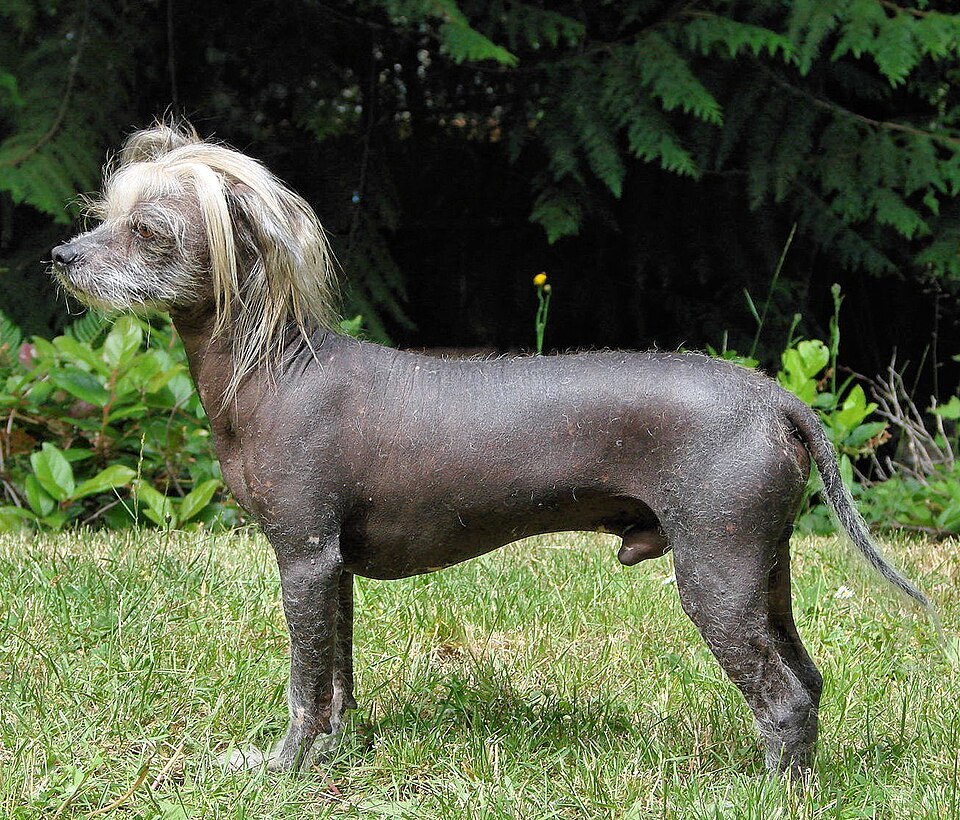
Figure: The outline of a hairless Crested. Sheri Terris, Wikimedia Commons[2]

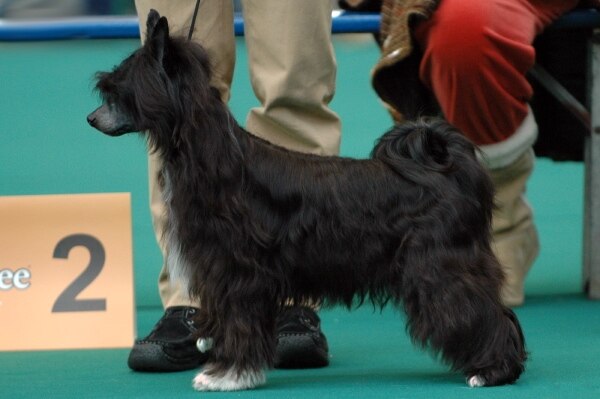
Figure: The Powderpuff’s long coat. Bonnie van den Born, Wikimedia Commons[3]

To picture life with either variety, start with who will take the dog for a walk on an ordinary weekday. The American Kennel Club (AKC) says short daily walks with an owner and time to play will usually meet a Crested’s exercise needs.[1] With a yard, you might follow the walk with a game at home. In an apartment, it helps to plan both a route and a safe place to stop and play. Let the dog help set the pace. Even on a familiar route, leave room to sniff, catch up or take a break.
At home, consider how the family moves through a room. A Crested following at your heels can slip below your line of sight as you change shoes or turn with a bag of groceries. Pick a waiting spot that everyone can see and that the door will clear when it opens. A level stretch of floor away from foot traffic can serve for rolling a ball or practising a recall. A child can kneel there, roll the toy and let the dog come closer, keeping all four paws on the floor. That little patch of usable space matters more than the size of the living room.
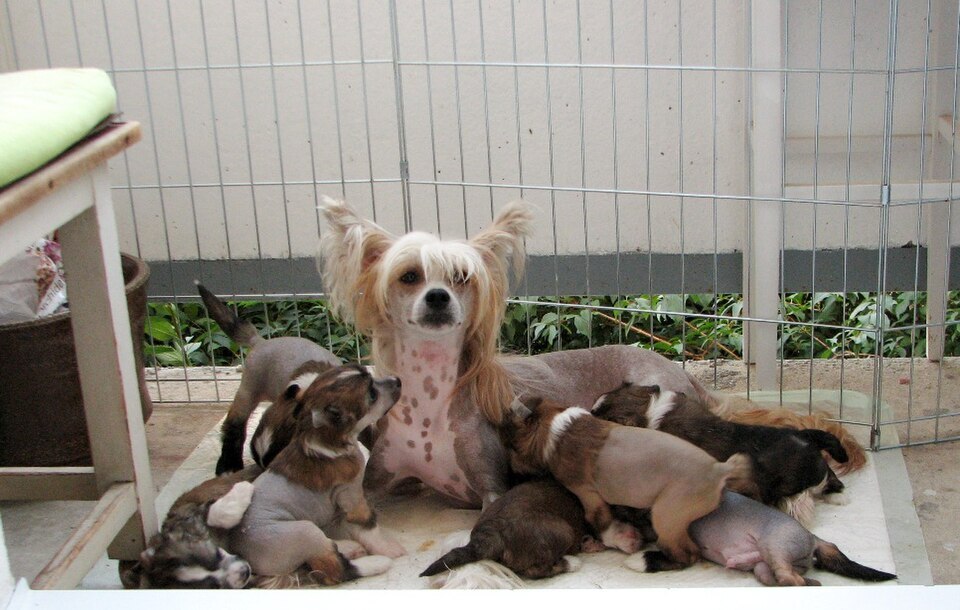
Figure: The foreground dog’s pale crest. HTO, Wikimedia Commons[4]

Cresteds tend to be lively and attentive to their people, which gives you a starting point for teaching everyday skills. To teach that wait by the door, begin when nobody is coming or going. Guide the dog to the spot and reward it as soon as it settles there. Once the spot is familiar, try reaching for the handle. If the dog follows at the first rattle, make a smaller movement on the next attempt. A harsh voice can put a sensitive Crested off trying again.[1] Agreeing on one cue makes it easier for everyone to teach the same lesson patiently.
For a family that enjoys learning alongside a dog, a game on a walk can grow into a shared hobby. Cresteds can take part in agility, flyball and obedience.[1] Watch what draws your dog back for another turn. A toy rolling away may be the attraction, or the dog may hurry back to you for the next cue. Follow that interest when choosing a game. If you reward with food, count the treats toward the day’s intake. When several people take turns training, setting aside one portion for everyone to share makes the total easier to track.
For a hairless Crested, skin care begins before the walk. The back and sides have little hair to shield them, and exposed skin is susceptible to sunburn and irritation.[1] Consider when the sun will be less intense and where the route offers shade. A well-fitting protective garment can cover the dog on open stretches. When trying one on, let the dog walk a few steps and watch whether an edge rubs the same patch of skin with every stride. Check that spot again when the garment comes off. If the dog needs sunscreen or additional skin care, ask a veterinarian to choose a dog-safe product suited to its skin.
A Powderpuff needs time set aside every day for brushing. The long outer hairs fall over a shorter undercoat, so the surface can look smooth even as tangles form underneath.[1] Gently part the hanging hair with your fingers and brush through one layer at a time. Pay attention to hair flattened by the harness. A brush that glides over the top can leave a small knot exactly where it was. If you feel resistance, stop before you pull on the skin. When considering a Powderpuff, picture who will sit down with the dog to do this after the walk.
For either variety, ask about eye and joint health in the family. A breeder should be able to explain which inherited eye conditions the parents were screened for, including progressive retinal atrophy and primary lens luxation, and show which result belongs to which parent. A slipping kneecap, called patellar luxation, also occurs in Cresteds.[1] The parents’ records can inform a decision about a puppy. A dog that repeatedly carries one hind leg while walking needs its own veterinary examination. Then bring the decision back to a busy weekday: who can take the dog out, patiently practise a cue and still make time for exposed skin or a long coat?