The Sokoke takes its name from the Arabuko-Sokoke Forest on the Kenyan coast. In 1978, Jeni Slater began breeding domestic cats from around Watamu. She originally called them African Shorthairs. Gloria Moeldrop took a pair to Denmark in 1983, and they were shown in Copenhagen the following year. The Fédération Internationale Féline (FIFe) recognized the breed in 1994. Its current standard lists the Sokoke in Category 3 under the code SOK. Britain’s Governing Council of the Cat Fancy (GCCF) lists it in Group 3 of Section 4, Foreign. The forest name preserves the geographic origins of these local domestic cats. Their markings alone tell us nothing about wildcat ancestry. [1–3]
Why do the flank markings look lighter in the middle?
Look at a Sokoke standing side-on. Follow the dark bars on a foreleg up past the shoulder, where the narrow stripes give way to broad swirls across the body. Trace the dark edge of a swirl and you may see what looks like the paler background showing through its center. FIFe calls these centers “oysters.” The swirls belong to the classic tabby pattern. What gives them their distinctive appearance is the ticking: even within a dark marking, individual hairs can carry alternating bands of light and dark. From a distance you see the outline. Up close, you can pick out flecks of color inside it. [1–3]
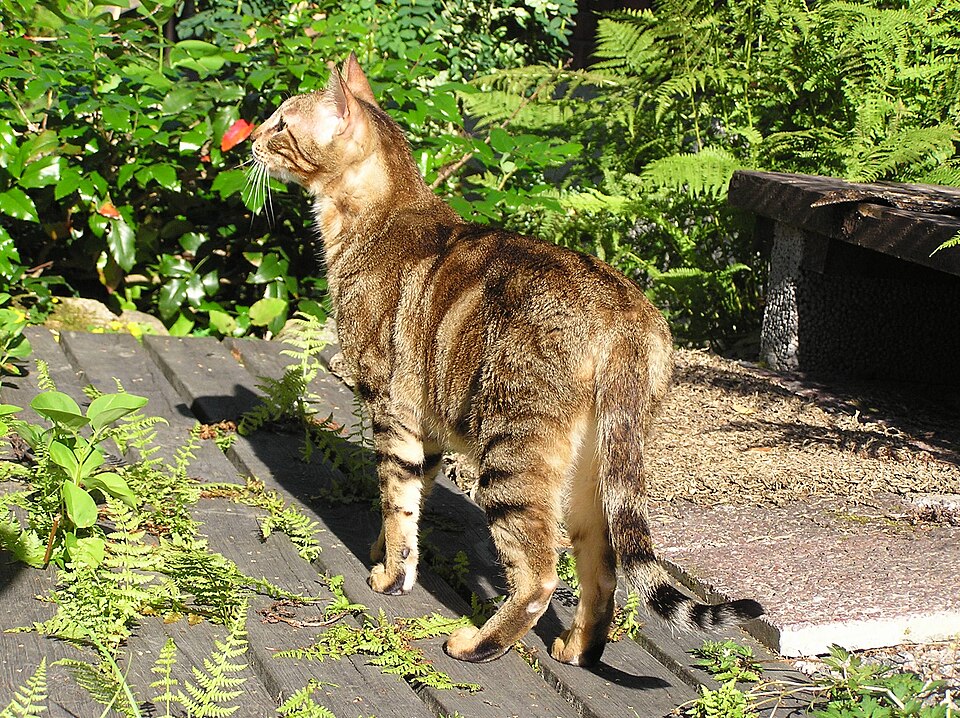
Broad swirls mark the Sokoke’s flanks. A. Turto, Wikimedia Commons[8]

Step back from the markings to see the cat’s proportions. The Sokoke is a medium-sized shorthair with a long, muscular body and a relatively small head. Its legs are long and slender. The hind legs are longer than the forelegs, with a pronounced bend when the cat stands. The short coat lies close, with little or no undercoat, so the lines of the shoulders, waist and thighs are easy to see. From the front, the eyes have dark rims that echo the coat markings. Eye color can range from amber to light green. A natural standing pose gives the clearest view of the build, while a front view brings out the eye rims and forehead stripes. [1,2]
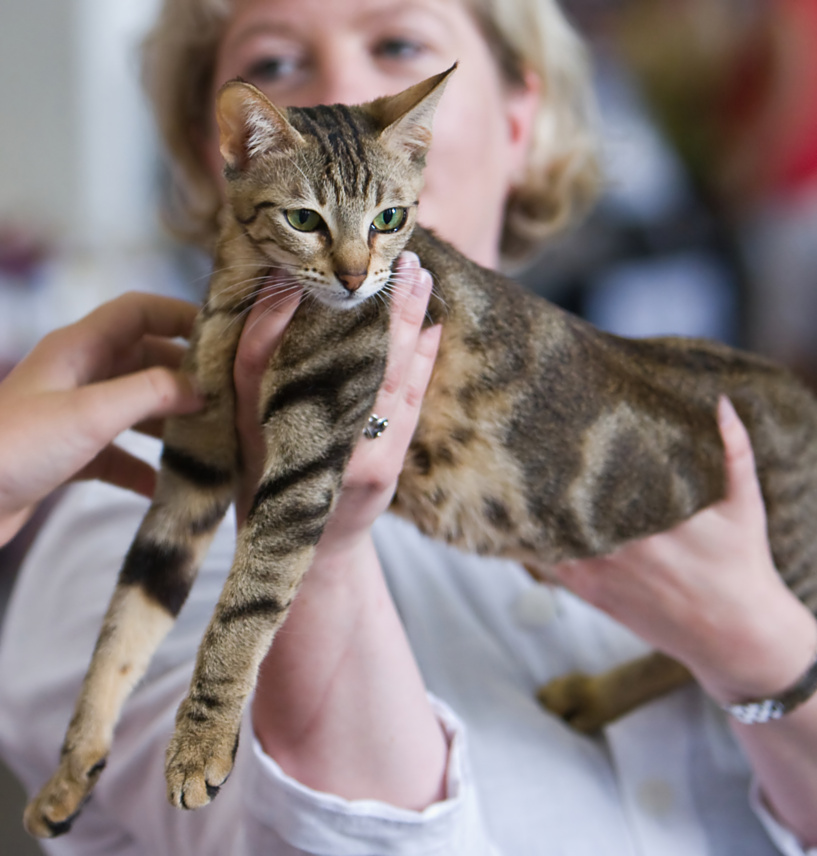
Dark markings frame the Sokoke’s eyes. Heikki Siltala, catza.net
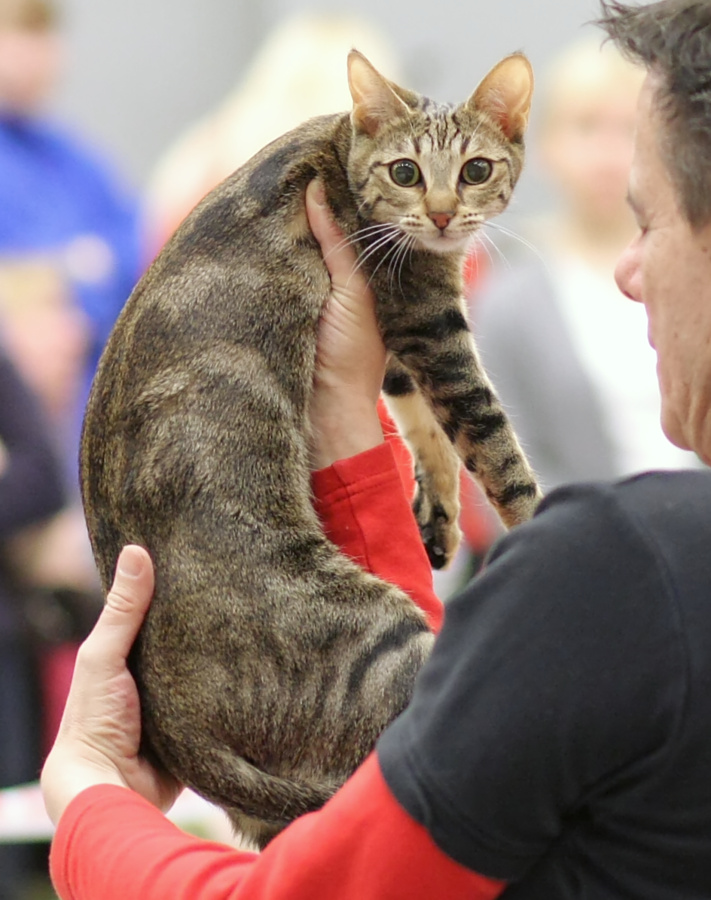
Ticking shades the Sokoke’s back. Heikki Siltala, catza.net
A high perch is a place to pause
FIFe singles out climbing as something Sokokes enjoy. To plan for it indoors, first watch which high places your cat chooses. Does it use the back of a chair as a step on the way up? Does it spend a long time on top of the same cabinet every day? The climber needs a series of steady footholds. A cat that lingers also needs enough room to stretch out and watch in peace. Feline veterinary guidance includes elevated perches among the safe resting places cats can choose. Even a cat tree with just a few levels can serve both purposes if your cat settles comfortably at the top. [1,4,5]
Work backward from the place your cat wants to reach. If it likes watching people in the room from beside a window, give it a stable platform there with space to turn around and a lower step within reach. Then look at the route from floor level. Is the step still there when someone pulls out a chair? If another cat falls asleep across the way down, is there a second way off? In a home with several cats, give them more than one route and spread their resting places around. Even two cats that often spend time together should each have somewhere to be alone. [4,5]
The perch gives your cat a lookout. The floor offers room for a chase. Drag a toy mouse along the floor, pause at the edge of a cardboard box, then bring it into view on the other side. Give the cat time to fix its gaze, crouch, creep closer and catch the mouse. If it watches from above for a while before coming down, let it set the pace. A cat that likes to explore with its paws may enjoy fishing a little of its usual food out of an easy puzzle feeder. If several cats share the home, play with them separately so a slower cat gets a chance to make the catch. Put string toys away when the game is over. [5,6]
Sokokes often vocalize to familiar people and cats and can form close bonds with both. Try calling to your cat once, then wait for it to come to you. If it stays on the perch to watch, let it keep its spot. An adult that has bonded with people or another cat may need time to settle into a new home. Put out a mat it has slept on and a box it can hide in, and keep playtime at a familiar hour. That leaves the cat free to choose when to emerge and when to approach. [1,4,5]
Trace the routes to water, food, scratching surfaces and litter boxes, too. Two bowls set side by side still require both cats to approach the same spot. Spacing resources apart gives one cat a way around a companion resting in a passage or guarding it. Put a favorite scratching surface within easy reach of the place your cat wakes up. Preserve familiar scents in the corners where it rubs its cheeks after resting. Over the next few days, watch whether each cat can eat, drink, use the litter box and settle down freely. That tells you more about the arrangement than a count of the items you have added. [4–6]
Has a familiar jump changed?
The GCCF’s Sokoke profile lists no known health problems specific to the breed. At home, a useful point of comparison is how your own cat usually moves. Perhaps it used to leap straight onto a favorite perch. Now it stops below every time and looks for a lower chair to climb up from. Note when the change began and whether going up or coming down seems harder. Is the cat also avoiding stairs or having trouble grooming its back? Those details give your veterinarian a clearer picture than saying the cat has been less active lately. [3,7]
According to the Cornell Feline Health Center, joint pain can affect a cat’s ability to jump, use stairs and groom, and the signs can be subtle. If a movement that used to come easily keeps giving your cat trouble, contact your veterinarian and describe what has changed at home. The veterinarian can use that history, a physical examination and an orthopedic examination to investigate the cause, with imaging as needed. Meanwhile, offer a lower resting spot and keep food, water and the litter box within easy reach. Spare your cat repeated attempts at the old jump. A favorite perch gives you a way to notice these changes simply by watching a familiar routine. [5,7]
References
-
[1] Fédération Internationale Féline. Sokoke.
-
[2] Fédération Internationale Féline. SOKOKE. January 1, 2026.
-
[3] The Governing Council of the Cat Fancy. Sokoke.
-
[4] Feline Veterinary Medical Association. New Feline Veterinary Medical Association Position Statement Reimagines Life for Indoor Cats. August 28, 2025.
-
[5] American Association of Feline Practitioners. Your Cat’s Environmental Needs.
-
[6] Cat Friendly Homes. Playing With Your Cat.
-
[7] Cornell Feline Health Center. Is Your Cat Slowing Down?.