An American Cocker Spaniel’s long ears hang alongside its cheeks and swing out when it runs. The photograph of one sailing through an agility hoop gives a glimpse of the athletic build that once served it in the field. Its ancestors followed hunters into brush and tall grass, using scent to find hidden birds, flushing them into the air and retrieving them after they fell. The name “Cocker” comes from the woodcock these dogs were skilled at finding. Life with a Cocker today has room for both a good outing together and a quiet moment when the dog lets you lift one of those long ears. [1][3]

The American Kennel Club (AKC) registers the American breed as the Cocker Spaniel and the English Cocker Spaniel separately. Seen side by side, the English Cocker is generally taller, with a longer head, while the American Cocker carries a fuller coat. An adult American Cocker stands about 14 to 15 inches (36 to 38 cm) at the shoulder. Its body is compact and sturdy, with a back that slopes gently down from the shoulders. Look closer at the head and you can see a slightly rounded skull, defined brows, forward-looking dark brown eyes and long, low-set ears. In the show photograph, long hair hides the outline of the legs, but you can still see how far the ear hair falls below the jaw. [1][2]

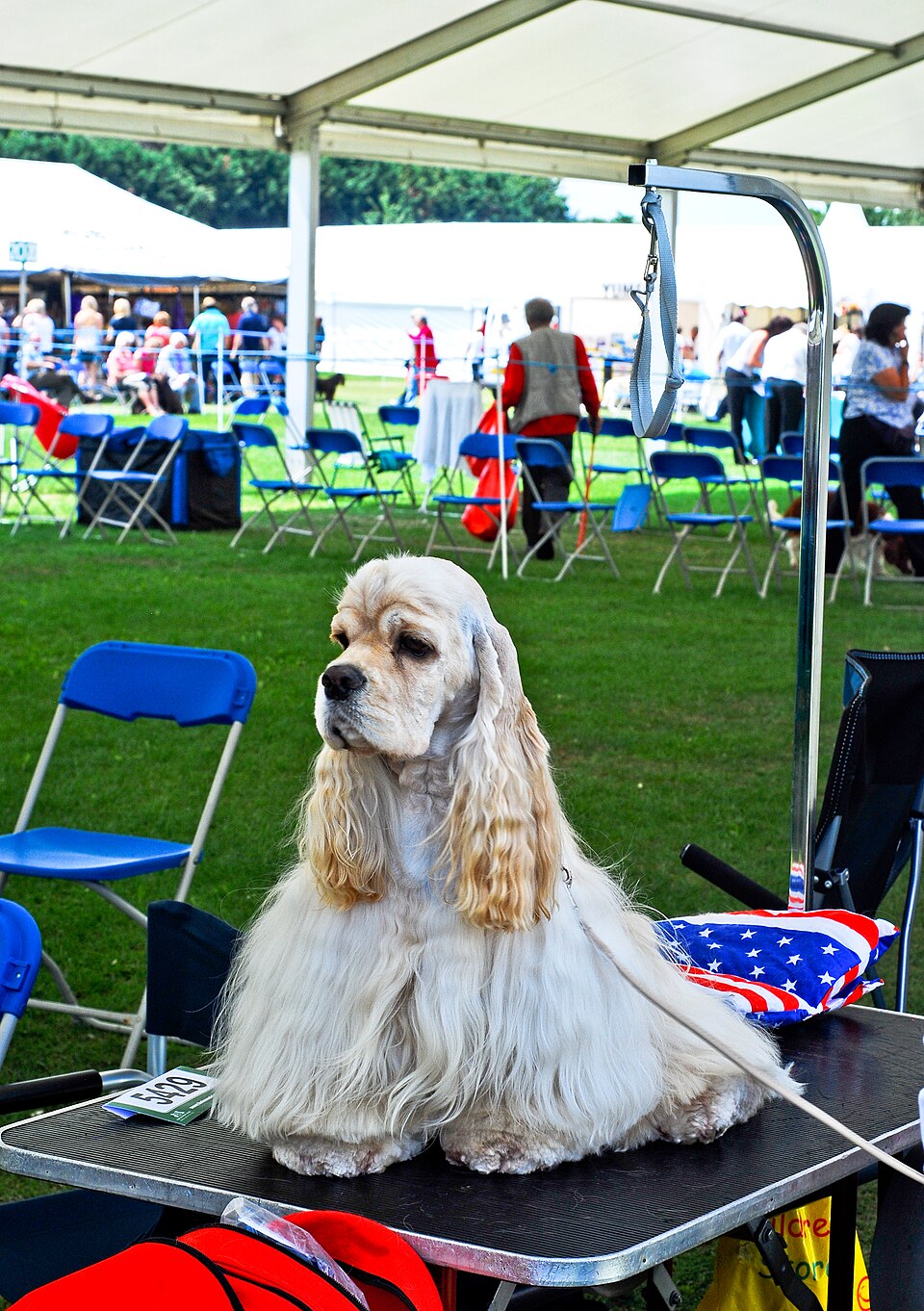
An American Cocker Spaniel sits at the Windsor Dog Show. Matt Batchelor, Wikimedia Commons[2]
What can you do together outdoors?
Two everyday activities the AKC suggests for this small hunting dog are walking with someone and fetching a ball or toy. Regular exercise helps keep its muscles in good condition. Start by making time on an ordinary workday for a walk you can both enjoy. Choose a route with enough room to stride out together and enough time for the dog to lower its nose and follow a scent. Can you pause when something catches its interest? Is there a stretch where you can both pick up the pace? A route that allows for both is one the family is more likely to enjoy walking again. [1]
In an enclosed area, roll a favorite toy along the ground. Give your Cocker a chance to chase it and pick it up, then call the dog back as it turns toward you. Watch which part it enjoys. One dog might bring the toy straight back and wait for another throw. Another might catch a scent on the ground and wander on. Reward the first with another round of fetch. With the second, you can carry on walking together. Your dog’s choice will help you decide whether to pack a toy next time or leave a little longer for the walk. [1]

An American Cocker Spaniel clears a hoop at an agility trial. Ron Armstrong, Wikimedia Commons[3]
Help your Cocker get used to having an ear lifted
During fetch, you can respond the moment your dog turns toward you. The same timing helps when you introduce grooming. American Cockers tend to enjoy working with people and are sensitive to tone of voice. A word of praise, a small treat or another turn at a game can tell your dog exactly which action earned the reward. Early socialization and puppy classes can help the family learn to give clear cues. At home, try practicing something you may use more often than asking for a sit or a paw. Teach your dog to rest one ear comfortably in your hand. [1]
Once your dog has rested after a walk, find a well-lit spot where its feet have a firm grip. Start with a light touch on the cheek. If the dog stays relaxed, take your hand away and offer a reward. Next time, slip your palm under the ear, support it briefly and let it down again. Once that feels familiar, try parting a small lock of ear hair with your fingers. Introduce the comb by running it through a few tangle-free ends. If the dog suddenly draws its head away when the teeth reach a particular spot, stop. Look for a knot and check whether the comb tugged on the edge of the ear. Next time, begin with a step your dog already finds easy. If family members take turns grooming, following the same sequence helps the dog know what comes next. [1]
Can the comb reach the hair underneath?
In the close-up of Coco, a golden Cocker, the outer locks of ear hair fall along the cheek, with several more layers beneath them. After combing the surface, part a section with your fingers until you can see the skin. Use a metal dog comb with both medium and fine teeth to work through one layer at a time and lift out loose hair. After the ears, check the chest, body and legs the same way. The more long coat you keep, the more time you’ll need to set aside. Once tangles have built up over several missed sessions, a quick brush on the weekend is unlikely to get them out. [1][4]

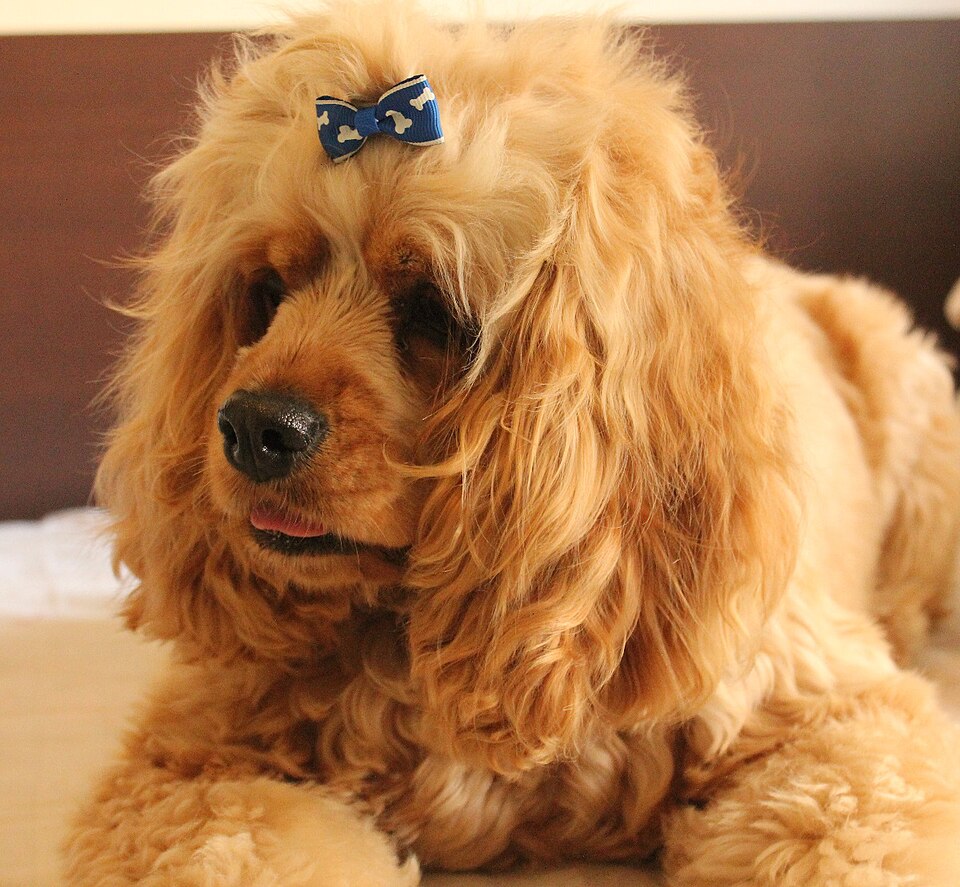
Coco’s long ear hair frames the face. AKS.9955, Wikimedia Commons[4]
If the comb catches, ease it out. Starting at the ends of the hair, tease the tangle loose a little at a time, then comb through. Feel for the edge of the ear flap as you work. The skin there is thin, and pulling hard on the comb can injure it. If a mat sits close to the skin and you can’t loosen it gently, ask a groomer who knows Cockers to take care of it. Bring your own comb to the appointment and ask the groomer to show you how to support the ear and part the coat into layers. That way, you can practice at home with the tool you’ll use between visits. [1]
Bath time gives you a chance to see the skin. As you part the coat, look for redness or inflammation beneath any tangles and contact your veterinarian if you find it. Rinse the shampoo all the way out of the thick coat, since residue can irritate the skin, and use gentle warmth when blow-drying. The ear canal needs care of its own even when the hair on the outside lies smooth. At a veterinary visit, ask for a demonstration of how to clean and dry your dog’s ears, especially after a bath. [1]
If you’re considering a puppy from a breeder, ask to see the hip evaluation and the veterinary ophthalmologist’s report for each parent. Match the dog named on each record to the sire or dam and read each dog’s results. These are the two breeding screenings listed on the AKC breed page. They tell you which checks the parents have had. If your puppy later develops a skin or ear problem, or starts moving differently, your veterinarian can assess the signs the puppy is showing at the time. [1]
Before bringing a Cocker home, think through an ordinary evening around dinner. Who will take the dog for a walk? Once it has rested, who will sit down to part and comb the long hair around its ears, a lock at a time? The person who loves a game of fetch and the one with a steady hand and the patience for grooming can be different members of the family. Making room for both, even on a busy day, gives your Cocker a chance to stretch its legs and get comfortable with the hands that care for its ears.
References
-
[1] American Kennel Club. Cocker Spaniel Dog Breed Information.
-
[2] Matt Batchelor. File:An American Cocker Spaniel.jpg. Wikimedia Commons. Photographed in 2011.
-
[3] Ron Armstrong. File:American Cocker Spaniel agility.jpg. Wikimedia Commons. Photographed in 2007.
-
[4] AKS.9955. File:American Cocker Spaniel Coco.JPG. Wikimedia Commons. Photographed in 2012.