Watch a Clumber Spaniel standing quietly and it is easy to overlook what the dog was bred to do. By the late eighteenth century, the Duke of Newcastle and his gamekeeper were developing the breed at Clumber Park in Nottinghamshire, England, to find game birds hidden in the undergrowth. Hunters needed a dog willing to push deep into the brush and stay with a scent. You can give that same concentration an outlet on an everyday walk. Leave time for a few places where your Clumber can stop and give an intriguing smell its full attention. [1]
Seen from the side, the Clumber has a long body, a deep chest, short, heavy-boned forelegs, and muscular hindquarters. That build helped the dog push through dense brush, and the white coat helped hunters keep it in sight. An adult stands about 17–20 inches (43–51 cm) at the shoulder and weighs about 55–85 pounds (25–39 kg). Look at the front feet, the depth of the chest, and the line of the back in the photograph. Then picture that weight at the other end of a leash. A dog that stands only about knee-high can still take a steady hand when it catches an interesting scent. [1]
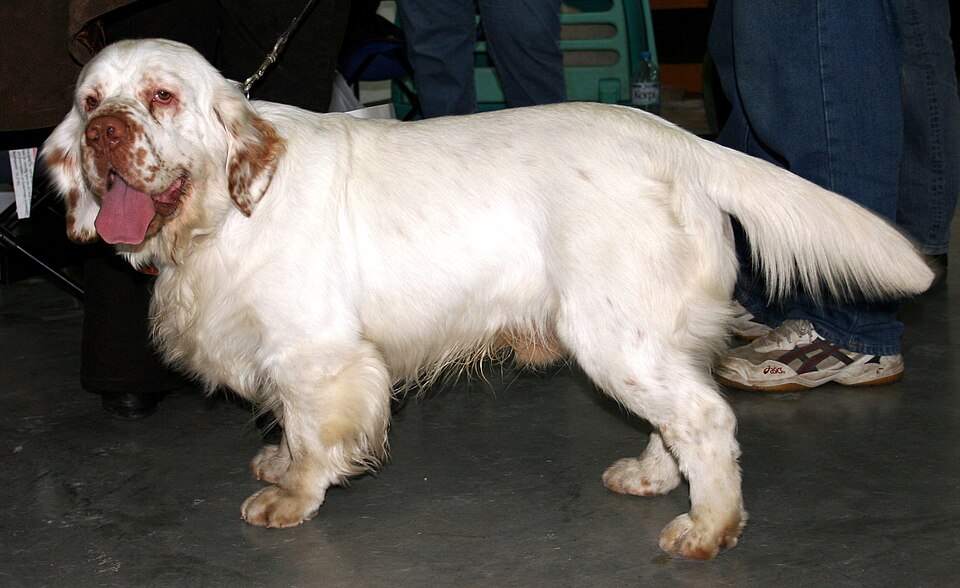
A Clumber Spaniel stands in profile. Pleple2000, Wikimedia Commons[2]

Count sniffing time as part of the walk
The American Kennel Club (AKC) recommends long walks with occasional stops to sniff. Choose a route with room for both. Keep your Clumber close on the leash at crossings and entrances, where you need to move along together. When you reach a quiet strip of grass where it is safe to linger, stop and let the dog follow a scent along the roots. Allowing a little extra time for the same route means you can wait there without watching the clock. For a dog bred to search by scent, that patch of grass is part of what makes the outing worthwhile. [1]
To see how a Clumber would fit into your week, start with an ordinary working day. If the morning allows only a quick trip outside, who can take the dog for an unhurried walk later? Is there a route nearby with places to pause? A fenced yard has its uses, too. Clumbers often enjoy retrieving. Toss a toy, give the dog time to find it and bring it back, and be there to take it for the next throw. The yard provides the space, and you provide the company that keeps the game going. [1]
For distance, start with what the individual dog is used to. If you are bringing home an adult, ask the current caregiver to take you along on a typical walk. Does the dog enjoy a long stretch of steady walking, or stop every few yards to sniff? Given a choice between fetching a toy and exploring the grass, which holds its interest? The answers tell your family more about the time to set aside than a general question about exercise needs. A puppy’s joints are still developing, so keep outings manageable and save the adult dog’s long route for when the youngster has grown. [1]
Teach your Clumber to look up from a scent
Clumbers are patient dogs with minds of their own. Yours may take a moment to act on a cue, especially halfway through investigating a smell. Start in a quiet place with something you will use on walks. Say the dog’s name once. As soon as it turns to look at you, praise it and walk a few steps together. When that becomes familiar, try it at the edge of a grassy area with fewer competing smells. Sometimes, after the dog follows you, let it go back to sniffing. That gives your Clumber a chance to learn that answering you can lead right back to what it was enjoying. [1]
Practice one small task at a time and switch activities after a success to keep the dog interested. Food often matters a great deal to a Clumber. Set aside a small portion of treats before the walk, and have everyone who takes a turn with the leash draw from that same portion. A Clumber already has a substantial frame, and its legs and joints must carry any extra weight it gains. Counting treats as part of the day’s food is easier when the whole family can see what is left. [1]
Look under those ears when you get home
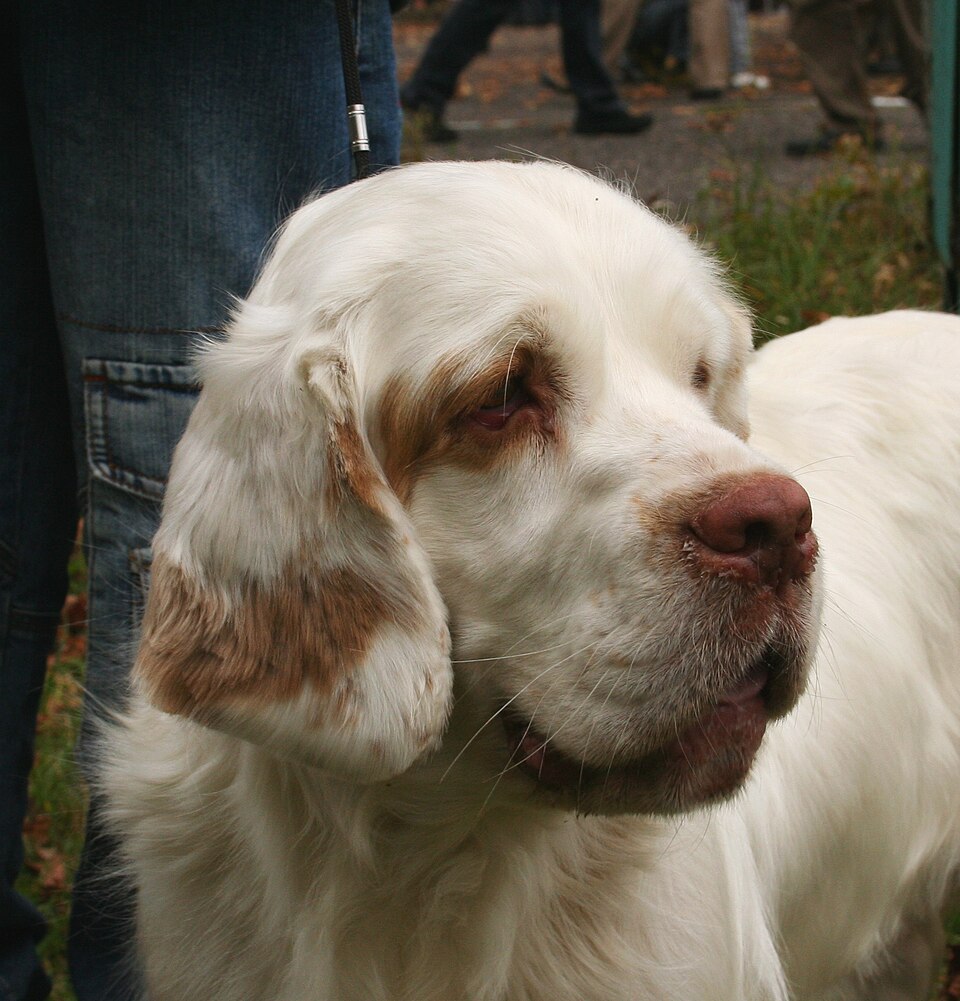
The Clumber’s ears hang close to its cheeks. Pleple2000, Wikimedia Commons[3]

In the close-up, you can see the broad, deep muzzle and the ears, which are set roughly level with the eyes and hang against the cheeks. These heavy, low-set ears need regular cleaning. When you take off the leash at home, lift each ear flap for a look and check the folds of skin on the face. Wipe the folds with a slightly damp cloth, then gently blot them dry. If your Clumber drools, a quick wipe around the mouth can leave moisture behind. Use a dry corner of the cloth to reach inside each fold. [1]
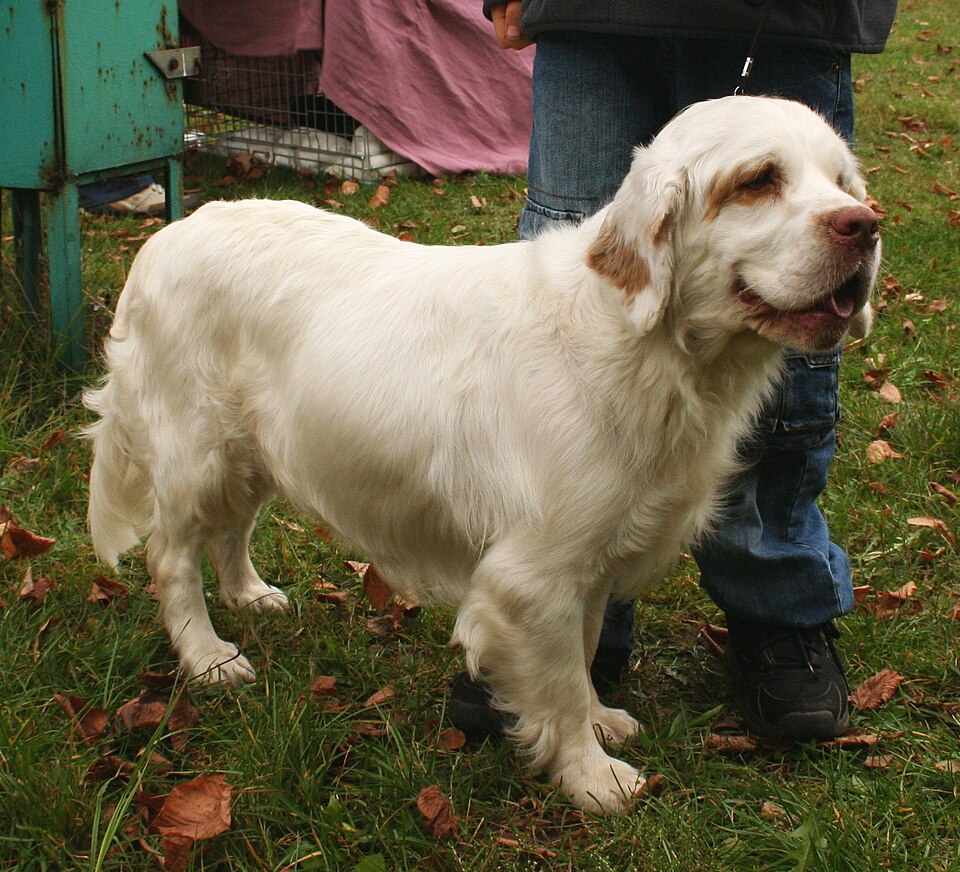
Feathering fringes the Clumber’s legs and belly. Pleple2000, Wikimedia Commons[4]

The photograph of the dog on grass shows where to start grooming. The white coat lies flat along the back, then grows longer on the chest, behind the legs, and under the belly. After a walk, pick bits of grass from the hair closest to the ground. Gently lift each front leg to see the hair hidden when the dog is standing. Once or twice a week, brush through the dense coat, then work a medium-toothed comb through the longer feathering. Clumbers shed and generally need little trimming. For a family dog, a bath about once a month is usually enough. That is also a convenient time to check the nails and trim them as needed. [1]
A walk also gives you a chance to learn how your Clumber normally moves. The breed is at risk for hip dysplasia, and its long back makes disc disease in the neck and chest regions of the spine a concern. If a dog that usually enjoys searching along the path starts limping repeatedly, or a familiar movement now seems painful, stop the activity and tell your veterinarian what has changed. If you are considering a puppy, ask the breeder for both parents’ hip, elbow, and eye evaluation results, along with their DNA test results for PDP1 deficiency. You can ask to see those records before you bring a puppy home. [1]
Picture a rainy workday. Is someone in your household happy to take a dog of this size outside, wait while it finishes sniffing a grassy verge, then come home to dry its face and comb the damp hair under its belly? If those small tasks sound like part of the pleasure of having a dog, there may be room in your life for both the determined searcher you meet outdoors and the gentle companion who comes home with you. [1]
References
-
[1] American Kennel Club. Clumber Spaniel Dog Breed Information.
-
[2] Pleple2000. File:Clumber spaniel 767.jpg. Wikimedia Commons.
-
[3] Pleple2000. File:Clumber spaniel glowa rybnik-kamien ppl.jpg. Wikimedia Commons.
-
[4] Pleple2000. File:Clumber spaniel rybnik kamien pppl.jpg. Wikimedia Commons.