Height is the first thing most people notice about an Irish Wolfhound standing in profile. Look again and you can see what makes this a running hound. Behind the deep chest, the belly sweeps upward. The legs are long and the thighs powerfully muscled. The Irish Wolfhound is a sighthound, bred to spot and pursue game. In Ireland these dogs hunted large animals, and by the 15th century they were known for hunting wolves. The same hound that lies quietly beside you at home may give chase the moment a small animal breaks into a run. [1][2]
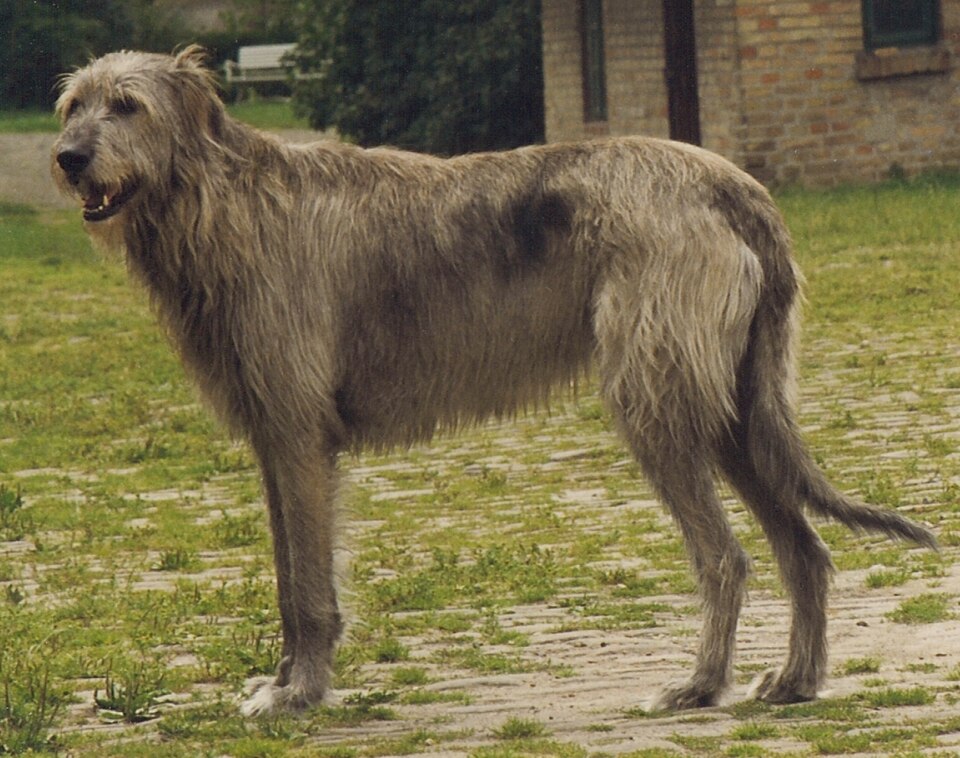
Sam is eight years old. Tirwhan, Wikimedia Commons[5]

Sam’s photograph shows where to measure a hound’s height. Follow the front leg up to the top of the shoulder. For dogs over 18 months old, the American Kennel Club (AKC) breed standard sets a minimum height there of 32 inches (about 81 cm) for males and 30 inches (about 76 cm) for females. At home, what’s easy to misjudge is the dog’s age. An Irish Wolfhound can take 18 months or longer to mature. A dog already big enough to knock over a toddler may still be a puppy who needs an adult to choose where and with whom it plays. [1][2]
Let the puppy decide when play is over
When choosing an activity for a puppy, ask one question first. Can the puppy slow down or stop the moment it wants to? On a fenced patch of grass with a pup of similar age and pace, it can run a few strides, turn aside to sniff, then decide whether to play some more. On a jog along a road, even at an easy pace, the person chooses how far to go and when to turn back. Writing for the Irish Wolfhound Club of America, veterinarian Mel Mercer favors free play with other puppies. She advises against running a pup alongside a bicycle, coaxing it through a long leash walk, or letting an adult wolfhound draw it into a prolonged chase. [3]
Even on the same patch of grass, a change in the game can change how hard the puppy works. When it trots back to you and starts sniffing around, put the toy away and let the game end there. If a dog beyond the fence keeps racing back and forth and your puppy follows it on every pass, lead the pup to a quieter part of the yard. A few steps outside the front door can be a leash lesson of their own. Reward the puppy while the leash hangs loose, then head back inside. There’s no need to cover the family’s usual brisk walking route to practice walking together. [1][3]
Before the puppy can set its own pace, someone has to choose a safe place for it to run. An Irish Wolfhound needs room to move inside a secure physical fence. Walk the perimeter and check the gate in particular. Does it latch when someone comes in from the yard? The breed club stresses the importance of a fence a sighthound can see. An electronic boundary also leaves other animals free to enter. Outside the fence, keep the hound on a leash, even in an open field with a clear view. A dog bred to scan the distance may spot movement at the far edge of the grass before the person holding the leash does. [1][2]
Practice household routines while the hound is young
In the first few months at home, practice the things you’ll still want the dog to do every day when fully grown. When you bring out the leash, wait for all four paws to be on the floor before clipping it on. When someone comes through the door, reward the pup for waiting to one side. In a quiet new place, give it time to look around before encouraging it to walk on with you. The AKC recommends early socialization and a reward-based puppy class. Ask how the class handles puppies of different sizes and speeds. For a long-legged youngster, taking a few relaxed steps while people and dogs come and go is already worth rewarding. [1][3]
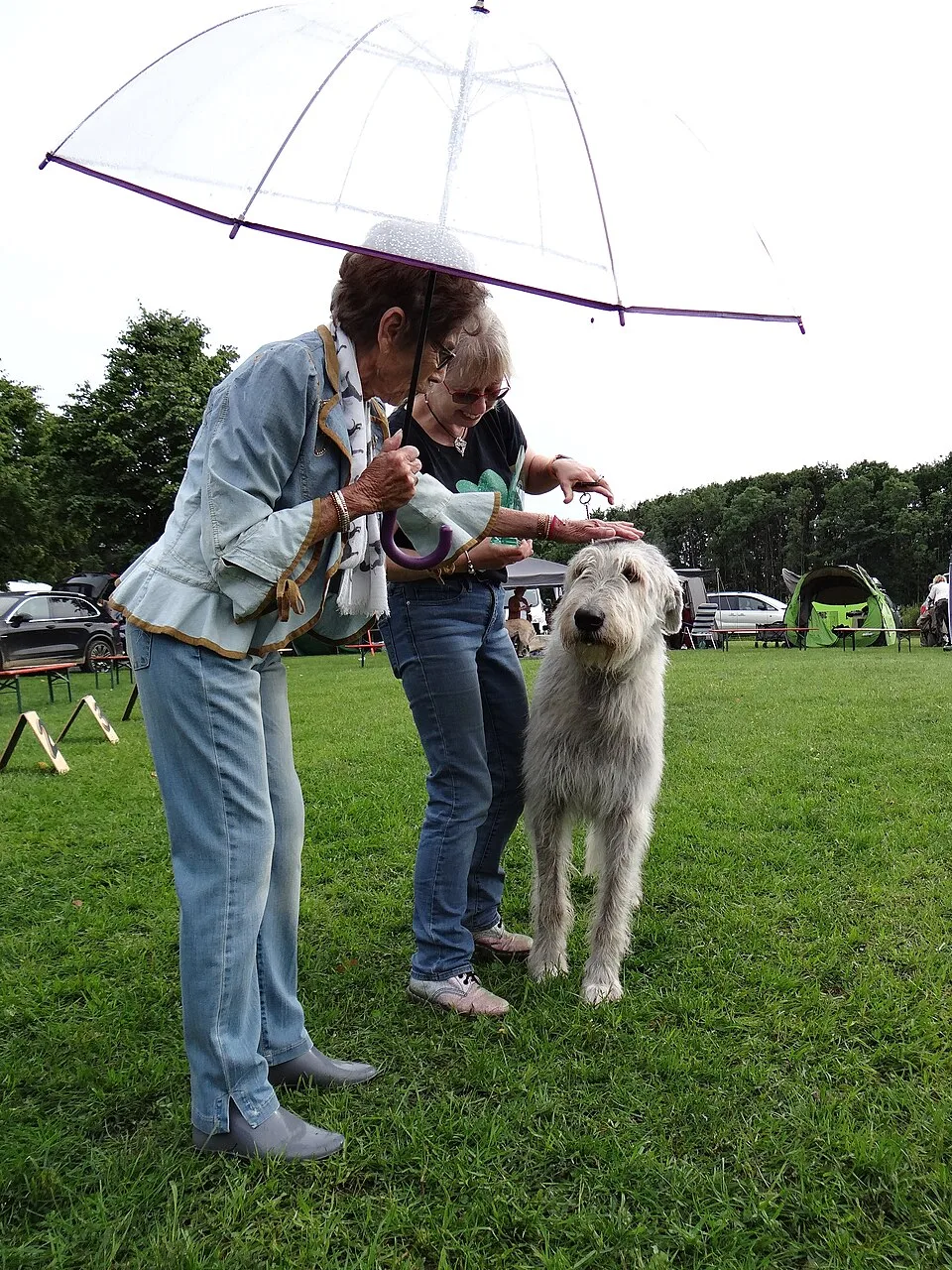
An Irish Wolfhound stands beside the judge. Anne Jea., Wikimedia Commons[6]

In the photograph, an adult bends only slightly to reach the top of the hound’s head. Picture a dog that size on the way from your front door to its bed. Can someone get past while the hound turns around? Once it lies down, can a child walk around it? Irish Wolfhounds are generally gentle with people, but a happy dog turning to greet someone can knock a small child off balance. An adult should supervise when a hound and a young child are together. If you have a cat or rabbit, allow room to keep the animals apart. Some hounds live comfortably with a familiar cat. Others give chase when a cat runs. Let the individual dog’s response guide introductions. [1][2]
Now picture an ordinary workday. Who can take the puppy outside during the day, and who will be there for the evening walk? Those questions matter more often than where the family might hike on a weekend. Irish Wolfhounds enjoy being with their people. A puppy left alone for a long stretch may chew things up or even hurt itself. The yard gives it space to move, and time indoors with the family should be part of the day too. As the hound matures, you can gradually work up to longer walks together or play in a fenced area. An adult may happily stretch out beside you on the sofa, so it still falls to the family to make regular outings happen. [1][2]
Make time for routine care
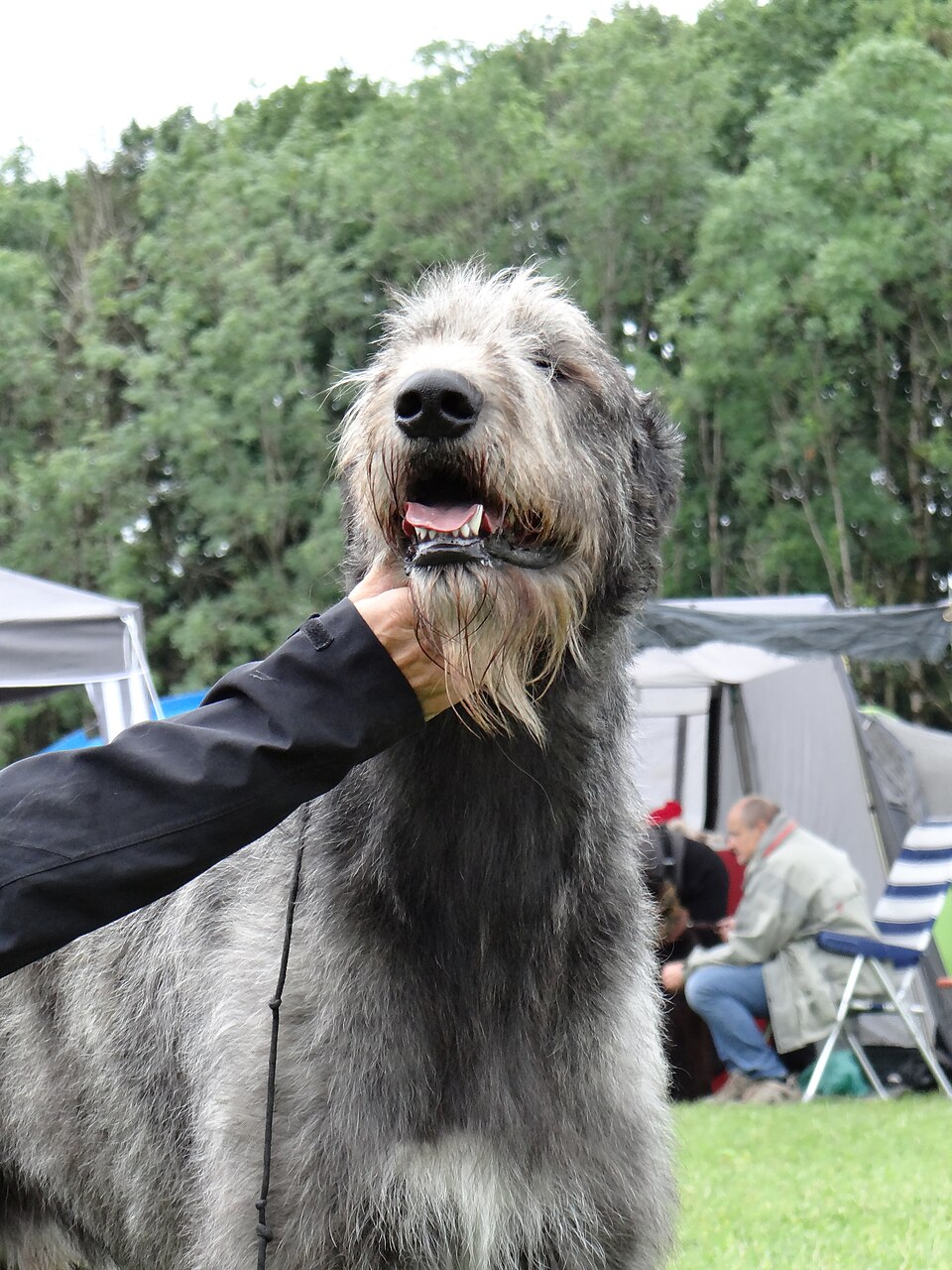
Nero shows the breed’s long brows and beard. Anne Jea., Wikimedia Commons[7]

Look closely at Nero and you can see the especially long hair over his eyes and under his jaw, two easy features to pick out on an Irish Wolfhound. A rough, wiry outer coat covers a softer undercoat. The breed sheds some hair throughout the year, usually without a heavy seasonal shed. Set aside time once a week to brush the whole coat and lift out loose hair and dirt. While you’re there, check the paws. Trim the nails regularly, since overgrown nails can make putting a foot down painful even on an ordinary walk. [1]
The deep chest you can see in profile also matters when planning the day. Deep-chested dogs are at risk of gastric dilatation-volvulus, a condition in which the stomach swells and twists. The AKC advises scheduling vigorous activity away from the times just before and after meals. One sign everyone in the household should recognize is a dog repeatedly trying to vomit without bringing anything up. Restlessness, drooling or a swollen abdomen can also occur. If you suspect this condition, go to an emergency veterinarian immediately. Before bringing a puppy home, check that your vehicle can carry a full-grown hound and save the emergency clinic’s address. [1][4]
Long-term care has a timetable too. When asking a breeder about a puppy’s family history, ask to see the parents’ heart, hip, elbow and eye screening records. Once the dog is home, the AKC recommends a yearly veterinary examination, ideally with a veterinarian familiar with sighthounds, and an electrocardiogram as part of that visit. To picture the space an Irish Wolfhound will take up in family life, think beyond its height. Can you give a puppy room to end a game when it chooses, make time for a daily walk with the adult, and get a giant hound to its checkup each year? [1]
References
-
[1] American Kennel Club. Irish Wolfhound Dog Breed Information.
-
[2] Irish Wolfhound Club of America. Irish Wolfhound Frequently Asked Questions.
-
[3] Mel Mercer. How Much Exercise Is Appropriate For a Young Irish Wolfhound? First published in Harp & Hound, Autumn 2014.
-
[4] American College of Veterinary Surgeons. Gastric Dilatation-Volvulus.
-
[5] Tirwhan. File:Irish Wolfhound Sam.jpg. Wikimedia Commons.
-
[6] Anne Jea. File:J.K. Rowling of Kirld Ground Castle 04.jpg. Wikimedia Commons.
-
[7] Anne Jea. File:Castlekeep's Nero for Kilmara 02.jpg. Wikimedia Commons.