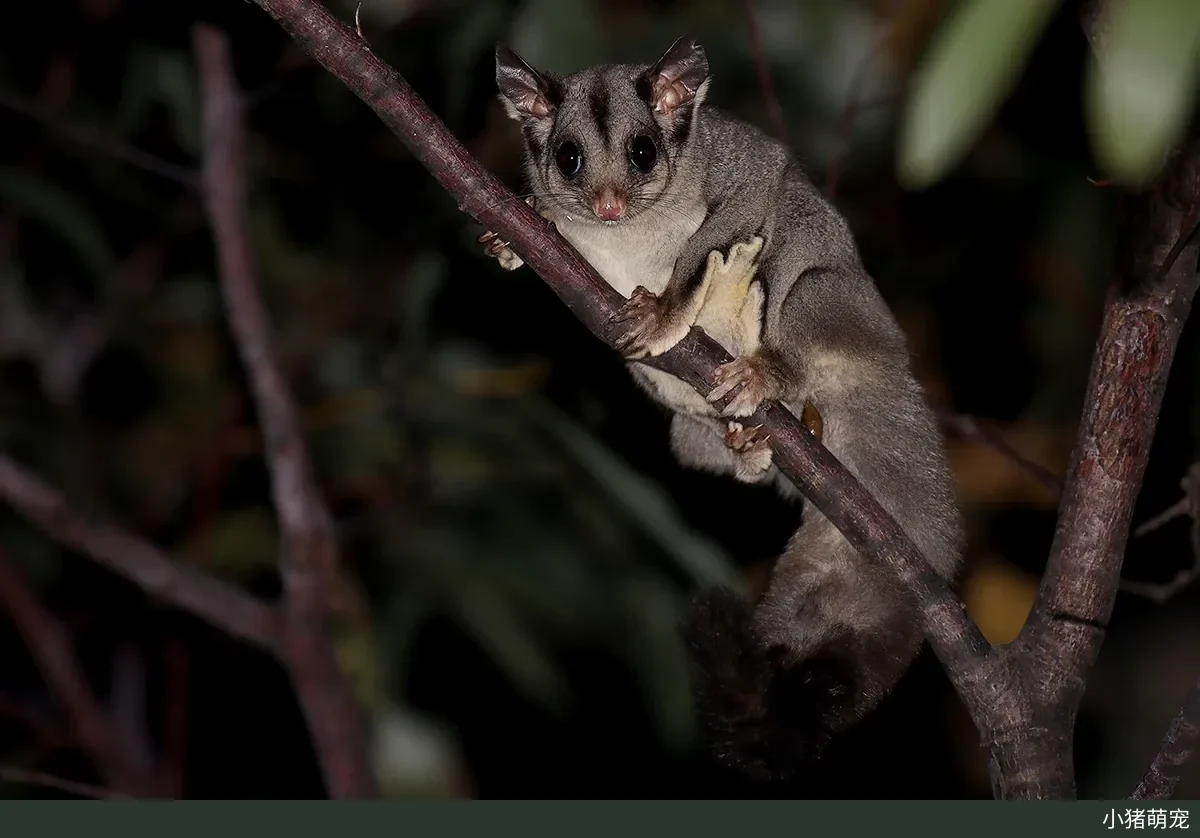
At night, a sugar glider climbs on a branch (photographed 5 September 2016 in Australia). Photo: Patrick Kavanagh; source: Wikimedia Commons; license: CC BY 2.0.

The sugar glider is a nocturnal, arboreal, social small marsupial that glides between trees on a membrane stretching from forelimb to hindlimb; adults weigh only 80–160 g. It needs a tall enclosure, companion animals, and a wild diet that is hard to reproduce at home—poor feeding readily leads to bone and dental disease. Drawing on veterinary manuals and conservation and regulatory sources, this article covers habits, husbandry, health issues, and legal and ethical points.
Natural habits and shifting taxonomy
Many people assume sugar gliders are rodents; they are marsupials like kangaroos and koalas, in the family Petauridae, genus Petaurus. The Merck Veterinary Manual notes they are native to eucalypt and acacia forests in Australia, Indonesia, and New Guinea; a gliding membrane runs from the wrist of the forelimb to the ankle of the hindlimb, and when spread they can glide up to about 50 meters, with the fluffy long tail acting as a rudder for steering. Adult females weigh about 80–135 g and males about 100–160 g; captive lifespan records range from 4–15 years.
Sugar gliders are nocturnal: they sleep in tree hollows by day and forage at night. They live in groups; the Merck Manual records group sizes of 5–12 animals, typically one dominant male, several subordinate males, and several females; the Australian Museum describes up to seven adults plus young sharing a nest. Group members mark one another and territory with scent-gland secretions, and drive off individuals from other groups loudly and aggressively.
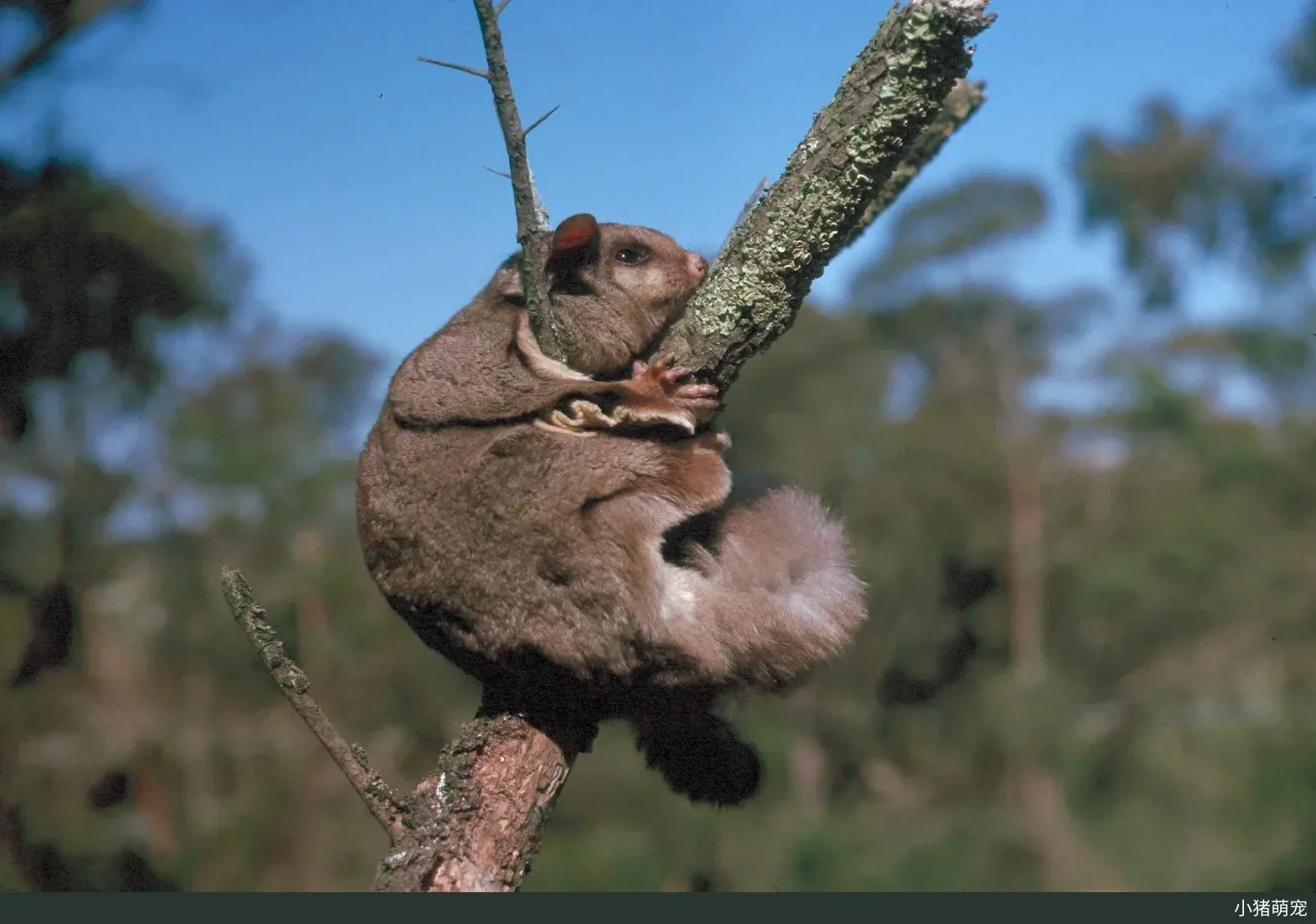
A sugar glider clinging tightly to a tree trunk, remastered from a 35 mm color slide shot in October 1964. Photo: Warren Garst; courtesy: Colorado State University Libraries; source: Wikimedia Commons; license: CC BY-SA 4.0.

Females have a pouch with four teats; most litters are twins. Gestation is only about 15–17 days; newborns weigh about 0.2 g, crawl into the pouch to continue development, leave the pouch after about two months, and wean at about 100 days.
What “sugar glider” refers to has also been shifting. In 2021, Cremona and colleagues split the Australian animals formerly lumped as Petaurus breviceps into three species: sugar glider sensu stricto P. breviceps (restricted to the seaward side of Australia’s eastern Great Dividing Range), Krefft’s glider P. notatus, and savanna glider P. ariel. A December 2025 study in Scientific Reports analyzed 76 samples from European zoos and private breeders and concluded that European and North American captive stock descend from a New Guinea lineage, proposing assignment to P. papuanus. Which species pet-trade “sugar gliders” belong to is still under study; this article uses the common name as in veterinary and husbandry materials.
Housing and diet
Before bringing sugar gliders home, decide how many to keep. Wild sugar gliders depend on groups; the Merck Veterinary Manual recommends keeping them in pairs or small groups. A solitary animal needs heavy owner companionship and enrichment, or stress can lead to overgrooming, self-mutilation, and similar problems. Remember their schedule is the opposite of yours: when you come home wanting to play, they may still be asleep; when they are most active, you are probably already in bed.
The cage must be tall and spacious. The manual’s minimum is 90×60×90 cm—larger is better; bar spacing should not exceed 1.25 cm so heads and feet do not get caught; horizontal bars are preferred because vertical bars are harder to climb. Do not use galvanized wire cages—chewing can cause heavy-metal poisoning; PVC-coated stainless cages have also been linked to poisoning after chewing, and the manual advises against them. Place a wooden bird nest box or fabric sleeping pouch high in the cage, plus branches, horizontal platforms, bird swings, and chew toys; choose exercise wheels with smooth interiors to avoid pinching toes. Cage flooring can be newspaper or recycled paper that is nontoxic if ingested; replace fabric pouches as soon as they fray.
For temperature, the Merck Manual lists a thermoneutral zone (the range where no extra energy is needed to maintain body temperature) of 27–31°C; WWF suggests ambient temperatures of 75–90°F (about 24–32°C) and avoiding direct strong light.
Diet is the hardest part of sugar glider care. In the wild they eat sugary secretions such as tree gums, sap, nectar, honeydew, and pollen, then take invertebrates for protein; they have a well-developed cecum and rely on bacterial fermentation to digest complex polysaccharides in gums. That diet is hard to copy at home; the Merck Manual states plainly that among captive diets studied so far, none has been shown to be ideal.
One reference scheme in the manual is: nectar or sap substitutes about half—sugar-glider nectar powders, products containing gum arabic, or fructose, sucrose, glucose, maple syrup, or honey water diluted to 10%; the other half calcium-dusted insects (crickets, mealworms, waxworms, cockroaches, moths, and so on) and sugar-glider pellets, with eggs or lean meat as optional protein; fruit, nuts, and vegetables together should not exceed 10%. If the staple is not fortified, sprinkle a calcium-containing vitamin–mineral supplement on food daily. Research on commercial pellets is limited, so nutrition may not be balanced. Feed in the evening with bowls on high platforms, because sugar gliders feel safer eating up high.
By analogy: a daily plate of cut fruit looks healthy, but for a sugar glider it is closer to drinking sugar water every day. Fruit is high in sugar and low in calcium and protein; too much readily causes periodontal disease and nutrient deficiencies, and the bone disease in the next section often starts there.
Common health problems
The Merck Veterinary Manual notes that with proper care, sugar gliders in captivity are usually quite hardy; many common illnesses, however, are linked to feeding. The categories below deserve the most attention.
Nutritional bone disease: diets long dominated by fruit with too little insect protein unbalance calcium, phosphorus, and vitamin D, leading to nutritional secondary hyperparathyroidism. Typical signs are progressive hind-limb weakness up to paralysis, muscle tremors, pathologic fractures, and in severe cases seizures. Treatment includes activity restriction, calcium and vitamin D3 supplementation, assisted feeding, and diet correction, but severe skeletal deformity (especially of the spine) may be irreversible.
Dental disease: sugar glider teeth do not grow continuously like those of hamsters and other rodents, so they do not need trimming; soft, sweet foods, however, readily cause tartar and periodontal disease that can progress to root abscesses and even spread behind the eye. Offering insects with harder exoskeletons in the diet helps reduce tartar.
Obesity and iron storage: high-fat, high-protein treats plus little chance to exercise make sugar gliders prone to obesity. The manual also notes reports of iron-storage disease in captive animals, with excess iron deposited in organs such as the liver and spleen; without early detection and treatment it can be fatal.
Behavioral problems and self-mutilation: when kept alone, mismatched with companions, or housed poorly, sugar gliders may chew their own fur and skin, pace stereotypically, or become aggressive; anxious animals often overgroom, with hair loss especially clear at the base of the tail. Sexually mature males without access to females may bite their own tail base, limbs, or genitals. When these signs appear, have a veterinarian rule out pain and other physical causes first.
Infection and zoonoses: toxoplasmosis is serious in marsupials, often presenting with neurologic signs or sudden death; oocysts in cat feces are one infection source—if you also keep cats, keep cat feces away from sugar glider bedding and food. Salmonella, Giardia, Leptospira, Toxoplasma, and similar pathogens can also pass between sugar gliders and people; the manual advises treating ocular, nasal, digestive, and urogenital secretions as potential infectious material.
Illness in sugar gliders is often nonspecific; the easiest signs to notice are lethargy, reduced appetite, and weight loss. Find an exotic-pet veterinarian before bringing one home; the manual also recommends annual fecal parasite checks.
Conservation status, law, and ethics
International status: a Species+ query on 17 October 2026 showed that genus Petaurus is not listed on the CITES Appendices, so international trade does not require a CITES permit. The IUCN Red List 2016 assessment listed the sugar glider as Least Concern (LC), but that assessment predates the 2021 taxonomic split; the IUCN SSC Australasian Marsupial and Monotreme Specialist Group’s 2021 report already listed sugar gliders among species needing reassessment under the new taxonomy. After the split, ranges of sugar glider sensu stricto and savanna glider are both clearly smaller; Cremona and colleagues argue this has important conservation implications for the relevant species.
In Australia: the Department of Climate Change, Energy, the Environment and Water (DCCEEW) states that regardless of CITES status, live native mammals may not be exported for commercial purposes; only six bird species may leave the country as household pets. In other words, the international pet market cannot lawfully obtain sugar gliders from Australia by commercial export. WWF notes that U.S. market animals often come from Indonesia, with some locally captive-bred individuals as well.
Domestic rules in China: sugar gliders are not a native species. Article 40 of the current Wildlife Protection Law (revised December 2022, in force 1 May 2023) requires that introducing wildlife species from abroad be approved by the State Council wildlife protection authority, that entry into the wild be prevented, and that unlawful release or abandonment be forbidden; under Article 59, releasing or abandoning introduced wildlife can bring an order to recapture within a deadline plus a fine of 10,000–100,000 yuan. Separately, Ministry of Agriculture and Rural Affairs and General Administration of Customs Announcement No. 470 (issued 20 October 2021) places all live mammals other than dogs and cats on the list of items prohibited from personal carriage or mail entry, except those pre-approved by the competent authority and accompanied by an official quarantine certificate from the exporting country or region—so bringing sugar gliders into China via “overseas shopping agents” or international express is not workable.
Note that this article checked national law and customs lists. Whether keeping or selling sugar gliders domestically needs separate local permits, and the import or breeding origin of animals on the market, has not been clearly stated in official materials we reviewed; rules may differ by locality. Before buying, consult the local forestry and grassland authority and ask the seller for proof of lawful origin.
Ethical reminder: in its responsible-pet guide, the World Wildlife Fund (WWF) rates sugar gliders’ conservation risk as “low” but animal-welfare risk as “high,” because housing, diet, and social needs are hard to meet over a lifetime, an ideal captive diet is still unclear, and nutritional disease is very common; WWF also notes that wild-caught animals carry higher conservation and zoonotic risks. Before deciding to keep them, ask yourself: can you care for at least two at once, and stay with them for a life that may last more than a decade? Is there an exotic-pet veterinarian nearby? Can you accept night activity and daytime sleep? If you are not sure, learning more and waiting before bringing them home is also responsible. In any case, never release or abandon them.
References
-
Dewey A. Overview of Sugar Gliders. Merck Veterinary Manual, comprehensively reviewed February 2025, updated November 2025. https://www.merckvetmanual.com/exotic-and-laboratory-animals/sugar-gliders/overview-of-sugar-gliders
-
Dewey A. Diseases and Syndromes of Sugar Gliders. Merck Veterinary Manual, comprehensively reviewed February 2025, updated December 2025. https://www.merckvetmanual.com/exotic-and-laboratory-animals/sugar-gliders/diseases-and-syndromes-of-sugar-gliders
-
Australian Museum. Sugar Glider. https://australian.museum/learn/animals/mammals/sugar-glider/
-
Cremona T. et al. Integrative taxonomic investigation of Petaurus breviceps (Marsupialia: Petauridae) reveals three distinct species. Zoological Journal of the Linnean Society, 2021, 191(2): 503–527. https://doi.org/10.1093/zoolinnean/zlaa060
-
Mulko M., Schneiderová I., Černá Bolfíková B. Taxonomic reassessment of captive sugar gliders using genetic analyses and complementary acoustic data. Scientific Reports, 2025-12-21. https://www.nature.com/articles/s41598-025-31262-0
-
UNEP-WCMC / CITES. Species+: Petauridae, queried 2026-10-17. https://speciesplus.net/#/taxon_concepts/516/legal
-
Salas L. et al. Petaurus breviceps. The IUCN Red List of Threatened Species 2016: e.T16731A21959798. https://doi.org/10.2305/IUCN.UK.2016-2.RLTS.T16731A21959798.en
-
IUCN SSC Australasian Marsupial and Monotreme Specialist Group. 2021 Report. https://iucn.org/sites/default/files/2023-09/2021-iucn-ssc-australasian-marsupial-and-monotreme-sg-report_publication.pdf
-
Australian Government DCCEEW. Do I need a permit?. https://www.dcceew.gov.au/environment/wildlife-trade/do-i-need-permit
-
Wildlife Protection Law of the People’s Republic of China (second revision 30 December 2022, in force 1 May 2023), Ministry of Ecology and Environment website. https://www.mee.gov.cn/ywgz/fgbz/fl/202302/t20230220_1016885.shtml
-
Ministry of Agriculture and Rural Affairs and General Administration of Customs Announcement No. 470 (20 October 2021), Beijing Customs website. http://gdfs.customs.gov.cn/beijing_customs/2023-10/20/article_2026060600490623867.html
-
World Wildlife Fund. Sugar glider – Responsible Pet Guide. https://www.worldwildlife.org/our-work/wildlife/wildlife-crime/responsible-pet-guide/assessed-exotic-species/sugar-glider/