A smoke Asian Shorthair lying still can look dark all over. When it gets up and turns, the coat parts across its shoulders and back, revealing silver-white or nearly white roots. Under Britain’s Governing Council of the Cat Fancy (GCCF), that cat can belong to the same Asian group as the Burmilla pictured here, with its darker back and pale underside. When choosing a brush, ask how long the coat is, how the cat is used to being brushed, and where it welcomes a touch. Shorthaired members of different colours can start with the same grooming routine. [1]
The Asian Shorthair in the breed registers
Asian Shorthair is a pedigree name with a particular breeding history. In the GCCF register, start with the group name, Asian. Its shorthaired members include selfs (solid colours) and tortoiseshells, smokes, shaded cats and tabbies. The shaded variety is called the Burmilla. The group also has a semi-longhaired member, the Tiffanie. A short coat and a birthplace in Asia, on their own, do not establish that a cat belongs to this group. [1]
How did cats with a Burmese build come to have so many different coats? The GCCF traces the group to a litter born to a male Chinchilla Persian and a lilac Burmese female. Breeders preserved the silver-tipped appearance of the early cats and bred back to Burmese cats to retain their head and body shape. Those early Burmillas formed the foundation of the Asian group, which came to include more colours and two coat lengths. By 2003, all five varieties had attained GCCF championship status. [1]
The International Cat Association (TICA) uses different categories. Its June 2026 Standing Rules list the Asian Shorthair as Registration Only (RE), with the breed code ANS. The championship list has separate entries for the shorthaired Burmilla (BM) and the Burmilla Longhair (BML). If a cat is described as registered, ask to see the association’s name and the full breed name on its papers. ANS on TICA papers identifies the Asian Shorthair entry. If GCCF papers say Asian, look for the variety within that group. [1][2]
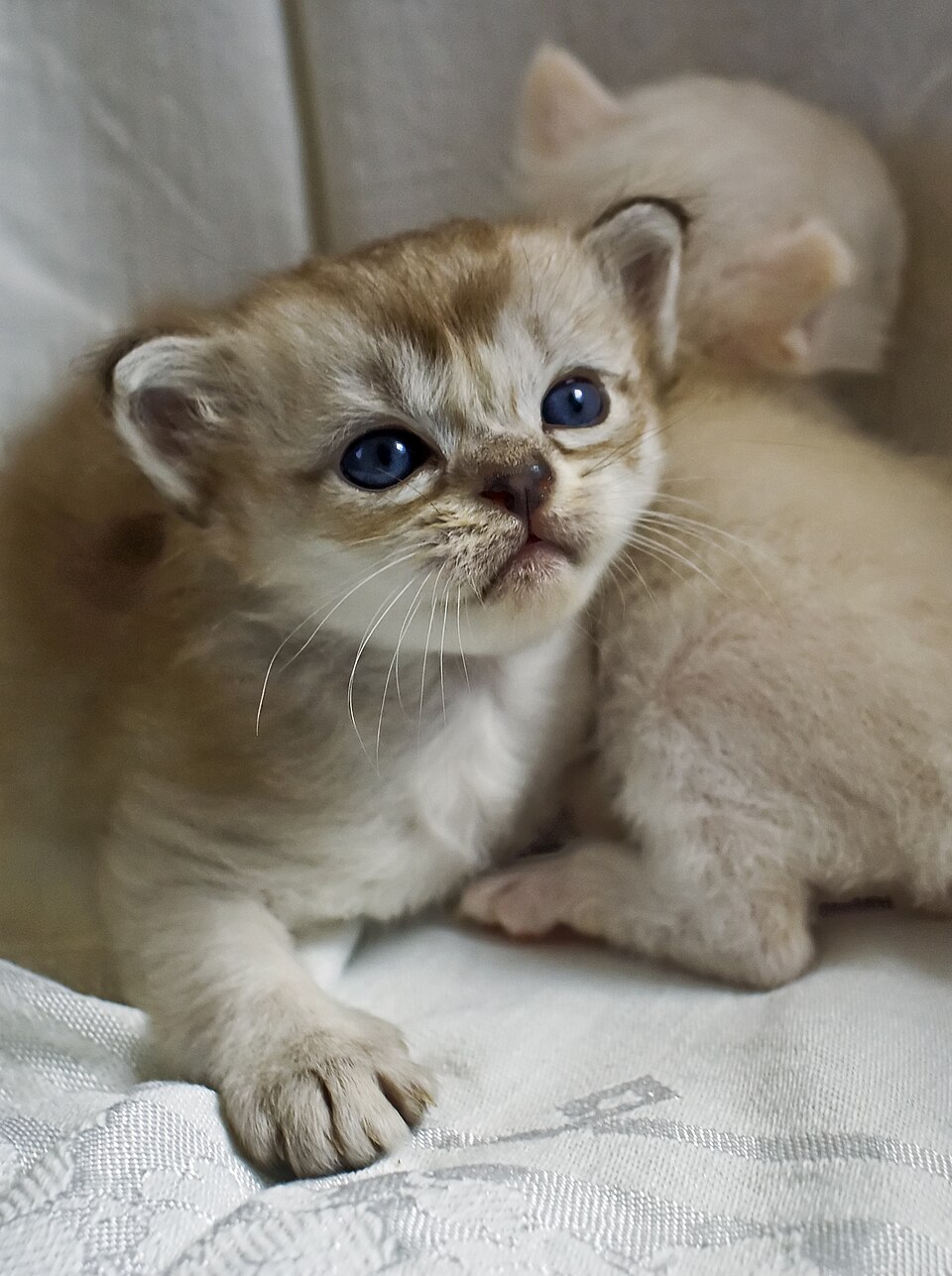
This Burmilla kitten has a shaded short coat. Neil H, Wikimedia Commons[6]

Brushing the short coat
To recognise the GCCF type, start with the outline. The Asian is a medium-sized cat with a broad, rounded chest and a neat, muscular body. When the cat stands, look for relatively slender legs, oval paws and a tail that tapers towards the tip. The head narrows from between the ears to the muzzle, forming a short, broad wedge with a blunt, rounded end. These proportions run through the group. The coat over that frame can show deeper shading along the back, distinct spots, narrow stripes or swirls. [1]
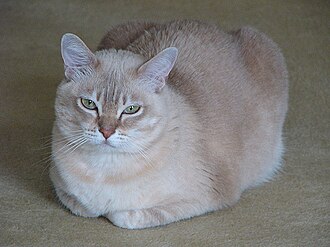
The coat follows the Burmilla’s shoulder line. John Turner, Wikimedia Commons[7]

Shorthaired Asians have fine, glossy coats. The GCCF recommends weekly brushing for the shorthaired varieties, with the same schedule for smokes, shaded cats and tabbies. When you collect your cat, ask its previous carer to demonstrate a few strokes with a familiar brush. Notice where the cat is happy to be brushed. At home, start there, brush gently in the direction the hair grows, and leave the cat free to walk away. If brushing a smoke reveals pale roots, you are seeing the natural layers of colour. There is no need to keep brushing that spot to even out the shade. The semi-longhaired Tiffanie takes more grooming time, with longer furnishings along its flanks and a plumed tail. [1][3]
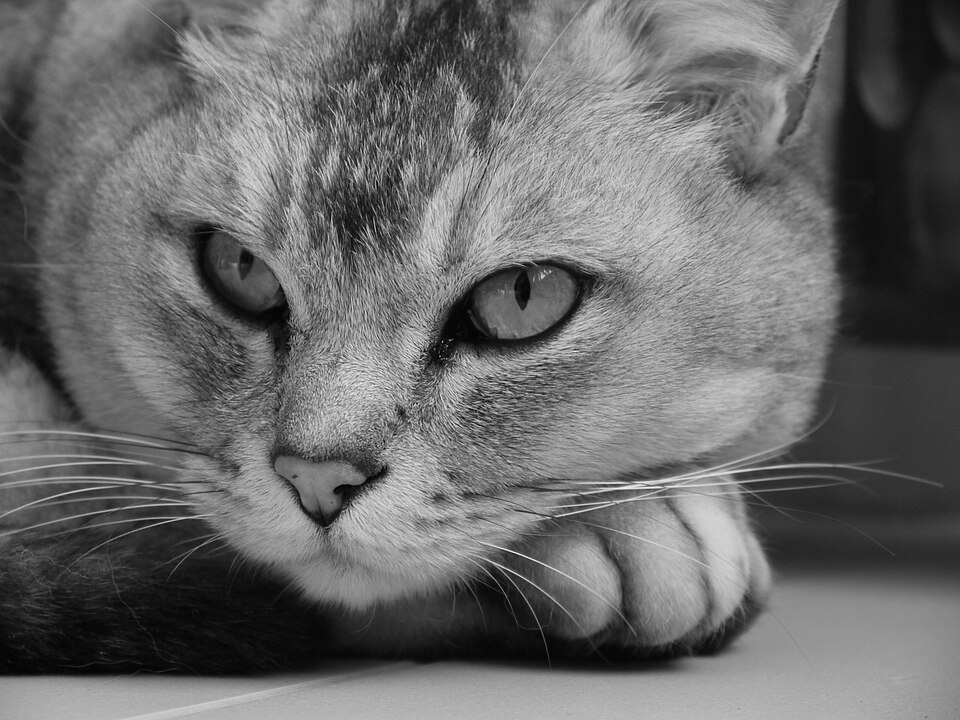
The Burmilla has a short, broad muzzle. Austinminers, Wikimedia Commons[8]

Giving the cat choices at home
The GCCF describes Asians as typically active, curious and interested in company. Give your cat a place to watch from, then invite it to play. Draw a wand toy along the floor past the edge of a cardboard box and pause. The cat can stay crouched and watch, follow the toy or pounce and catch it. If it walks away, let the game end. The same approach works for brushing and stroking. Offer a familiar invitation and give the cat room to approach or leave. Its response tells the family how to approach it next time. [1][3]
The Feline Veterinary Medical Association identifies five needs for an indoor cat: a safe retreat, resources in separate places, opportunities to chase and catch, predictable interactions with people, and a familiar sensory environment. To see how a room works for your cat, start at its hiding place and walk the routes to water, food and the litter tray. In a home with two cats, each might have its own bowl, yet if both bowls sit at the end of one narrow passage, a cat resting at the entrance can block the other’s way. Spread resources across different locations and give each cat somewhere quiet to rest. When moving house, put a cushion the cat already sleeps on in its new bed so it has a familiar scent there. [3]
What can family test records tell you about inherited hypokalaemia?
When bringing home an Asian Shorthair, ask about inherited hypokalaemia, a condition involving low blood potassium. The GCCF records that since 2018, Asians intended for breeding must meet its testing requirements for entry on the Active Register. When reading a report, identify the cat that was tested, then check the test name and result. The UC Davis Veterinary Genetics Laboratory tests for a WNK4 variant associated with the condition. N/N means the laboratory found no copy of the variant in that cat. N/BHK means the cat carries one copy. The parents’ results can help explain the risk from a particular mating. Keep each report with the tested cat’s name so that your vet can see whose result it is. [1][4]
Burmese ancestry alone cannot give you a probability that an individual Asian Shorthair will develop the condition. The study that identified the variant compared affected and unaffected cats primarily within the Burmese breed. A separate analysis estimated the variant’s frequency in a pooled sample that included Asians, Burmese and Burmillas. That figure describes how often the variant appeared in the sample. It cannot tell you how likely an Asian Shorthair is to become ill today. At home, watch for changes in how your cat moves. If it becomes noticeably weak, struggles to walk or has trouble lifting its head while awake, contact a vet promptly. Note when the change began and take along any test records you have. [4][5]
References
-
[1] The Governing Council of the Cat Fancy. Asian.
-
[2] The International Cat Association. Standing Rules, Version C, 3 June 2026. Section 701.4.
-
[3] Feline Veterinary Medical Association. New Feline Veterinary Medical Association Position Statement Reimagines Life for Indoor Cats. 28 August 2025.
-
[4] UC Davis Veterinary Genetics Laboratory. Burmese Hypokalemia.
-
[5] Gandolfi B, et al. First WNK4-Hypokalemia Animal Model Identified by Genome-Wide Association in Burmese Cats. PLOS ONE. 2012, 7(12), e53173.