The World Cat Federation (WCF) lists the shorthaired Ural Rex as Ural Rex SH, with the code URX. The word “curly” can be misleading if it brings ringlets to mind. In the WCF description, the coat is short, fine and dense, and its springy waves can lie quite flat. They follow the contours of the body and extend along the tail. Get to know how those rows of waves usually lie on your cat, and it becomes easier to tell where a comb is needed.[1]
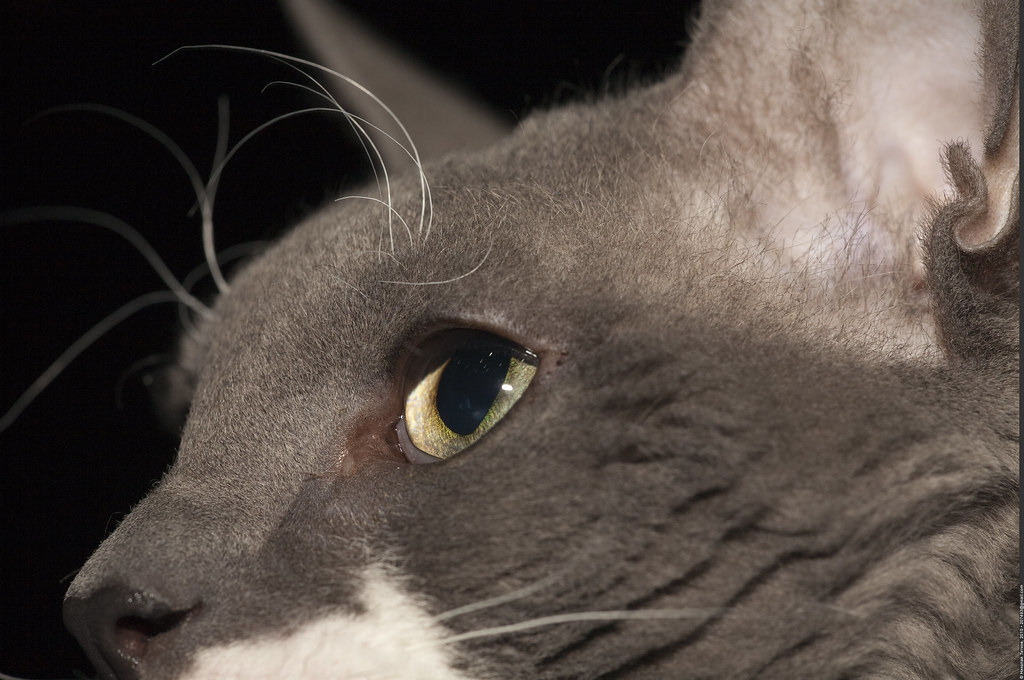
Waves run across the cheek. Nickolas Titkov, Flickr[2]
Photographer Nickolas Titkov identifies this blue-and-white cat as Амулет Уралочка. Follow the grey fur from just below the eye towards the base of the ear. Within that single patch of colour, the fur rises and falls in several diagonal rows. A wider view of the same cat shows a different kind of line where the white muzzle meets the grey cheek. To pick out the waves in a photograph, choose a patch of one colour and follow the ridges across it.[2][3]
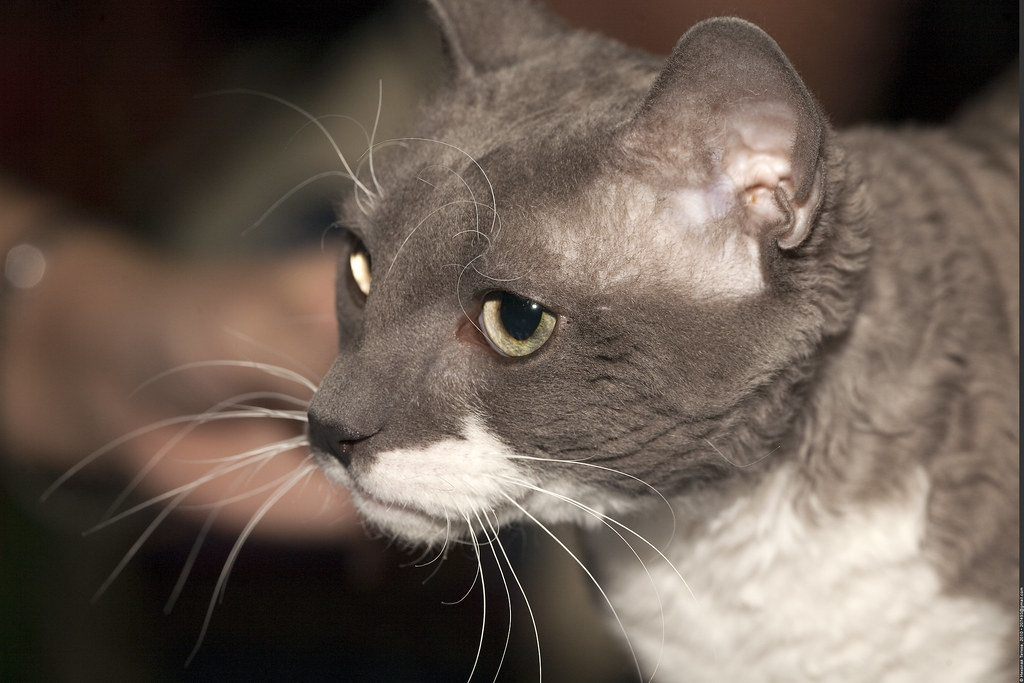
A side view shows the head shape. Nickolas Titkov, Flickr[3]
The WCF describes a short, broad, wedge-shaped head with pronounced cheekbones, a broad muzzle and a firm chin. The large oval eyes are set wide apart at a slight slant. The ears are medium in size and set high, with gently rounded tips. In a full-body view, look for a relatively short, muscular torso carried on slender legs with oval paws. The federation also lists the Ural Rex Longhair (URL). Its medium-length coat falls in looser waves over the body and tail.[1][4]
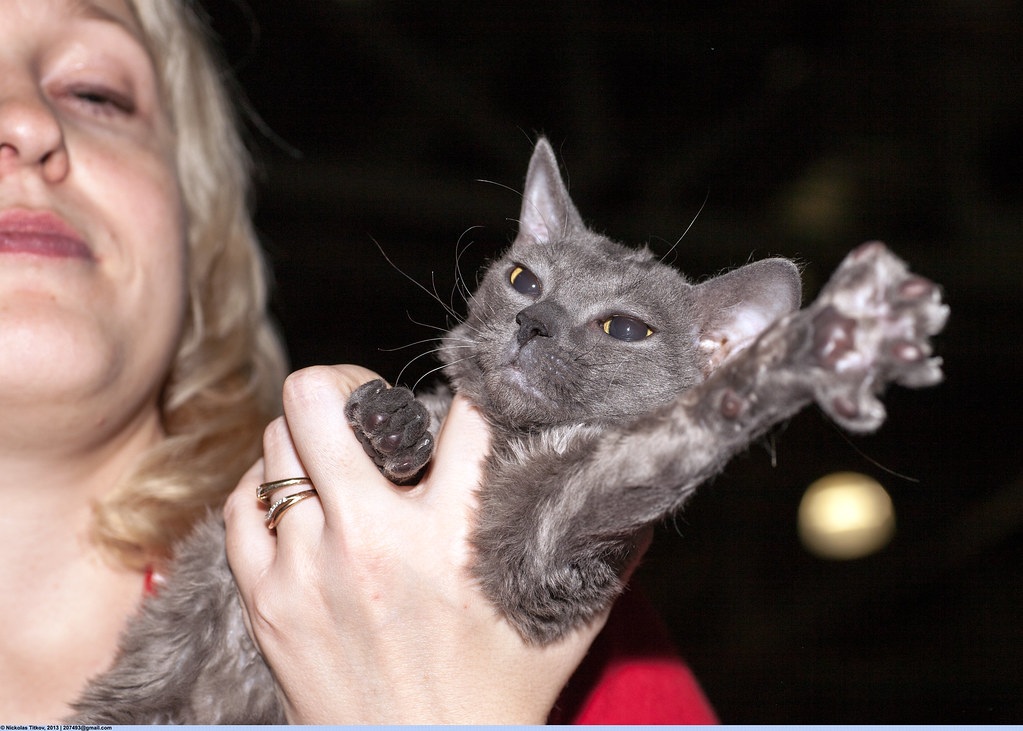
Waves show along the extended foreleg. Nickolas Titkov, Flickr[7]
Finding tangles among the waves
Choose a time for the daily coat check when your cat is relaxed and comes close of its own accord. Run a hand lightly over the back and sides to get a feel for the fine fur. Then check behind the ears, under the front legs, along the inner thighs and down the backs of the hind legs. The waves on the surface are easy to see. A tangle tucked behind an ear or high on a leg takes a different angle to spot. You can check a few places at a time as your cat turns its head, stands up or stretches. VCA’s general grooming advice for curly-coated cats is a gentle daily brushing, with particular attention to places where the fur tends to tangle.[5][6]
How do you know when to keep combing? Leave a neat row of natural waves as it is. If you feel a small tuft of hairs caught together, gently ease that spot apart. Stop if the comb pulls on the skin or your cat flinches away when you touch it. With a firm mat close to the body, it can be hard to see where the fur ends and the skin begins. Scissors can easily cut the skin, so leave that mat to a veterinarian or professional groomer. When you finish, you should still be able to see the waves on the cheeks and body.[1][5]
Most healthy adult cats keep themselves clean and seldom need a full bath. When a bath is needed, ease out small tangles beforehand, since wetting them can make them harder to undo. Use a shampoo formulated for cats and rinse it out thoroughly. If the same patch repeatedly gets dirty or clumps together, watch what happens when your cat washes. Does it still lick that patch? Can it turn to reach it as easily as before? Those details tell a veterinarian more about the help your cat may need than the date of its last bath.[5]
Giving your cat room to come and go
When setting up your home, think through the routes your cat will take in a day. Where can it get a drink after a nap, stop to scratch when it is active, or retreat when visitors arrive? The Feline Veterinary Medical Association recommends giving indoor cats separate places to rest, eat, drink and use the litter box, along with a safe place to hide. If you already have a cat, pay particular attention to doorways. When one cat sits in a doorway, can the other still reach water or a litter box? A second bowl or box gives the cat a choice when it can reach that spot by a separate route.[6]
Indoor cats need chances to watch, chase and pounce. Move a toy where your cat can see it, then pause long enough for the cat to crouch, creep closer and spring. If it is ready to chase again, give it another turn. If it heads back to its resting place, let play end there. Try the same pause during grooming. After a few strokes, take your hand away and see whether your cat comes back for more. These small pauses make interaction predictable and help you learn how this particular cat likes to play and where it feels comfortable being touched.[6]
Which coat changes call for a veterinary visit?
Your best reference is your cat’s usual coat. A patch that used to comb through easily may keep forming a hard mat. A spot you could stroke comfortably may have become tender, or gently parting the fur may reveal red skin beneath a clump. Tell your veterinarian about these changes. If the skin is irritated or the area is painful, stop pulling at the fur and arrange a visit. Describe where you first noticed the change, how long it has been there and whether your cat skips the spot when washing. That gives the veterinarian something more specific to work with than a general impression that the curls look different.[5]
One change is easy to miss. A cat may still wash its face carefully while gradually spending less time grooming its back and hindquarters. VCA gives joint discomfort as one reason a cat can have trouble grooming itself. Make a note of the places your cat can still reach and the ones where it has recently needed help. At the visit, those observations can help the veterinarian decide whether to examine the skin or also check how comfortably your cat turns and moves.[5]
References
-
[1] World Cat Federation. Ural Rex SH (URX). 2010-01-01.
-
[2] Nickolas Titkov. URX Амулет Уралочка. Flickr, photograph 5273557503.
-
[3] Nickolas Titkov. URX Амулет Уралочка. Flickr, photograph 5274167574.
-
[4] World Cat Federation. Ural Rex Longhair (URL). 2010-01-01.
-
[5] Courtney Barnes, Ryan Llera, Tammy Hunter, Cheryl Yuill. Grooming and Coat Care for Your Cat. VCA Animal Hospitals.
-
[6] Feline Veterinary Medical Association. New Feline Veterinary Medical Association Position Statement Reimagines Life for Indoor Cats. 2025-08-28.
-
[7] Nickolas Titkov. URX cat. Flickr, photograph 11351313965.