The Japanese Chin was bred as a companion in Japan’s aristocratic households. A Chin still likes to be near familiar people, though its choice of seat may come as a surprise. The Japanese Chin Club of America says many climb onto the back of a sofa or chair and claim it as a favorite spot. Picture a small dog curled up just behind your shoulder. Will the cushion shift when you stand up? Where can the dog put its feet on the way down? Those questions tell you more about how a Chin might fit into your living room than measuring the floor for a dog bed. [1][3]
In the photograph of the Chin standing on grass, the plumed tail curves over the back and long hair falls across the chest. To get a sense of the dog’s size beneath that coat, look at its shoulders and feet. The breed’s ideal height at the shoulder is 8 to 11 inches (about 20 to 28 cm). From the front of the breastbone to the rear of the rump, the body is about as long as the dog is tall, giving it a nearly square outline. The American Kennel Club (AKC) lists a weight of 7 to 11 pounds (about 3.2 to 5 kg). Hair stands out around the neck and shoulders and hangs like loose trousers behind the hind legs, making the dog look bulkier in photographs. [1][2]
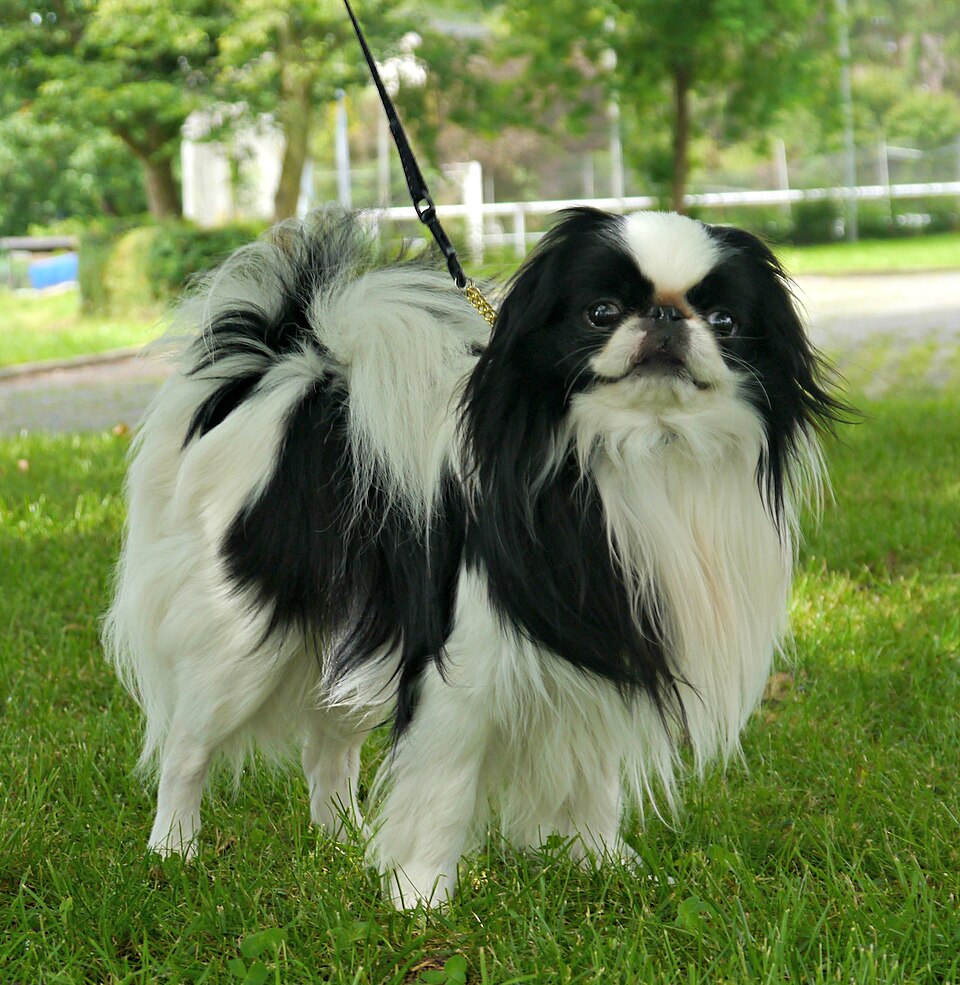
A Japanese Chin stands in profile. Joliot, Wikimedia Commons[5]

Seen from the front, the head is broad for the size of the body. The dark, round eyes are set well apart, the nose sits high, and the muzzle is short and broad. In the portrait below, a white blaze runs from the middle of the forehead down beside the nose. Long black ear fringes frame the face. When looking at another Chin, notice the spacing of the eyes, the shape of the muzzle and the way the ears hang. Coat color can vary. Alongside the black and white seen here, Chin can be red and white, or black and white with tan markings in places such as above the eyes. [2]
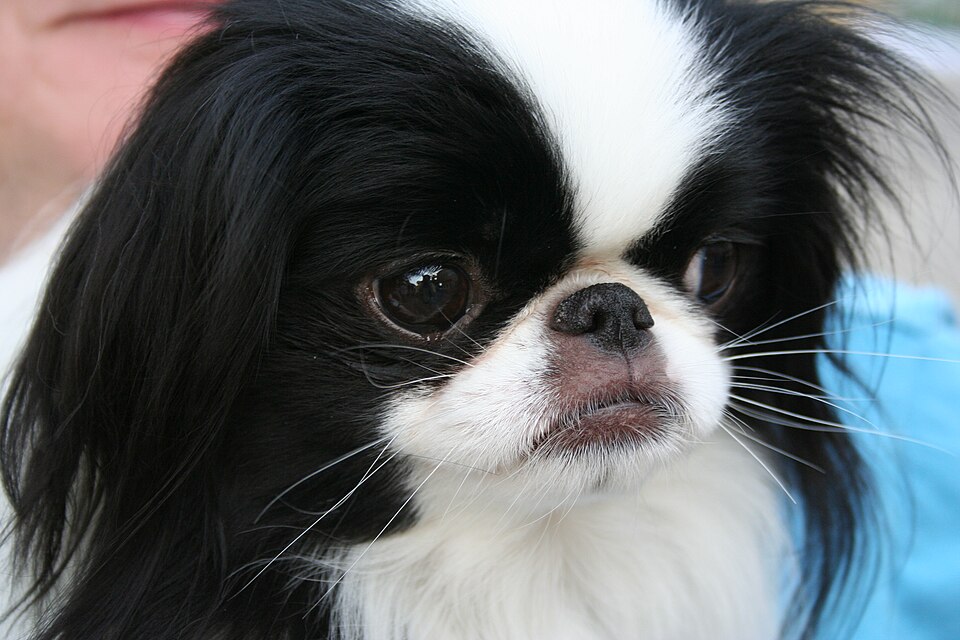
The Japanese Chin has a short, broad muzzle. LostinTexas (Alex Archambault), Wikimedia Commons[6]

Make time for an unhurried daily walk
A Japanese Chin can live comfortably in an apartment and still have plenty to do outdoors. The AKC describes two activities that suit the breed: strolling with a person and exploring a fenced yard. If you live in an apartment, choose a stretch of footpath where you have time to follow the dog’s pace and stop when a scent catches its interest. If the family usually heads out for a brisk fitness walk, set aside a separate outing for the Chin. Let the dog’s usual walking distance, its energy that day and the weather help you decide where to turn back. [1][3]
Fit the harness indoors and clip on the leash before opening the door. A Chin that turns at the sound of its name in the living room may follow a scent straight toward the road. With the leash attached to the harness, you can pause together while the dog sniffs and guide it away from a driveway in time. If you have a yard, walk the fence line and look for gaps along the bottom, especially under the gate, before letting such a small dog explore. In hot, humid weather, walk during a cooler part of the day and have fresh water and an airy resting place ready at home. [1][3]
Teach your Chin to settle beside the sofa
Crouch beside the sofa and trace the route a small dog could take from the floor to the seat and up to the back. Steady or move a stool that tips, secure a rug that slides, and check for an open window beside the backrest. If you want your Chin nearby while you watch television, try a low, nonslip mat at the end where you usually sit. Pick a spot where the dog can see you and can also walk away. Children can sit on the floor beside the mat when they want to play, giving the dog room to come to them. [2][3]
Start a mat lesson when your Chin is already on the floor. Hold a treat low, guide the dog one step toward the mat, and praise it as soon as its front paws reach the surface. Once it steps onto the mat willingly, add a cue everyone in the family can use. Then try sitting back on the sofa and giving the dog attention while it stays on the mat. Practice a few times and finish while the dog is still interested. Chin respond well to gentle training that holds their interest. A harsh tone can make them lose the desire to join in. If your dog hangs back, move the mat a little closer to make the next step easier. [1]
That familiar mat can also give your Chin somewhere to settle when visitors arrive. Affectionate with family, a Chin may take time to size up a stranger or a new place. Ask guests to sit down, let the dog watch from its spot, and wait for it to approach before saying hello. Give it a similar choice around other dogs. Start by walking a little distance apart. When the Chin shows interest in getting closer, arrange supervised play with a dog of similar size. Think about whether everyone at home will be as willing to give the dog space as they are to welcome it when it comes over. [1][2]
Brush from the ears down to the feet
On the Chin lying down below, long black hair falls from behind the ears onto the shoulders, and white chest hair drapes over the front legs. Those layers overlap in the photograph, but you can part them and brush each area in turn. The Japanese Chin has a single coat of straight, silky hair. Once or twice a week, work through the ear fringes, chest, backs of the legs and tail plume, brushing more often when the dog is shedding. A bath about once a month is a starting point. Adjust it to where your dog spends time and how dirty it gets. After a walk through grass, check the long hair that brushes the ground for bits of grass caught in it. [1][2][3]
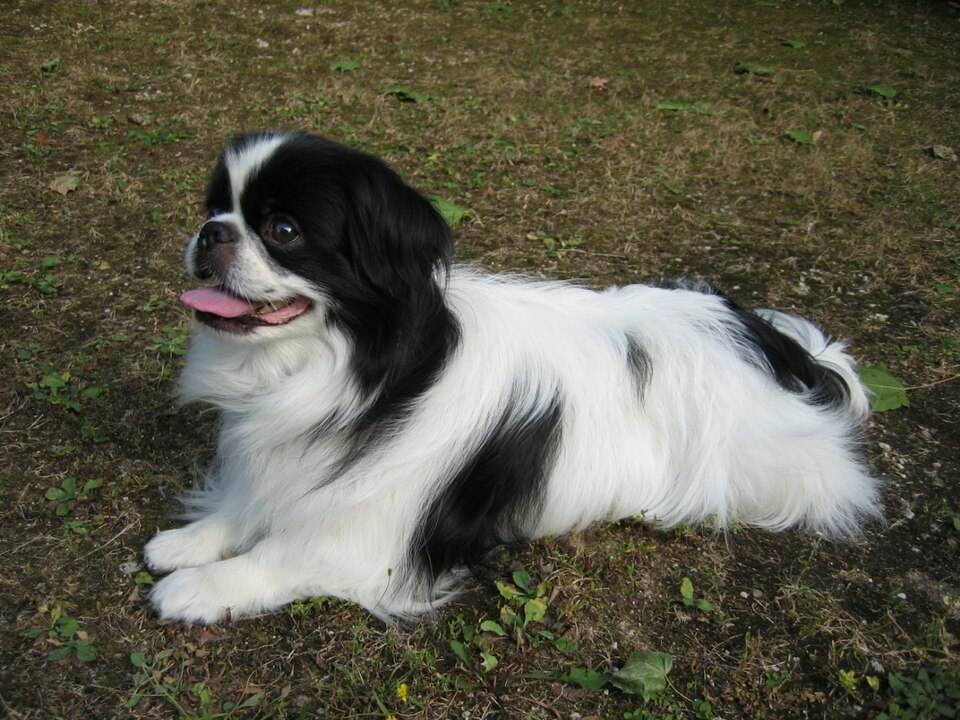
Long ear fringes meet the chest coat. Arnaud 25, Wikimedia Commons[7]

When you reach the feet, gently part the hair covering the toes so you can see how long the nails are. A Chin’s nails grow quickly and need regular trimming. At the ears, lift each flap to check for accumulated wax or debris. For toothbrushing, choose another quiet moment and gradually get the dog used to a gentle touch around the mouth. A few brief, pleasant sessions spread through the week can be easier for the family to keep up than saving the brush, nail clippers and toothbrush for bath day. [1][2][3]
If you are preparing to welcome a puppy, there are a few things its photograph cannot tell you. Ask the breeder for both parents’ eye, heart and patella examination records, along with their DNA test results for GM2 gangliosidosis in Japanese Chin. The first three checks look at the eyes, heart and kneecaps. The DNA test can identify dogs that carry the inherited GM2 variant and help breeders plan pairings. Asking for each result tells you what was covered when a breeder says the parents had a health check. When you bring your puppy home, take the available records to your veterinarian so you can plan care around the dog in front of you. [1][4]
References
-
[1] American Kennel Club. Japanese Chin.
-
[2] American Kennel Club. Official Standard of the Japanese Chin. Effective November 30, 2011.
-
[3] Japanese Chin Club of America. Frequently Asked Questions.
-
[4] Jennifer Baumer. JCCA Health Testing Recommendations. Japanese Chin Club of America.