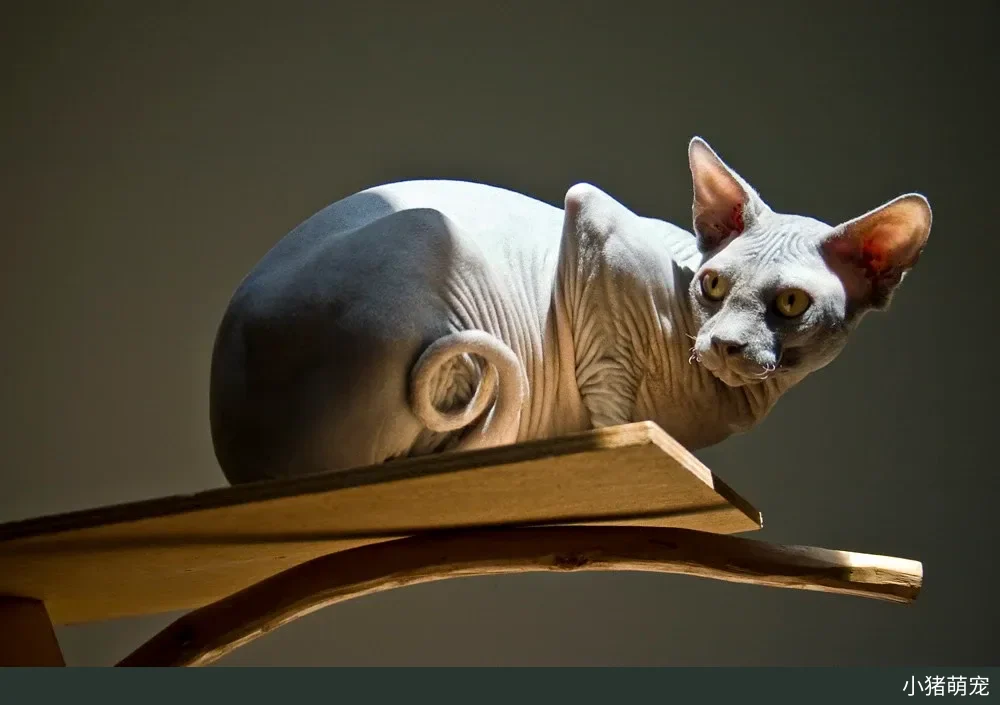
An 8-month-old blue Sphynx lying on a homemade cat-tree board looking back. Photo: The Pug Father; source: Flickr; license: CC BY 2.0.
Sphynx cats look bare but feel like warm suede. The breed traces to a spontaneously hairless kitten born in Ontario, Canada, in 1966 and is now recognized by CFA, TICA, FIFe, and other associations. They are clingy, curious, and talkative, but missing a coat also brings extra care needs around oily skin, warmth, sun protection, and heart-disease screening; the Netherlands and Germany have already restricted breeding over animal-welfare concerns.
Origins and the hairless gene
The Sphynx story began with a natural mutation. CFA’s breed profile says a domestic cat in Toronto, Canada, produced a hairless kitten in 1966; TICA’s account is more specific: a black-and-white cat in Ontario produced a hairless kitten whose wrinkled skin earned the name Prune. TICA holds that modern Sphynx mainly descend from several hairless cats found in Minnesota and Toronto between 1975 and 1978—Epidermis, Punkie, and Paloma—which were outcrossed to Devon Rex; CFA mentions Epidermis and Dermis, born in Minnesota in 1975, outcrossed to American Shorthair and Devon Rex and then folded into the gene pool. The two associations’ early-individual accounts do not fully match; both are noted here. As for the name, TICA says it comes from the Egyptian Sphinx.
Hairlessness is recessive: both parents must carry it for a kitten to be born bare. In 2010 a University of California, Davis School of Veterinary Medicine team published in Mammalian Genome, mapping the Sphynx hairless allele to a splice-site variant in the keratin gene KRT71; a different variant in the same gene produces the Devon Rex’s curly coat. The researchers explain that the mutation severely damages hair structure—hair can grow, but without a well-formed hair bulb it sheds easily.
On recognition, CFA accepted Sphynx for registration in 1998 and advanced them to championship status in 2002; FIFe’s current standard notes recognition in 2002; TICA says it has recognized the breed for more than 40 years. To preserve genetic diversity, CFA still allows outcrosses to American Shorthair, Devon Rex, and domestic cats, while requiring that Sphynx born on or after 31 December 2033 have two Sphynx parents.
Appearance and temperament
Sphynx are not completely hairless. CFA, TICA, and FIFe standards all describe a nearly imperceptible fine down that feels like suede or peach skin; short hair is allowed on the bridge of the nose, ears, feet, and tip of the tail. Whiskers may be complete, broken, or absent. Medium in size yet “surprisingly heavy”: well muscled, with a broad, rounded chest and a rounded belly that CFA likens to having “just finished a big meal.” Large lemon-shaped eyes, broad bat-like ears, thick paw pads, and long, finger-like toes are signature traits. TICA lists adult weight at about 6–12 lb (about 2.7–5.4 kg), with males usually larger than females, and expected lifespan 7–15 years. Color and pattern show directly on the skin; all colors are accepted, and CFA notes that sun exposure can deepen color.
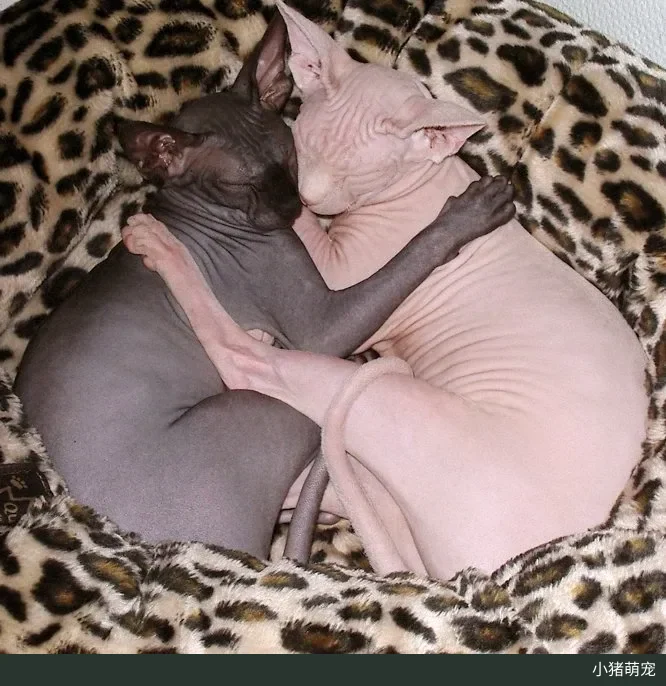
Two Sphynx sleeping cuddled in a cat bed—one dark gray, one pink-and-white—with color showing directly on the skin. Author: PuppetMasteX (English Wikipedia); source: Wikimedia Commons; license: CC BY-SA 3.0.
On temperament, association materials almost uniformly call them clingy. TICA says they are often nicknamed “Velcro cats,” love burrowing under the covers, and some like to perch on a shoulder like a parrot; CFA warns they will follow you around the house while “chattering” about their needs—not especially noisy, but hardly quiet. They are curious, smart, and energetic; some retrieve, and those long, agile toes can open doors and cabinets. CFA holds that the breed enjoys other cats—especially its own kind—and is a poor fit for long stretches alone, so considering a pair is advised. These are breed-association tendencies; individual cats still vary.
Common health issues and welfare debate
Associations often call Sphynx “generally hardy,” but the top concern is hypertrophic cardiomyopathy (HCM). It is the most common feline heart disease: the myocardium thickens abnormally and can lead to heart failure, thrombosis, or sudden death. In a 2024 prospective Animals study from New Zealand, cardiologists screened 55 apparently healthy Sphynx; at a median age of 5.8 years, HCM prevalence was 40% (20/55), and three cats died of congestive heart failure during the study. North Carolina State University Veterinary Hospital notes that many Sphynx present at 2–3 years of age, while others not until 8–10. Genetic testing is not a one-and-done answer: a variant in ALMS1 was reported as associated with Sphynx HCM, but neither the New Zealand study nor a 2026 Thai study found a significant link; the variant is common in the breed, so a positive result does not guarantee disease and a negative result does not rule it out. TICA therefore stresses that breeders should have veterinary cardiologists perform echocardiographic screening, and because HCM may not appear in the first few years, pet owners should also schedule regular rechecks.
Skin is the second focus. Without a coat to absorb sebum, Sphynx skin tends to get oily. A 2009 Journal of Feline Medicine and Surgery study isolated Malassezia (a lipophilic yeast) from the skin of 26 of 32 Sphynx (81%), versus none of 10 domestic shorthair controls; all five cats with oily seborrhea yielded Malassezia pachydermatis. World Association for Veterinary Dermatology consensus guidelines from 2020 also note that Devon Rex and Sphynx are prone to high Malassezia colonization and generalized seborrheic dermatitis. CFA also lists pigmented urticaria among skin conditions; the Dutch government notes that hairless cats sunburn more easily and face skin-cancer risk.
CFA further mentions: kittens prone to respiratory issues without a coat, hereditary myopathy, digestive sensitivity, and periodontal disease. Hereditary myopathy was mapped in two 2015 studies to a recessive COLQ variant—a congenital myasthenic syndrome with limb and trunk weakness, pharyngeal weakness, megaesophagus, and post-exercise fatigue. The good news is that DNA testing is now available; in one European sample, about 3.7% of 81 Sphynx were healthy carriers.
Unlike folded-ear, short-legged, or flat-faced cats, Sphynx breed standards do not pursue skeletal extremes: CFA disqualifies folded or curled ears, short legs (chondrodysplasia), short tails, and polydactyly, and FIFe requires that skin folds not impair normal function. But “hairlessness” itself faces growing scrutiny. Debate centers on two points: missing coat impairs thermoregulation and skin protection; many individuals lack functional whiskers, which cats use for orientation in the dark, exploring objects, and social signaling. Courts in several German states, citing Animal Protection Act §11b (ban on “torture breeding”), have upheld breeding bans or neutering orders for Sphynx lacking functional whiskers—for example a Berlin Administrative Court judgment in 2015 and a Rhineland-Palatinate Higher Administrative Court interim-relief ruling on 13 April 2026. The Netherlands has long banned breeding hairless cats and, from 1 January 2026, further bans keeping and showing them; cats already owned and verifiable by microchip records may continue under transitional rules. Associations say breeders are managing breed health through HCM and other health testing. Before welcoming a Sphynx, learn local rules and honestly assess whether you can sustain the extra care long term.
Care essentials
- Bathe moderately: CFA says oily skin needs regular baths; TICA warns that “weekly baths” are a common myth—overwashing disrupts skin pH and can stimulate more sebum, and a gentle shampoo every few months is usually enough. Oiliness varies; discuss frequency with a veterinarian.
- Weekly light care: TICA recommends weekly nail trims, eye cleaning, and gentle ear cleaning (no hair in the ears means wax builds up easily); also brush teeth with pet toothpaste.
- Warmth and sun protection: They chill easily and seek monitors, sunny windowsills, or the owner’s bed; also avoid sunburn and skin injury—warm indoor beds are safer than free outdoor roaming.
- Eat more, but don’t get fat: TICA notes a high metabolism and higher daily calorie needs than coated cats; feed on a schedule 2–3 times a day with fresh water. A round belly is a breed trait, but still watch weight.
- Health screening: Choose breeders who do echocardiographic screening, and have your own cat’s heart assessed regularly; ask about COLQ and other genetic results.
- Not a “hypoallergenic” cat: CFA and TICA both note Sphynx are not low-allergen; the main allergen Fel d 1 is in saliva and glandular secretions. Some allergic people tolerate them; others do not—meet one in person first.
- Need company: Poor fits for long solitude; if the house is empty much of the day, consider a multi-cat home.
References
-
The Cat Fanciers' Association. Sphynx (breed profile and standard)
-
The International Cat Association. Sphynx
-
Fédération Internationale Féline. FIFe Standards: Category 4 (SPH, 2026-01-01 edition)
-
Gandolfi B, et al. (2010). The naked truth: Sphynx and Devon Rex cat breed mutations in KRT71. Mammalian Genome, 21(9-10): 509–515.
-
Seo J, et al. (2024). Prevalence of Hypertrophic Cardiomyopathy and ALMS1 Variant in Sphynx Cats in New Zealand. Animals, 14(18): 2629.
-
Sussadee M, et al. (2026). Prevalence and Clinical Relevance of Alström Syndrome Protein 1 Gene Variant and Feline Hypertrophic Cardiomyopathy in Sphynx Cats in Thailand. Animals, 16(12): 1815.
-
NC State Veterinary Hospital. Sphynx Hypertrophic Cardiomyopathy (HCM)
-
Åhman S, Bergström K. (2009). Cutaneous carriage of Malassezia species in healthy and seborrhoeic Sphynx cats and a comparison to carriage in Devon Rex cats. Journal of Feline Medicine and Surgery, 11(12): 970–976.
-
Bond R, et al. (2020). Biology, diagnosis and treatment of Malassezia dermatitis in dogs and cats: Clinical Consensus Guidelines of the World Association for Veterinary Dermatology. Veterinary Dermatology.
-
Gandolfi B, et al. (2015). COLQ variant associated with Devon Rex and Sphynx feline hereditary myopathy. Animal Genetics.
-
Abitbol M, et al. (2015). A COLQ Missense Mutation in Sphynx and Devon Rex Cats with Congenital Myasthenic Syndrome. PLoS ONE, 10(9): e0137019.
-
RVO (Netherlands Enterprise Agency). Houdverbod naaktkatten en vouwoorkatten (verified 2026-10-05)
-
Oberverwaltungsgericht Rheinland-Pfalz. Kastration zweier Katzen der Rasse „Canadian Sphynx“ (2026-04-21)
-
Landestierschutzbeauftragte Berlin. Pressemitteilung zum Verbot der Qualzucht von Nacktkatzen (2015)