On Chesapeake Bay in the nineteenth century, hunters needed a dog willing to swim out into cold water and make the trip back with a bird in its mouth. The bay lies on a migration route for waterfowl, and its shallows can approach freezing in winter. The Chesapeake Bay Retriever developed there has powerful hindquarters to propel it through the water, broad webbed feet, and a double coat that sheds water and holds in warmth.[1] When you turn that work into a game at home, the part that’s easy to overlook is the return trip. After the dog chases down a toy, it still has to turn around and carry it back to the person waiting with an open hand.
In the side view, start with the chest and hindquarters. The dog stands with its head up, showing a deep chest, sturdy hind legs, and well-defined thighs. Adult Chesapeakes stand about 21 to 26 inches (53 to 66 cm) at the shoulder. The hindquarters can be level with the shoulders or slightly higher. Follow the line of the back toward the head and you can see waves in the short coat across the shoulders and neck. The hair on the face lies much smoother. Coat colors include brown, reddish sedge, and the paler shades known as deadgrass. To recognize a Chesapeake, look at its build, coat texture, and head together. Chocolate brown is just one color you might see.[1]
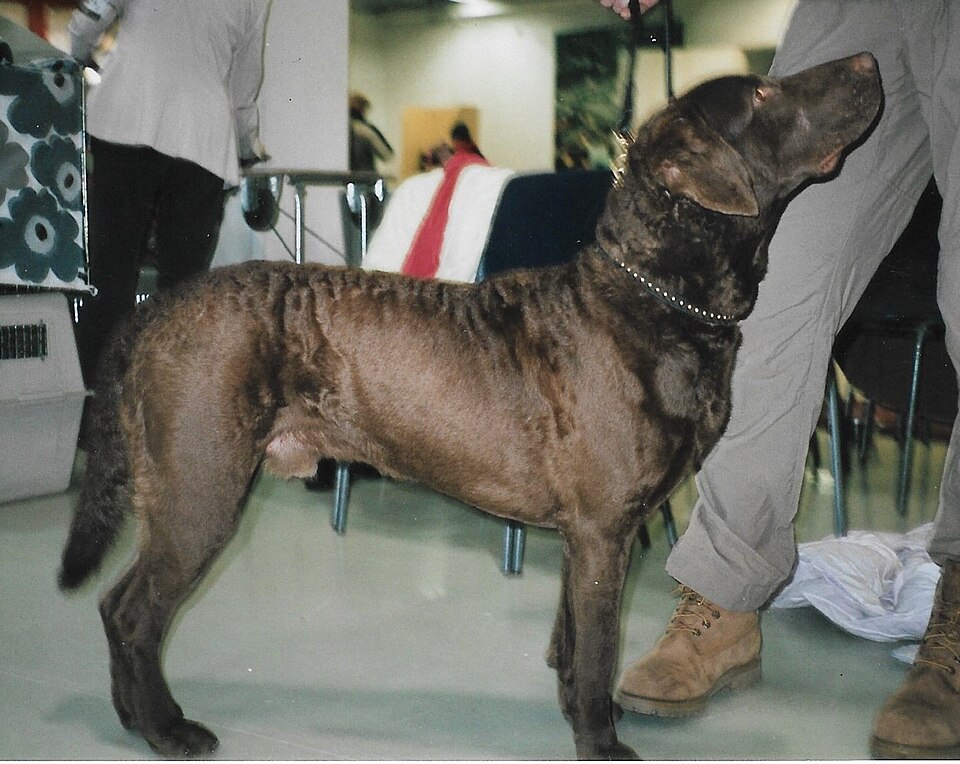
A Chesapeake Bay Retriever stands in profile. Canarian, Wikimedia Commons[4]

Start with the handoff
For the first game of fetch, keep the toy in your hand. Choose one your dog likes to mouth and sit facing each other in a quiet spot. At first, praise your dog and offer a small treat for coming over to investigate. Once the dog approaches readily, wait for its mouth to touch the toy before you reward it. The next step is to reward the moment it takes hold. The timing tells your dog which action earned the treat. These small steps are worth spending time on, especially with a dog that chases a toy eagerly but drops it halfway back.[2]
Keep a hand on the toy and let your dog hold it a moment longer before you take it back and give the reward. Once the dog holds it steadily, briefly let go, then put your hand under the toy again while it’s still in the dog’s mouth. After a few smooth exchanges, set the toy at your feet for the dog to pick up. Working this close makes it easier to see where the retrieve breaks down. If your dog picks up the toy easily but drops it as it turns toward you, put your hand a little closer next time. Give the dog a chance to deliver the toy straight into it.[2]
When your dog can pick up the toy at your feet and give it back, set it a little farther away. Practice with the toy resting on the ground, gradually increasing the distance, then begin mixing in short tosses. If family members take turns, agree on the cue and on the moment that earns the treat. When you’re working on the return, give the praise and reward as the toy reaches your hand. The next time you practice outdoors, start close again and see whether your dog can put the whole retrieve together in the new spot.[2]
What does exercise look like on a workday?
Chesapeakes have energy to spare and enjoy a job they can stick with. Hiking, swimming, following a scent trail, and obedience training each draw on some of their abilities.[1] Choose a combination that fits your surroundings. On weekdays, one person might take the dog for a walk and stop somewhere suitable for a few retrieves. A weekend might leave time for a swim or a hike. On a rainy day you can practice holding and handing over the toy indoors. When the weather clears, make room in the day for the dog to stretch out its stride and get a good run.
To decide whether a Chesapeake fits your household, picture the busiest day of your week. Who has time to pick up the leash and go out? When the dog settles down to play with the toy on its own, who’s willing to kneel beside it and practice the handoff again? A toy lying in the yard supplies only half the game. Someone still has to be there to receive it. A family without a lake nearby can build a routine around retrieves on land, scent work, and walks. The setting can vary. What counts day to day is having someone who can regularly make time to do things with the dog.
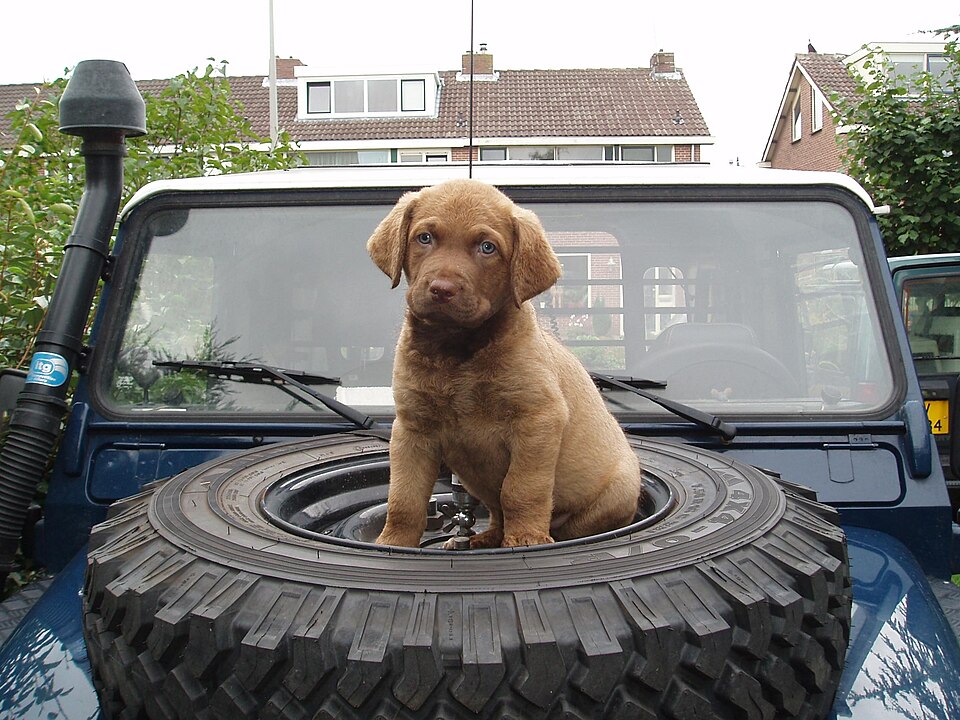
A six-week-old Chesapeake Bay Retriever faces the camera. Benbas, Wikimedia Commons[5]

The puppy in the photograph tilts its head toward the camera, its ears hanging beside its cheeks. As adults, Chesapeakes tend to be attached to their families and have minds of their own. Some greet strangers politely, while others prefer to keep their distance. The American Kennel Club (AKC) recommends socialization and basic training classes beginning in puppyhood.[1] If you often have visitors, you can practice arrivals, too. Let the dog watch a guest arrive beside someone it knows, with enough room to stand quietly. Responding to a familiar cue and calmly walking away with that person is already something worth rewarding.
How do you care for a Chesapeake’s oily, wavy coat?
On the dog standing in the grass, the coat lies close in little waves along the shoulders, back, and sides. The pattern stands out against the short, smooth hair on the face. A Chesapeake’s outer coat typically feels slightly coarse and oily, with a dense, soft undercoat beneath it. The natural oils and the two layers of hair helped protect these dogs while they worked in cold water. For everyday care, brush once a week to lift out loose hair. Chesapeakes do shed, and the slight oily feel is normal. It seldom calls for a bath.[1]
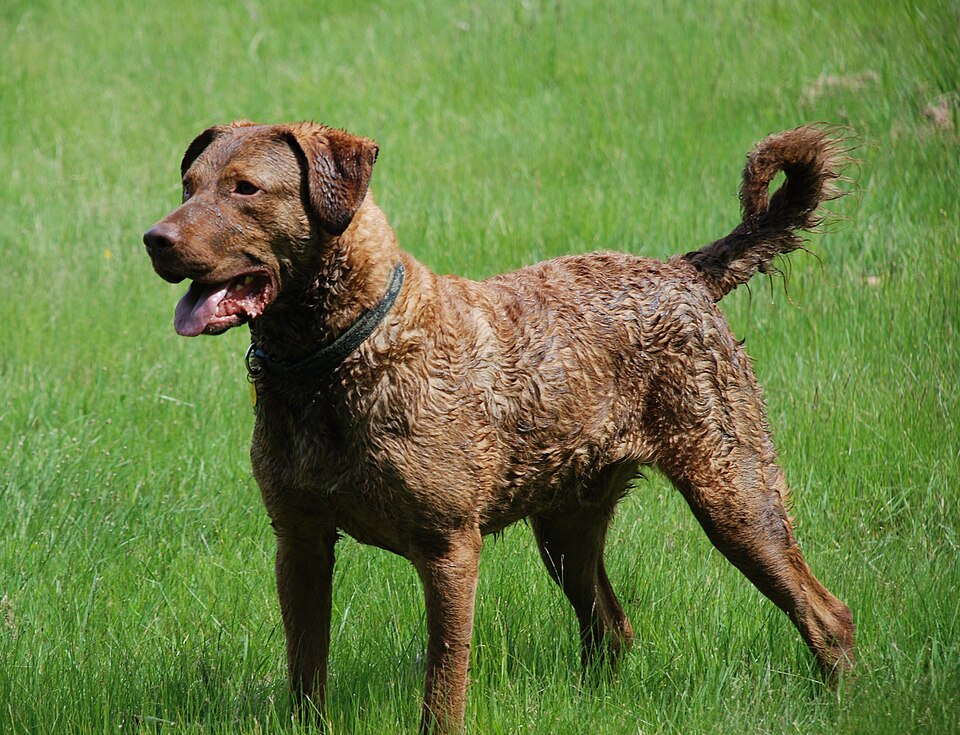
Waves run across the shoulders, back, and flanks. Keith Rousseau, Wikimedia Commons[6]

If you spend a lot of time outdoors with your dog, brushing is a convenient time to check the ears and feet. Gently lift each ear flap and look for redness, swelling, or unusual discharge at the opening of the ear canal. A bad smell is also a reason to arrange a veterinary visit. Check the nails as well. Long nails can make walking and running uncomfortable, so trim them regularly. For routine toothbrushing, use toothpaste made for dogs. Pairing these small jobs with something your family already does helps you remember them. It also helps you get to know how your dog usually stands and responds when you handle its ears and paws.[1]
Before bringing a puppy home, ask the breeder for the health records of both parents. Match each set of results to the dog it belongs to. Look for hip and elbow evaluations and a veterinary eye examination. Ask, too, about DNA tests for progressive rod-cone degeneration (PRCD), a form of progressive retinal atrophy, as well as exercise-induced collapse and degenerative myelopathy. Each result answers a different question. The joint evaluations assess structure, the eye exam assesses the eyes, and the DNA tests look for particular inherited variants.[1][3] Those records give your veterinarian family history to work with. When planning walks, swims, or retrieves, take your own dog’s age, movement, and physical condition into account.
References
-
[1] American Kennel Club. Chesapeake Bay Retriever Dog Breed Information.
-
[2] Sassafras Patterdale. How to Teach Your Dog to Fetch. American Kennel Club.
-
[3] American Chesapeake Club. Health Statement for Chesapeake Bay Retrievers. Approved September 11, 2016.