The Japanese Spitz made its first appearance at a Tokyo dog show in 1921. Its ancestors likely included white German Spitz dogs brought to Japan by way of Siberia and China around 1920. Other white spitz dogs were later imported and bred in Japan. Early records were lost during World War II, making the full pedigree difficult to reconstruct. The Japan Kennel Club established the breed standard in 1948. In the United States, the American Kennel Club (AKC) lists the Japanese Spitz in its Foundation Stock Service (FSS). [1]
The show photograph gives a good side view of the breed. Two triangular ears stand upright above a muzzle that tapers to a black nose. In front of the shoulders, long hair fans out around the neck and over the chest to form a ruff. The other plume, above the line of the back, is the tail curled up and over the body. The AKC gives a height of 12 to 15 inches (about 30 to 38 cm) at the shoulder. Much of the fullness you see around the chest and tail comes from the coat. [1][2]

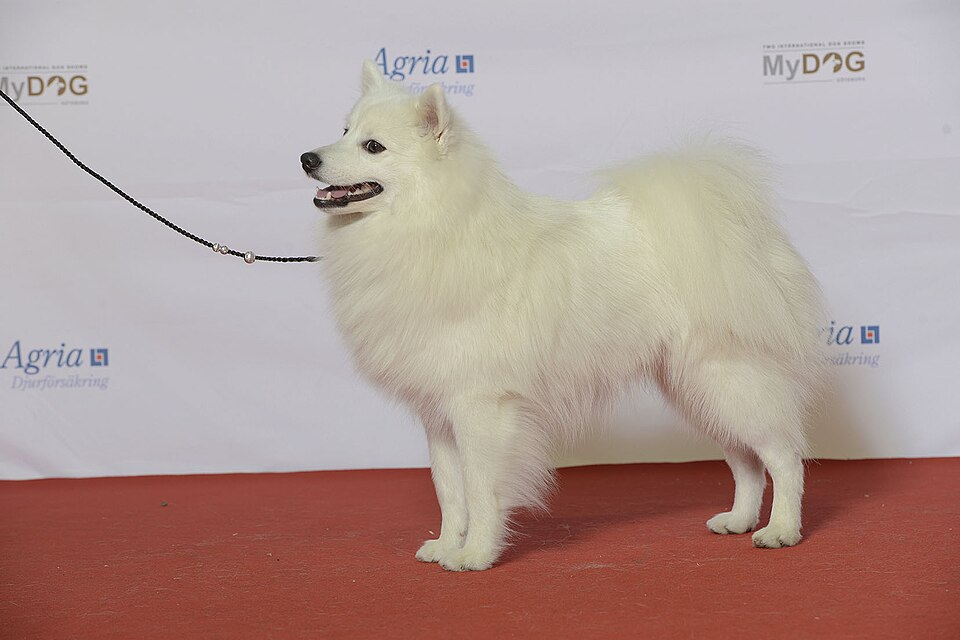
A Japanese Spitz stands in profile. Johan Frick-Meijer, Wikimedia Commons[2]
From the front, the black eye rims and nose stand out against the white face. The dog beside the tulips has turned toward the camera, showing where the short hair on either side of the muzzle meets the longer hair on the cheeks and neck. The Japanese Spitz owes its fluffy outline to a long outer coat over a dense undercoat. Those two layers set the household grooming schedule. A weekly brushing usually takes care of the coat. When the undercoat starts coming out in quantity, the brush needs to come out every day. [1][3]

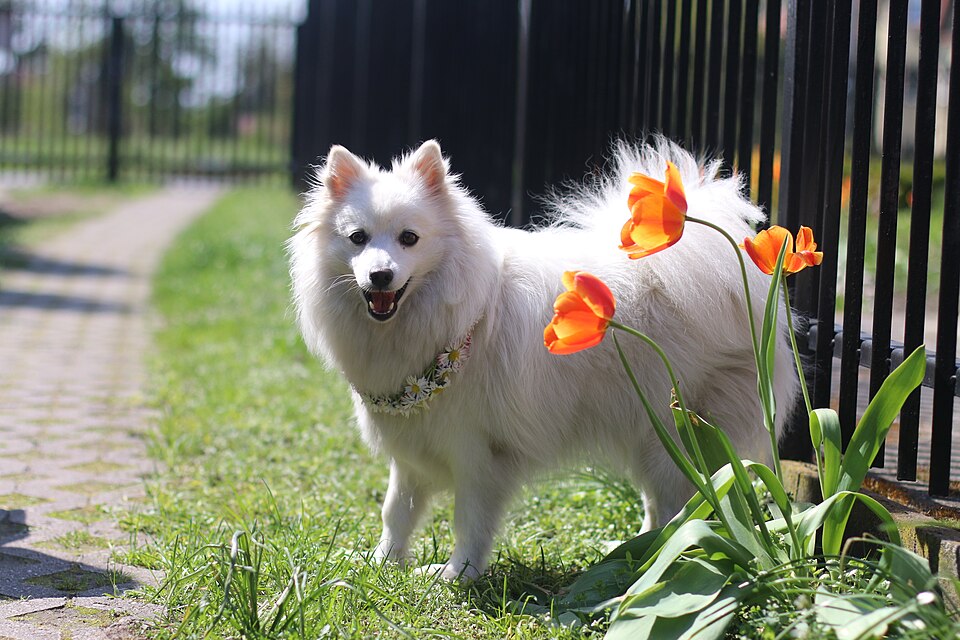
Dark eye rims frame the eyes of a Japanese Spitz. Yukisnowflakeprincess, Wikimedia Commons[3]
Who will walk the dog on a workday?
The Japanese Spitz is a companion dog that enjoys joining in with family life. That might mean coming along on an outing or settling beside the sofa after a walk. An apartment can accommodate that routine. Picture the walk from your front door and the route you could take on a typical day. If you have a yard, consider when you could join the dog outside to run and play. Either home can offer room for activity if someone has time to share it. [1]
A busy weekday tells you more about the fit than a weekend hike. Who has time for an unhurried walk in the morning? How long is the stretch between the last person leaving and the first getting home? Who will still be up for a game that evening? The AKC notes that Japanese Spitz dogs seek out human company and may develop behavior problems when left alone for long periods. If everyone regularly leaves early and gets home late, work out before bringing a dog home whether someone can come back during the day to spend time with it. [1]
Japanese Spitz dogs respond readily to people and learn from what family members do each day. Start with something the dog will use on every walk. Pick up the leash, wait until all four paws are on the floor, then clip it on and go outside. If everyone who walks the dog follows that sequence, the dog has a chance to learn how to wait at the door. Leave time in puppyhood for gradual introductions to new people and places. The AKC recommends early socialization and puppy training classes. Let the dog's response on one outing guide how far you walk or what you practice on the next. [1]
The two to three weeks when the undercoat sheds
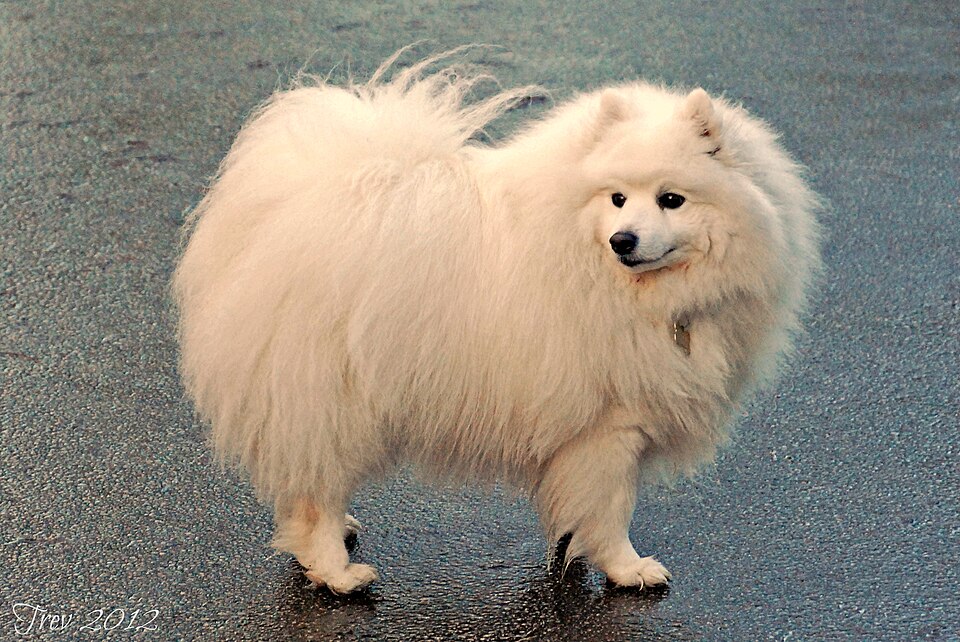
Long hair covers the neck and flanks of a Japanese Spitz. Trev Grant, Wikimedia Commons[4]

On the dog standing on the pavement, you can follow the layers of long hair from the side of the neck along the flanks, where the ends hang almost to the legs. The outer coat is easy to see in the photograph. The soft, dense undercoat beneath it accounts for the busiest weeks of grooming. According to the AKC, the Japanese Spitz typically sheds its undercoat twice a year, each time over about two to three weeks. During those weeks, daily brushing removes the undercoat as it comes loose. [1][4]
When dividing up the chores, picture an ordinary week and a shedding week separately. For much of the year, one person might handle the grooming on a weekend. Once the undercoat starts shedding, someone will need to pick up the brush again on the work nights that follow. Even after brushing, loose hair will find its way onto clothes, the sofa and the floor. If the dog is welcome on the sofa, allow time to clean its favorite spot as well. [1]
A muddy walk needn't end in a bath. Ordinary splashes of mud can dry and then be brushed out. Save the bath for when the dog is truly dirty. The AKC notes that bathing too often can strip the coat of its natural oils and irritate the skin. Mud on the tips of the outer hairs calls for a different job from the tuft of undercoat that comes away in the brush during shedding season. One can wait until the mud dries. The other is part of that day's brushing. Regular nail trims also belong on the calendar. [1]
Watch how the hind legs move on walks
Daily walks give you a chance to learn your dog's usual stride. The AKC reports cases of patellar luxation in the Japanese Spitz. The patella is the kneecap. It normally slides in a groove in the thighbone, but in a dog with patellar luxation it can slip out of that groove. The American College of Veterinary Surgeons describes a pattern in which a dog suddenly lifts a hind leg, skips a few steps, then stretches the leg and resumes walking. If this happens repeatedly, note which leg the dog lifts and how many steps it takes before putting it down. Tell your veterinarian what you saw. During an orthopedic examination, the veterinarian can feel how securely the kneecap sits in its groove. [1][5]
Before bringing a puppy home, ask the breeder about any knee examination records for the puppy and its parents. Which dog was examined, and what did the veterinarian find? Then look at the family calendar again. Even in the heaviest week of shedding, the dog will still need walks, play and company. If someone can take the leash each day, and someone can take up the brush each evening for two or three weeks, you have made room for two ordinary demands of life with a Japanese Spitz that are easy to underestimate. [1][5]
References
-
[1] American Kennel Club. Japanese Spitz.
-
[2] Svenska Mässan. Photograph by Johan Frick-Meijer. BIR Grupp 5- JAPANSK SPETS, Chezzay’s Nice N’Easy (23938629860). January 7, 2016.
-
[3] Yukisnowflakeprincess. 1 year old Japanese Spitz. April 29, 2023.
-
[4] Trev Grant. Japanese Spitz. December 25, 2012.
-
[5] American College of Veterinary Surgeons. Patellar Luxations.