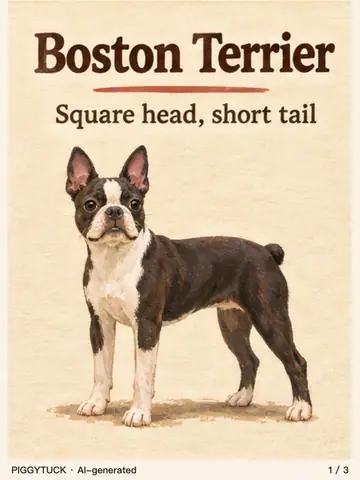
The Boston Terrier belongs to the AKC Non-Sporting Group—a small companion whose very name points to a city.[1] Nineteenth-century English blood sports pushed terrier–bull crosses for pit work and ratting; in late-1860s Liverpool a Bulldog × extinct white English Terrier litter produced the tough dark dog Judge.[1] Sold to William O’Brien, taken to Boston, then in 1870 to Robert C. Hooper, “Hooper’s Judge” became the breed’s founding sire for nearly all true Bostons.[1] Historians sketch him as a high-stationed dark brindle of about thirty-two pounds with a white face stripe, square head, and nearly even bite.[1] Later selection shrank and softened that fighting type into a companion first nicknamed the Round Head; the Boston Terrier Club of America formed in 1891, and the AKC registered its first of the breed two years later; the dog is Boston University’s mascot and, since a 1979 state act, Massachusetts’ official “American Gentleman.”[1] Generations of selection produced the small companion dog we know today.[1]
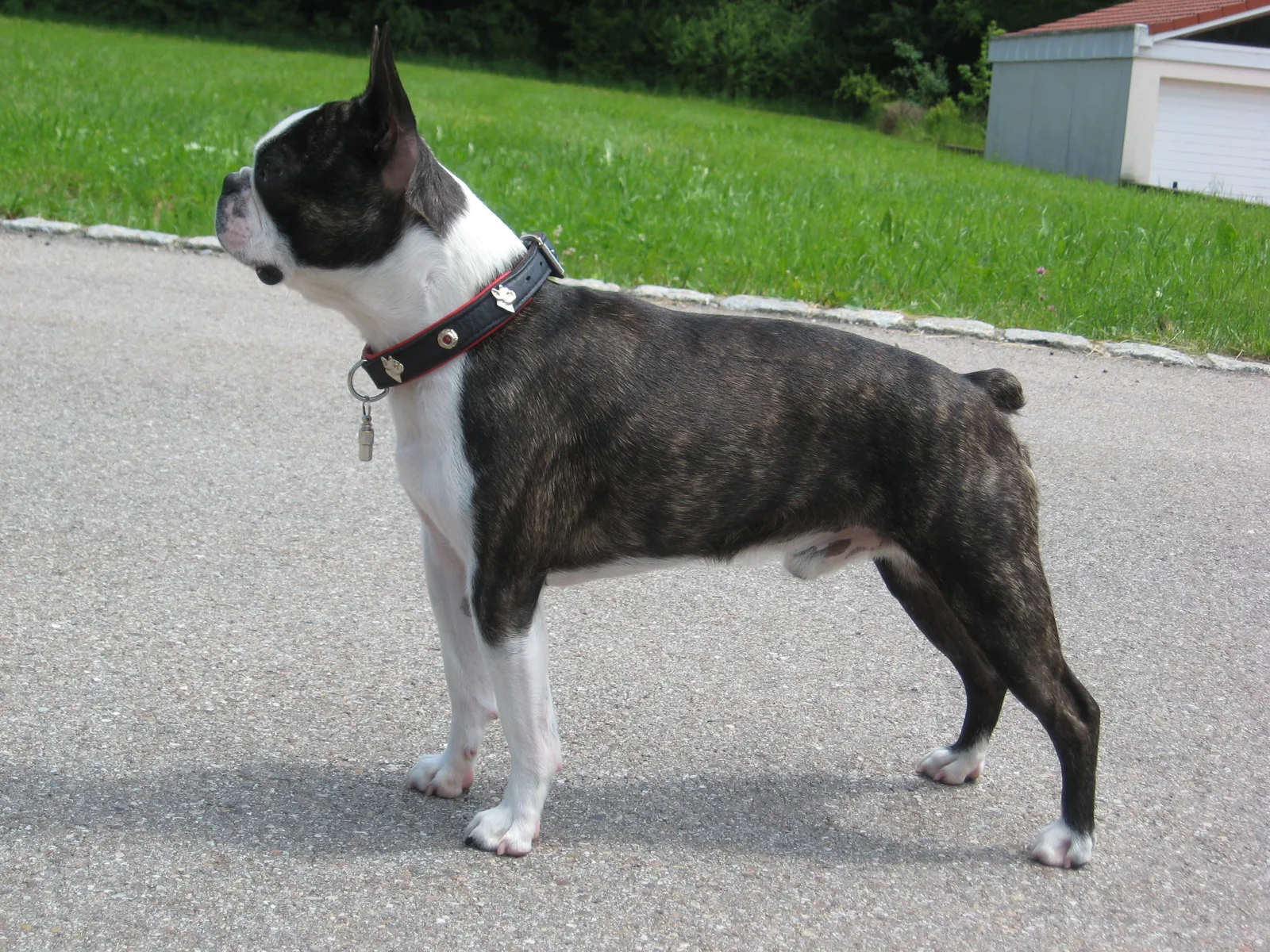
Figure: Brindle-and-white Boston Terrier standing in side profile on pavement, ears, muzzle, tail, and legs all visible. Andreas Schlaugat, Wikimedia Commons[2]

Tuxedo coat, square head, and short tail
A Boston Terrier weighs up to 25 pounds, with a compact build, short tail, and white-marked “tuxedo” coat of black, brindle, or seal (black with a reddish cast in strong light).[1] The square head, short muzzle, and large round eyes can look kind, curious, or mischievous; carriage is alert, with a jaunty step.[1] Look for a flat-topped, square skull without wrinkles, flat cheeks, an abrupt brow and clear stop; wide-set dark round eyes (any blue is a disqualification); small erect ears near the skull corners; slightly arched neck, level topline, deep wide chest, short-looking body; a low-set short tapering tail, straight or screw, never carried above horizontal; straight well-boned forelegs and small arched feet.[1] A full side view shows short back, deep chest, erect ears, short tail, and straight legs better than a front crop that hides muzzle and tail.
A city companion whose exercise varies by dog
Bostons are sturdy, easy to take out, and often enjoy company, all of which can suit city life.[1] Some are satisfied with one or two brisk walks a day, while others need longer play sessions. A dog left in the yard may simply wait at the door. Long stretches alone can lead to frustration and behaviour problems. Try a ball or other favourite toy, or give an active dog an outlet through agility, obedience, flyball, or rally.[1]
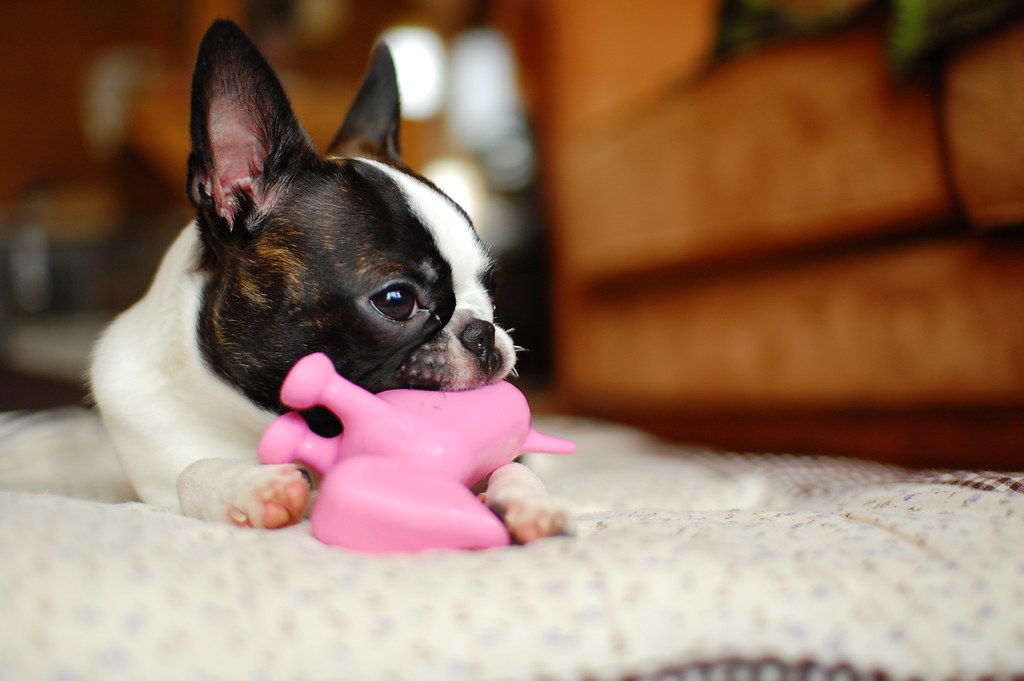
Figure: Boston Terrier lying on bedding with a pink rubber toy between its forepaws, erect ears and white blaze visible. Sendai Blog, Flickr[3]
Early socialisation and puppy class are recommended for every breed; treats motivate; many Bostons are sensitive, so gentle corrections should end in warmth and praise.[1] Feed age-appropriate quality food, watch weight and treat calories, and keep water available.[1] City homes should schedule walks plus indoor play and plan for alone time; the dog in the second photo has a pink rubber toy between its paws.
A sleek coat, brushed weekly
The short sleek coat sheds a little, not heavily.[1] A weekly soft brush, rubber mitt, or hound glove lifts loose hair and spreads skin oils.[1] Baths are occasional unless the dog gets filthy; trim nails so gait stays comfortable.[1] A short coat and light shedding do not predict an individual person’s allergy symptoms.
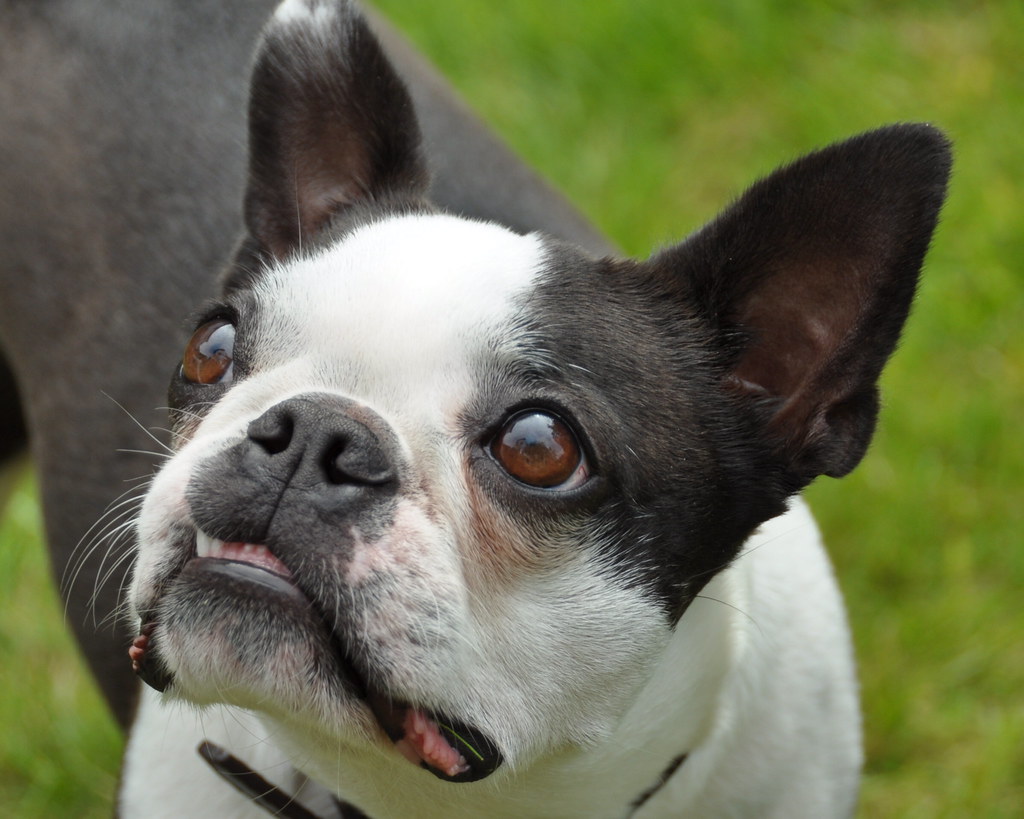
Figure: Black-and-white Boston Terrier looking up on grass, white blaze, round eyes, and short muzzle clearly visible. Michael Gwyther-Jones, Flickr[4]
Prominent eyes and a flat face in hot weather
Check the prominent eyes daily for redness, tearing, or irritation and have a veterinarian examine persistent discomfort. Ask breeders about screening for eye problems, deafness, and patellar luxation.[1] Like other flat-faced dogs, Bostons can struggle to breathe in hot, humid weather. Choose cooler times for outings and offer a shaded, ventilated place to rest. Seek prompt veterinary help for laboured breathing.[1]
Recognise a Boston by the square head, short muzzle, large dark round eyes, erect ears, and short tail, then match on exercise that varies by dog, limited alone time, weekly brushing, daily eye checks, and heat shelter; talk with a veterinarian and breeder about eye, deafness, and patella screens.[1] Identity rests on the dog and its registration.[1]
References
-
American Kennel Club. Boston Terrier.
-
Schlaugat, A. Boston-terrier-carlos-de.JPG.
-
Sendai Blog. Boston terrier.
-
Gwyther-Jones, M. Boston Terrier.