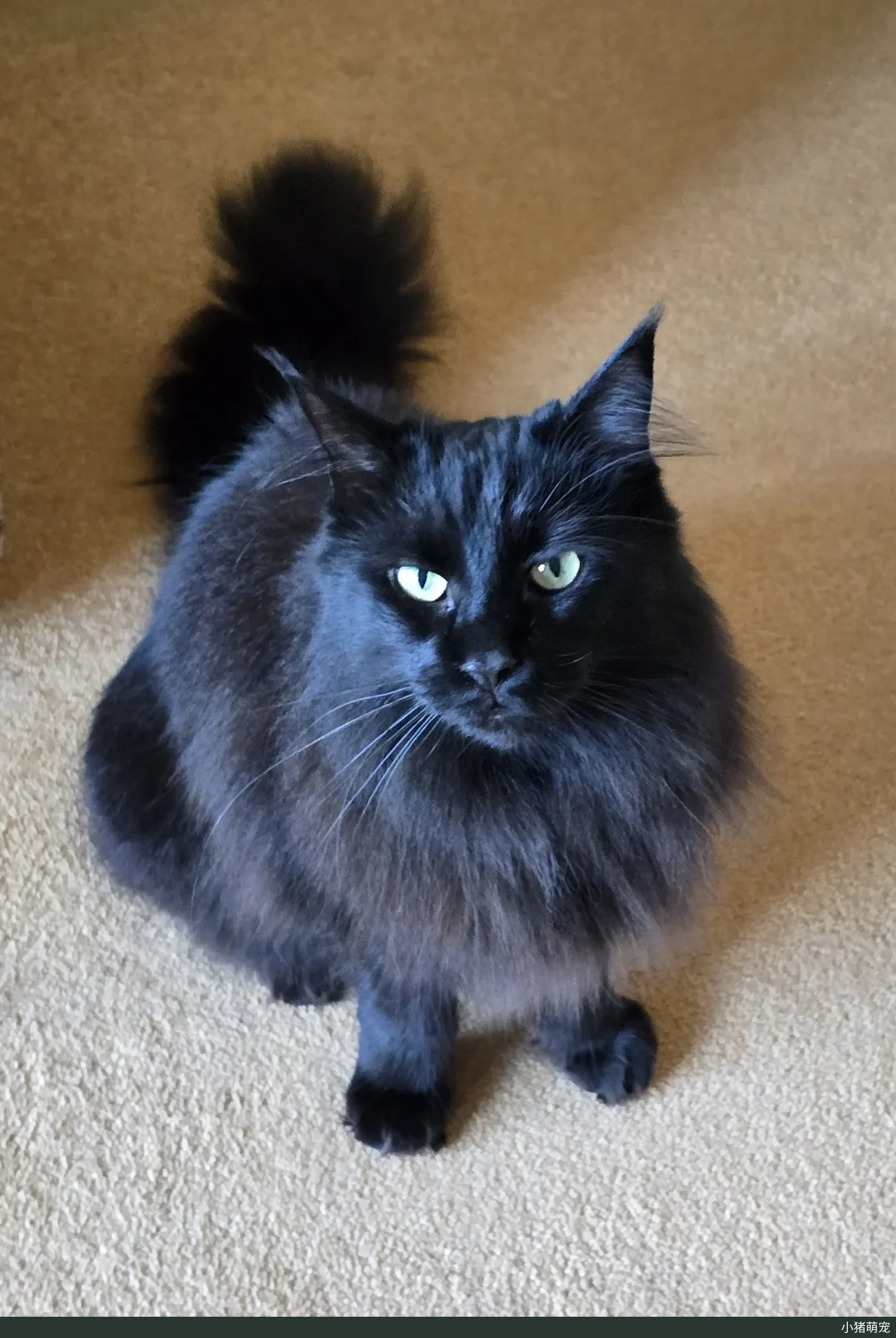
Black female Maine Coon showing the breed’s typical ear tufts, chest ruff, large paws, and bushy long tail. Photo: AUKS; source: Wikimedia Commons; license: CC0 1.0.

The Maine Coon is called a “gentle giant” by both CFA and TICA: large in size, affectionate yet not clingy. It originated in New England in the United States and was already a familiar cat-show guest by the late nineteenth century. This “Cat of the Day” piece covers origins, looks, and temperament, and draws on veterinary research for common health issues such as hypertrophic cardiomyopathy and hip dysplasia, plus picking and care points.
Origins and history
The Maine Coon is generally treated as a native breed of the U.S. state of Maine; TICA calls it the only longhaired pedigree breed originating in the United States. In 1985 Maine made it the state cat by statute; the current law is a single sentence: “The state cat shall be the Maine coon cat.”
The “Coon” in the name comes from a widely told story: brown tabby Maine Coons have bushy, ringed tails like raccoons, so some people thought they were cat–raccoon hybrids. Both CFA and TICA note that is biologically impossible. There are other legends about the long coat—for example that Marie Antoinette’s pet cats were sent to Maine. The associations’ plainer account is that shorthaired house cats arriving with early immigrant ships in New England crossed with overseas longhaired cats (TICA mentions Angora-type cats possibly brought by sailors), then natural selection in cold woodland produced a thick-coated, large-pawed, ear-tufted “working cat.” Note that this is the breeding community’s mainstream view; neither association page cites genetic research as evidence.
CFA says the Maine Coon’s documented history reaches the 1850s; TICA writes that it first appears in feline literature in 1861 as a black-and-white cat named “Captain Jenks of the Horse Marines.” At the first U.S. cat show in 1895, a brown tabby Maine Coon was judged best cat—CFA writes Cosey and calls it a male; TICA writes Cosie and calls it a female; the two accounts disagree. Early in the twentieth century other longhaired breeds rose in popularity and Maine Coons briefly left the show hall; after breeders’ efforts in the 1960s–1970s, the breed gained CFA Championship status in 1976 and for many years ranked in CFA’s top ten by registrations.
Looks and temperament
The Maine Coon is among the largest pedigree cats. Per CFA and TICA breed descriptions, hallmarks include a rectangular body, heavy bone, and a broad chest; large ears with clear tufts; large, round paws with tufts of hair, like natural snowshoes; and a long, bushy tail. The coat is heavy and water-resistant, shorter on the shoulders and longer on the belly, hind legs, and chest ruff. Many colors are accepted; brown tabby is most common, but pointed patterns (Siamese-style darker face and limbs) are not. Early Maine Coons were often polydactyl; TICA now lists polydactyl individuals separately as Maine Coon Polydactyl.
Maine Coons grow slowly, but association figures do not match. CFA says full maturity can take up to three years; TICA’s breed page says about age 4 in one place and 3 to 5 in another. Weight varies too: CFA says adult males at or above 20 pounds (about 9 kg) are not uncommon; TICA’s same page first gives males 18–22 pounds (about 8–10 kg) and females 12–15 pounds (about 5.4–6.8 kg), then later males averaging 13–18 pounds (about 5.9–8.2 kg) and females 9–13 pounds (about 4.1–5.9 kg). Treat these as rough ranges; individual variation is large, and CFA’s standard stresses that size should not be chased at the expense of quality.
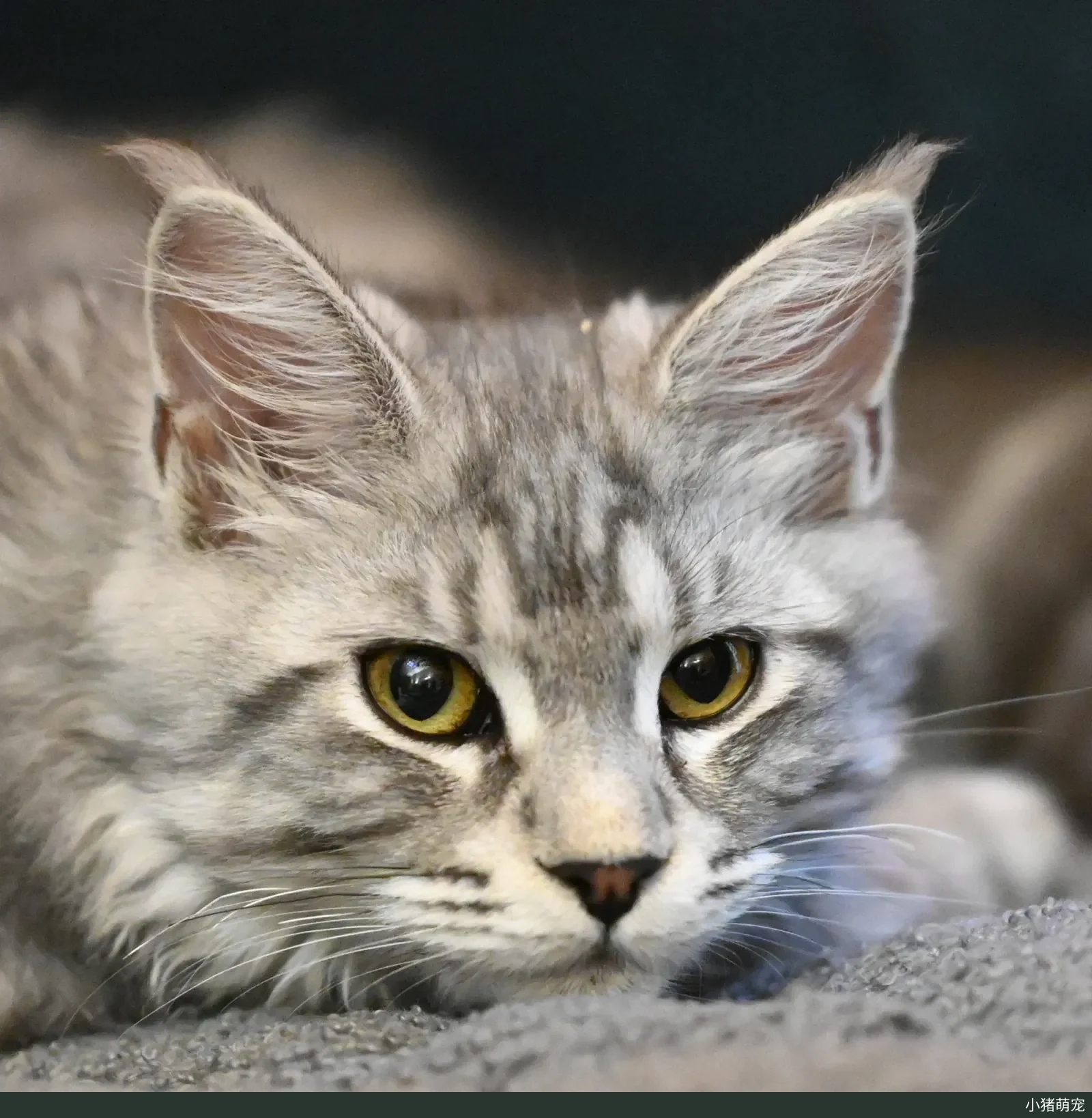
Black silver blotched tabby female Maine Coon. Tabby is the most common Maine Coon pattern, and silver colors fall within CFA and TICA accepted ranges. Photo: Azurfrog; source: Wikimedia Commons; license: CC BY-SA 4.0.

On temperament, both associations describe the breed as gentle, friendly, and easygoing. CFA says Maine Coons are social, loyal, and smart, enjoy interacting with every family member, and will move from one lap to another rather than bonding to only one person; TICA likens them to “clowns” that follow their people from room to room and “help” with chores, though most are not lap cats and do not constantly demand attention. They usually get along with children, dogs, and other cats, though CFA notes that children and other pets may at first be startled by the size. Maine Coons rarely meow loudly; they more often chirp and trill. Many like water play and retrieve games. These are association descriptions of the breed as a whole; individual cats still differ.
Common health issues
Hypertrophic cardiomyopathy (HCM) is the most common heart disease in cats: abnormal thickening of the left ventricular myocardium that in severe cases can cause sudden death. In 2005 Meurs et al. reported in Human Molecular Genetics a single-base MYBPC3 mutation (A31P) causing familial HCM in a UC Davis Maine Coon research pedigree—the first spontaneous HCM-causing mutation reported in a non-human species. UC Davis Veterinary Genetics Laboratory’s summary of later work notes that about two-thirds of Maine Coons do not carry the mutation; cats with one copy have roughly 1.8 times the HCM risk of non-carriers, and those with two copies about 18 times, with the latter possibly developing moderate-to-severe heart disease or sudden death by age 4 or earlier. The mutation is not the only cause; Maine Coons without it can still get HCM. A negative DNA test does not mean a clear heart, so TICA advises breeding cats to have both DNA testing and periodic echocardiograms read by a veterinary cardiologist.
Hip dysplasia is not rare in Maine Coons. Loder and Todhunter analyzed Orthopedic Foundation for Animals (OFA) registry data through April 2015; the paper went online in 2017 in the Journal of Feline Medicine and Surgery: among 2,548 Maine Coons with definitive scores, 24.9% had hip dysplasia, slightly higher in males (27.3%) than females (23.3%). Another 2019 Scientific Reports study used 20 years of Swedish PawPeds screening radiographs on 5,038 Maine Coons and found a 37.4% radiographic prevalence; lesion severity rose with age and weight and showed genetic correlation with weight; hip-focused selection in that program reduced severity in offspring. Both samples were voluntarily submitted registered cats and cannot stand for all Maine Coons, but both support real value in radiographic screening of breeding cats.
Spinal muscular atrophy (SMA) is a recessive genetic disease caused by a large deletion on chromosome 1. Per UC Davis VGL, affected kittens begin to show hind-limb muscle atrophy, unsteadiness, and abnormal posture around 3–4 months of age; the disease is not painful or fatal, and indoor cats can live comfortably. A kitten must inherit a mutant copy from each parent to be affected; two carriers mated are expected to produce about one in four affected kittens, so DNA testing helps breeders avoid carrier-to-carrier matings. TICA also notes that more breeders screen for pyruvate kinase deficiency and check for luxating patellas.
Care points
- Ask for test records when choosing a kitten: Both CFA and TICA note that responsible breeders screen breeding cats for HCM (DNA plus echocardiogram) and hip radiographs; TICA also lists SMA and other DNA screens. Ask to see the parents’ results.
- Groom regularly: CFA suggests brushing 2–3 times a week for 5–10 minutes to control shedding, reduce hairballs, and prevent mats; most Maine Coons do not need frequent baths. TICA notes coat texture varies—cottony coats may need daily brushing—and advises starting the habit as a kitten.
- Watch weight: TICA warns that neutered Maine Coons gain weight more easily; watch both food quality and portion size. The hip studies above found heavier cats often had worse lesions; UC Davis’s summary also notes heavier cats seem more prone to HCM, though that may relate to larger male body size.
- Nail and dental care: TICA suggests weekly nail trims for kittens and every 2–3 weeks for adults, plus regular tooth brushing as with other cats; ask a veterinarian for technique.
- Leave time for company and play: CFA says Maine Coons need moderate interaction and will “ask” for attention when people are home. TICA notes they prefer floor chase games over climbing; many retrieve, and some learn leash walks.
References
-
The Cat Fanciers' Association. Maine Coon Cat. Page undated; accessed 2026-10-17.
-
The International Cat Association. Maine Coon. Page undated; accessed 2026-10-17.
-
Maine State Legislature. Title 1, §217: State cat. PL 1985, c. 737, Pt. A, §4.
-
Meurs KM, Sanchez X, David RM, et al. A cardiac myosin binding protein C mutation in the Maine Coon cat with familial hypertrophic cardiomyopathy. Human Molecular Genetics, 2005, 14(23): 3587–3593. doi:10.1093/hmg/ddi386
-
UC Davis Veterinary Genetics Laboratory. Hypertrophic Cardiomyopathy (HCM) in Maine Coons. Page undated; accessed 2026-10-17.
-
UC Davis Veterinary Genetics Laboratory. Spinal Muscular Atrophy (SMA) in Maine Coon Cats. Page undated; accessed 2026-10-17.
-
Loder RT, Todhunter RJ. Demographics of hip dysplasia in the Maine Coon cat. Journal of Feline Medicine and Surgery, published online 2017-04-21. PMC11129213
-
Low M, et al. Demography, heritability and genetic correlation of feline hip dysplasia and response to selection in a health screening programme. Scientific Reports, 2019-11-20. doi:10.1038/s41598-019-53904-w