When an English Setter stops at the edge of the grass with its nose angled into the breeze, take a look around. If the spot is safe and the leash is slack, give the dog a moment to sniff. About 400 years ago, hunters in England bred these dogs to search for game birds. On finding a bird, the dog would hold still, or “set,” showing the hunter where to look. That posture gave the setter its name. If you are thinking of living with one today, allow time on walks both to follow an interesting scent and to stretch out into a good stride. [1]
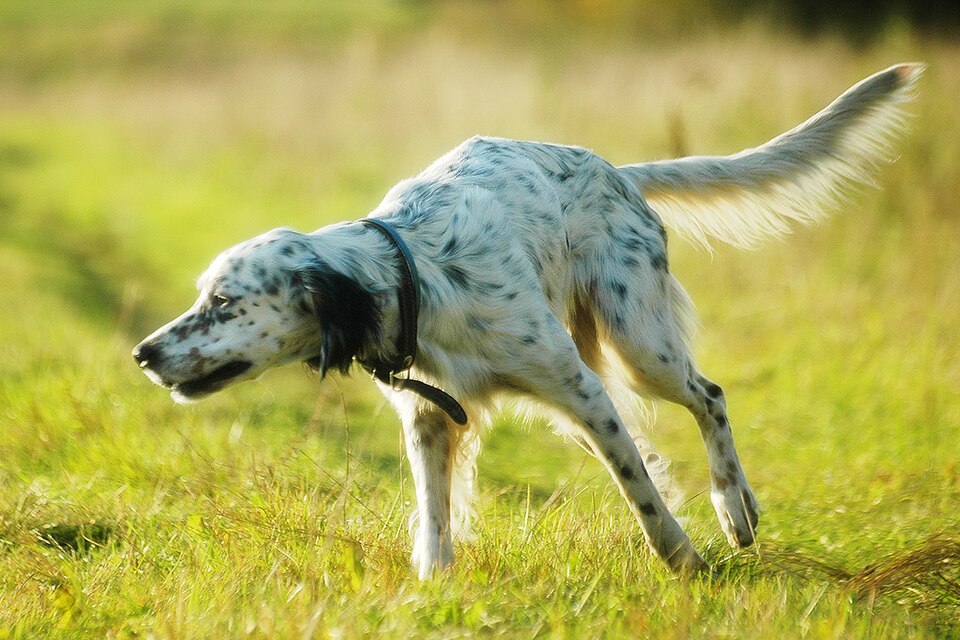
An English Setter works in a field. Dmitry A. Mottl, Wikimedia Commons[2]

In the field photograph, follow the dog's outline from its outstretched muzzle along its neck and back to the tip of its tail. The English Setter is a medium-sized sporting dog with a deep chest, muscular hind legs, and a stride that lets the front legs reach well forward. The coat lies flat along the back. On the ears, under the chest and belly, down the backs of the legs, and beneath the tail, it grows into a silky fringe called feathering. The raised tail shows how that fringe varies in length. To recognize the breed, start with its proportions and the places where the feathering grows. Then look at the markings. [1][2]
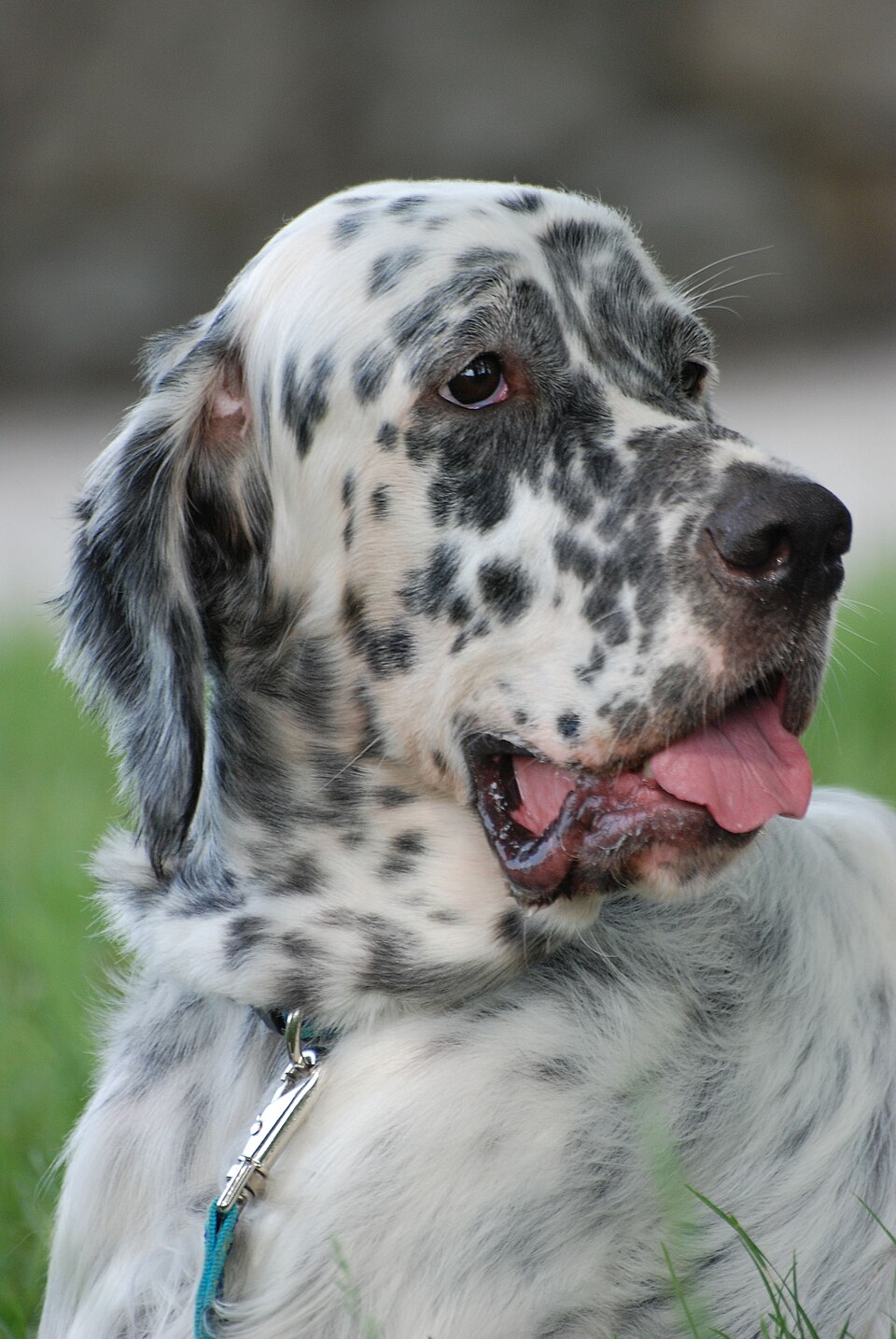
Fine spots mark this English Setter’s face. Lilly M, Wikimedia Commons[3]

Up close, the head is long and finely shaped, with dark brown eyes and low-set ears that hang close to the cheeks at rest. On the dog in the portrait, the dark flecks along the muzzle grow denser around the eye. Long hair covers the outer ear. The breed term for colored flecks scattered over a white coat is belton. The flecks can be black, as they are here, or shades of orange, lemon, or liver. When it comes time to groom a setter, pay particular attention to the long hair on those ears and the fringe along the underside of the body. [1][3]
A route with room to sniff and run
Choose a route you could manage on an ordinary workday. An adult English Setter needs regular exercise. A large, securely fenced area gives you room for a daily run or a game together. If the green space near you is open, a long leashed walk can work well. Find a stretch where you can both lengthen your stride and a grassy verge away from traffic where the dog can linger. With time for both, you can let the dog finish sniffing and still get a good walk in. If most weekdays allow only a quick trip around the block, work out who can take the longer walk. [1]
An adult setter may be a fine hiking companion. A puppy you have just brought home needs a different outing. An English Setter’s bones and joints can take up to about two years to reach mature strength. Puppies and young dogs can explore and learn to walk on a leash while long runs and repeated jumps wait. If your household usually combines the dog’s walk with someone’s morning run, plan two outings for now. Give the puppy a walk at an easy pace on a route you can cut short. [1]
Teach the dog how to move on before a scent has its full attention. Start on leash in a quiet place. Say “let’s go,” turn, and take a step. As soon as the dog turns to follow, offer praise or a small treat. Once that movement is familiar, try it on a stretch of path with more smells. Near birds, a blind corner, or an open gate, use the leash and give yourself enough distance to keep the dog safe. Practice where it can still respond to you. English Setters have keen noses and can take a scolding to heart. It is easier for the dog to learn what comes next when everyone uses the same cue and rewards the moment it follows. [1]
To picture a particular setter in your home, ask its current caregiver to talk you through yesterday. Where did the dog exercise? What did it do when it saw a bird? Where did it settle afterward? Many English Setters play hard outdoors and then rest quietly near their people. Even with a yard, someone needs to go out and exercise with the dog, then welcome it back into the household routine. If what appeals to you is a quiet companion at your side, who will share the lively part of its day? [1]
Start with the feathering
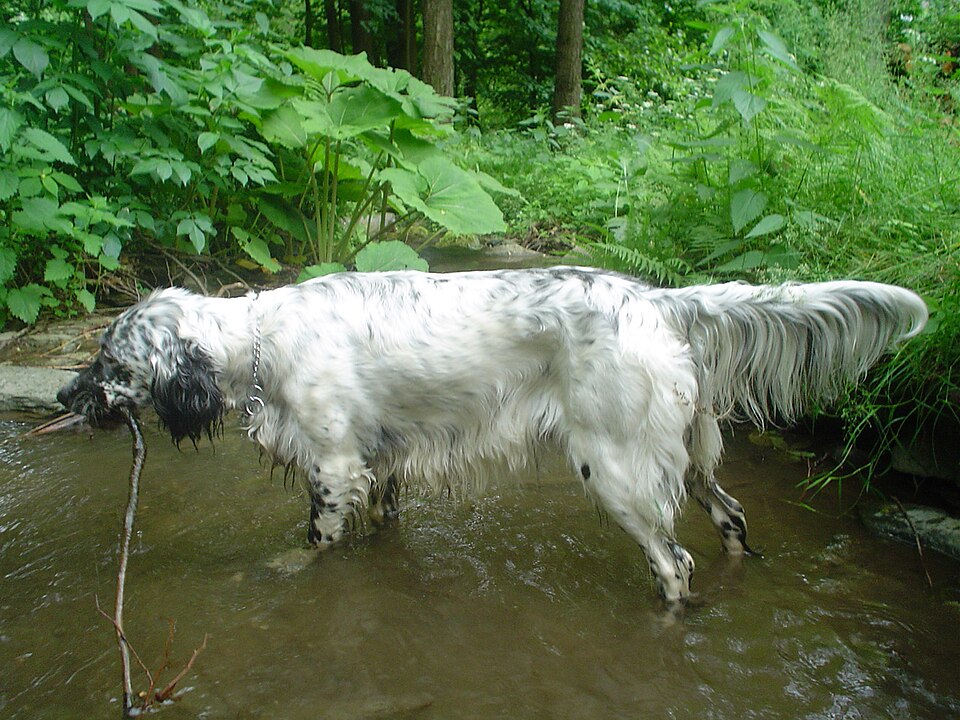
Feathering hangs beneath the belly and tail. Nik jerinic, Wikimedia Commons[4]

The setter standing in the creek shows where a brush needs to reach. The coat lies smooth across the back, while long strands hang from the chest, belly, and underside of the tail. After a walk through wet grass, run your fingers through those strands to feel for bits of grass or a tangle beginning to form. The American Kennel Club (AKC) recommends brushing at least once a week with a soft-bristled brush. Brush the back, lift the long hair on the ears to check underneath, and work through the feathering behind the legs and under the tail in small sections. For a small tangle, hold the hair close to the skin and gently tease it apart from the tips with a long-toothed metal comb. A mat that tightens against the skin can cause discomfort and skin problems. [1][4]
When you reach the head, gently lift each ear flap so you get to know how the ear usually looks. If you notice redness, swelling, an unusual smell, or the dog pulling away when you touch an ear, tell your veterinarian what has changed and arrange an examination. Check the hair around the feet and the length of the nails regularly, too. The AKC suggests trimming the nails about once a month and bathing the dog every four to six weeks. As you brush each week, notice where the first tangles form. That gives you a place to start next time. [1]
Before bringing a puppy home, ask the breeder for both parents’ hip, elbow, thyroid, and hearing screening records. The AKC lists all four checks for English Setters. The hearing test, called BAER, measures the brainstem auditory evoked response to sound. Check the dog’s identity on each record so you know which results belong to each parent and which tests the puppy has had. Your veterinarian can then explain what the findings mean for this dog. Everyone at home should also recognize one urgent sign. If the dog suddenly keeps trying to vomit and nothing comes up, go to an emergency veterinary hospital immediately. A swollen abdomen or restless pacing may accompany the retching. Gastric dilatation volvulus, in which the stomach expands and twists, can progress rapidly. Do not wait for every sign to appear. [1][5]
References
-
[1] American Kennel Club. English Setter Dog Breed Information.
-
[2] Dmitry A. Mottl. File:English setter in the field.jpg. Wikimedia Commons, 2006.
-
[3] Lilly M. File:English Setter R 01.JPG. Wikimedia Commons, 2007.
-
[4] Nik jerinic. File:Gucci.English setter.jpg. Wikimedia Commons, 2008.
-
[5] Cornell University College of Veterinary Medicine. Gastric dilatation volvulus (GDV) or “bloat”. Updated April 2025.