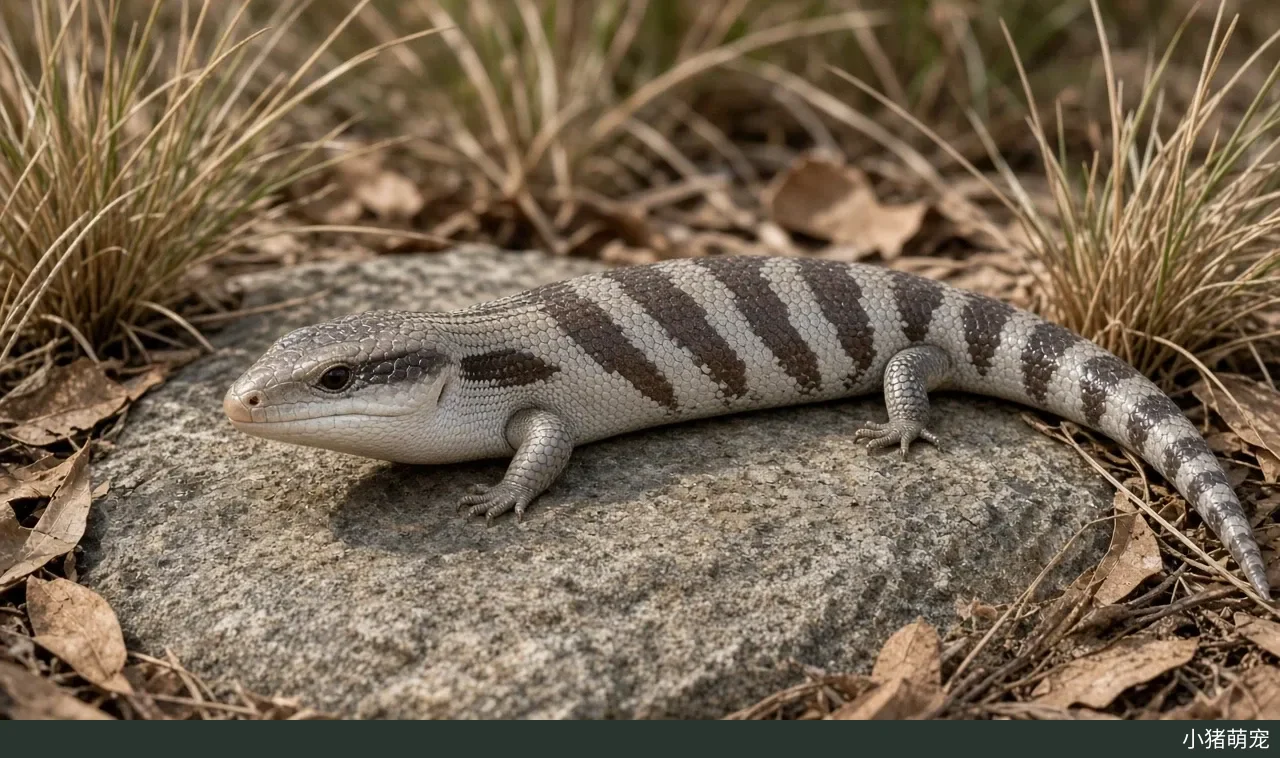
Blue-tongue skinks have a broad head, short legs, and a stout body, with dark crossbands on the back. AI-generated illustration, not a real photograph.
Blue-tongue skinks are a group of large terrestrial skinks native to Australia, New Guinea, and Indonesia; when startled they flash a blue tongue to deter rivals. They are generally gentle, and captive lifespan often reaches 15–20 years. Keeping one well requires a spacious enclosure with a temperature gradient, a UVB lamp, a mixed animal-and-plant diet, and single housing; before you acquire one, confirm a legal source and check CITES Appendices and China’s import-approval rules.
Natural habits
“Blue-tongue skink” is not a single species but a collective name for several species, subspecies, and geographic forms in the skink genus Tiliqua, found in Australia, New Guinea, and Indonesia. Per LafeberVet veterinary materials, the pet trade most often sees the northern blue-tongue (T. scincoides intermedia) and an as-yet undescribed T. scincoides type from Irian Jaya, Indonesia; some animals are locally bred, but many are also imported from Indonesia and New Guinea. The Australian Museum notes that blue-tongues are among the largest members of the skink family; eastern blue-tongues can reach nearly 600 mm total length, with overlapping scales that contain small bony plates.
In the wild, blue-tongues favor open country with dense grass and thick leaf litter; at night they shelter under litter, rocks, or fallen wood, bask in the morning sun, and forage once warm; active body temperature is about 30–35°C. They are not especially quick and mainly take slow prey such as snails and beetles; powerful jaws crush snail shells outright, and they also eat flowers, fruit, and other plant matter. When threatened, a blue-tongue turns to face the opponent, opens its pink mouth wide, and shows its broad blue tongue; if that fails, it hisses and flattens its body to look larger. They spend most of the year alone, hold strong territories, and males fight fiercely in the breeding season.
Blue-tongue skinks are viviparous: embryos develop in the mother’s oviduct with placental support, and females give birth to live young 3–5 months after mating. Australian Museum materials say eastern blue-tongues produce up to 19 young per litter, usually about 10; neonates are independent at birth and disperse within days; they mature around age 3 at about 400 mm total length. The museum records captive animals living past 20 years; RSPCA Australia gives a captive life expectancy of 15–20 years.
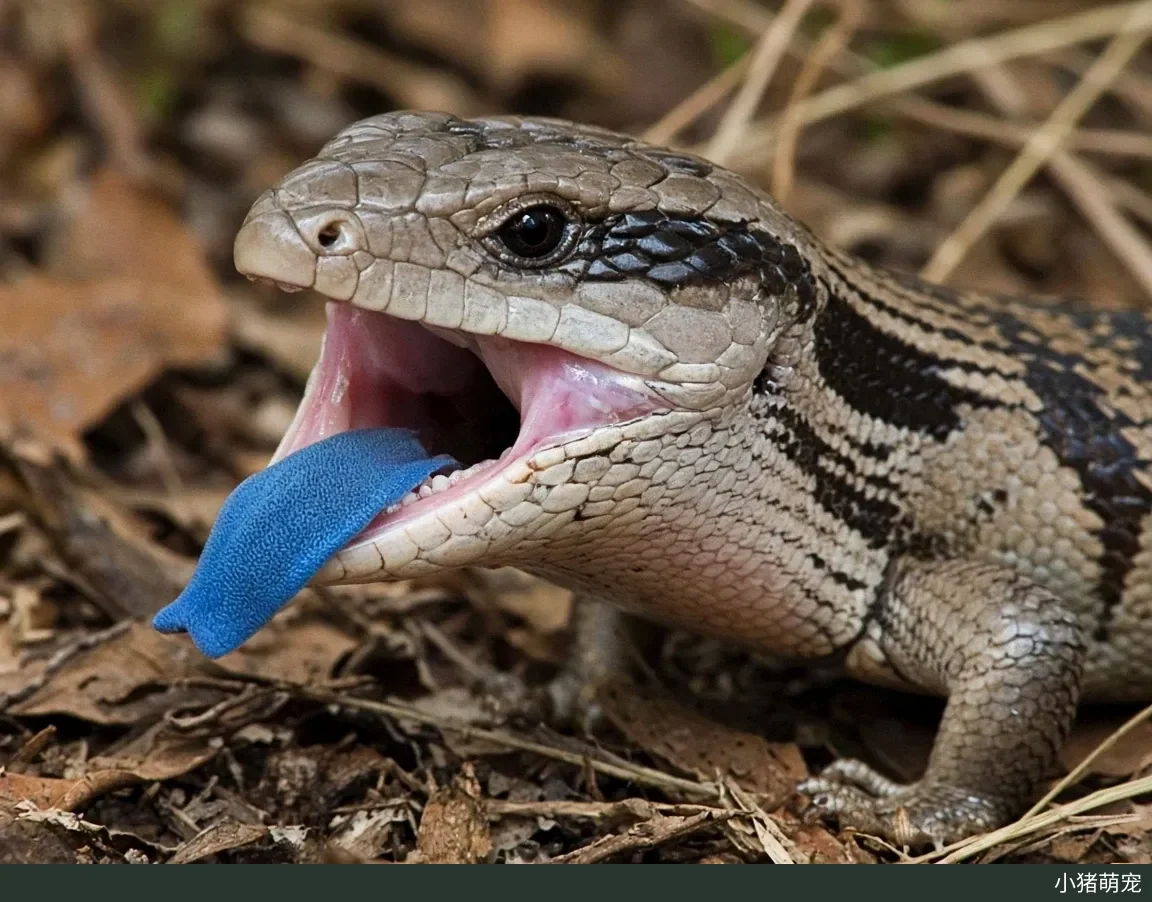
When threatened, a blue-tongue skink opens its pink mouth and flashes its blue tongue to deter opponents. AI-generated illustration, not a real photograph.
Husbandry environment
Blue-tongues are terrestrial animals, so the enclosure should be long rather than tall. RSPCA (UK) recommends a sturdy, sealed vivarium of at least 120 cm long, 60 cm high, and 60 cm deep for a single adult, with good ventilation; RSPCA Australia’s reference for an adult eastern blue-tongue is 1.2–1.8 m long, 0.6 m wide, and 0.6–0.9 m high. Place a hide at each end of the thermal gradient and a wide, flat basking rock in the warm zone. Blue-tongues like to dig; RSPCA (UK) suggests about 10 cm of natural soil or a soil–sand mix and avoiding indigestible substrates such as calcium sand, corn-cob granules, or crushed walnut shell that can cause intestinal blockage if swallowed.
Temperature should form a “hot at one end, cool at the other” gradient so the animal can thermoregulate. RSPCA (UK) references a basking spot of 30–35°C (somewhat higher for juveniles), a cool end of 22–26°C, and nights no lower than 20–22°C; LafeberVet for northern blue-tongues gives a cool end of 21–29°C and a basking spot of 33–38°C. The numbers differ because species and origin differ—knowing which blue-tongue you have matters. All heaters should be on thermostats, checked daily with a digital thermometer, and lamps should have guards against burns. Lighting is equally critical: UVB helps lizards synthesize vitamin D3 and absorb and use calcium. RSPCA (UK) suggests a UV index of 3.0–5.0 at the basking spot, tapering to 0 in shade, with lights on 12 hours and off 12 hours. The Merck Veterinary Manual notes that most clear glass and plastics block UVB; fluorescent tubes generally need to be within 30 cm of the animal and replaced every 9–12 months.
Humidity is also species-specific: RSPCA (UK) gives a range of 40–90%, about 40–60% for eastern blue-tongues (RSPCA Australia), and LafeberVet suggests about 30% for northern blue-tongues. Monitor with a hygrometer at the cool end and provide a humid hide lined with damp moss; always offer a wide, shallow dish of clean water. One point that is easy to miss: blue-tongues must be housed singly. LafeberVet notes that “even juveniles will fight aggressively,” and RSPCA Australia warns that co-housing can cause serious or fatal injury.
Diet and common health issues
Blue-tongues are omnivores, but recommended ratios differ by source: RSPCA (UK) suggests roughly 50–60% animal matter and 40–50% vegetables for adults, with fruit under 10%; LafeberVet recommends dark leafy greens as the base (45–60%); RSPCA Australia suggests insects at 70% for animals under one year, dropping to 50% for adults. The shared points are clear: mix animal and plant foods, treat fruit as a snack, and give juveniles more protein. Animal foods can include gut-loaded crickets, dubia roaches, silkworms, and similar insects, plus eggs and pet-store snails; do not feed wild-picked snails, which may carry pesticides or parasites—the Australian Museum notes wild blue-tongues can be poisoned by snails that have taken molluscicide. On supplements, LafeberVet suggests dusting non-breeding adults once a week with a low-phosphorus calcium powder (Ca:P at least 2:1) and a multivitamin once a week; RSPCA (UK) warns that vitamins and minerals can be overdone, and that large extra D3 is unnecessary when UVB is adequate—dose guidance is best from a reptile vet. Feeding frequency also varies: RSPCA Australia suggests daily feeding under 3 months, three times a week at 3–8 months, and one to two times a week after 8 months, while LafeberVet writes every 1–2 days for adults. Captive blue-tongues fatten easily; RSPCA (UK) suggests weighing monthly and adjusting accordingly.
LafeberVet considers blue-tongues generally hardy; common problems include bite wounds from group housing, nutritional secondary hyperparathyroidism (metabolic bone disease, MBD), obesity, and wasting from poor husbandry. RSPCA (UK) explains that MBD most often follows a lack of UVB, leading to vitamin D3 deficiency, poor calcium absorption, muscle weakness, and soft bones; early signs in blue-tongues include a wavy or sunken spine, then jaw deformity. Other issues to watch: vitamin A deficiency can cause periocular and lip skin lesions with secondary infection; weight loss, constipation, or diarrhea may involve internal parasites—ask a vet for a fecal exam; prolonged soaking in the water dish may signal skin problems or mites; incomplete sheds often track low humidity, especially residual old skin on toe and tail tips. Reduced winter activity and appetite are common in healthy animals, but sudden anorexia or clear weight loss warrants a reptile vet promptly. LafeberVet’s prevention advice is regular checkups, fecal parasite testing, and quarantine for new animals. When handling, support the body with both hands and never grab the tail—blue-tongues can drop the tail, and the regrown tail is shorter. Reptiles can carry Salmonella; wash hands before and after contact and cleaning.
Legality, protection status, and ethics
Under the CITES Secretariat Appendices in force from 5 March 2026, Tiliqua is regulated in three ways. The pygmy blue-tongue (T. adelaidensis) is in Appendix I, the strictest tier; the Australian government notes Australia proposed the listing and CoP19 adopted it by consensus because trade threatened the species’ survival. Australian-native T. scincoides scincoides (eastern blue-tongue), T. s. intermedia (northern blue-tongue), T. rugosa, T. occipitalis, T. nigrolutea, and T. multifasciata are listed by Australia in Appendix III. Other Tiliqua groups—such as Indonesian and New Guinean forms—are not named in the Appendices and are currently outside CITES controls.
In China, the 1993 Ministry of Forestry Notice on Approving Certain Endangered Wildlife as National Key Protected Wildlife manages non-native wild animals listed in CITES Appendices I and II as national first- and second-class protected wildlife respectively; under that notice, Appendix I pygmy blue-tongues are managed as national first-class protected wildlife, and the notice does not cover Appendix III species. The current Wildlife Protection Law (revised 30 December 2022, in force 1 May 2023) Article 40 requires that importing wildlife species from abroad be approved by the State Council wildlife protection authority; species on the Convention’s restricted-trade list also need lawful import/export permits, which Customs uses for inbound quarantine. Unlawful imports may lead to confiscation and fines of 50,000–500,000 yuan (Article 58). Imported wildlife must not be unlawfully released or discarded; otherwise the animal must be recovered within a deadline and fines of 10,000–100,000 yuan may apply (Article 59). This article found no China-specific listing or local rule aimed only at blue-tongue skinks; localities may add keeping and trade requirements—before purchase, ask the seller for proof of lawful origin and consult the local forestry and grassland authority.
Legality is only the floor. RSPCA Australia’s position is that wildlife should not be taken from the wild as pets; only species clearly suited to home care should be kept, and poor care and husbandry are common, serious welfare problems in captive wildlife. RSPCA (UK) advises confirming you can afford 10–20-plus years of care and cost, identifying the exact species, and preferring captive-bred animals or rehoming blue-tongues that need a new home. Set up and test-run the new enclosure for at least a week before arrival to confirm thermostats and lamps work; minimize handling in the first week so the animal can settle. Most important: never release a blue-tongue outdoors—it does not belong in China’s natural environment, and release both harms the animal and may break the law.
References
-
Australian Museum. Eastern Blue-tongue Lizard (page undated; accessed 2026-10-17)
-
Pollock C, Donoghue S. Basic Information Sheet: Northern Blue-Tongued Skink. LafeberVet, 2011-02-25 (reviewed/updated 2012-05-31)
-
RSPCA. Blue-tongue skink CARE SHEET (PDF, © 2019)
-
RSPCA Australia Knowledgebase. How should I care for my blue tongue skink? (updated 2023-08-14)
-
Divers SJ, Comolli JR. Management and Husbandry of Reptiles. Merck Veterinary Manual (comprehensive review July 2025)
-
CITES Secretariat. Appendices I, II and III valid from 5 March 2026
-
Australian Government DCCEEW. The 19th Conference of the Parties to CITES (CoP19) (page undated)
-
Ministry of Forestry. Notice on Approving Certain Endangered Wildlife as National Key Protected Wildlife (Lin Hu Tong Zi [1993] No. 48), 1993-04-14
-
Standing Committee of the National People’s Congress. Wildlife Protection Law of the People’s Republic of China (revised 2022-12-30, in force 2023-05-01)