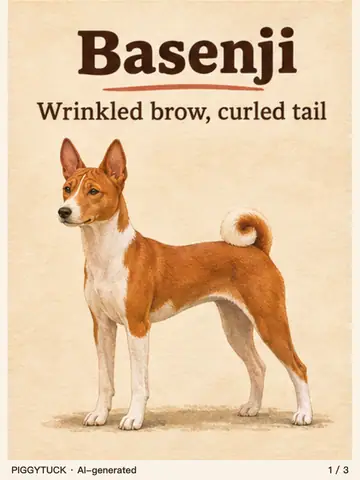
The Basenji sits in the AKC Hound Group as a small, short-coated African hunter: short back, light build, tall on the leg for its length, about 16–17 inches at the shoulder.[1] It is an old hound breed, with a resemblance to some depictions of early domestic dogs; images show up in Egyptian artifacts and in Babylonian and Mesopotamian art after gifts moved up the Nile to pharaohs.[1] When those courts faded, the type persisted semi-wild at Nile and Congo headwaters; African hunters valued keen sight, burst speed, and scent, plus a vertical leap used to scan grassland prey—one African name translates roughly as a jumping-up-and-down dog.[1] Western import attempts from the late 1800s were fragile: an 1895 English pair died quickly; a 1937 pair caused such a show stir that police managed crowds, yet only the male Bois survived after the female and a litter died; a Boston breeder paired Bois with Congo to produce the first American-bred litter.[1] For homes, the through-line is a sight-and-scent chaser that defaults to instinct—this is worth accounting for when planning walks, fencing, and training.[1]
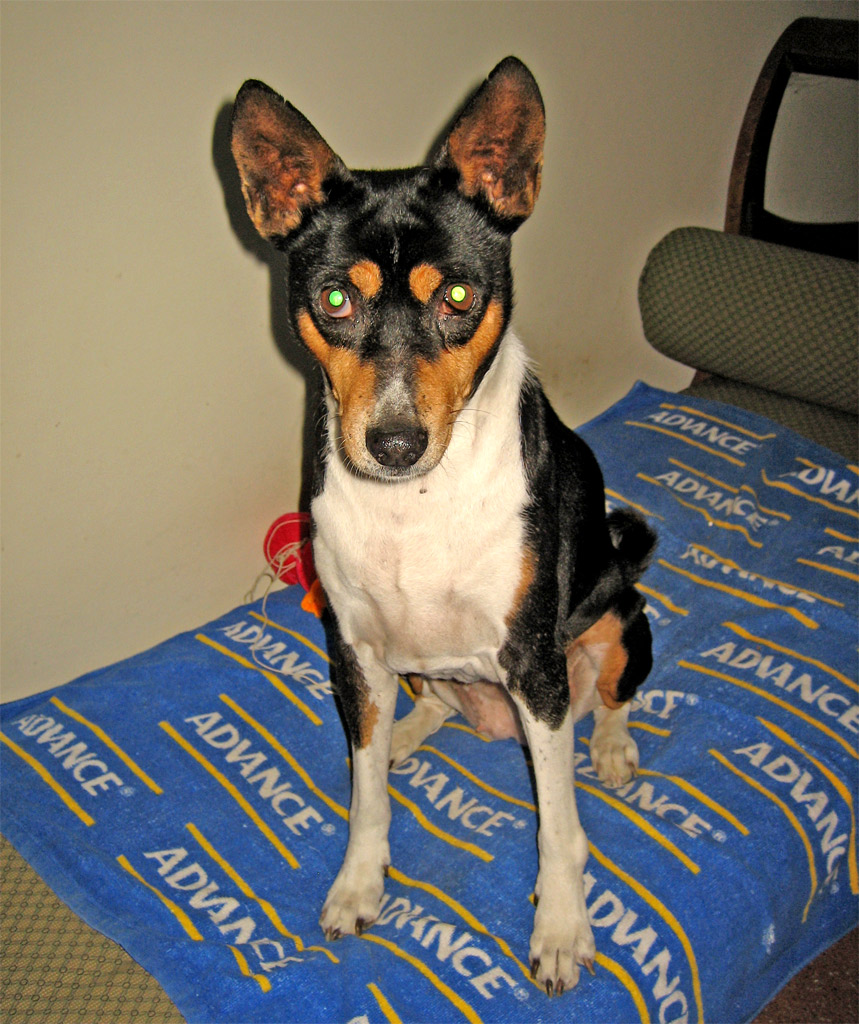
Figure: Tricolour Basenji sitting on a blue blanket, erect ears and white chest visible. fugzu, Flickr[2]
Wrinkled brow, curled tail, and a racehorse trot
Its outline is light and alert, with a flat, chiseled skull tapering to the eyes; dark hazel to dark brown almond eyes set obliquely; small erect, slightly hooded ears set forward; fine forehead wrinkles when the ears rise—clearest on puppies, harder to see on black, tricolor, or brindle coats.[1] Neck long and crested, back level, short coupled with a waist; tail set high, bent sharply forward and curled tight to one side; gait compared to a racehorse at a full trot.[1] Coat is short and fine over pliant skin; colors are chestnut red, pure black, black-and-red tricolor, or black-striped brindle on red, always with white feet, chest, and tail tip—white legs, blaze, or collar optional, but white must not dominate.[1] The first photo shows a tricolor adult facing the camera on a blanket—erect ears, tan brow points, white chest; flash eye-glow is not real iris color.
Long play in a fence, short training
Basenjis are energetic and curious, and can get destructive when bored. Plan daily walks on leash and plenty of play in a secure enclosure.[1] A moving animal or an interesting scent can send a Basenji off in pursuit. The breed can jump high, so check the fence for both height and security. Lure coursing, tracking, obedience, and agility can give that energy an outlet.[1]
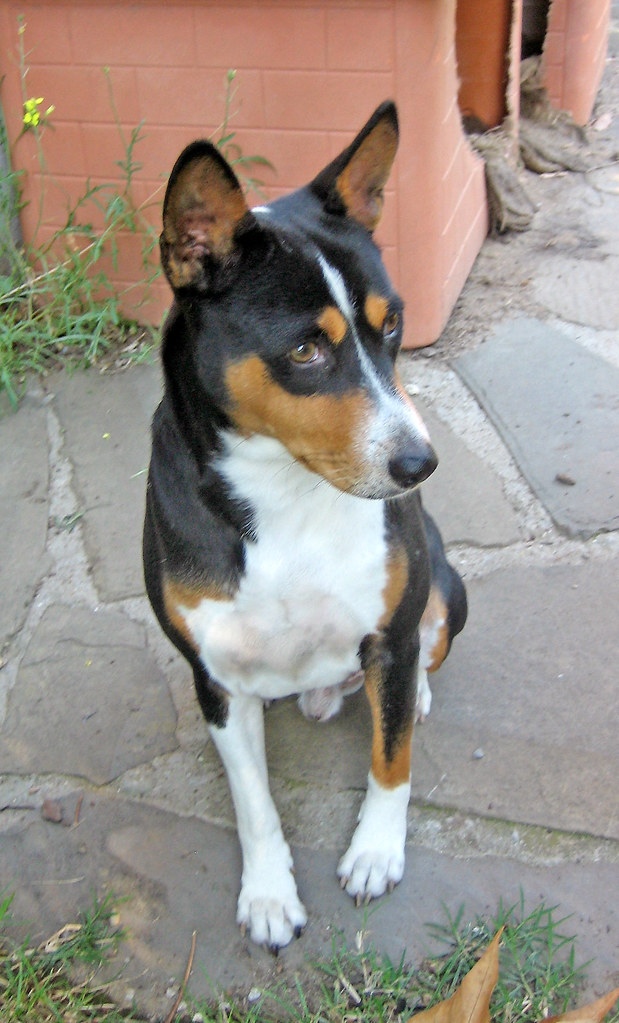
Figure: Tricolour Basenji sitting on outdoor paving, head turned right, white face blaze and front paws visible. fugzu, Flickr[3]
Start socialisation and puppy class early to give an energetic, quick-learning dog a start on everyday manners.[1] “Catlike” habits do not block learning—positive, rewarding sessions work—but interest fades fast, so keep drills to about five or ten minutes.[1] Basenjis rarely bark in the usual way. Their calls can sound like a chortle or a yodel.[1] The second photo’s tricolor adult on paving, head turned, is a typical watchful sit.
A short coat, brushed weekly
Basenjis groom themselves much like cats; a weekly pass with a soft brush, rubber mitt, or hound glove usually suffices and spreads skin oils for gloss.[1] Little “doggy” odor means baths only after a mess; trim nails regularly so walking and running stay comfortable.[1] Time saved on coat care belongs to exercise and supervision—easy to brush is not the same as easy to keep.
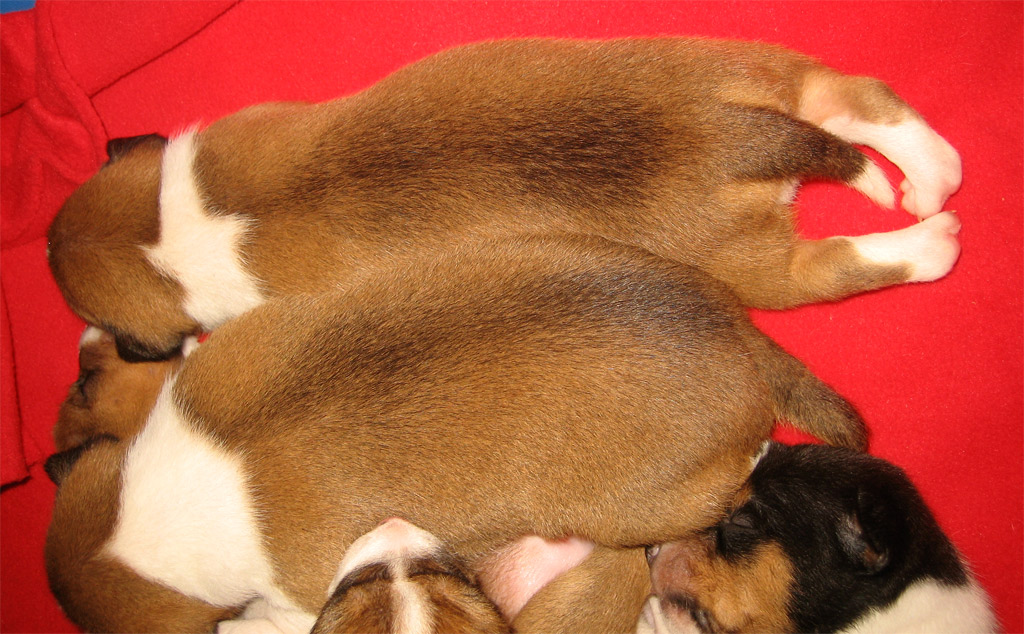
Figure: Basenji puppies sleeping huddled on red bedding, short fine coats visible. fugzu, Flickr[4]
Thyroid, bowel, and gene tests
Ask breeders about screening for hypothyroidism, IPSID inflammatory bowel disease, and hip dysplasia.[1] Separate gene tests identify carriers of Fanconi syndrome (a kidney disorder) and progressive retinal atrophy (PRA); those results cover only the assayed genetic risks and help breeders plan pairings—they are not a whole-dog health guarantee and do not rule out untested conditions.[1] As with other breeds, check ears and brush teeth; some dogs gain weight easily, so watch calories, treat volume, and water access.[1] Use the list when talking with breeders and veterinarians, not as a diagnosis of one dog; appetite, weight, vision, or stool changes belong with a veterinarian.[1]
Recognise a Basenji by the wrinkled brow, small erect ears, high curled tail, and short fine coat, then match on heavy regular exercise, long fenced or on-lead play, early socialisation with short training sessions, weekly brushing, and talks about thyroid and bowel screens plus Fanconi/PRA carrier tests.[1] Identity rests on the dog and its registration.[1]
References
-
American Kennel Club. Basenji.
-
fugzu. Basenji delle Caserosse.
-
fugzu. Basenji delle Caserosse.
-
fugzu. comodità basenji….