The Eurasier owes its beginnings to a much-loved family dog. In Germany, Julius Wipfel missed a clever, independent-minded spitz he had owned and wanted to breed a companion that could form a close bond with the whole family. In 1960, he and a group of fellow breeders crossed a Chow Chow with a German Wolfspitz. They called the early dogs Wolf-Chows. In 1972, breeders introduced the Samoyed. The name they eventually chose, Eurasier, reflects the European and Asian origins of those ancestors. The American Kennel Club (AKC) has recorded the Eurasier in its Foundation Stock Service since 2008. [1][2]
A side view reveals something a close-up of a fluffy face can easily miss. The Eurasier is a medium-sized spitz whose body is slightly longer than it is tall at the shoulder. In the show photograph, the dog stands on all four feet. Its tail curls forward, with the long, pale hair lying across its back. Follow the outline of the chest downward and you can still see where the forelegs stand beneath the thick coat. The Fédération Cynologique Internationale (FCI) standard gives a shoulder height of 52–60 cm for males and 48–56 cm for females. It also specifies that the coat should allow the body’s proportions to show. [2]
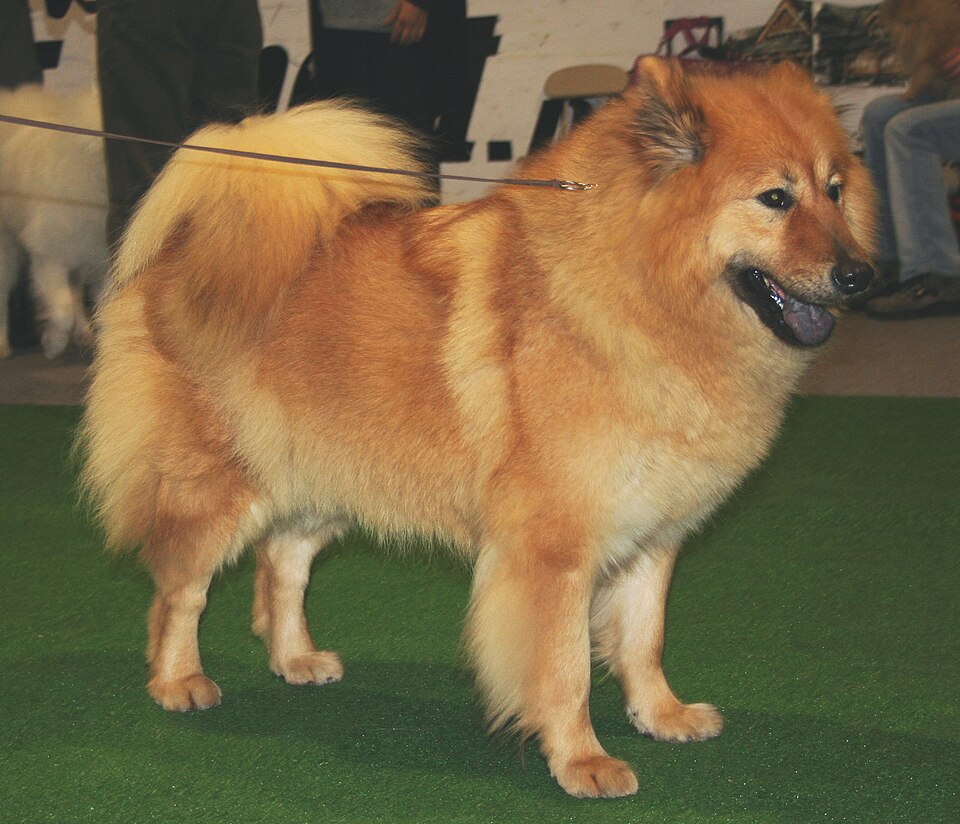
A Eurasier stands in profile. Pleple2000, Wikimedia Commons[5]

On the head, look for upright triangular ears and a muzzle that tapers from the cheeks to a black nose. These make better clues to the breed than coat color. One Eurasier may have dark fur around the muzzle, another pale cheeks and lighter markings around the eyes. Even the tongue varies in color. It can be pink, purple, or spotted. The profile photograph also shows where the coat changes length. Short hair lies flat along the bridge of the nose, then grows fuller along the sides of the face and around the neck. [1][2]
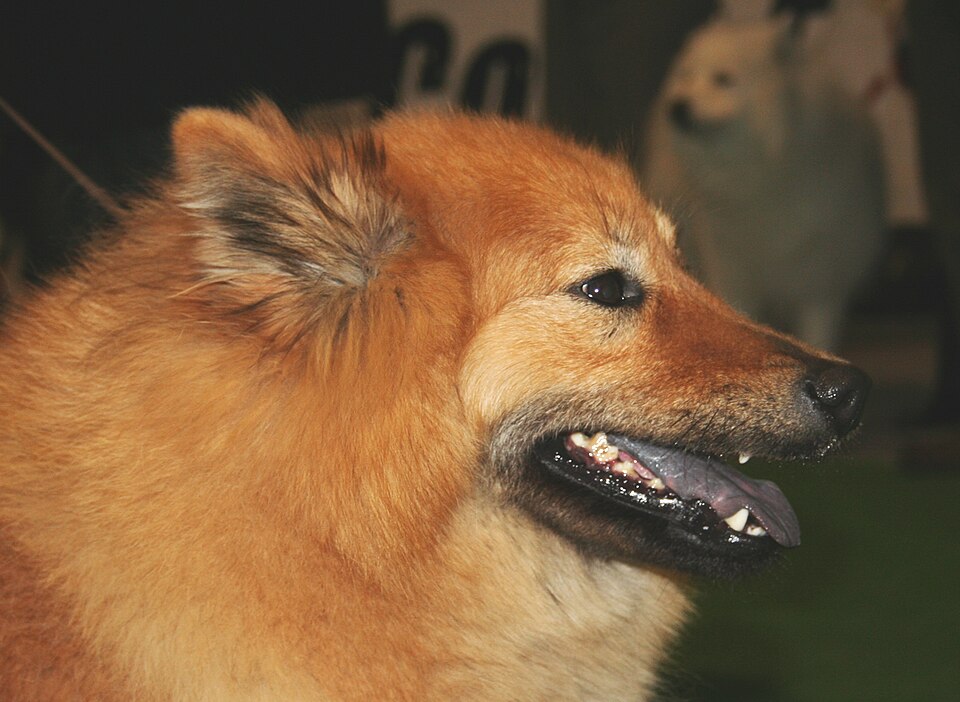
The Eurasier’s muzzle tapers toward the nose. Pleple2000, Wikimedia Commons[6]

Let the dog choose when to greet a guest
A Eurasier may treat a familiar person and a stranger quite differently. The United States Eurasier Club describes a dog that likes to stay close to family activities but often takes time to watch a newcomer before deciding how close to get. When someone visits for the first time, ask them to say hello to the family first. Leave the dog a clear path back to someone it knows. You can judge the distance by what the dog has room to do. Can it stay where it is, step forward for a sniff, and walk away again? Even if it comes over first, the guest can give it a moment before reaching out. [3]
Start with one regular visitor who is happy to give the dog that choice. Take your usual seat. If the dog lies down beside you, let it rest there. If you get up and it turns to follow, a quiet word of praise is enough. When the same person next visits, notice whether the dog settles more easily. Some Eurasiers make friends quickly. Others still prefer to sit a little way off after several visits. If friends and relatives often come over, consider whether everyone would be happy to have a dog whose idea of joining the gathering is to sit nearby. [3]
An ordinary workday with a Eurasier
The quieter hours between visits say more about a Eurasier’s need for company. While someone reads or works, the dog may be content to rest nearby, each occupied in their own way. To see how that would fit your home, think through an ordinary workday. Who takes the dog out in the morning? Once people leave, how long is the house empty? Where can the dog settle with everyone in the evening? If the routine leaves a Eurasier alone in the yard most of the time, even a generous yard offers little of the company this breed seeks. [1][3]
A Eurasier that is quiet indoors can be lively once outside. Set aside time each day for a walk together. A stop in a fenced area is a chance to practice coming when called. Start close enough that the dog is still paying attention to you. Reward it when it comes back, then let it go on exploring. Wait until it returns reliably even with distractions before considering off-leash time where it is permitted. Play with a compatible dog can be part of an outing, too. Some Eurasiers enjoy swimming, others take to agility. Let the dog’s interests guide what you add to the daily walk. [1][3]
Eurasiers enjoy working with people they know. They also have minds of their own and are sensitive to harsh corrections. Keep the meaning of a cue consistent as you practice it in different places. For example, once the dog turns to look at you on hearing its name in a quiet room, try the same thing just before a walk. When it looks at you, praise it and head out together. That one response is a good place to end the lesson. Working a familiar cue into something the dog enjoys makes it easier to hold its interest than asking for the same action over and over in one spot. [1][3]
Brush daily when the undercoat sheds
The Eurasier lying in the field shows several coat lengths on one dog. Compare the short hair on the face with the fuller coat around the neck and chest and the long tail hair spread out behind it. On the body, a medium-length outer coat covers a dense undercoat. The outer hairs are especially long on the tail and the backs of the legs. In an ordinary week, set aside a regular time to brush the whole dog. Part the thick coat and work through it section by section, picking out grass seeds or burrs caught on walks. Take the chance to check the eyes, ears, paw pads, and nails, including the dewclaws higher up the legs. [1][2]
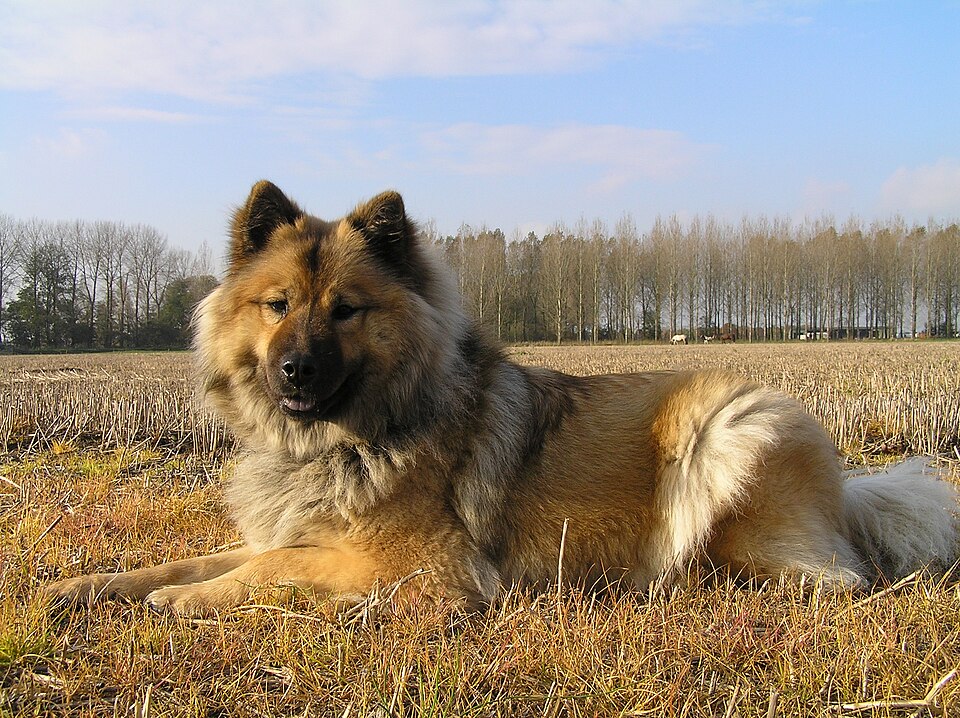
Coat length varies across the Eurasier’s body. Ekta, Wikimedia Commons[7]

It is the seasonal shedding of the undercoat that changes the household routine. According to the AKC, Eurasiers typically shed their undercoat once or twice a year. Each shed lasts about three weeks, with daily brushing needed to remove the loosened hair. A weekend grooming session may fit neatly into the rest of the year. During those few weeks, someone needs to pick up the brush on weekdays as well. Baths are generally infrequent. When considering the breed, picture both schedules, including who could take over if the person who usually does the brushing is away during a shed. [1]
Reading the parents’ screening records
When asking about a litter, ask the breeder to show you the screening records for both parents. The United States Eurasier Club recommends hip, kneecap, eye, and thyroid screening for breeding dogs, along with a genetic test for Dandy-Walker-like malformation (DWLM). Each report answers a different question. X-rays show the hip joints. A veterinarian examines the kneecaps, and an eye specialist checks for conditions including distichiasis, in which extra eyelashes grow along the eyelid margin. For DWLM, a cheek swab provides the sample for a DNA test that shows whether the dog carries the associated genetic variant. [4]
Start by matching the name on each report to the parent it belongs to, then look at the test, the date, and the result. The date matters particularly for thyroid screening. Because autoimmune thyroiditis is a concern in Eurasiers, the club requires a thyroid test within the 12 months before each breeding. For information about hips or eyes, look for the corresponding examination reports alongside the DNA result. Reading the records this way gives your family a clear picture of which risks were assessed and a useful family history to pass on to the veterinarian who will care for your dog. [4]
References
-
[1] American Kennel Club. Eurasier.
-
[2] Fédération Cynologique Internationale. FCI-Standard N° 291: EURASIER (Eurasian). 2020-02-17.
-
[3] United States Eurasier Club. Character.
-
[4] USEC Board of Directors. United States Eurasier Club Health Statement. 2024-11-21.