Look at the cat resting on pink fabric. Its blue eyes draw your gaze to the dark fur around them. Follow a pale foreleg down and the darker colour appears again at the toes. The markings on the face give the Neva Masquerade its mask, and the paws repeat the pattern. When you pick up a comb, the places that need your attention are behind the ears, under the forelegs and along the backs of the hind legs, where small knots can escape the cat’s own grooming. Point colour explains where this cat appears in a breed registry. The length and density of the fur tell you where to comb. [1][2][3]
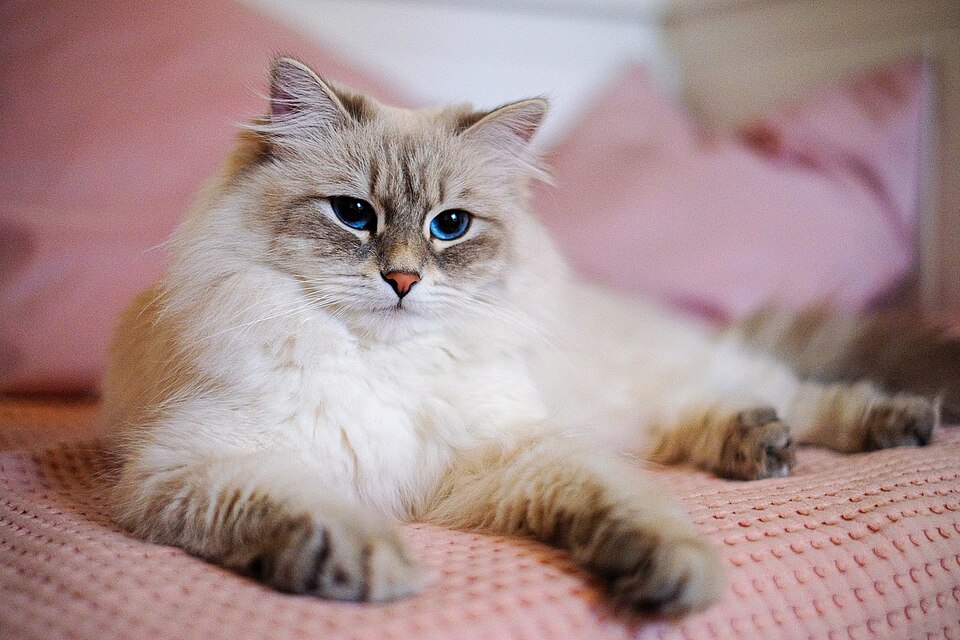
This Neva Masquerade has blue tabby points. Apinanaivot, Wikimedia Commons[7]

Why does the Neva Masquerade appear in the Siberian standard?
Our Siberian cat profile introduces these close relatives. Their shared history goes back much further than either registry entry. Semi-longhaired domestic cats from Russia and the surrounding region formed the foundation of the Siberian breed. Records place Russian semi-longhaired cats at shows as early as the nineteenth century. Formal development of the modern Siberian began in the late 1980s. In 1998, the Fédération Internationale Féline (FIFe) recognised the Siberian. That date marks the breed’s recognition by this particular association. [1][4]
The name Neva Masquerade identifies the colourpoint member of the Siberian family. FIFe gives it a separate entry as the Siberian’s sister breed, with the code NEM for the Neva Masquerade and SIB for the Siberian. The World Cat Federation (WCF) puts both names at the top of its SIB standard. Under coat colours, it identifies the Neva Masquerade as the colourpoint variety of the Siberian. To find the same cat in the two systems, look up NEM in the FIFe directory and open the Siberian standard at WCF. [1][2]
What markings can the mask carry?
“Colourpoint” describes where the colour falls. The face, ears, lower legs, paws and tail are darker than the body. Within those darker areas, you can distinguish the colour of the fur and any pattern it carries. The photographer describes the first cat as a blue tabby point. Here, “blue” refers to the soft grey of the fur on its face. The blue of its eyes is a separate trait. WCF specifies blue eyes for the Neva Masquerade and permits any amount of white in the coat. In the portrait of Ermes, white fur runs from the middle of the forehead down the nose to the muzzle, leaving dark tabby markings visible beside both eyes. [2]
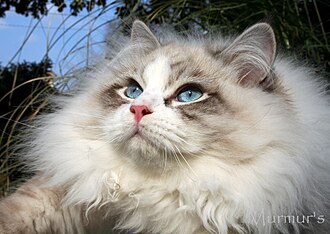
A white blaze divides Ermes’s mask. Gatto Siberiano Murmur's, Wikimedia Commons[8]

Below the mask, the Neva Masquerade has the Siberian’s sturdy build. WCF describes a medium to large adult with muscular legs and round, compact paws tufted between the toes. The head is short and broad, with low-set cheekbones and a rounded muzzle. The sleeping FleurAmour Caramel Frossika offers another view of the points. Even with the eyes closed, you can see the dark fur along the ear and forepaw and the fine spots around the muzzle. The show catalogue lists this cat as a seal tabby point. [2]
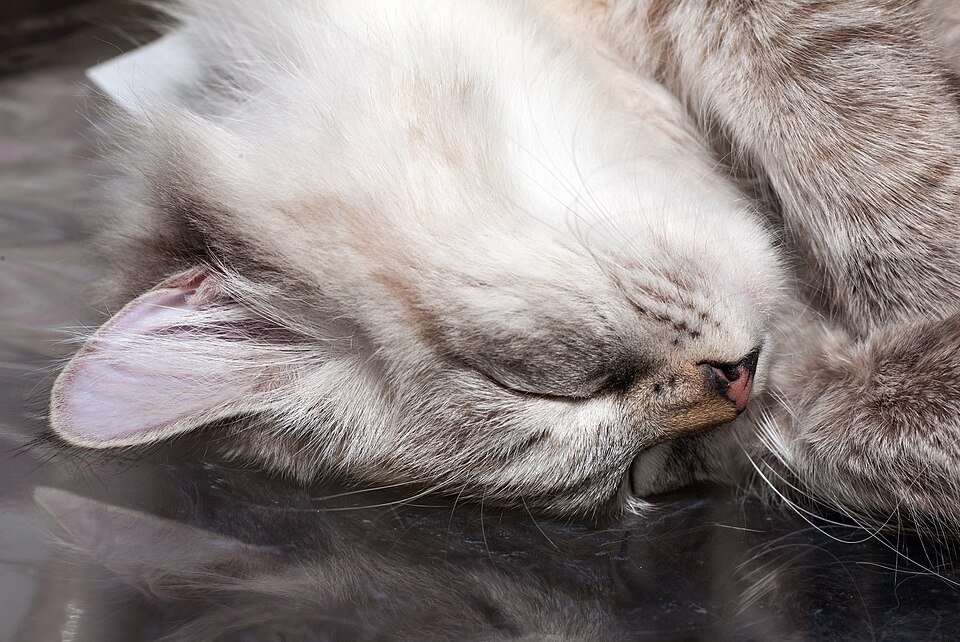
FleurAmour Caramel Frossika has a seal tabby mask. Nickolas Titkov, Wikimedia Commons

Grooming beneath the outer coat
The coat feels different depending on where you touch it. Firm, coarse outer hairs cover the back and sides, with shorter, softer fur packed densely underneath. Longer hair forms a ruff around the neck and chest, hangs like breeches down the backs of the hind legs and fills out the bushy tail. The winter ruff and undercoat can be especially full. A much shorter summer coat can give the same cat a slimmer outline. Once you have combed the smooth surface of the back, gently part the long hair at the sides of the neck and behind the legs with your fingers to feel for tangles underneath. [1][2][3]
Set aside a quiet moment each day. Start with gentle strokes where your cat likes to be touched, then check behind the ears, where the forelegs meet the chest, and along the insides and outsides of the hind legs. A small, loose tangle may tease apart easily. Stop if the teeth of the comb start pulling the skin. Leave large, tight mats close to the skin to a professional groomer or veterinarian. Scissors can easily cut the skin beneath a mat. If you uncover redness or a light touch makes your cat flinch in pain, show your veterinarian the exact spot. Keep up the daily check even when the ruff thins out in summer. [3]
Let the cat choose how close to be
FIFe’s Siberian profile mentions a familiar bit of household behaviour. These cats often take an interest in whatever the family is doing. A sturdy perch with room to turn around gives a cat of this build a place to watch. A sheltered bed in a quiet spot gives it somewhere to retreat. Offer company when the cat approaches and let it rest when it settles back into bed. The same principle works for grooming. Choose a moment when your cat welcomes contact and leave it room to walk away. You can then tell how much grooming it is comfortable with that day. [1][5]
The Feline Veterinary Medical Association includes opportunities to hunt in play and separate places for essential activities among an indoor cat’s basic needs. Move a wand toy along the floor and pause now and then so the cat can watch, chase and pounce. In a home with several cats, trace the route each one takes to its food. If two bowls sit side by side, one cat can guard both, leaving another to squeeze past it for a meal. Spread out food, water, litter trays and resting places so each cat can reach what it needs on its own. A familiar scent on a sleeping mat can also help a cat feel secure. [5]
Which records tell you about heart health in the family?
Before bringing a cat home, ask whether either parent or another cat in the same family line has been diagnosed with hypertrophic cardiomyopathy (HCM). New Zealand Cat Fancy records HCM in Siberians and recommends screening breeding cats by heart ultrasound when there is reason to suspect the condition in a line. If the breeder mentions screening, ask to see the report. Look for the identity of the cat examined, the date of the scan and the veterinarian’s findings. Keep those details for the veterinarian who will care for your own cat. [4]
A heart ultrasound lets the veterinarian see whether the wall of the left ventricle has thickened. Some cats with HCM show no outward signs. A cat that plays and seeks company may look well even with the condition. If your cat is breathing through an open mouth or visibly struggling to breathe while at rest, contact an emergency veterinarian immediately. A registration document tells you what the association calls the cat. A dated ultrasound report bearing the cat’s identity tells you what the veterinarian saw in that individual heart on the day of the scan. [4][6]
References
-
[1] Fédération Internationale Féline. Siberian.
-
[2] World Cat Federation. Siberian Cat – Neva Masquerade (SIB). 24 February 2022.
-
[3] VCA Animal Hospitals. Grooming and Coat Care for Your Cat.
-
[4] New Zealand Cat Fancy. Health & Conformation Policy: Siberian. Issued April 2022.
-
[5] Feline Veterinary Medical Association. New Feline Veterinary Medical Association Position Statement Reimagines Life for Indoor Cats. 28 August 2025.
-
[6] Cornell University College of Veterinary Medicine. Hypertrophic Cardiomyopathy (HCM).
