The name Ukrainian Levkoy refers to a selectively bred line of cats. In their account of the history of hairless cats, veterinary researchers at Utrecht University list the Levkoy among the lines developed by crossing hairless cats with cats selected for other distinctive physical traits. The standard published by Rolandus Union International (RUI) names the Don Sphynx and the Scottish Fold among the permitted outcrosses. The name therefore has a more specific meaning than any sparsely coated domestic cat from Ukraine. [1–3]
RUI lists the Ukrainian Levkoy under its own code, ULV, in its Ukrainian-language breed directory. Its English-language standard carries the word “Provisional” in the title. These documents establish how one association names and judges the breed. They do not establish recognition across the major international cat registries. The distinction matters at home, too. A judge can use the standard to assess the direction of an ear fold or the position of a wrinkle. Whether the skin is inflamed or a joint hurts when the cat moves is a different question. [1–3]
What the photographs show
In Alena Ivanchuk’s photograph of a dark Levkoy, the upper edges of the ears are easy to pick out. The bases sit wide apart, and the tips turn forward and down, leaving the inner ear flaps visible. RUI describes a rounded fold involving the upper third to half of the ear flap. Below the ears, slightly slanted almond-shaped eyes and prominent cheekbones give definition to the elongated, wedge-shaped head. Ear shape varies within the line. RUI also lists a separate judging category for straight-eared cats. [1,2]
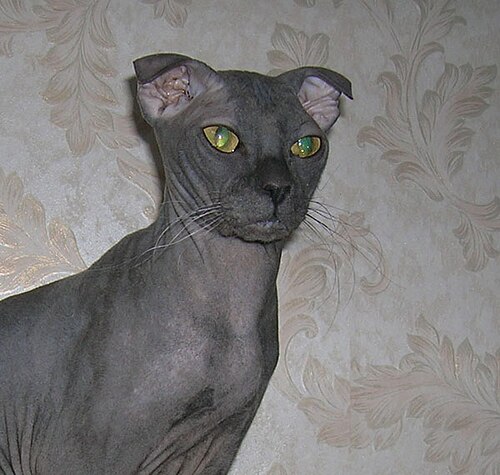
The Levkoy’s ear tips fold forward. Alena Ivanchuk, Wikimedia Commons[9]

The next two photographs show the same male show cat, Helen Grig’s Pink Panther. As he turns his face toward the camera, fine lines run from below his eye across his cheek. When he lowers his head, several deeper folds appear between his jaw and shoulder. RUI describes loose skin that can form folds on the head and neck. Coat coverage varies too. Some Levkoys are nearly bare, some have fine down, and others retain a coarser, curly coat. A patch of exposed skin or an extra crease when the cat looks down tells you little about whether the area needs cleaning. [1,2]
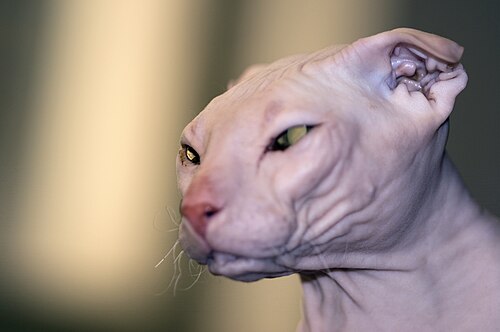
Fine folds run across the Levkoy’s cheek. Nickolas Titkov, Wikimedia Commons[10]

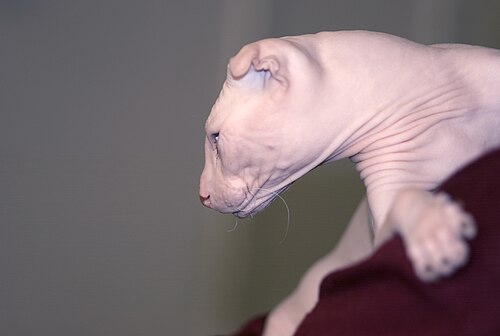
Neck folds stand out as the head lowers. Nickolas Titkov, Wikimedia Commons[11]

What does your cat’s skin usually look like?
Neck folds alone are no reason to wipe the skin every day. When your cat comes over to be stroked, notice the colour and texture of the same patch of skin as the head rises and falls. Once you know what it usually looks like, changes are easier to spot. A previously smooth patch may develop a scab, an area may stay red, or the cat may repeatedly scratch the same spot with a hind foot. A note of where the change first appeared and when the scratching began will tell your vet more than a count of the folds. [1,4]
If the skin is red, itchy or broken, contact your vet before deciding how to clean it. Allergies, parasites and infections can all cause scratching, and wiping away a scab will not reveal the cause. Cats Protection advises that washes, creams and ear cleaners can disturb the skin’s natural balance of oils. Some products made for people are unsafe for cats. If your vet recommends washing an area, ask which product to use, exactly where to apply it and how often. A forward fold in the ear tip does not itself call for cleaning or medicating the ear canal on the same schedule. [4]
A sparse coat also affects the choice of a sleeping spot. Fur helps retain warmth and shields the skin from sunlight. Offer a warm, sheltered bed away from draughts that your cat can enter and leave freely, as well as a cool place in the shade. Limit exposure to strong sunlight, particularly if the skin around the ears or nose is pale. If the only comfortable perch in the house is a sunny windowsill, a cosy bed out of the sun gives the cat a way to stay warm without lying in direct light. [3–5]
Indoor cats also need opportunities to chase, hide and spend time alone. Draw a toy along the floor and give your cat time to crouch, stalk and pounce. Let the game end when the cat walks away. In a home with several cats, spread food, water, litter trays and resting places across different locations. Watch whether your Levkoy can reach a drink or a bed without having to get past another cat. A cat that seeks out your lap should be just as free to leave it. [5]
Why do folded ears matter for mobility?
The welfare concern behind a folded ear extends beyond keeping it clean. In Scottish Fold cats, Gandolfi and colleagues linked the forward ear fold and osteochondrodysplasia, a disorder of bone and cartilage development, to the same variant in the TRPV4 gene. The disorder can affect the lower limbs and tail, and joint damage can progress. That finding makes the Levkoy’s Scottish Fold ancestry relevant to its care. The study did not establish how common the disorder is in Levkoys, and the depth of an ear fold cannot tell you how much pain an individual cat feels. [1,6]
RUI’s Ukrainian-language standard expressly prohibits mating two folded-eared Levkoys. In its guidance on unrecognised breeds, the UK’s Governing Council of the Cat Fancy cites osteochondrodysplasia as a reason the Scottish Fold is ineligible for recognition. The Feline Veterinary Medical Association also names the Scottish Fold in its position on responsible breeding, which puts a cat’s comfort and welfare ahead of selection for a particular appearance. [2,7,8]
If you live with a folded-eared Levkoy, its usual movements give you a point of comparison. Perhaps your cat used to jump onto a favourite chair every day with ease and now repeatedly stops in front of it. Its steps may have become noticeably stiff. Note when the change began, take a short video if you see it happen naturally, and arrange a veterinary assessment promptly. There is no need to ask the cat to repeat a jump for the camera. While you wait for the appointment, put its usual bed and water where it can walk to them easily. [5–7]
References
-
Rolandus Union International. RUI Breed Standard: UKRAINIAN LEVKOY (Provisional).
-
Rolandus Union International. RUI Breed standard: UKRAINIAN LEVKOY (ULV).
-
Universiteit Utrecht. 18 November 2018. Deskundigenverklaring: Fokken van designerkatten als de Bambino Sphynx.
-
Cats Protection. Skin disorders.
-
Feline Veterinary Medical Association. 28 August 2025. New Feline Veterinary Medical Association Position Statement Reimagines Life for Indoor Cats.
-
Gandolfi B et al. 2016. A dominant TRPV4 variant underlies osteochondrodysplasia in Scottish fold cats. Osteoarthritis and Cartilage, 24(8), 1441–1450.
-
The Governing Council of the Cat Fancy. Unrecognised Breeds.
-
Feline Veterinary Medical Association. 2024. 2024 Responsible Breeding in Feline Medicine.
-
Alena Ivanchuk. File:Ukrainian Levkoy cat.jpg. Wikimedia Commons.
-
Nickolas Titkov. File:Ukrainian Levkoy (3416903263).jpg. Wikimedia Commons.
-
Nickolas Titkov. File:Ukrainian Levkoy (3416954579).jpg. Wikimedia Commons.