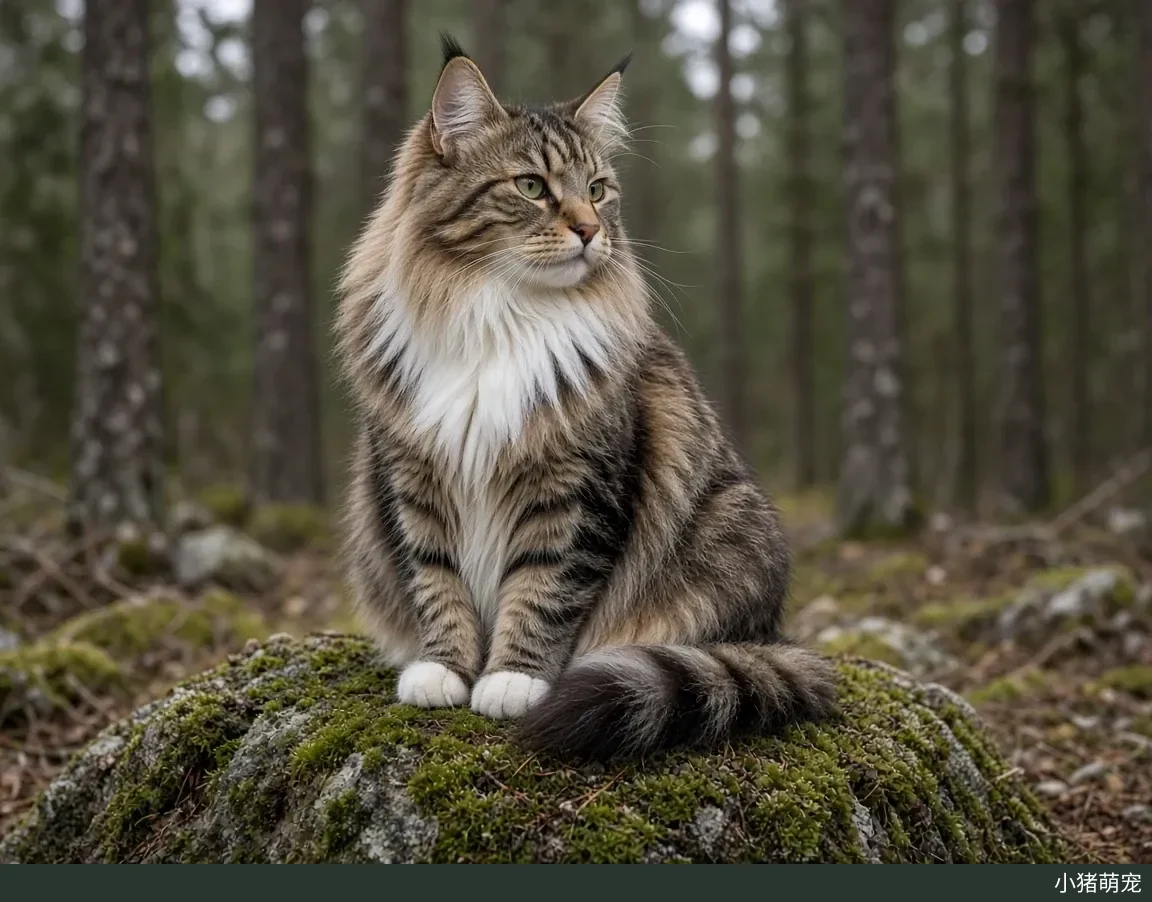
A brown tabby-and-white Norwegian Forest Cat sitting on mossy stone in a pine forest, with ear tufts, chest ruff, and a fluffy long tail visible. AI-generated illustration, not a photograph.
The Norwegian Forest Cat is a large semi-longhair that formed naturally in the Nordic cold: a triangular face, large tufted ears, a waterproof double coat, and maturity that may take until about five years of age. It is gentle yet independent and likes to join in household life. Overall it is considered a healthy breed, but genetic risks such as glycogen storage disease type IV and hypertrophic cardiomyopathy exist; before bringing one home it is worth reviewing parental test records.
Origins and path to breed recognition
In Norway it is called Skogkatt (forest cat); the English name is Norwegian Forest Cat, and enthusiasts often nickname it Wegie. Its exact origin is unclear. The Cat Fanciers’ Association (CFA) breed profile says these cats are thought to have come out of the forest about 4,000 years ago and later become farm ratters; in Norse myth, the goddess of love and beauty Freya’s chariot is drawn by two huge forest cats. CFA and The International Cat Association (TICA) also mention that they sailed with the Vikings and caught mice on shipboard. These accounts come from legend and associations’ speculative descriptions, not from verified chronology.
Treating it as a breed to protect is a twentieth-century story. In a breed note released in November 2025, the Norwegian Forest Cat club Norsk Skogkattring (NSR) writes that numbers of this native cat gradually fell from the late nineteenth into the early twentieth century; from 1930 there was a push for breed recognition, and individuals were shown by 1938, but World War II interrupted the work. CFA also notes that crossing with short-haired strays nearly erased the breed’s distinctive traits. NSR was founded in 1975 and selected cats meeting the standard from across Norway to build a breeding base. In 1976 the Fédération Internationale Féline (FIFe) granted provisional recognition; formal recognition came in Paris in 1977, when Norway had 192 Norwegian Forest Cats on the register, with championship (CAC) status effective from 1 January 1978.
The breed then spread worldwide. Both CFA and TICA record that King Olav of Norway named it Norway’s national cat in the 1970s, and the first breeding pair entered the United States in 1979. TICA says it was the first North American registry to grant the breed championship status, in 1984; CFA granted championship status in 1993.
Appearance and coat
The Norwegian Forest Cat has solid bone and a strong frame. Under the FIFe breed standard in force from 1 January 2026, the head is an equilateral triangle; in profile the nose is long and straight with no break (no stop); ears are large with a broad base, lynx-like tufts at the tips, and long hair growing from inside the ear; the body is long and powerful, limbs strong, hind legs higher than the front; the tail is long and bushy, reaching at least to the shoulder blade and preferably to the neck. CFA’s standard is broadly consistent, except that ear-tip tufts are “desired but not required,” and ideal tail length equals the body length.
Its most recognizable feature is the double coat: a dense, woolly undercoat and a long, coarse, glossy waterproof outer coat; fully coated cats also have a chest ruff, a neck ruff, and “breeches” on the hind legs. CFA notes that the undercoat only fully develops in winter; TICA also says the coat shortens in summer, so the same cat can look like two different animals in winter and summer. On color, CFA accepts almost all colors and patterns, but not chocolate, lilac/lavender, cinnamon, fawn, sable, or pointed colors, which the standard treats as signs of outcrossing to other breeds.
It is also famously a “slow-maturing” breed: both CFA and TICA say full maturity may take until about five years of age, and the FIFe standard asks judges to allow for that slow development. CFA’s adult weight reference is 12–16 lb (about 5.4–7.3 kg) for males and 9–12 lb (about 4.1–5.4 kg) for females. These are standard reference ranges; whether your own cat’s weight is appropriate still needs a veterinarian’s body-condition assessment.
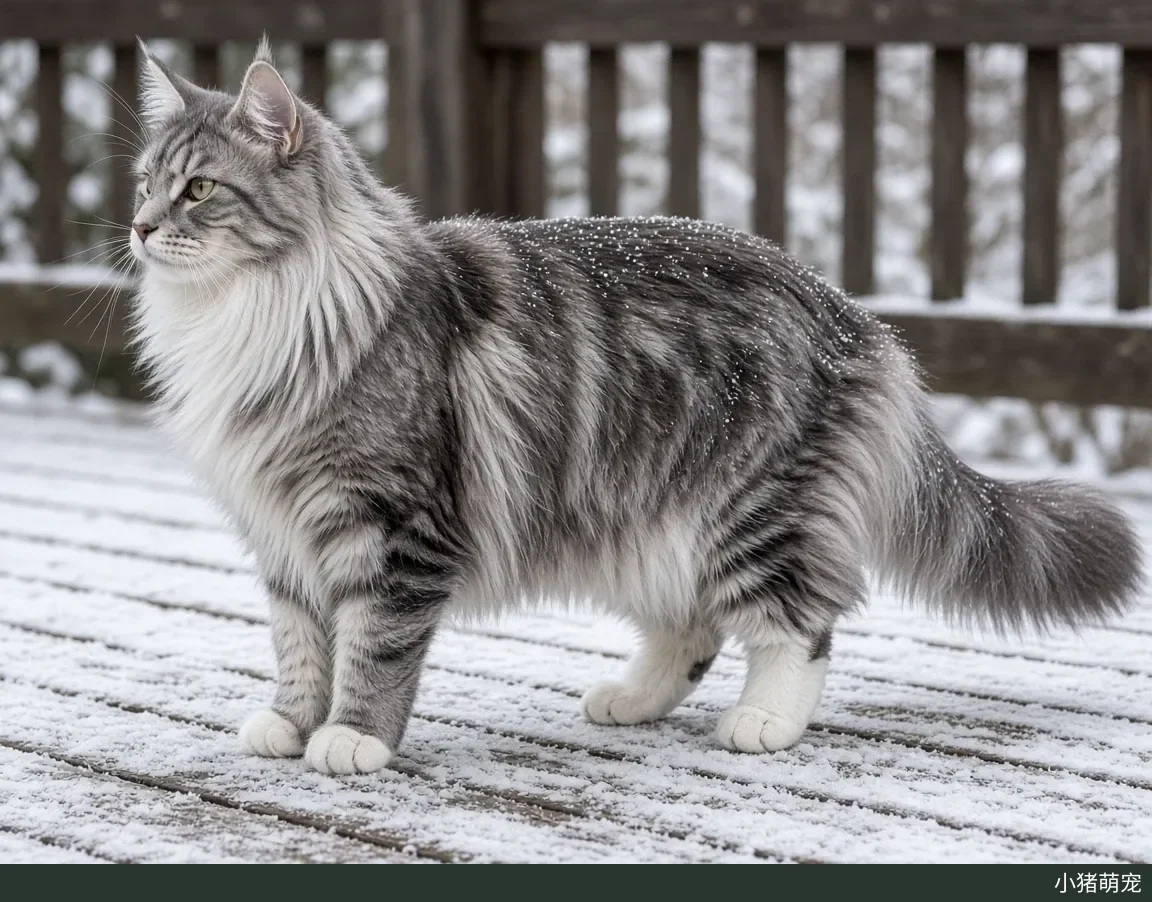
A silver tabby-and-white Norwegian Forest Cat standing in profile in winter, showing the dense double coat, hind “breeches,” and long fluffy tail. AI-generated illustration, not a photograph.
Temperament and day-to-day care
CFA describes the Norwegian Forest Cat as independent and intelligent, not clingy, yet ready to seek company if left alone too long; it can be a lap cat, but when it climbs up and when it leaves is entirely its own decision. Activity level is moderate, with sudden bursts of “zoomies,” and when excited it may make birdlike chirps. TICA summarizes it as “gentle, adaptable, and happy to play with the family.” CFA also says it usually gets along with other cats, dogs, and children, though every cat’s temperament and history differ, so first meetings are still safer taken slowly.
It especially likes high places. CFA suggests providing a tall scratching post or cat tree; otherwise it may treat the top of the cabinets as its lookout. NSR reminds owners that the breed should be muscular rather than fat, and feels heavier than it looks when lifted; weigh at least once a year and adjust diet and exercise promptly.
That thick coat is less work than it looks. Both CFA and TICA see it as a lower-maintenance longhair: a stainless-steel comb on a regular schedule is usually enough, with more frequent sessions when the winter coat sheds in spring; some coat textures mat more easily and need more diligence. If bathing is needed, CFA notes that the waterproof coat is hard to wet and harder to dry, so ask the breeder about suitable products and methods first. NSR also mentions that feline odontoclastic resorptive lesions (FORL) and gingivitis/periodontal disease are increasingly common in this and other breeds; annual checkups can include a look at the mouth.
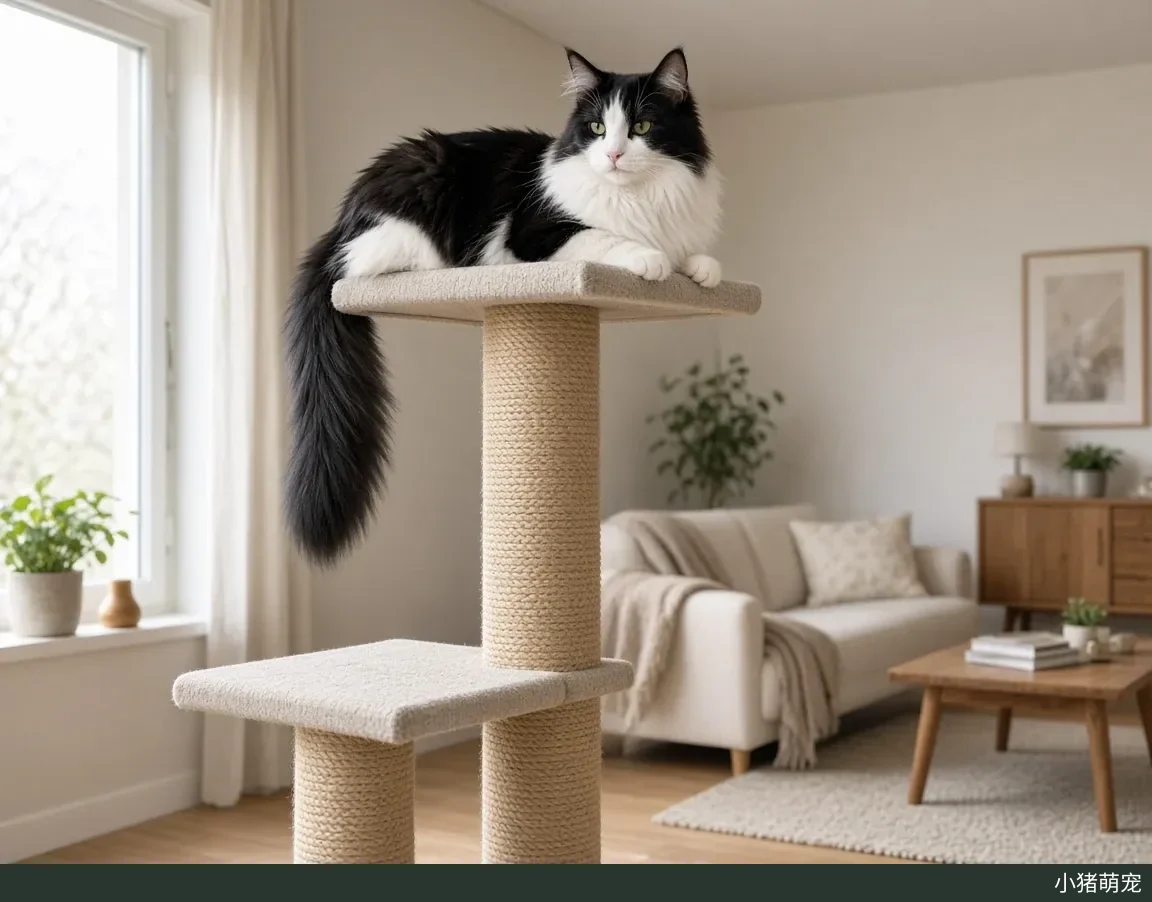
A black-and-white Norwegian Forest Cat lying on the top level of a cat tree looking into the room—high perches suit this breed well. AI-generated illustration, not a photograph.
Common health concerns
Overall, NSR considers the Norwegian Forest Cat a healthy breed, with an average lifespan of about 12–15 years and many living to 17 or 18; that is the club’s description based on statistics it holds, not an independent epidemiological study. The breed standard also does not pursue folded ears, short legs, or short faces—forms with contested health effects: FIFe requires a long, straight nose with no break; CFA lists a severe nasal break and malocclusion as disqualifications, and hind legs must be higher than the front. What needs attention are mainly the hereditary conditions below.
Glycogen storage disease type IV (GSD IV): an autosomal recessive disease caused by a GBE1 defect; abnormal glycogen accumulates in muscle, liver, and nerve cells. The UC Davis Veterinary Genetics Laboratory (VGL) notes that most affected kittens die at or soon after birth; a few appear normal until about five months of age, then develop persistent fever and muscle tremors, progressing to generalized muscle atrophy and death. Fortunately there is a clear DNA test from a cheek swab: N/N is normal, N/GSD is a carrier (does not develop disease), GSD/GSD is affected; mating two carriers is expected to produce 25% affected kittens. A 2007 study of 402 privately owned Norwegian Forest Cats found 58 carriers and 4 affected cats; that is a sample from that year and cannot represent today’s frequencies. Since 2012 NSR has required breeding cats to be tested, and GSD IV status appears on pedigrees registered with Norway’s NRR.
Hypertrophic cardiomyopathy (HCM): the most common heart disease in cats, affecting both pedigreed and ordinary house cats. The heart muscle (especially the left ventricle) thickens abnormally; severe cases can lead to heart failure, fluid in the lungs, thrombosis, or sudden death. NSR materials place Norwegian Forest Cats among higher-risk breeds; HCM usually appears after six months of age and is most often seen at 2–4 years; there is no breed-specific gene test yet—only echocardiographic screening. The cat registry PawPeds runs an HCM echo health program for the breed. If a household cat becomes lethargic, loses appetite, breathes hard, or suddenly shows weak or dragging hind legs, seek care promptly.
Pyruvate kinase deficiency (PK-def): NSR notes that this recessive disease caused by PKLR mutation also exists in the breed; it causes premature red-cell breakdown and chronic or intermittent anemia, and can likewise be screened by DNA test. NSR has also observed occasional entropion in the breed but does not currently see it as high-incidence.
So when bringing a cat home, ask the breeder for parental GSD IV results, breeding cats’ echo records, and PK-def status. CFA also notes that breeders now routinely test for HCM and GSD and work to remove carriers of disease alleles from breeding programs.
References
-
The Cat Fanciers' Association (CFA). Norwegian Forest Cat (breed profile and standard, undated page, accessed 2026-10-17)
-
The International Cat Association (TICA). Norwegian Forest – Breed Introduction (undated file, accessed 2026-10-17)
-
Fédération Internationale Féline (FIFe). Norwegian Forest Cat (NFO) Breed Standard (2026-01-01 edition)
-
Norsk Skogkattring (NSR). Breed Specific NFO, The Norwegian Forest Cat 2025 (2025-11-07)
-
UC Davis Veterinary Genetics Laboratory. Glycogen Storage Disease type IV (GSD IV) in Norwegian Forest Cats (undated page, accessed 2026-10-17)
-
Fyfe JC, Kurzhals RL, Hawkins MG, et al. A complex rearrangement in GBE1 causes both perinatal hypoglycemic collapse and late-juvenile-onset neuromuscular degeneration in glycogen storage disease type IV of Norwegian forest cats. Molecular Genetics and Metabolism, 2007, 90(4): 383–392.
-
PawPeds. Norwegian Forest Cat (breed health-program index, undated page)