In the Scottish Highlands, Bearded Collies tended livestock on rolling pastures and sometimes drove cattle all the way to market. A dog working at a distance from the herder had to judge for itself which way to go. That history helps explain why a Beardie might happily head out with you in a drizzle and then, at a fork in the path, have an opinion of its own about which way to turn.[1]
To recognize this herding dog, start with its outline. The Bearded Collie is a medium-sized dog, about 51 to 56 centimetres tall at the shoulder, with a body length to height ratio of roughly five to four. In the photograph, the dog stands side-on on a path. Its back is level, its tail hangs behind it, and a strip of the path shows beneath its belly. The long coat adds apparent width. Follow the line from the shoulders along the back to the rump and you can see the long, sturdy frame underneath.[1]
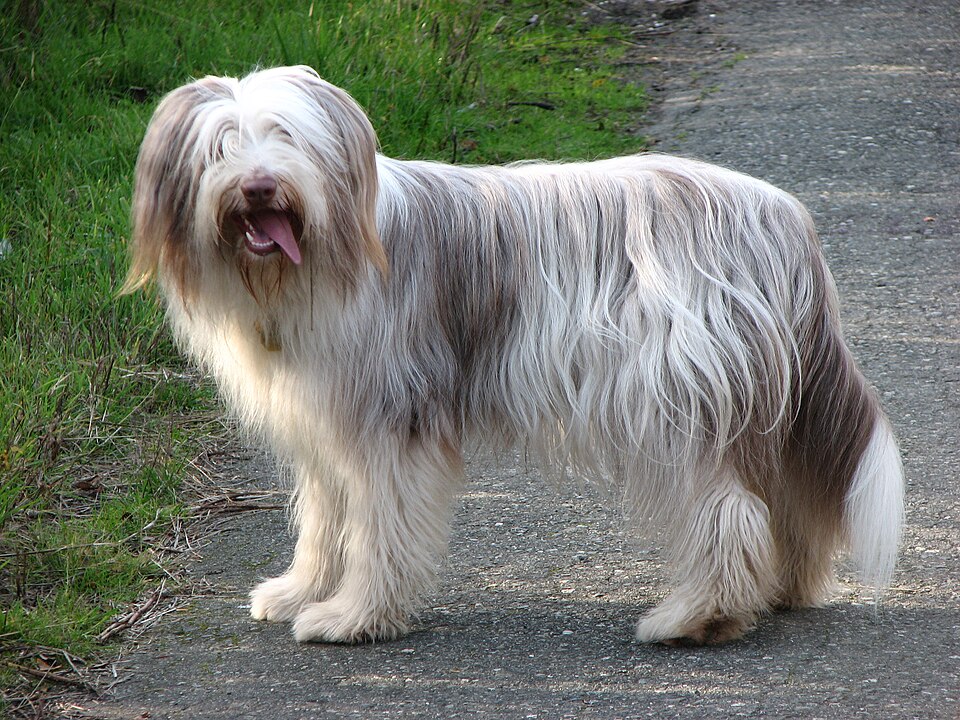
图:The Bearded Collie in profile. marbla123, Wikimedia Commons[3]

Next, look for the feature that gives the breed its name. The hair is shorter on the bridge of the nose. Across the cheeks, lower lip and chin, it grows longer and hangs towards the chest in a beard. With the dog's head turned, you can see how the pale hair around the mouth falls in a different direction from the darker hair on the ears. The body coat has two layers. A coarse outer coat falls naturally to either side over a soft, close-fitting undercoat. That coat protected the dog as it worked outdoors. It also determines what needs doing when a walk is over.[1]
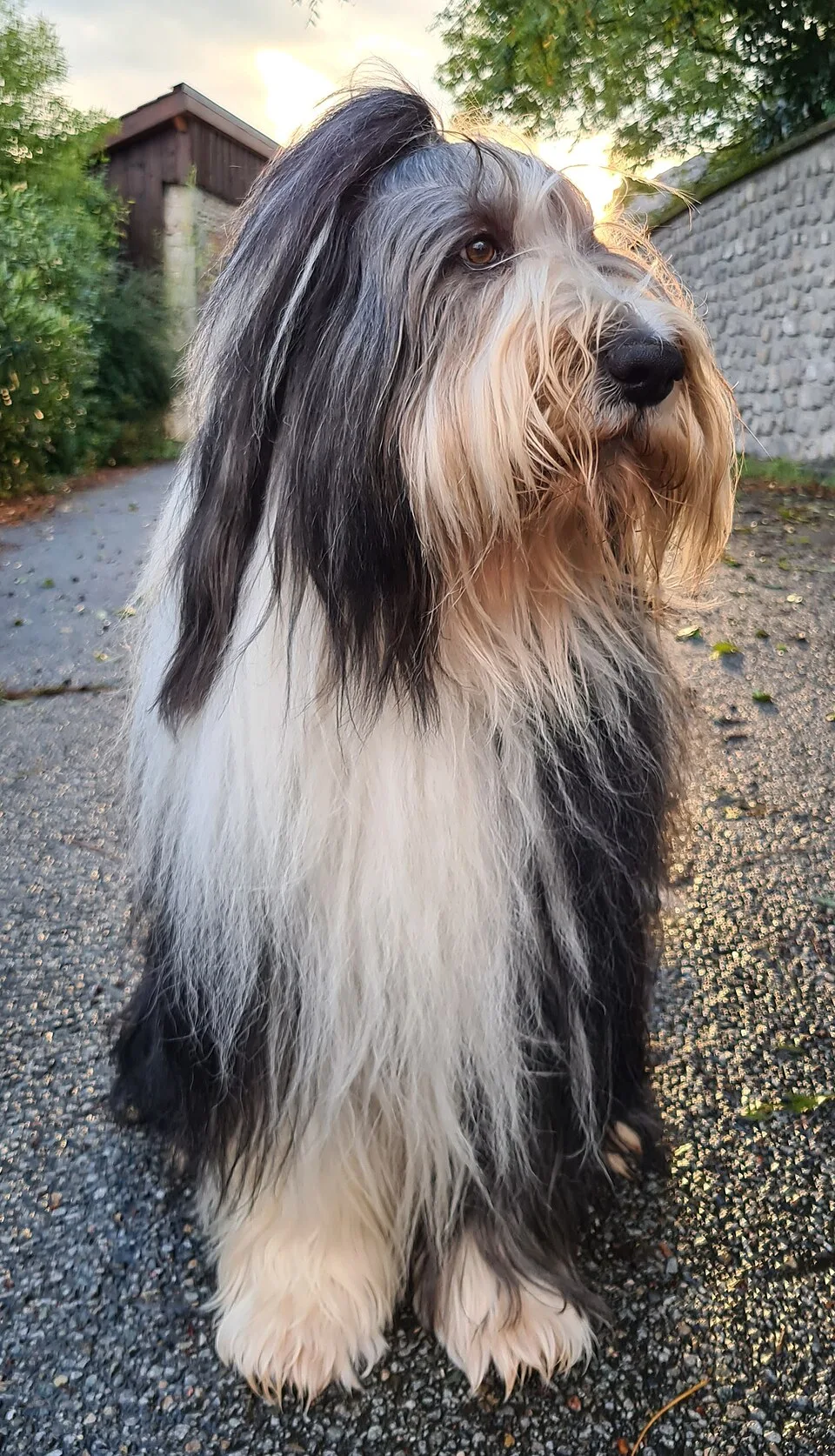
图:The Bearded Collie's muzzle and beard. 08baptiste08, Wikimedia Commons[4]

Give a Beardie something to do on a walk
Start by picturing an ordinary weekday. Bearded Collies need daily exercise. They enjoy long walks, hikes, chasing a ball or playing with another dog in a fenced area. If you have a yard, leave enough open space to play fetch together. If there's a path nearby, slow down along one stretch, give the dog time to sniff the grass, then call it along with you. A workable routine depends on what your family can do regularly and on your dog's age, stamina and enthusiasm.[1]
A dog bred to make decisions while tending livestock needs a reason to pay attention to the person walking beside it. Try calling its name somewhere quiet. The moment it turns to look at you, reward it, then let it go back to exploring. Once that comes easily, try it just before a turn on a walk. A small treat can be the reward one time and a favourite game the next. After a few successful repetitions, move on to something else. Beardies can lose interest in a drill. Short sessions with a little variety give them practice working with you.[1]
If your household includes children or other animals, allow time for introductions. A puppy can watch a visitor from a comfortable distance and have a brief greeting when it chooses to come closer. Several quiet meetings give you a better chance to see how it responds than bringing everyone together at once. A puppy class also gives family members a place to practise when to give a cue and when to reward the response. For a family that enjoys hiking, it's easy to picture who will take the dog out at the weekend. Who can also walk it after dinner on a Tuesday and spare a few minutes when they get back indoors?[1]
Make room for two kinds of brushing
Coming home from a walk is a good time for the short daily brush. Look at the dog standing among leaves in the photograph. Hair covers the fronts of its legs and even the tops of its feet, just where twigs and grass brush past as it walks. Start at the feet and work upwards, picking out bits of grass and gently brushing through small tangles from the day. Check the chest and beard as you go. The American Kennel Club (AKC) puts this daily brushing at about five to ten minutes. Allow more time for cleaning up after a muddy outing.[1]
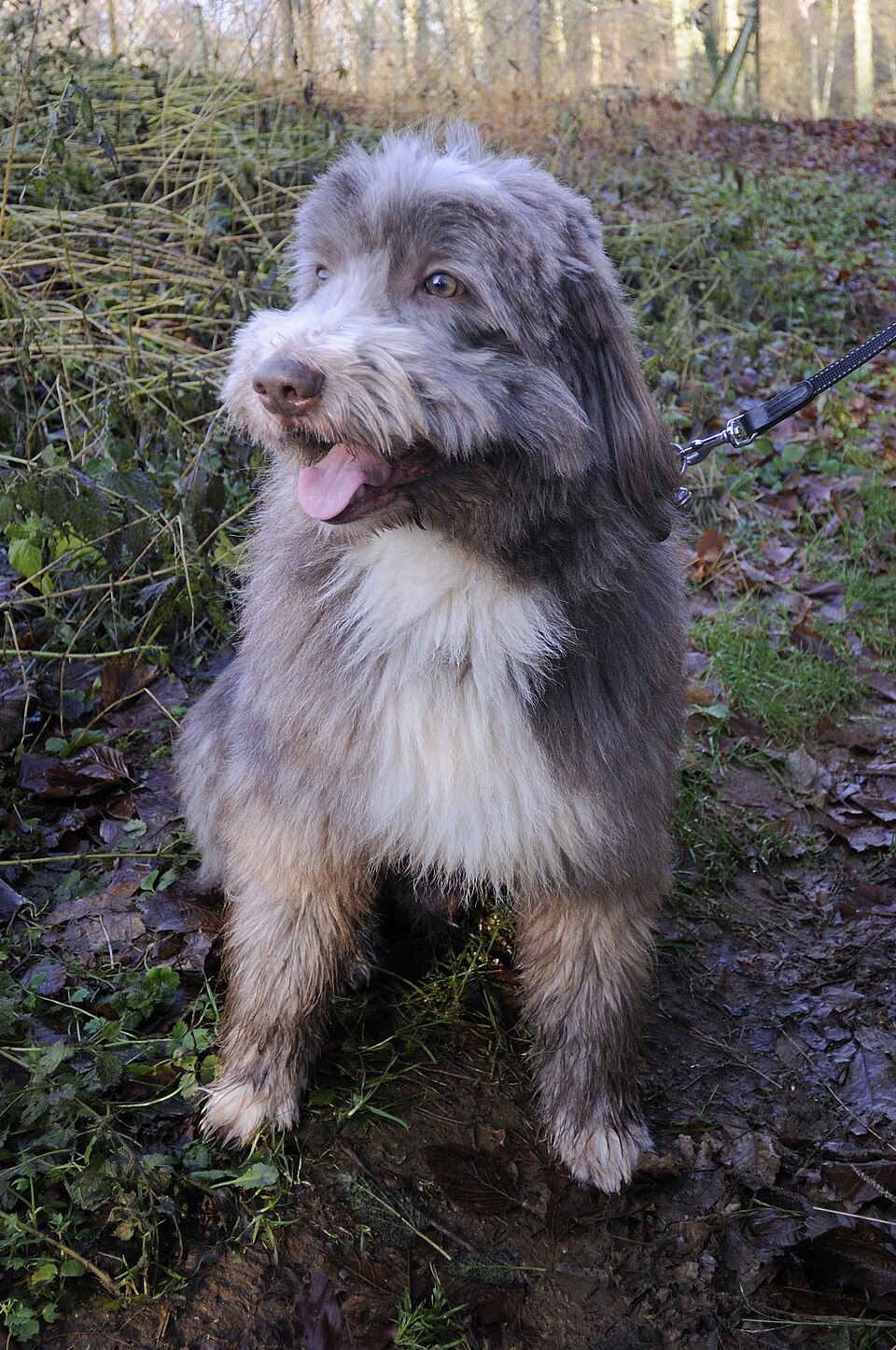
图:The Bearded Collie's chest and leg coat. Cornischong at Luxembourgish Wikipedia, Wikimedia Commons[5]

Set aside a longer session each week to remove loose hair beneath the outer coat. With the dog standing sideways to you, lift a layer of the long hair with one hand. Work through a small section underneath with a pin rake or brush, then check that a comb passes through easily. Lower the hair once you've finished that section so you can keep track of the ground you've covered. Give the chest, sides and legs the same attention. The AKC estimates half an hour to an hour for this session. Putting that time on the family calendar before bringing a Beardie home gives you a realistic picture of the work the coat takes.[1]
The same approach to rewards that you use on walks can help a dog learn to stand quietly for grooming. Start somewhere it is comfortable being handled, such as the side of the shoulder. Brush a small section and reward the dog while it stands still. As it grows accustomed to the brush, gradually lengthen the session and include the feet. Those short daily brushes give you both plenty of practice before the longer weekend session. Other regular care includes checking the ears for debris or wax buildup, trimming the nails regularly and brushing the teeth daily.[1]
Read both parents' health records
If you're getting a puppy from a breeder, ask about its walking and grooming routine and request the screening records for both parents. The Bearded Collie Club of America recommends hip dysplasia evaluation, an examination by a veterinary ophthalmologist and screening for autoimmune thyroiditis in breeding dogs. It lists elbow evaluation as optional. For each parent, match the dog's identity to the test and its date. The date is particularly useful for eye examinations. The club recommends one every year, so the date tells you which year's assessment you're looking at.[2]
The parents' records show which risks the breeder considered. If your own dog develops a persistent limp or is clearly reluctant to put weight on a leg, have a veterinarian examine it. Daily walks and the brush afterwards have a benefit here, too. You get to know your dog's usual stride and where it is comfortable being touched. If something changes, you'll be better able to tell the vet when you first noticed it.[1][2]
References
-
[1] American Kennel Club. Bearded Collie Dog Breed Information.
-
[2] Bearded Collie Club of America. Health Statement.