The leopard gecko is native to arid rocky scrub in Pakistan and Afghanistan, is crepuscular, reaches about 25 cm as an adult, and typically lives about 10–15 years, with a maximum around 20. It is often called a “beginner reptile,” but a temperature gradient, hideouts, calcium-dusted live insects, and follow-up with a reptile veterinarian are all essential. Drawing on veterinary, animal-welfare, and research sources, this article covers habits, housing, diet and health, and legality and ethics of keeping them in China.
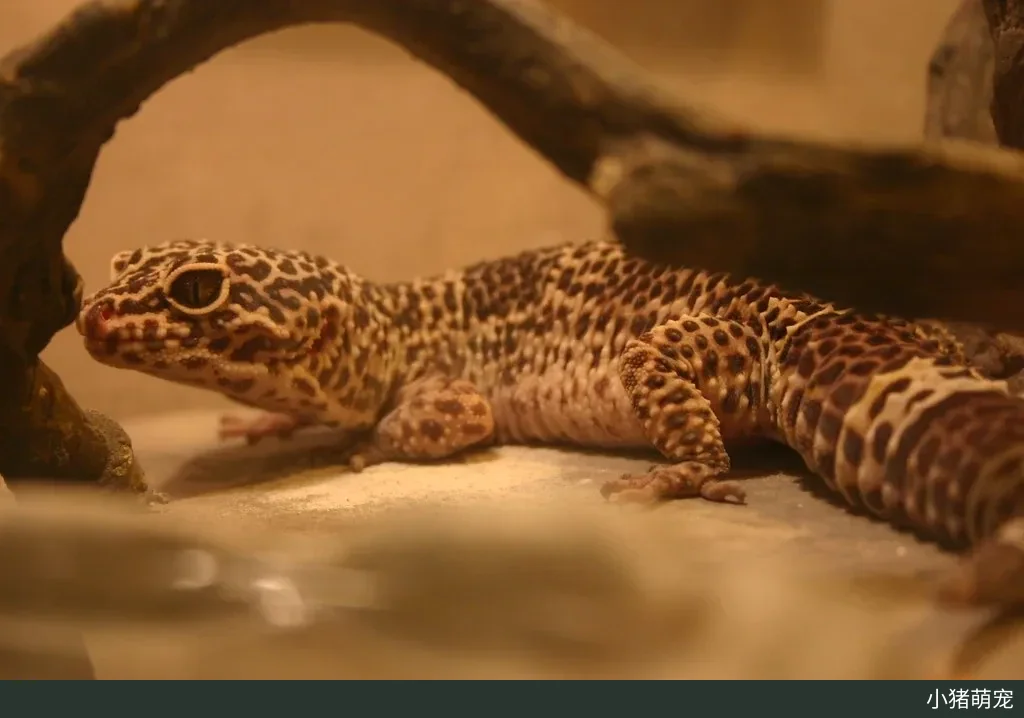
A leopard gecko on the sand of a display enclosure, with an arched piece of dry wood above. Photo: Ryan Somma, Pacific Science Center, Seattle, U.S.; source: Flickr; license: CC BY 2.0.
Habits and background
Per RSPCA care guidance, the leopard gecko (Eublepharis macularius) is native to Pakistan and Afghanistan, a ground-dwelling lizard adapted to rocky, clayey arid scrub; animals on the U.K. market are captive-bred. It is crepuscular—most active at dawn and dusk, sheltering under rocks in the heat of day from heat and predators. In the wild it mainly eats invertebrates, occasionally small mammals and seasonal flowers. Size and lifespan figures differ slightly: RSPCA gives about 25 cm length and up to 20 years; VCA Animal Hospitals veterinarian Gregory Rich cites adults of 12–25 cm and 10–15 years with good care. Many color and pattern morphs are now available.
They do not need companions. RSPCA recommends solitary housing—no social need, and risk of mutual aggression; VCA also notes territorial males and extra caution with groups. When handling, support the body from below with both hands so all limbs have purchase; never pinch the tail: leopard geckos can drop the tail in defense, and though it regenerates, the tail stores fat and regrowth has a health cost. If it backs away or threatens to bite, RSPCA advises putting it down and trying another day, keeping out-of-enclosure sessions to about 10–15 minutes so body temperature does not drop.
Housing
Enclosure size differs between sources: VCA says a 10-gallon (about 38 L) tank can work for one, at least 15 cm high, with an escape-proof lid; RSPCA’s minimum for a single adult is 60 × 40 × 30 cm (L × H × D), stressing “bigger is better,” good ventilation, and distance from radiators and direct sun.
Temperature must form a gradient: heat at one end. RSPCA suggests a basking area of 28–30°C and a cool end of 24–26°C so the gecko can choose; all heat sources need thermostats, with digital thermometers checking both ends daily. Turn heat off at night, but supplement if room temperature falls below 18°C. VCA does not recommend “hot rocks,” which can create local burn spots; heat lamps must keep the gecko from approaching within 15 cm to avoid burns.
Leopard geckos need a relatively dry setup. RSPCA suggests about 30–40% humidity at the cool end, plus a humid hide lined with damp moss to aid shedding. Provide hides at both warm and cool ends so the animal need not choose between security and temperature. Enrichment has research support: Bashaw et al. (2016) studied 16 adult males and found most interaction with heat- and feeding-related enrichment, which also improved behavioral diversity and other welfare measures, while mirror-only visual enrichment had little effect.
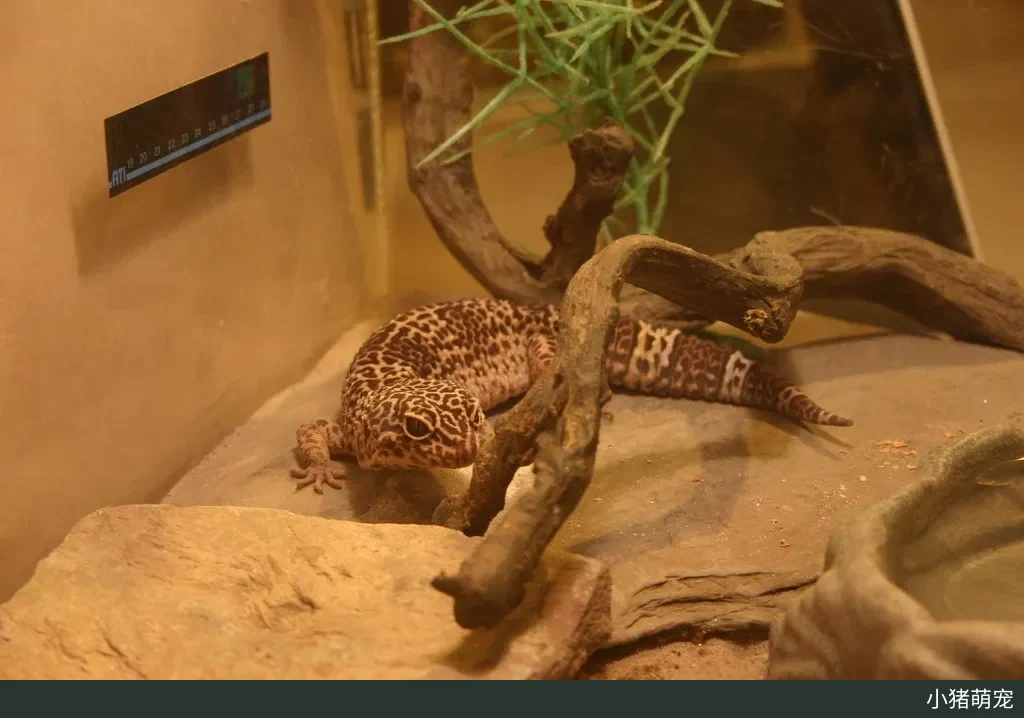
Leopard gecko in a display enclosure on a flat stone slab, with dry wood and fake plants around, a thermometer strip on the wall, and a water dish at lower right. Photo: Ryan Somma, Pacific Science Center, Seattle, U.S.; source: Flickr; license: CC BY 2.0.
Substrate is more contested. VCA clearly advises against coarse sand, corncob, crushed walnut shell, and similar materials that can be swallowed; RSPCA allows healthy adults in well-set enclosures a roughly half organic soil, half children’s play-sand mix, but not calcium sand or beech chips, and prefers non-loose substrates for juveniles. The shared floor is avoiding particles that risk gut blockage; reptile carpet and rough slate that cannot be swallowed are safer choices.
Whether UVB is required also differs: VCA calls it “not essential but recommended”; RSPCA requires a 2–5% UVB tube at the warm end, creating a gradient from about UVI 0.7 at the basking spot to 0 in shade, on a 12-hour light / 12-hour dark cycle. Research: Gould et al. (2018) found that in 12 adult males, 1 hour of UVB at dawn and dusk daily raised blood 25-hydroxyvitamin D3 after 30 days versus controls; Oonincx et al. (2020) saw higher levels in a low-dose UVB juvenile group as well (61 vs 38 nmol/L), though both groups received dietary vitamin D3, growth did not differ over the first six months, and longer-term benefits remain open. So leopard geckos can use UVB, but “no UVB means illness” is not yet strongly evidenced. RSPCA also notes red-eyed morphs may be light-sensitive—ask a reptile vet before choosing lamps.
Diet and health
Live insects are the staple. VCA recommends farmed crickets as the base, with limited silkworms, Dubia roaches, mealworms, superworms, waxworms, and similar; RSPCA warns waxworms are fatty and should be sparse, and prey should not exceed the gecko’s head size. Feeding frequency: VCA says juveniles every 1–2 days, adults 2–3 times weekly; RSPCA says juveniles daily, adults every other day, with regular weighing. Remove uneaten live insects so they do not injure the gecko.
Do two things before feeding. First, gut-load feeder insects: for 24–48 hours before offering, feed them nutritious feed or safe vegetables. Second, lightly dust with calcium powder—VCA specifies phosphorus-free calcium; RSPCA also advises a vitamin supplement per product directions to avoid excess. Keep a small dish of pure calcium powder available for free licking, and a shallow water dish at the cool end, changed daily.
Common health problems listed by RSPCA include:
- Metabolic bone disease (MBD): among the most common issues in captive reptiles, often linked to lack of UVB and insufficient vitamin D3 impairing calcium absorption. Signs include muscle twitching, swollen limbs, and fragile bones; severe cases permanently deform limbs, jaws, spine, or tail—seek care promptly.
- Incomplete sheds: retained skin on toes can cut off blood flow and cause toe loss. Do not tear it off; if it will not come free, consult a vet.
- Egg binding: adult females may lay infertile eggs without a male and need a nesting box of moist soil or sand, or eggs may be retained.
- Digestive problems and impaction: abnormal feces or constipation with weight loss can signal serious trouble.
Day-to-day observation per RSPCA: healthy animals have clear eyes and are active; the belly stays off the ground except when resting; the tail is plump; feces are relatively dry, with dark feces and white urates. Some enter brumation-like winter rest—eating less and sleeping more—but should not lose much weight. Reptiles can carry Salmonella; wash hands before and after contact with the gecko and its equipment.
Legality and ethics
Whether a permit is needed in China can be read against a 3 February 2023 public-inquiry reply from the Yunnan Provincial Forestry and Grassland Bureau: leopard geckos are not on national or Yunnan key-protected wildlife lists, not on the list of terrestrial wildlife of important ecological, scientific, or social value, and not listed under CITES; they fall outside forestry-department licensing for captive breeding and commercial use, so related permits are not required there. Note this is a provincial consulting reply; other regions follow local authorities, and list changes may alter the conclusion.
Never release them. As a non-native species, China’s Wildlife Protection Law (second revision, 30 December 2022) Article 40 requires State Council wildlife-protection authority approval to import wild species from abroad, reliable measures to keep them out of the wild, and forbids illegal release or abandonment; Article 59 provides that releasing or abandoning imported wildlife may bring an order to recapture within a deadline and a fine of 10,000–100,000 yuan. If you can no longer keep one, contact the original seller, a rescue group, or a reliable adopter.
Ethically, RSPCA raises concerns about trading and keeping wild animals as “exotics” and stresses confirming you can afford lifelong care and cost before buying. On VCA and RSPCA figures, that may mean 10 to 20 years. Choose captive-bred animals of clear origin, confirm a nearby reptile-capable vet, then decide whether to bring one home.
References
-
Gregory Rich, DVM. Leopard Geckos: Care and Feeding. VCA Animal Hospitals. Page undated, accessed 2026-10-17.
-
RSPCA. Leopard gecko. Page undated, accessed 2026-10-17.
-
Gould A, Molitor L, Rockwell K, Watson M, Mitchell MA. Evaluating the Physiologic Effects of Short Duration Ultraviolet B Radiation Exposure in Leopard Geckos (Eublepharis macularius). Journal of Herpetological Medicine and Surgery, 2018, 28(1-2): 34–39.
-
Oonincx DGAB, Diehl JJE, Kik M, Baines FM, Heijboer AC, Hendriks WH, Bosch G. The nocturnal leopard gecko (Eublepharis macularius) uses UVb radiation for vitamin D3 synthesis. Comparative Biochemistry and Physiology Part B, 2020, 110506.
-
Bashaw MJ, Gibson MD, Schowe DM, Kucher AS. Does enrichment improve reptile welfare? Leopard geckos (Eublepharis macularius) respond to five types of environmental enrichment. Applied Animal Behaviour Science, November 2016.
-
Yunnan Provincial Forestry and Grassland Bureau. Regarding leopard geckos. 2023-02-03.
-
Wildlife Protection Law of the People’s Republic of China (second revision, 30 December 2022). Text published on the Ministry of Agriculture and Rural Affairs website.