Two pale cats rest together. The one facing the camera has fine stripes across its forehead and a touch of warm brown along the bridge of its nose. Photographer Kathryn Smith identifies the pair as chocolate lynx point Colorpoint Shorthairs. If you’ve read our Siamese profile, the large ears and long face may look familiar. Breeders set out to preserve the Siamese build while introducing new colors on the face, ears, legs, paws and tail. The family resemblance carries over into daily life. The same gentle grooming and interactive games that suit a Siamese can work for a Colorpoint Shorthair, too. [1][2][3]

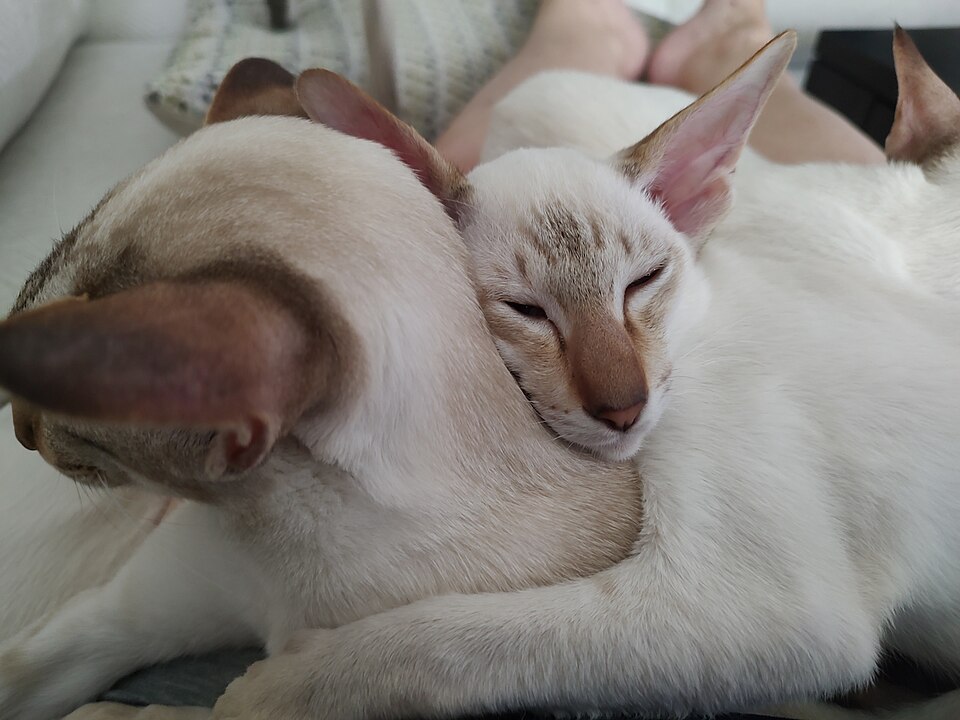
Both cats have chocolate lynx points. Kathryn Smith, Wikimedia Commons[2]
How red points led to a new breed name
In the mid-1950s, breeders began working to add red to the four traditional Siamese point colors of seal, chocolate, blue and lilac. After several generations of selective breeding, the Cat Fanciers’ Association (CFA) accepted red point, cream point and tortie point Colorpoint Shorthairs for registration in the late 1950s. The breed gained championship status in 1964. Meanwhile, breeders in England were developing cats with tabby stripes on their points. The British called the pattern “tabby point.” When it crossed the Atlantic, it became known in the United States as “lynx point.” [1]
CFA recognizes the Colorpoint Shorthair as a distinct breed with 16 colors and color combinations. The International Cat Association (TICA) includes red and cream points, as well as tabby and tortoiseshell markings, within its Siamese classification. Take the pair in the photograph. Their chocolate points have stripes, a combination that appears in the CFA Colorpoint Shorthair standard and also fits TICA’s description of a Siamese coat. When reading an adoption listing or a pedigree, look first for the registry, then read the breed and color entries separately. Shorthaired domestic cats can have points, too. Coat color alone cannot establish a cat’s registered breed. [1][2][3]
How pale can the points be?
Start by comparing the cheeks with the chest. The cat below has an almost white chest. There’s just a wash of warmer color in the middle of the face and along the edges of the ears, enough to see where the color gathers. CFA describes cream points as pale as pinkish cream, while red points can range from apricot to deep red. The word “point” tells you where to look. Compare the color across several parts of the cat, even when the contrast is subtle. That contrast can also change with age as the coat on the body grows darker than it was in kittenhood. [1][4]

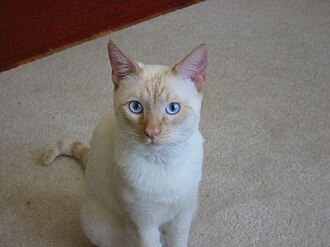
The points show against a pale coat. Ckolony at en.wikipedia, Wikimedia Commons[4]
On the cat resting on the black cushion, the dark forehead stripes and the outlines around the eyes catch the eye first. Look back at the pair in the opening photograph and you can see similar stripes, though theirs are much fainter. The markings can influence your first impression of the face. To see the wedge shape in the CFA standard, trace an imaginary line from the tip of the nose to the tip of each ear. The standard also describes almond-shaped blue eyes, a short coat that lies close to the body, a long, slender tail and a long, muscular build. That last feature describes the cat’s proportions. It gives no reason on its own to put a cat on a weight-loss diet. [1][2][5]

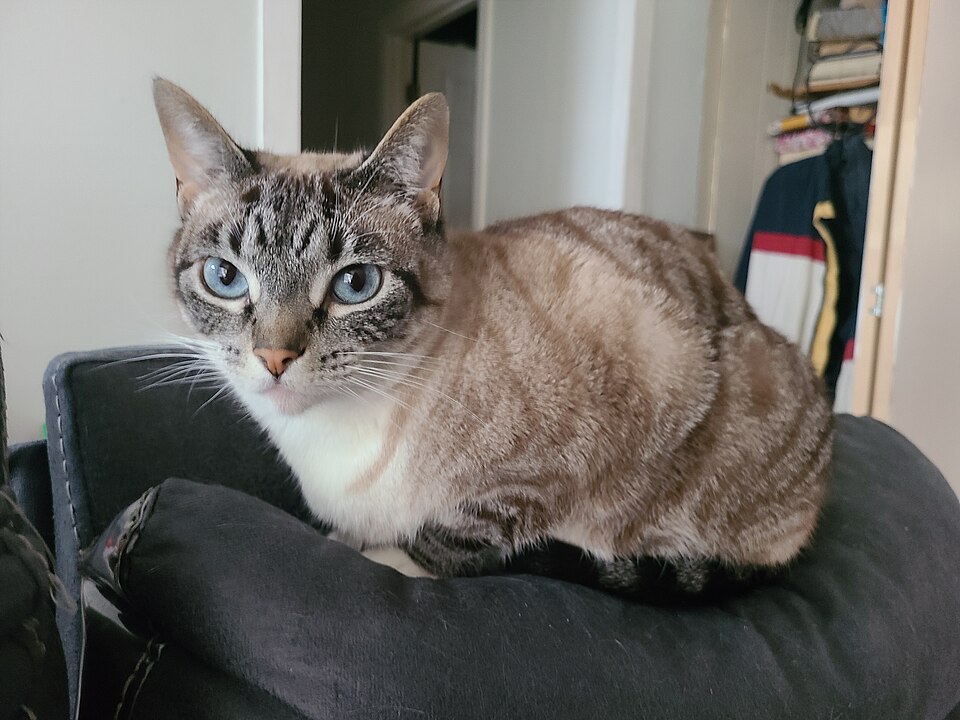
Lynx point stripes frame the eyes. Williamep4, Wikimedia Commons[5]
Making time for daily interaction
One of the easiest Siamese care routines to borrow is grooming. When your cat settles beside you, gently draw a soft rubber brush in the direction the fur grows to lift away loose hairs. A slightly damp hand stroked along the coat works, too. The pale chest and striped cheeks are all part of the same fine, short coat and need the same care. For a household pet, there’s usually no need to schedule regular baths. When your cat gets up to leave, let that grooming session end. [1]
What’s worth setting aside each day is a little undivided attention. CFA describes Colorpoint Shorthairs that follow people around the house or call to them. Try a routine you can easily repeat. After dinner, move a toy along the floor and pause at the edge of a cardboard box. Give your cat time to crouch, creep closer and pounce, then let it catch the toy. Next time, see whether the sound brings your cat over or whether it prefers to keep resting. A game is easier to make part of the day when you know when your cat likes to join in. The number of rounds matters less. [1][6]
The two cats in the opening photograph chose to curl up together. In a home with several cats, they also need room to go their separate ways. Imagine two food bowls side by side at the end of a narrow passage. Each cat has a bowl, yet the one arriving second still has to squeeze past the first. Set up feeding spots apart from each other. Offer water, litter boxes and resting places in different locations, with somewhere quiet to hide. Watch how each cat moves through the space. Whether it can eat, use the litter box and walk away from its companion comfortably tells you more than a count of bowls and beds. [2][6]
How do you read a kitten’s eye screening report?
Blue eyes are one of the breed’s visible features. When bringing a cat home, there’s a separate question to ask about its eyesight. Which eye condition does the health record say the cat was screened for? The UC Davis Veterinary Genetics Laboratory lists the Colorpoint Shorthair among the breeds for which it offers a genetic test for the rdAc form of progressive retinal atrophy. Affected cats can have normal vision at birth and gradually lose their sight. Watching a kitten chase a toy tells you something about what it can see today. Finding out whether it carries the variant takes a genetic test. [1][7]
First match the identifying details on the report to the cat, then look for the test name, CEP290/rdAc. An N/N result means the test found no copies of this variant. A cat with an N/rdAc result carries one copy and will not lose its sight from this form of the disease. An rdAc/rdAc result means the cat has two copies and will develop this form of retinal degeneration. Keep the parents’ test reports separate from the kitten’s own result. If your cat later starts bumping into things repeatedly in familiar surroundings, arrange a veterinary examination. Bring the report and tell the vet when you first noticed the change and what the light was like. The breed name helps you ask for the right record, and those details tell the vet what has changed for your cat. [7]
References
-
[1] The Cat Fanciers’ Association. Colorpoint Shorthair.
-
[2] Kathryn Smith. Two Chocolate Lynx Point Colorpoint Shorthairs. 2023.
-
[3] The International Cat Association. Siamese.
-
[4] Ckolony at en.wikipedia. Colorpoint Shorthair.
-
[5] Williamep4. Lynx colorpoint shorthair. 2022.
-
[6] Feline Veterinary Medical Association. New Feline Veterinary Medical Association Position Statement Reimagines Life for Indoor Cats. August 28, 2025.
-
[7] UC Davis Veterinary Genetics Laboratory. Progressive Retinal Atrophy (PRA rdAc) (Abyssinian).