
Close-up front view of a male Russian Blue. Figure: Flor de Azur, from Wikimedia Commons (File:Russian Blue cat.jpg), CC BY-SA 3.0.
The Russian Blue is a medium-sized shorthair with only one color: a blue double coat with silver tipping, paired with vivid green eyes. CFA and TICA both link its aliases to the northern Russian port of Arkhangelsk, but written records before the late nineteenth century are scarce. It is usually quiet, cautious with strangers, and affectionate with family; appetite is hearty, so weight control is a care priority.
Origin legends and documented history
The most common origin story is the “Arkhangelsk theory.” CFA’s profile says the breed is thought to come from the Archangel Isles of northern Russia, with almost no written history before the late 1800s. TICA notes that the alias “Archangel Cat” comes from the White Sea port of Arkhangelsk, about 150 miles (about 240 km) south of the Arctic Circle; both associations mention that these cats may have traveled with sailors’ ships to Britain and elsewhere in Europe. Stories of “the tsar’s pets,” “Queen Victoria’s favorites,” and Russian folk belief that they were lucky charms with healing powers are relayed by CFA and TICA only as legend or rumor; this article treats them as stories only.
More documentable history begins with cat shows. TICA records Russian Blues at some of Britain’s earliest shows in the 1880s; CFA adds that they were then called “Archangel Cats” and competed with all solid blue cats. Per TICA, by 1912 these large-eyed, large-eared cats gained their own class as “Foreign Blue.” From the early twentieth century through World War II, Scandinavian breeders led breed development. War disrupted breeding; afterward some British breeders introduced blue British Shorthairs to keep a pale dense coat, others blue-point Siamese to keep a longer body; Scandinavian breeders developing their own lines also used Siamese and a blue cat named Pierette. Russian Blues reached North America in the early 1900s, but large-scale breeding came much later: postwar U.S. breeders imported stock from Britain and Scandinavia and gradually combined the two lines into today’s look. CFA’s current reference information lists “none” under allowable outcrosses for the Russian Blue.
Silver-blue double coat and green eyes
What draws people first is the coat. CFA’s breed standard requires short, dense, fine, soft coat that feels like seal-skin; it is a double coat that stands slightly off the body from density. Color is an even, bright blue, with lighter blues preferred; guard hairs have distinct silver tips that give the whole cat a silver sheen, with no tabby markings. The nose leather is slate gray; paw pads lavender-pink or mauve. The coat is dense enough that a finger drawn across leaves a “footprint” that must be smoothed away.
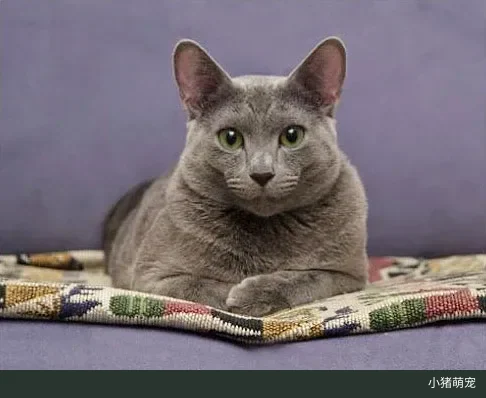
A Russian Blue from Finland, one year and one month old. Figure: Ras (Wikimedia Commons uploader), from Wikimedia Commons (File:Russian blue cat.jpg), CC BY-SA 3.0.
Eyes must be vivid green; CFA notes that this green usually deepens with age. On CFA’s score sheet, coat and color are 20 points each and eye color 10—half of the 100-point total. In body, the bone is fine, the body long and muscular; the head is a medium wedge, with large ears set wide, broad at the base. CFA’s weight references: males rarely exceed 10 lb (about 4.5 kg); females about 5–8 lb (about 2.3–3.6 kg).
Both associations state that the Russian Blue comes in only one color—blue—and one coat length—short. CFA’s standard disqualifies any color other than blue, long hair, small white spots (locket or button), a kinked or deformed tail, and incorrect toe count. Early shows putting all blue shorthairs together also show that a blue-gray coat alone does not prove a cat is a Russian Blue.
Quiet, cautious temperament
CFA and TICA describe temperament similarly: quiet, intelligent, reserved with strangers, affectionate once familiar. CFA writes that when guests arrive, hiding under the sofa is common, but curiosity soon brings them out to study new faces. TICA’s take is that the cat prefers to observe and assess a person before deciding whether to approach—caution often read as shyness or aloofness. Once it accepts you, it is affectionate, follows family around, and sometimes drapes over a shoulder.
It is not usually noisy, but TICA notes that if you speak to it, it answers. It likes a regular routine and remembers meal times; it can stay home alone and still enjoy interaction when people return, so TICA considers it apartment-friendly. Intelligence has another side: CFA warns it will figure out cabinet doors, drawers, even jars—prepare puzzle toys and interactive play to burn energy. CFA thinks it suits quieter homes and older children willing to give it time to settle; many Russian Blues also thrive in lively homes and make friends with other animals. These are common tendencies summarized by associations; individuals still vary.
Daily care and weight management
Grooming the Russian Blue coat is not demanding, but the associations differ on frequency: CFA says two or three brushings a month control shedding; TICA suggests one or two times a week—adjust within that range by how much the cat sheds. The rest is basic care every cat needs: TICA suggests wiping eye corners with a soft damp cloth, using different parts of the cloth for each eye; check ears weekly and wipe with a cotton ball or damp cloth when dirty—no cotton swabs; brush teeth weekly; trim nails about every two weeks. CFA also notes that some cats’ coats occasionally get oily; if a bath is needed, ask the breeder about suitable products first.
On overall health, CFA calls it a healthy natural breed with no known specific hereditary problems at present, though some believe the gene pool is relatively small and may raise risk for certain diseases. TICA’s expected lifespan is 10–20 years, and living past 16 with good care is not uncommon. These are association summaries, not epidemiology focused on Russian Blues.
Weight needs the most attention. CFA and TICA both note a hearty appetite: CFA says that without regular interactive exercise there is a risk of gaining weight and advises careful portion control; TICA also recommends scheduled meals and few treats. Cornell Feline Health Center materials define feline obesity generally as 20% or more above normal weight—the most common nutritional problem in house cats—which can worsen osteoarthritis and diabetes and add cardiovascular load. The center’s veterinarians advise meal feeding rather than leaving dry food out all day. If a cat is already overweight, weight loss should be under veterinary guidance, aiming to lose about 1%–2% of body weight per week; sudden severe calorie cuts can trigger hepatic lipidosis and other serious problems.
References
-
The Cat Fanciers' Association (CFA). Russian Blue (breed profile and CFA breed standard; page undated)
-
The International Cat Association (TICA). Russian Blue (breed profile; page undated)
-
Cornell Feline Health Center, Cornell University College of Veterinary Medicine. Obesity (page undated)