
A black curly-coated dog stands on a veterinary exam table while a young owner holds the leash nearby. Photo: Steven Depolo, source: Flickr, license: CC BY 2.0.
On 11 October, the pet-nutrition blog Petfoodology at Tufts University’s Cummings School of Veterinary Medicine explained that the “IBD” often heard when dogs have long-term vomiting or diarrhea is being renamed “chronic inflammatory enteropathy (CIE)” in veterinary medicine. The rename follows an ACVIM canine consensus guideline published early in 2026, and the treatment approach is shifting too: try diet therapy first, and use empirical antibiotics less.
Terminology shift: from IBD to CIE
The article was published 11 October 2026 by Cailin R. Heinze on Petfoodology, the pet-nutrition blog of Tufts Cummings School of Veterinary Medicine. It is not a new study but a terminology explainer. It notes that gastrointestinal signs such as vomiting, diarrhea, poor appetite, gas, and weight loss are common in veterinary practice; lasting more than a few weeks counts as chronic. In human medicine, irritable bowel syndrome (IBS) and inflammatory bowel disease (IBD) can look similar, but IBD has inflammatory cells in the intestinal wall and needs endoscopy plus biopsy to confirm; IBS lacks clear inflammation and is a diagnosis of exclusion. Veterinary medicine used to call pets with “chronic GI signs, inflammation on biopsy, or a response to corticosteroids” IBD; IBS is not a recognized standalone disease in animals—some owners borrow the name because the signs feel similar. The author notes that veterinarians have long worried that both terms make people think of the human diseases, which differ in treatment and prognosis.
The Tufts piece only says “ACVIM recently published a consensus statement,” without a link. Matching that description is an ACVIM-endorsed consensus statement and systematic review on diagnosis and treatment of chronic inflammatory enteropathy in dogs, led by Romy M. Heilmann and Albert E. Jergens, published online 21 January 2026 in the Journal of Veterinary Internal Medicine (J Vet Intern Med) volume 40, issue 1. Using Delphi voting, the panel agreed on the term “chronic inflammatory enteropathy” (CIE) and recommended dropping IBD because that word refers to a “similar but not identical” disease in human gastroenterology. The guideline describes canine CIE as a group of GI diseases with persistent or recurrent signs and varying mucosal inflammation—a diagnosis of exclusion—further subdivided by treatment response, such as food-responsive (CIE-FR) and immunosuppressant-responsive (CIE-IR); protein-losing enteropathy (PLE) and granulomatous colitis (GC) are treated as special phenotypes within the CIE spectrum. The Tufts summary’s classification also lists a “non-responsive” type.
Treatment order: diet first, antibiotics later
The Tufts article notes that alongside the rename, treatment thinking is changing: in many CIE cases, diet therapy is increasingly seen as first-line; antibiotics are used less—both for lack of good evidence and for concern about disrupting the gut microbiome; many cases improve after a diet change even when a food allergy link is unclear, so corticosteroids and other immunosuppressants are used less. The ACVIM guideline is more specific: for stable dogs with suspected CIE that are still eating, run a diet trial before invasive tests such as endoscopy (strong recommendation). The rationale is that 38%–89% of CIE dogs respond to diet, and many maintain remission for more than three months on diet alone. Each trial should use a single therapeutic diet for at least two consecutive weeks—options include highly digestible, limited-ingredient novel protein, hydrolyzed protein, elemental, high-fiber, low-fat or ultra-low-fat, and homemade formulas; when possible try at least three different diets, scoring clinical signs at least weekly. An effective diet should be fed for at least 12 weeks before considering a transition to other foods.
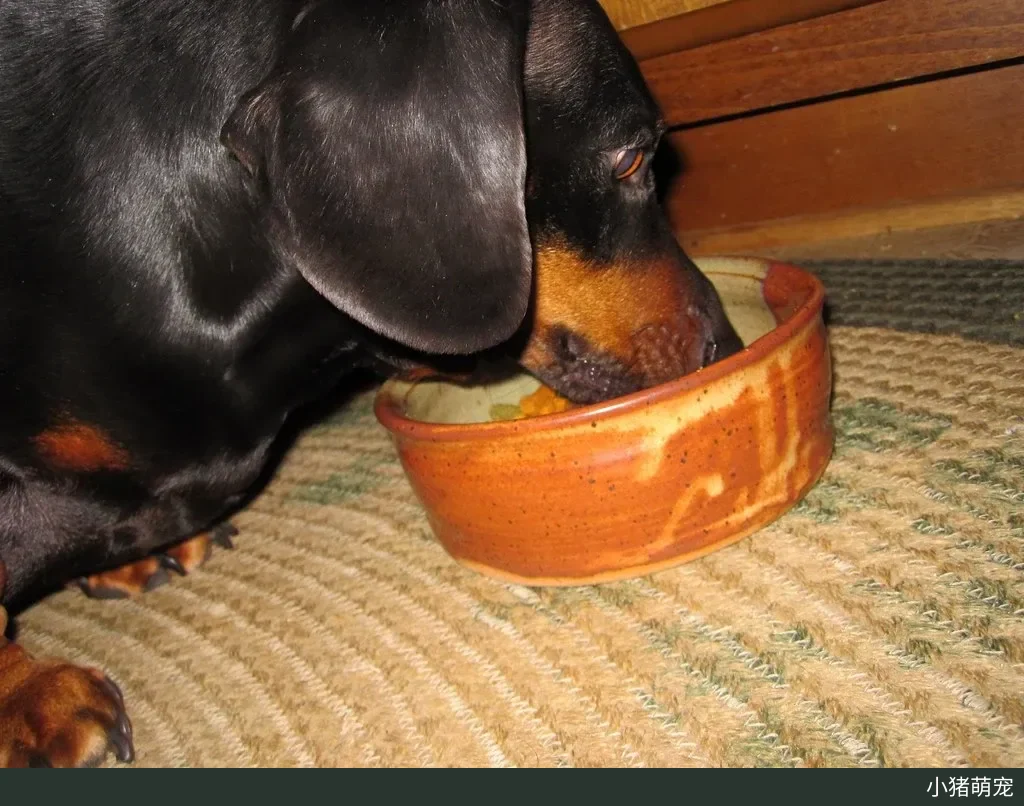
A black dog with tan markings eats from its ceramic food bowl. Photo: Tony Alter, source: Flickr, license: CC BY 2.0.
If other similar diseases have been ruled out and about three proper diet trials still fail, the guideline recommends endoscopy with biopsy to confirm intestinal inflammation before escalating to immunomodulatory therapy. On antibiotics, the guideline explicitly advises against empirical use in suspected CIE (strong recommendation): tylosin, metronidazole, and similar drugs may bring short-term improvement, but relapse often follows soon after stopping, and lasting microbiome disruption is possible—so they should be reserved for cases that fail other treatments. The exception is granulomatous colitis linked to adherent-invasive Escherichia coli (AIEC); those cases need colonic biopsy with culture and susceptibility testing before drug choice.
Meaning for pet households
For owners, this change is mainly about wording and order of steps—not a new drug or test. Points to keep in mind:
- Don’t panic at CIE: What veterinarians call CIE roughly matches what used to be called pet IBD; they are simply no longer borrowing the human disease name. Online information about human IBS or IBD should not be applied directly to dogs.
- Diet trials must be exclusive: The guideline requires feeding only the chosen therapeutic diet for at least two weeks, with the veterinarian guiding the owner. Adding treats or table scraps mid-trial makes results hard to interpret. The guideline also suggests veterinarians take a detailed diet history—owners can prepare a list of past foods, treats, and supplements.
- Score signs weekly: Changes in stool frequency and quality, vomiting, appetite, and weight help the veterinarian judge whether a diet is working.
- Don’t self-medicate: Do not try leftover antibiotics or anti-diarrheals “just to see.” Which diet to try and when to scope should be decided with the veterinarian and diagnostics.
- Seek care promptly for warning signs: Diet-first advice is for stable dogs that are still eating normally. If a dog stops eating, loses marked weight, or has an unusually distended belly (possible ascites) or limb edema, the guideline notes this may suggest malabsorption or protein-losing enteropathy—seek care promptly rather than slowly swapping foods at home.
Cat owners should note: this ACVIM guideline is for dogs only. The Tufts piece speaks of “pets” broadly, but cats with chronic enteropathy have a separate 2023 ACVIM consensus focused on distinguishing lymphoplasmacytic enteritis from low-grade intestinal T-cell lymphoma. That feline consensus uses “chronic enteropathy (CE)” and states that no single marker reliably separates the two diseases; histopathology remains the main basis. So when cats have long-term vomiting or diarrhea, diagnosis should follow feline-specific veterinary assessment.
Evidence base and limits
The canine guideline’s methods are solid: the panel systematically searched PubMed and CABI (diagnosis search 19 June 2024; treatment search 12 January 2025), meta-analyzed 24 randomized controlled trials, then used Delphi rounds of discussion and anonymous voting until full consensus. Every recommendation carries evidence quality and strength ratings. The paper was submitted 29 September 2025, accepted 8 October, and published open access (CC BY-NC), so anyone can read the full text free. The guideline also cites research that about 20%–30% of companion-animal visits involve vomiting, diarrhea, or both.
The guideline also states its limits. The panel finds diagnostic evidence limited: many studies are underpowered or compare only sick dogs with healthy dogs, without suitable controls. On treatment, hydrolyzed-protein diets show 64%–89% remission in referral-hospital reports, but only two of those studies are randomized controlled trials, and high loss to follow-up raises bias risk; referral data may not represent dogs in general practice. High-quality trials assessing antibiotics are likewise scarce. As for the Tufts article, it is the author’s reading of terminology and treatment trends without a full citation list; “new terms will bring more research and better care” is the author’s expectation, not a proven result.
References
-
Heinze CR. IBS, IBD, CIE: The ABCs of gastrointestinal disease. Petfoodology, Cummings School of Veterinary Medicine at Tufts University. 2026-10-11.
-
Heilmann RM, Jergens AE, Kathrani A, et al. ACVIM–endorsed statement: consensus statement and systematic review on guidelines for the diagnosis and treatment of chronic inflammatory enteropathy in dogs. J Vet Intern Med. 2026;40(1):aalaf017. PubMed 41742497
-
Marsilio S, et al. ACVIM consensus statement guidelines on diagnosing and distinguishing low-grade neoplastic from inflammatory lymphocytic chronic enteropathies in cats. J Vet Intern Med. 2023;37(3):794–816.