A cairn is a pile of stones. In the Scottish Highlands, people built cairns to mark boundaries, and rodents made their homes in the gaps between the stones and underneath them. The little terriers that worked there had to listen for movement, find a way in and dig until they could flush out their quarry. Once out of sight underground, a dog had to decide for itself where to look next. Freshly turned soil in a flower bed can still stir that curiosity in a Cairn Terrier today.[1]
Seen from the side, it is easy to picture how a Cairn could work among the rocks. The breed stands about 9½ to 10 inches (24 to 25 cm) at the shoulder, with short legs, a level back, a deep chest and strong hindquarters. The front feet are slightly larger than the hind feet, and the dog stands firmly on all four. On the pale Cairn in the photograph, hair of uneven lengths hangs from the chest and belly. To see the shape beneath it, follow the line of the back to the base of the tail, then look for where each foot meets the surface.[1][5]

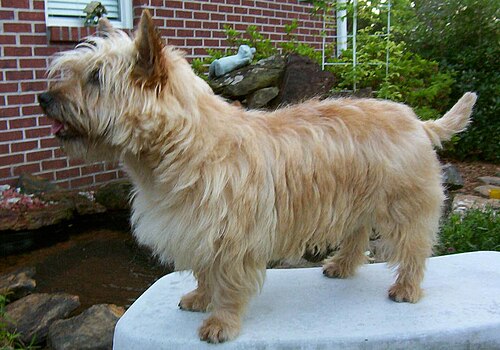
A Cairn Terrier stands in profile. alanna stewart, Wikimedia Commons[5]
From the front, look at the width of the head and the position of the ears. A Cairn has a short, broad head with small, pointed ears set well apart. Beneath shaggy eyebrows, the eyes are widely spaced too. Of the two dogs on the grass, one is pale tan and the other dark gray. Despite the difference in the color of their facial hair, both have the same pair of pointed ears rising above a broad forehead. That outline is a useful way to recognize a Cairn across coat colors.[1][6]

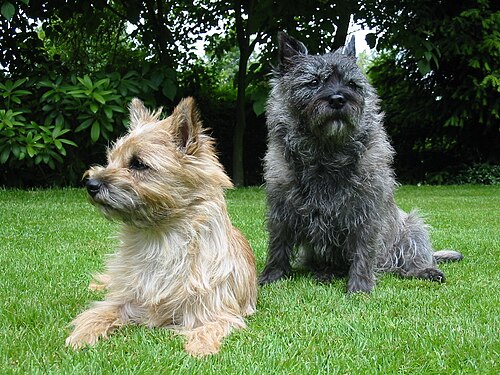
Two Cairns show the breed’s distinctive head shape. Ronald Müller-Hagen (Ketterechts), Wikimedia Commons[6]
Leave time to explore on daily walks
The American Kennel Club (AKC) describes the Cairn’s exercise needs as moderate and recommends getting outside every day. A single walk can have two paces. Walk briskly together along a clear stretch, then slow down somewhere away from traffic where the dog can stop and sniff. You needn’t keep lengthening the route. Pay attention to what holds your Cairn’s interest. A dog that likes following a scent may enjoy searching for hidden objects. One that enjoys working alongside you might take to obedience or agility training.[1][2]
If you live in an apartment, think through an ordinary weekday. Who will take the dog out on a leash? Who can play ball indoors for a while when the weather is poor? A yard brings a different question. When a squirrel darts across the lawn, will the gate be shut? The Cairn Terrier Club of America recommends supervising Cairns in a securely fenced yard and using a leash in open areas. Even a dog that comes when called at home may take off after a small animal that suddenly breaks cover.[1][2]
Give your Cairn a place to dig
To protect a flower bed, set up a shallow sandbox with clearly defined edges in another part of the yard. Fill it with clean sand and bury a favorite toy just beneath the surface. Walk over with your Cairn. As soon as a front paw starts to scrape the sand, praise the dog and let it uncover the toy. Stay close enough to notice if it starts eating sand, and cover the box when the game is over. The next time your Cairn starts to dig in the flower bed, calmly lead it back to the sandbox for another search.[2][3]
You can teach the same game indoors. Spread an old blanket that the dog is allowed to paw in a quiet corner and tuck a piece of kibble just under one edge. Give your Cairn time to sniff. The moment a paw moves the blanket, praise the dog and lift the corner so it can eat the kibble. Once your Cairn reliably paws at the blanket, say “dig” just before the paw comes down. When that is familiar, try leaving the blanket empty. Give the cue, wait for the dog to paw, then reward it from your hand. Even if you move somewhere without a garden, you can take this search game with you.[3]
Agree on one cue and one place for the game. If one person enjoys watching the dog turn over the flower bed and another intervenes only after a seedling comes up, the rule is hard for the dog to learn. When a puppy first comes home, fit short practice sessions into the time you spend together and give it chances to meet different people and get used to everyday surroundings. Children can help an adult hide a toy, with the adult staying for the game. When the dog goes back to its resting place, let it settle in peace. These brief stretches of hands-on time count when you consider how much company your family can offer each day.[1][2][3]
Brush through both layers each week
In the beach photograph, the Cairn rests its head on the sand, and individual locks of outer hair stand out along the cheek and shoulder. The outer coat feels coarse and wiry. Beneath it lies a short, soft undercoat close to the body. Set aside time each week to brush small sections in the direction the hair grows with a soft pin brush, then work through each section with a comb. For a puppy learning to stand quietly for grooming, one shoulder can be a whole session. Introduce the rest of the body a little at a time.[1][2][7]

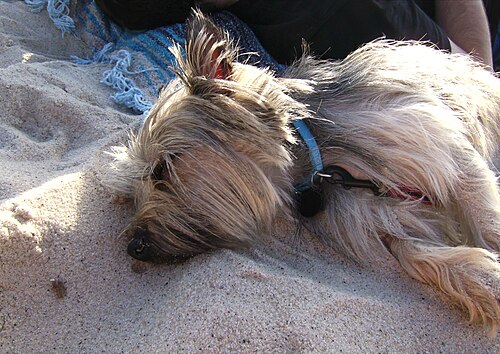
The Cairn’s outer coat falls in locks along the cheek and shoulder. Amanxseattle, Wikimedia Commons[7]
To preserve the wiry texture of the coat, the AKC also recommends periodic hand-stripping to remove mature outer hairs. For a first session, ask a groomer who knows terrier coats to demonstrate. They can show you what the weekly combing should accomplish and which hairs to leave for stripping. As you work down the legs, help your Cairn get used to having each paw gently lifted. Keep up with regular nail trims, too. Even a dog that walks daily and loves digging in sand needs its nails checked, since overgrown nails can make walking uncomfortable.[1][2]
Bring the health records to your next vet visit
When you bring a Cairn home, ask which checks the puppy has had, which reports belong to each parent and how old each dog was at the time. The Cairn Terrier Club of America’s health guidelines, for example, recommend a kidney ultrasound at 12 to 15 weeks to see whether both kidneys are present and how they have developed. For ocular melanosis, the club recommends yearly examinations starting at age three by a veterinary ophthalmologist familiar with the condition. Those records cover different organs at different ages. Keep the date with each report when it changes hands.[1][4]
The breed’s screening recommendations also cover the kneecaps and heart. Bring any existing reports to your Cairn’s first veterinary visit so the vet can plan follow-up around the dog’s age, examination findings and previous results. If you repeatedly see your dog hold one hind foot off the ground on walks, note whether it happens as you set out or after you have been walking for a while. Describe the change in stride to your vet. The person who walks alongside the dog and sees it use its paws every day is well placed to notice when something changes.[1][4]
References
-
[1] American Kennel Club. Cairn Terrier Dog Breed Information.
-
[2] Cairn Terrier Club of America. Breed Characteristics.
-
[3] Sassafras Patterdale. Teach Your Dog to Dig on Cue: Reduce Unwanted Digging. American Kennel Club.
-
[4] Cairn Terrier Club of America. Cairn Terrier Suggested Minimal Health Testing Guidelines. April 27, 2016.
-
[5] alanna stewart. Cairn side view.jpg. Wikimedia Commons.
-
[6] Ronald Müller-Hagen. Cairn-Terrier-Garten1.jpg. Wikimedia Commons.
-
[7] Amanxseattle. Cairn Terrier sleeping on the beach.jpg. Wikimedia Commons.