The familiar aquarium name neon tetra refers specifically to Paracheirodon innesi, a small South American characin placed in Acestrorhamphidae by FishBase and traditionally listed under Characidae [1][5]. It is frequently confused with the closely related cardinal tetra (Paracheirodon axelrodi), but the two are easy to tell apart: in Paracheirodon innesi the bright red lower stripe starts roughly midway along the flank and runs to the tail base, leaving a silvery-white belly forward, whereas the cardinal tetra's red band runs the entire length beneath the head. Assessed as Least Concern on the IUCN Red List (2021) and not listed under CITES, neon tetras in the aquarium trade are predominantly commercially farm-bred [1].
Amazonian Blackwater Streams and Natural Habits
Paracheirodon innesi is native to shaded blackwater and clearwater tributary streams of the Solimões River in the western Amazon basin [1]. Canopy cover and decaying leaf litter create dim, tannin-tinted water that is remarkably soft and acidic: FishBase records a natural pH range of 5.0 to 7.0, hardness of just 1 to 2 dH, and cooler tropical temperatures of 20 to 26°C—milder than many hobbyists assume for an Amazonian fish [1]. Reaching a maximum standard length of about 2.5 cm (roughly 3 cm total length), this pelagic omnivore feeds on tiny worms, small insects, micro-crustaceans, and plant matter [1].

Figure: An iridescent blue-green stripe and posterior red band help Paracheirodon innesi stay visually coordinated in dim streams. Holger Krisp, Wikimedia Commons

Why Keeping Neon Tetras Alone or in Pairs Causes Chronic Stress
Neon tetras must be kept in a school because collective swimming is their primary evolutionary defense. Tiny, defenseless open-water prey fishes rely on coordinated groups to dilute individual predation risk and confuse attacking predators with flashing stripes. Controlled research confirms this need persists in home tanks: Saxby et al. (2010) tested Paracheirodon innesi in group sizes of one, two, five, and ten in Applied Animal Behaviour Science and found that fish in larger groups—especially ten compared with solitary fish or pairs—showed significantly less nervous darting and conspecific aggression while spending more time shoaling naturally, yielding clearly higher behavioral welfare scores [2].

Figure: Swimming in a coordinated school reduces darting stress and encourages confident open-water foraging. Benoît Prieur, Wikimedia Commons

FishBase therefore lists at least five individuals in a minimum 60 cm aquarium as a baseline, while behavioral welfare evidence favors keeping eight to ten or more so the school relaxes into mid-water swimming rather than cowering behind plants [1][2]. Social cohesion also carries diagnostic value. In a 2021 fish-robot experiment in Biological Cybernetics, Romano and Stefanini demonstrated that healthy Paracheirodon innesi readily schooled with normal-looking replicas but actively avoided replicas showing pale skin patches or unsteady swimming—with combined cues triggering the strongest social distancing [3]. Consequently, a single fish isolating itself during the day with persistent pale patches signals a real health concern, whereas brief whole-school color fading while resting near plants after lights-out is a normal circadian shift.
Mature Soft Water and Neon Tetra Disease Boundaries
Even a properly sized school fails rapidly in an uncycled aquarium. As the Merck Veterinary Manual notes, new tank syndrome typically strikes within the first six weeks of setup, and a tropical biofilter can require up to eight weeks to mature fully; toxic ammonia or nitrite spikes quickly cause hiding, clamped fins, rapid gill movement, and losses, making fishless cycling and water testing until both ammonia and nitrite reach zero the safest start [4]. Although captive-bred neon tetras adapt to moderately soft neutral water, they fare best in stable, mature, lightly shaded planted tanks with soft slightly acidic-to-neutral water (roughly pH 5.5 to 7.0) and temperatures around 20 to 25°C [1]. Because their mouths are tiny, offer fine micro-pellets or crushed quality flakes daily, supplemented a few times a week with small frozen daphnia, baby brine shrimp, or finely chopped insect larvae while avoiding uneaten food that degrades water quality [1]. Given their 3 cm adult size, never house neon tetras with predatory tank mates such as adult freshwater angelfish (Pterophyllum scalare).
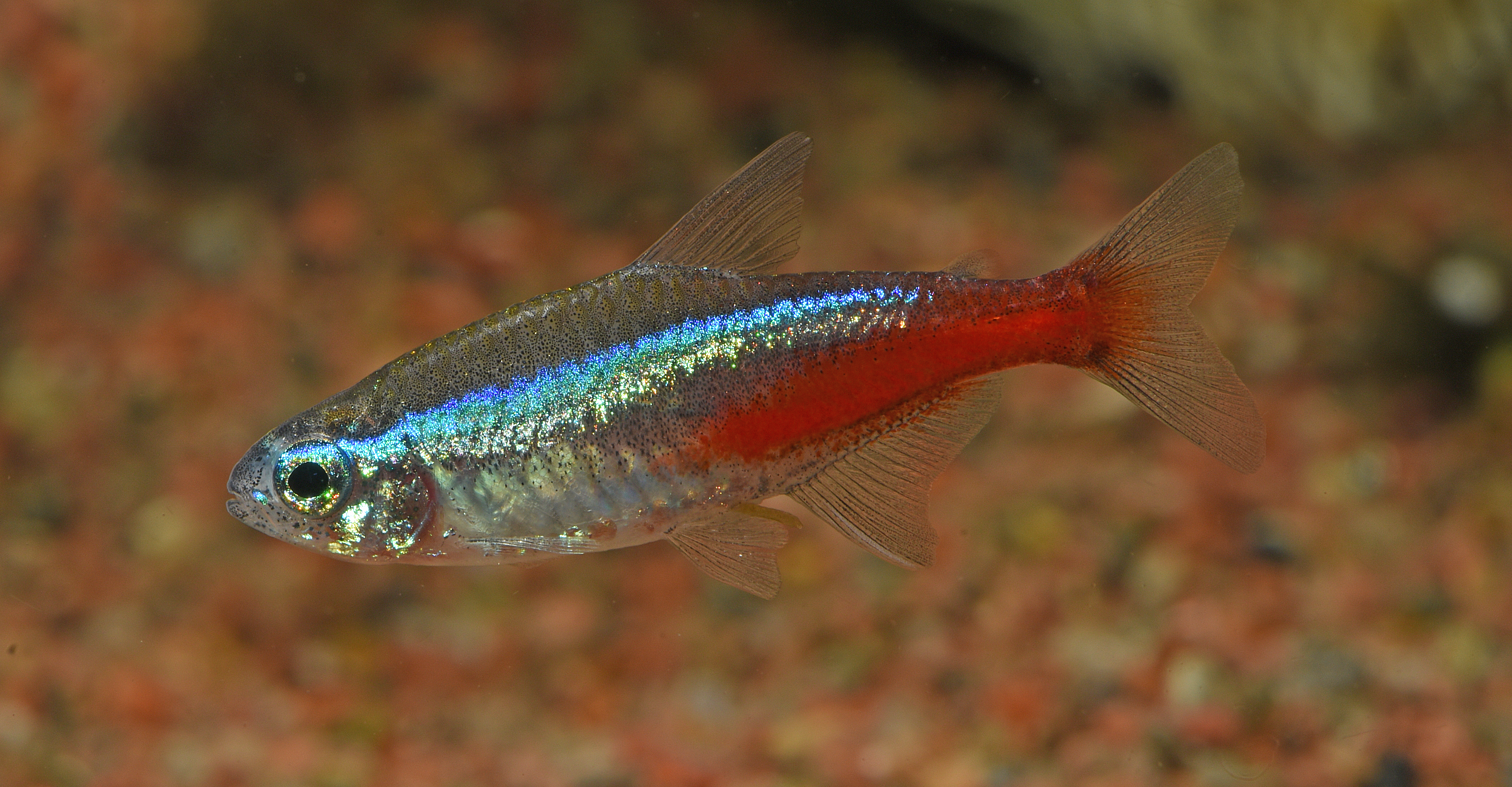
Figure: A healthy Paracheirodon innesi displays uniform coloration and straight posture, making persistent pale muscle patches stand out immediately. SOK, Wikimedia Commons

The other major husbandry concern is true neon tetra disease. According to the Merck Veterinary Manual, this condition is caused by the intracellular microsporidian parasite Pleistophora hyphessobryconis, which invades skeletal muscle—producing persistent opaque or whitish patches, marbled necrotic tissue, erratic swimming, and spinal curvature [4]. Sanders et al. (2010) confirmed that despite its name, Pleistophora hyphessobryconis infects roughly 20 freshwater aquarium species across multiple families (including zebrafish, rasboras, barbs, and angelfish); fish contract spores by scavenging dead or dying tank mates—in one trial, spores from a single infected neon tetra infected seven of ten young zebrafish—and carriers may appear normal for months [5]. Because no effective cure exists, Merck recommends prompt removal of moribund or dead fish, dedicated nets and siphons, and a minimum 30-day quarantine for all new additions [4].
Crucially, pale patches alone do not confirm microsporidiosis. Investigating repeated die-offs in imported Paracheirodon innesi, Michel et al. (2002) in the Journal of Fish Diseases found Pleistophora spores in only a minority of cases; most fish with faded skin and white muscle necrosis actually suffered severe bacterial columnaris disease caused by Flavobacterium columnare, often dubbed false neon tetra disease [6]. Separating the two requires microscopic wet-mount or laboratory testing by an aquatic veterinarian [4][6]. Keepers should isolate any fish showing persistent pale patches, erratic swimming, or sudden separation using dedicated equipment, remove deceased fish promptly, and consult an aquatic vet rather than guessing diagnoses or medications [4][5][6].
Suitable Setups and When Not to Keep Neon Tetras
Neon tetras thrive for keepers who provide a matured, planted aquarium at least 60 cm long with subdued lighting, soft stable water at 20 to 26°C, peaceful small companions, room for a proper school of eight to ten or more fish, and consistent quarantine habits [1][2][4]. Prospective owners should confirm legal captive-bred origin and check local rules covering ornamental fish keeping. They are poorly suited to tiny desktop bowls holding one to three fish, brand-new uncycled aquaria, hot hard-water tanks, or communities containing larger predatory species.
References
[1] FishBase. Paracheirodon innesi (Myers, 1936). https://www.fishbase.se/summary/Paracheirodon-innesi.html
[2] Amelia Saxby, Leoni Adams, Donna Snellgrove, Rod W. Wilson, Katherine A. Sloman. The effect of group size on the behaviour and welfare of four fish species commonly kept in home aquaria. Applied Animal Behaviour Science, 125(3–4):195–205, 2010. https://pdfcookie.com/documents/the-effect-of-group-size-on-the-behaviour-and-welfare-of-four-fish-species-commonly-kept-in-home-aquaria-9mlxq18p3273
[3] Donato Romano, Cesare Stefanini. Unveiling social distancing mechanisms via a fish-robot hybrid interaction. Biological Cybernetics, 115(6):565–573, 2021. https://pmc.ncbi.nlm.nih.gov/articles/PMC8960612/
[4] Barbara D. Petty, Ruth Francis-Floyd, Roy P. E. Yanong. Mycotic Diseases of Fish (and Management of Aquarium Fish). Merck Veterinary Manual. https://www.merckvetmanual.com/exotic-and-laboratory-animals/aquarium-fish/mycotic-diseases-of-fish
[5] Justin L. Sanders, Christian Lawrence, Donald K. Nichols et al. Pleistophora hyphessobryconis (Microsporidia) infecting zebrafish (Danio rerio) in research facilities. Diseases of Aquatic Organisms, 91(1):47–56, 2010. https://pmc.ncbi.nlm.nih.gov/articles/PMC4155925/
[6] C. Michel, S. Messiaen, J.-F. Bernardet. Muscle infections in imported neon tetra, Paracheirodon innesi Myers: limited occurrence of microsporidia and predominance of severe forms of columnaris disease caused by an Asian genomovar of Flavobacterium columnare. Journal of Fish Diseases, 25(5):253–263, 2002. https://onlinelibrary.wiley.com/doi/abs/10.1046/j.1365-2761.2002.00364.x