Look along the shoulders of the pale Peterbald sitting in the shade. A layer of short hair is visible across its back. The photographer identifies it as a brush-coated cat. The World Cat Federation (WCF) lists the breed as Peterbald, code PBD, and describes a long, muscular body, a wedge-shaped head and large ears. Its standard allows for bare skin or a light covering of down and expresses a preference for hairless cats. The photograph shows a detail that is easy to miss in the breed’s name alone. A Peterbald can have hair you can see. [1][2]

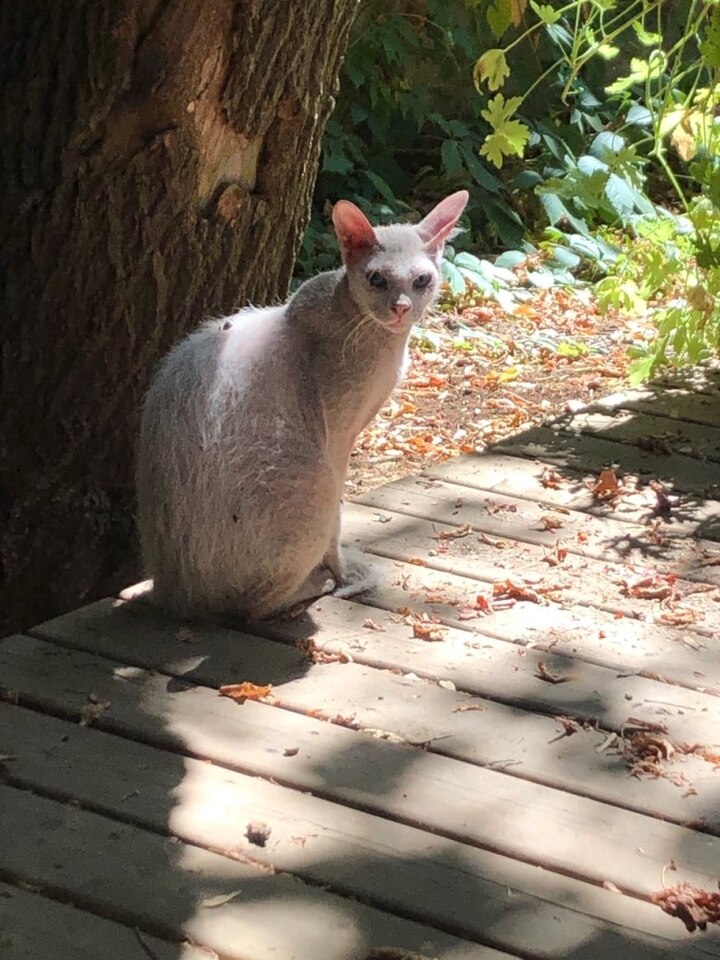
Figure: A brush-coated Peterbald. Acracrabe, Wikimedia Commons[2]
Seen head-on, the wedge is easiest to trace from the tip of the nose. Follow each side of the face upwards. In the WCF description, those lines spread apart as they reach the broad ear bases and continue along the outer edges to the tips. The ears sit wide apart, with almond-shaped eyes between them that tilt slightly towards the nose. The blue eyes in the photograph draw attention, but the expected eye colour depends on the coat pattern. WCF specifies deep blue for colourpoints and bright green for other colours. [1][7]

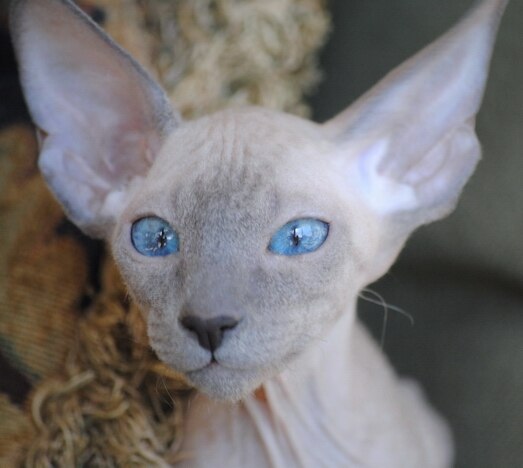
Figure: Peterbald ears seen from the front. Atlantiscats, Wikimedia Commons[7]
In profile, the long, straight nose leads to a fine muzzle. WCF gives a precise way to picture the chin. A vertical line dropped from the tip of the nose should meet the front of the chin. The same long lines run through the body. A slender neck joins an elongated torso, with shoulders and rib cage no wider than the hips. Long legs end in small oval paws with long toes. The tail is thin even at its base and tapers to a point. For all its slenderness, the ideal is a muscular, medium-sized cat. WCF lists excessively fine bone as a fault. [1][8]

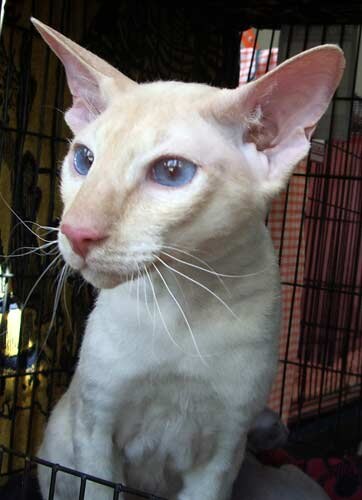
Figure: A Peterbald in profile. Peterbald, Wikimedia Commons[8]
When bringing home a kitten, ask where its coat has always been thickest and where it has changed. WCF allows kittens to have a little hair on the legs, paws, tail and muzzle. For show cats over two years old, its standard calls for that covering to have gone. That age describes what a judge looks for. The International Cat Association (TICA) discusses care according to the coat a Peterbald actually has. For a brush-coated kitten, the hair you see today can guide grooming even while its adult appearance is still taking shape. [1][3]
When your cat comes over for a stroke, notice how the covering varies across its back, flanks and legs. A cat with short hair along its back may have much less on the side it leans against the bed. Keep the brush to the areas with hair. Run your hand along the rim of a favourite bed or the opening of a hideaway to feel for a stiff seam or rough edge. If your cat repeatedly pulls away when you touch one spot, let it move away and remember exactly where it was sensitive. That detail is useful to the next person caring for it. [3][4]
Give your Peterbald a choice of places to sleep. TICA notes that cats with more bare skin are more sensitive to the weather. A sheltered bed with a soft lining offers warmth away from draughts. An open resting place nearby lets the cat move if it gets warm. Watch what it does on a sunny windowsill. If the attraction is the view of people passing below, a perch at a similar height can offer the same view out of prolonged direct sun. See which spots your cat returns to before deciding where its favourite blanket belongs. [3][4]
Follow the route your cat takes after waking up. Can it stretch out to scratch, climb onto a steady platform to watch the room, and slip into a quiet hiding place if something startles it? These are everyday needs Peterbalds share with other indoor cats. The Feline Veterinary Medical Association considers physical activity and emotional wellbeing together. In a home with several cats, the route to a bed matters as much as the bed itself. Two comfortable cushions offer a timid cat little choice if another cat can guard both from a single doorway. [3][4]
Give the cat room to choose during play, too. Draw a toy along the floor within sight. If the cat fixes its gaze on it and crouches, give it a chance to chase and catch it. On another occasion it may stay on its perch and watch. For petting, offer a hand and wait for the cat to approach. Pause after a few strokes and see whether it leans in again or walks away. This makes contact predictable and helps you recognise an unusual flinch when touching a spot the cat ordinarily enjoys having stroked. [4]
Before your Peterbald arrives, ask the previous caregiver how they cleaned its skin, whether any areas were repeatedly sore, and whether there are veterinary records for those episodes. Britain’s Governing Council of the Cat Fancy lists the Peterbald among its unrecognised breeds. It cites reported health problems associated with hairlessness and the care that bare skin can require as reasons for concern. For the household taking on that care, the cat’s history is a practical starting point. Its coat coverage, the condition of its skin and its response to earlier cleaning all matter when choosing a routine. [3][5]
A patch that has always had a little down tells a different story from one that began to thin after repeated licking or biting. The Cornell Feline Health Center lists excessive scratching, licking or biting, redness, swelling, scabs and hair loss among the signs of skin disease in cats. If you notice these changes, contact your veterinarian. Note where the change started, when the cat tends to lick and whether the affected area has spread. Your veterinarian can use that history, the pattern on the skin and any tests needed to investigate the cause. You can contribute something a single examination cannot show: how that patch usually looked and felt. [6]
References
-
[1] World Cat Federation. Peterbald (PBD). Updated January 1, 2010.
-
[2] Acracrabe. Peterbald blanc, type brush. Wikimedia Commons.
-
[3] The International Cat Association. Peterbald.
-
[4] Feline Veterinary Medical Association. New Feline Veterinary Medical Association Position Statement Reimagines Life for Indoor Cats. August 28, 2025.
-
[5] The Governing Council of the Cat Fancy. Unrecognised Breeds. Peterbald entry.
-
[6] Cornell Feline Health Center. Feline Skin Diseases. Updated 2023.
-
[7] Atlantiscats. Kita Peterbald. Wikimedia Commons.
-
[8] Peterbald. Cream-pointed Peterbald cat (male). Wikimedia Commons.