
A dark brown dog eating from a terracotta bowl. Photo: Tony Alter (Flickr user Tobyotter), photographer-dated 3 March 2011; source: Flickr; license: CC BY 2.0.
On 12 October 2026, industry outlet GlobalPETS reported that postbiotics—inactivated microbes or their components—are extending from gut health into joint, skin, and immune pet products, with firms such as ADM and YuMOVE launching related ingredients or supplements. The piece also cautioned that independent evidence remains limited: a systematic review in dogs found no significant differences between postbiotic and control groups on the outcomes analyzed.
New uses for postbiotics and industry moves
The English term is postbiotics. In 2021 the International Scientific Association for Probiotics and Prebiotics (ISAPP) published a consensus defining them as a “preparation of inanimate microorganisms and/or their components that confers a health benefit on the host.” In plain terms: probiotics are “live good bacteria”; postbiotics are cells or components inactivated by heat or similar means—the bacteria are gone, but structures and substances they leave behind may still act. ISAPP stresses that benefits must be shown in the target host (species and population)—effect in humans does not equal effect in dogs or cats.
Per GlobalPETS, rising interest from pet-food makers partly reflects easier processing: viability need not be maintained, and industry voices say postbiotics are simpler to add to powders, extruded treats, dry food, and wet food. On 25 March 2026 U.S. nutrition company ADM announced an expansion of its PRIOME postbiotic line with PRIOME Joint Health for cats and dogs (heat-treated Lacticaseibacillus rhamnosus NCIMB 30446), framed around a “gut–joint axis” (gut microbiota may influence joints via immune and inflammatory pathways). U.K. pet-supplement brand YuMOVE launched a canine chew on 18 May 2026 combining prebiotics, probiotics, and postbiotics, claiming support for gut balance, stool quality, and immunity; industry media say it is sold only in the U.K. so far.
Pet owners still know little about postbiotics. GlobalPETS cited International Probiotics Association (IPA—a nonprofit industry group promoting such ingredients) figures: 32% of pet owners thought probiotics benefit animal health, 17% thought the same of prebiotics, and only 8% of postbiotics; fewer than 25% said they understood the terms well. IPA’s site says the survey covered 754 dog and cat owners. Another set comes from ADM: in September 2025 it surveyed 5,148 pet owners in China, France, Mexico, the U.K., and the U.S.; 71% said they actively seek products supporting pet longevity, and 65% want products with “probiotic/prebiotic/postbiotic”–type ingredients. Note that 65% merges those three categories—it is not postbiotics alone.
Evidence: company research versus independent work
Much support for new uses comes from companies themselves. ADM’s release states that potential benefits of PRIOME Joint Health rest on “preliminary in vitro and model-organism research”—lab cells or model organisms, not clinical trials in cats or dogs. The canine “gut–joint axis” evidence cited compares gut microbiota of healthy dogs with dogs that have hip or elbow arthritis, finding different composition and lower diversity—association, not proof that postbiotic supplements improve joints. GlobalPETS also notes ADM preclinical work observing reduced gut permeability, less fat accumulation, and improved muscle structure among potential benefits, and that U.S. ingredient firm Kingdom studied postbiotics’ effects on canine stool consistency. The reporting itself flags conflict of interest when stakeholders fund the work.
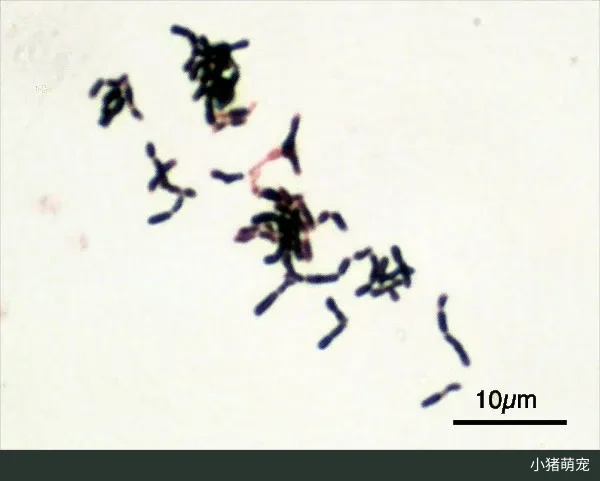
Gram-stained light micrograph of Bifidobacterium adolescentis ATCC 15703 at 1000×, showing rod-shaped, partly branched cells; inactivated, such bacteria can be formulated as postbiotics. Photo: Y tambe; source: Wikimedia Commons; license: CC BY-SA 3.0.

On the independent side, a dermatology lab at Jeonbuk National University College of Veterinary Medicine published in Animals on 10 February 2026: researchers took culture supernatant (a postbiotic) from Bifidobacterium animalis subsp. lactis DS008 isolated from healthy canine facial skin, applied it to cultured canine keratinocytes, and saw marked drops in itch- and irritation-related inflammatory mediators (such as IL-31 and TSLP) and a rise in barrier-related keratin 10; damaged stratum corneum structure also improved on reconstructed canine epidermis models. Authors declared no conflicts and no funding. These are dish and tissue-model experiments, not yet verified in live dogs.
The most systematic assessment so far comes from a Complutense University of Madrid team. Their systematic review and meta-analysis in Microorganisms (3 July 2025) searched literature through 10 October 2024, included 69 papers, and found only 13 true in vivo dog studies. Meta-analysis of selected outcomes showed no statistically significant differences between postbiotic and control groups. Authors pointed to small samples, heterogeneous strains, and varied designs, while noting evidence in other species that postbiotics may improve microbiota composition and modulate immunity and inflammation—hence a call for more canine research. Evidence in cats is thinner still: a University of Córdoba review in Journal of Small Animal Practice (January 2025) concluded current data are insufficient for high-confidence evaluation of probiotics, prebiotics, synbiotics, and postbiotics for feline gastrointestinal health, and that more research is needed before recommending use.
What this means for pet owners—and limits of the sources
In short, postbiotics are a field where products run ahead of evidence. Seeing “postbiotic” or “supports joints/skin/immunity” on pet food or supplements is best read as: ingredient firms have early lab data, but independent clinical evidence in cats and dogs is not yet enough to prove reliable effect. ISAPP’s definition also implies benefits depend on specific strains and preparations; products that share the label “postbiotic” cannot borrow one another’s conclusions. For stiff joints, recurring skin itch, or chronic soft stool, have a veterinarian find the cause first; supplements are at most adjuncts, not substitutes for diagnosis and treatment. If you try one, bring the ingredient list to your vet and watch how the pet responds.
Source limits also need stating: GlobalPETS is trade media, and market judgments often come from interviewed firms; IPA’s page does not publish survey timing or sampling methods, and the 32%/17%/8% figures are relayed via GlobalPETS; Kingdom’s stool-consistency work could not be located in full text here and is paraphrased from reporting; ADM preclinical details were also not found in open publication. As more independent, well-designed clinical trials in cats and dogs appear, these conclusions may change.
References
-
GlobalPETS (Thaís Matos): Postbiotics move beyond gut and digestive health, 2026-10-12.
-
Salminen S. et al. (ISAPP): The International Scientific Association of Probiotics and Prebiotics (ISAPP) consensus statement on the definition and scope of postbiotics, Nature Reviews Gastroenterology & Hepatology, 2021.
-
ADM: ADM Introduces PRIOME® Joint Health Postbiotic for Pets, 2026-03-25.
-
ADM: New Research Uncovers Country-Based Consumer Perceptions of Pet Longevity; Pet Food Processing: Report: Pet longevity a priority worldwide.
-
YuMOVE: YuMOVE Pre, Pro & Postbiotic for Dogs; Pet Food Processing: YuMOVE introduces triple biotic supplements, 2026-05-28.
-
International Probiotics Association: Companion Animal Biotics Market.
-
Kim M. et al. (Jeonbuk National University): Effects of Canine-Derived Bifidobacterium animalis subsp. lactis DS008 Culture Supernatants on In Vitro Canine Keratinocytes, Animals, 2026-02-10.
-
Complutense University of Madrid team: Effects of Postbiotic Administration on Canine Health: A Systematic Review and Meta-Analysis, Microorganisms, 2025-07-03.
-
López Martí Á. et al. (University of Córdoba): Efficacy of probiotic, prebiotic, synbiotic and postbiotic supplementation on gastrointestinal health in cats: systematic review and meta‐analysis, Journal of Small Animal Practice, 2025-01-12.