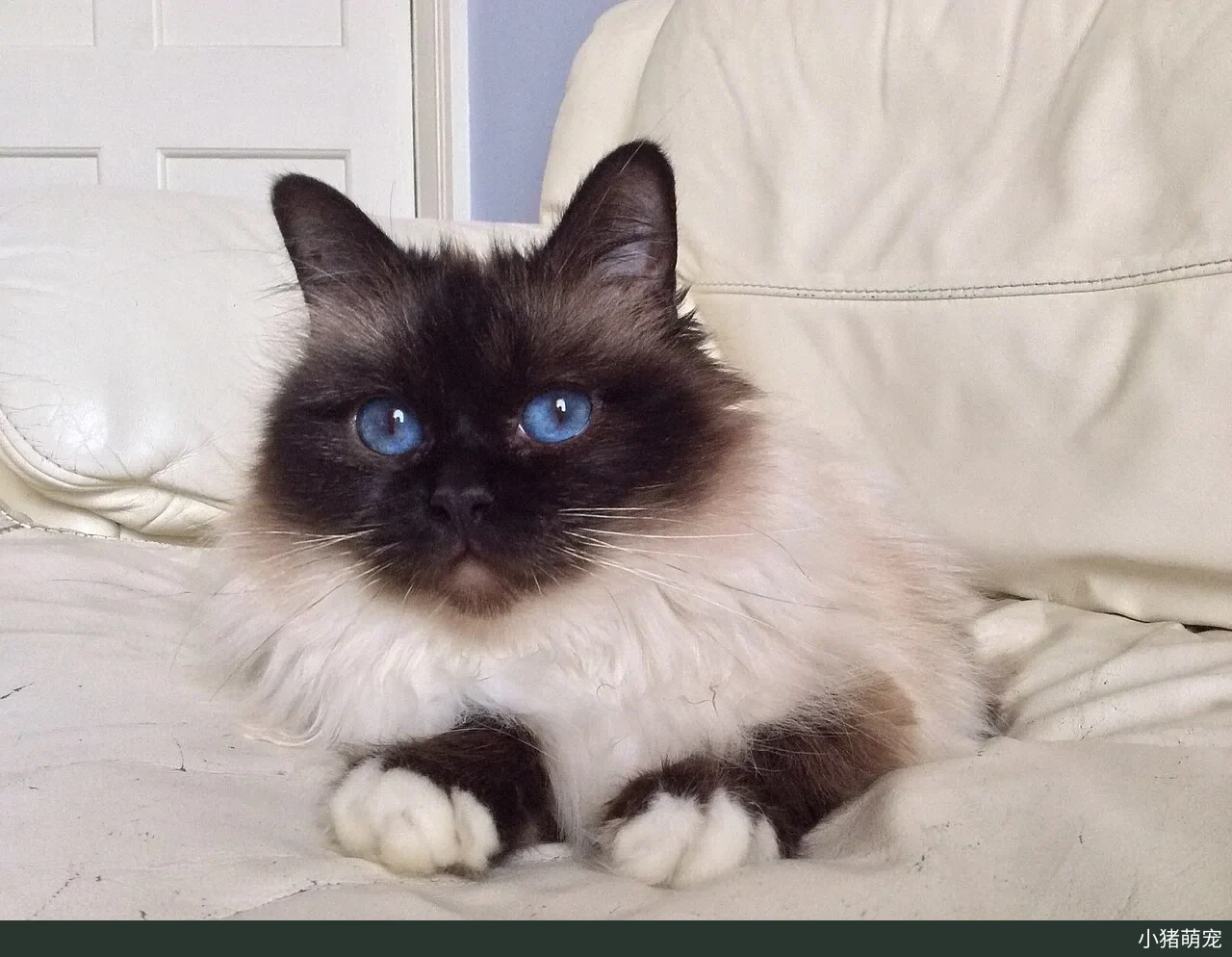
Three-year-old seal-point Birman Tallulah: a deep brown face and ears set off deep blue eyes, with snow-white “gloves” on both front paws (the photographer noted January 2014). Photo: Jon McKnight; source: Wikimedia Commons; license: CC BY-SA 4.0.

The Birman has a romantic alias—the “Sacred Cat of Burma.” It wears a pointed semi-long coat, deep blue eyes, and four feet that look as if they are wearing neat white gloves. Breed associations describe it as gentle and people-oriented; the coat has no undercoat and is easier to manage than that of most longhairs. Still, the breed nearly vanished after World War II, its gene pool is relatively narrow, and before bringing one home it is worth learning its history, health risks, and care essentials.
Origins: temple legend and French breeding history
The most widely told story of the Birman’s origins is a temple legend. TICA’s breed page retells it this way: in a Burmese temple, a golden-eyed white cat kept watch beside a dying priest; when the priest’s soul entered the cat, its face, legs, and tail turned deep brown, its body took on a golden sheen, its golden eyes became sapphire blue, and the four feet that had rested on its master’s chest remained snow-white, a sign of the master’s purity. TICA also notes that the story has many versions—it is legend, not historical record.
Documented history is much shorter and still incomplete. CFA admits that the Birman’s true origins “remain a mystery to all,” but what can be established is this: around 1919 a pair of Birmans was brought from Burma to France; the queen arrived already pregnant and became the foundation of French Birmans; the breed name comes from the French word for Burma, “Birmanie.” TICA records that the Birman was first recognized and shown in France in the 1920s, and recognized in Britain in 1966. For arrival in the United States, CFA writes 1959 and TICA the 1960s; both record registration or showing in the U.S. from 1967. Europe’s FIFe lists the “Sacred Birman” among breeds recognized from its founding in 1949. Genetic research also supports an Oriental background: a 2007 study across multiple breeds found Birmans clustering genetically with Southeast Asian breeds such as the Siamese and Burmese.
World War II nearly wiped the breed out. CFA says that at war’s end Europe had only one breeding pair left; TICA names them—Orloff and Xenia de Kaabaa, owned by Baudoin-Crevoisier. To keep the line alive, French breeders had to outcross to other breeds: CFA names Persians and Siamese; TICA says “presumably Persians.” Purebred Birman litters only reappeared in the early 1950s. CFA also notes a French tradition that continues today: kittens born in the same year share names beginning with the same letter—for example U in 2023 and V in 2024.
Appearance: points, blue eyes, and white gloves
The Birman is a medium to large cat. The CFA standard describes the body as “long and stocky,” neither delicate nor cobby, with a heavy bone structure and solid muscle; queens are usually smaller than males, and full maturity takes about three years. The coat is medium-long to long, silk-like in texture, with a full ruff around the neck and slightly wavy hair on the belly. Both CFA and TICA note that it is a single coat without undercoat, so it is less prone to matting.
Its coloring is “pointed”: a light body with darker face, ears, legs, and tail. The UC Davis Veterinary Genetics Laboratory explains that pigment production is temperature-sensitive—warmer body areas stay paler, cooler extremities darker. The CFA standard also favors a soft “golden mist” over the back and sides. Birmans originally came in only four point colors—seal, blue, chocolate, and lilac; today lynx (tabby) points are also accepted, as are red, cream, and tortie points. Eyes must be blue, the deeper and more vivid the better; under the CFA standard, non-blue eyes are a disqualification.
The most distinctive feature is the four white paws. The white “gloves” on the front feet should form a neat horizontal line across the paw; on the hind feet the white extends up the back of the hock into pointed “laces,” ideally reaching about half to three-quarters of the hock segment. Missing gloves on any foot is a CFA disqualification. The UC Davis Veterinary Genetics Laboratory notes that these white gloves are caused by a KIT gene variant and are autosomal recessive. For the head, the standard calls for a broad, rounded skull and a strong chin, with a medium-length nose that rises slightly—the so-called “Roman nose.”
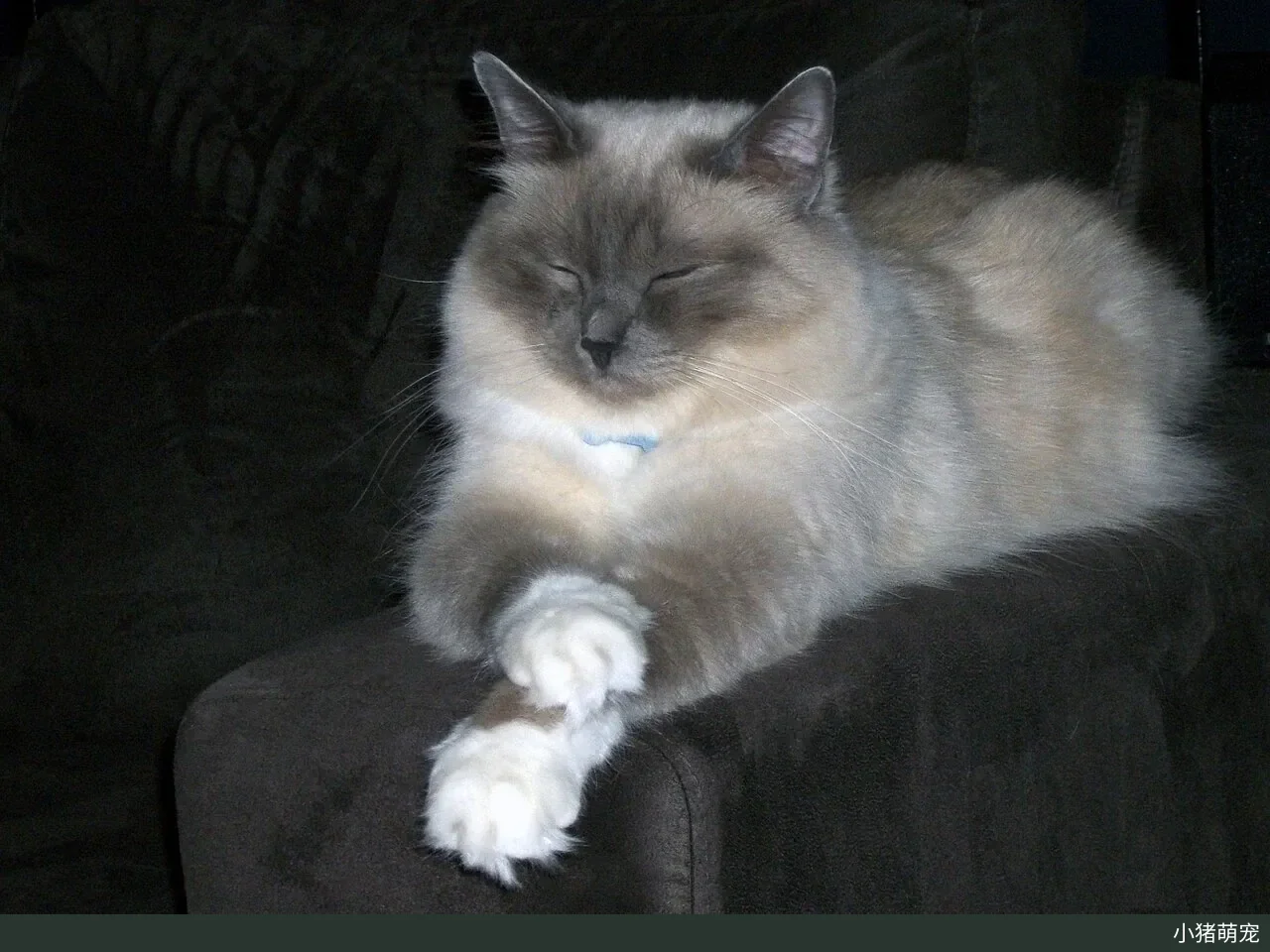
A two-and-a-half-year-old blue-point Birman male; the crossed front paws show neat white gloves against blue-gray legs; the hind “laces” are not in frame (the photographer noted February 2011). Photo: sk_catz; source: Wikimedia Commons; license: CC BY-SA 3.0.

Temperament and day-to-day care
CFA and TICA describe Birman temperament in highly similar terms: gentle, people-oriented, and easygoing. CFA calls the breed intelligent and willing to learn, usually responsive to training; activity level is moderate, yet it loves to “help,” often joining you during household chores. TICA calls it a “Velcro cat” because it likes to follow people around all day; it also has a playful side, chasing balls, retrieving toys, and enjoying interactive toys that make it think. Its voice is usually soft, but both associations caution that if you answer every call, it may become quite talkative. These are breed-association summaries; individual cats still vary.
Because of its patience and even temper, CFA considers the Birman a good fit for homes with children or other pets. It depends heavily on companionship, though, and is not suited to long stretches alone; CFA suggests that if you work daytime hours and have no other pets, you might consider keeping two.
For grooming, Birmans are among the less demanding longhairs. TICA recommends a metal comb once a week, with more frequent sessions when the winter coat is shedding in spring. CFA says most Birmans do not need regular baths—an occasional wash is enough—and grooming products can be discussed with the breeder first. Day-to-day care also means regular nail trims, ear cleaning, brushing with a veterinarian-approved pet toothpaste, and a tall enough scratching post. On diet, TICA sees no special nutritional needs beyond a quality dry food, with treats in moderation; fresh, clean water should be available daily, preferably with the water bowl about 1 meter (3 feet) from the food dish, or with a filtered fountain instead.
Common health concerns
TICA describes Birmans as generally healthy, with an expected lifespan of 9 to more than 15 years. Unlike folded-ear, short-legged, or flat-faced breeds, the Birman standard does not chase extreme conformation: CFA requires a muzzle that is “neither short and blunt nor pointed and narrow,” penalizes Persian- or Siamese-type heads, and disqualifies kinked tails or structural abnormalities. What it does need serious attention to is a narrow gene pool. Beyond the postwar bottleneck, a 2007 breed-genetics study found Birman heterozygosity and allelic richness relatively low among breeds tested; a 2018 study using a 63K SNP chip measured the largest linkage-disequilibrium range among 20 breeds in Birmans (about 1450 kb) and listed them with Burmese as breeds with “severely reduced” genetic variation. The authors also cautioned that the Birman samples came mainly from two large, closely related families, which may have affected the results. The narrower the gene pool, the greater the chance that two cats carry the same recessive disease allele.
Two Birman hereditary conditions are relatively well studied. The first is congenital hypotrichosis with thymic aplasia: kittens are born nearly hairless, without a thymus, and with severe immune deficiency. A 2015 PLOS ONE study identified the cause—a 4-base-pair deletion in FOXN1; disease appears only when a copy is inherited from each parent; none of the 13 hairless kittens recorded in the literature lived past 8 months. Researchers estimated healthy carriers at about 3.2% in French samples and noted that DNA testing already exists to avoid carrier-to-carrier matings. The second is neutrophil granulation anomaly: a 1984 study found fine granules in the white cells of some Birmans, also recessive, but bactericidal and phagocytic function was normal; it does not appear to affect health, though it can cause a false alarm on bloodwork. CFA also notes that breeders screen for hypertrophic cardiomyopathy (HCM) and similar conditions to protect the population.
Two further points matter for clinical judgment. First, feline infectious peritonitis (FIP): in a 16-year case review at a North Carolina State University teaching hospital, the FIP diagnosis rate in Birmans was significantly higher than in mixed-breed cats (4 of 18, 22.2%; mixed breeds 0.35%). With only 18 Birman cases from a teaching hospital, that rate cannot be treated as prevalence in all Birmans. Second, kidney markers: a 2018 University of Milan study found mean serum creatinine in healthy Birmans of 1.58 mg/dl, higher than 1.19 mg/dl in other breeds; 20 of 50 healthy Birmans exceeded both the general reference range and the IRIS stage 2 chronic kidney disease cutoff (1.6 mg/dl). The researchers argued that combining SDMA with breed-specific reference ranges can reduce misclassification. Meanwhile, Swedish pet-insurance data for 2011–2016 listed “upper urinary tract” (kidney and ureter) problems among the five most common reasons Birmans visited the veterinarian. Claims data reflect only visit categories for insured cats and do not prove specific diagnoses, but they are enough to urge owners to take kidney health seriously.
If you plan to keep a Birman, you can: ask the breeder for parental FOXN1 test results and which cardiac screens have been done; tell your veterinarian the cat is a Birman and establish a bloodwork baseline while it is young and healthy, then recheck regularly; and if drinking, urination, or weight change markedly—classic early signs of feline chronic kidney disease—seek care promptly.
References
-
The Cat Fanciers' Association. Birman, undated page, accessed 17 October 2026.
-
The International Cat Association. Birman, undated page, accessed 17 October 2026.
-
Fédération Internationale Féline. Breeds, accessed 17 October 2026.
-
UC Davis Veterinary Genetics Laboratory. Birman, accessed 17 October 2026.
-
Abitbol M, et al. A Deletion in FOXN1 Is Associated with a Syndrome Characterized by Congenital Hypotrichosis and Short Life Expectancy in Birman Cats. PLOS ONE, 2015, 10(3): e0120668.
-
Hirsch VM, Cunningham TA. Hereditary anomaly of neutrophil granulation in Birman cats. American Journal of Veterinary Research, 1984, 45(10): 2170.
-
Pesteanu-Somogyi LD, Radzai C, Pressler BM. Prevalence of feline infectious peritonitis in specific cat breeds. Journal of Feline Medicine and Surgery, 2006, 8(1): 1–5.
-
Paltrinieri S, et al. Serum symmetric dimethylarginine and creatinine in Birman cats compared with cats of other breeds. Journal of Feline Medicine and Surgery, 2018, 20(10).
-
Hadar BN, Bonnett BN, Poljak Z, Bernardo TM. Morbidity of insured Swedish cats between 2011 and 2016: Comparing disease risk in domestic crosses and purebreds. Veterinary Record, 2023, 192(12): e2778.
-
Lipinski MJ, et al. The ascent of cat breeds: Genetic evaluations of breeds and worldwide random-bred populations. Genomics, 2008, 91(1): 12–21.
-
Gandolfi B, Alhaddad H, et al. Applications and efficiencies of the first cat 63K DNA array. Scientific Reports, 2018.
-
EveryCat Health Foundation. Chronic kidney disease in cats attending primary care practice in the UK: a VetCompass study (study summary), accessed 17 October 2026.