The dark patch around a Himalayan’s nose and mouth is the natural color of the fur. You can leave it alone when you clean the cat’s face. It is part of the same pattern that gives the ears, feet and tail their darker color. Look instead at the inner corners of the eyes. Has discharge collected there? Is the fur underneath wetter than usual? The markings may look just as they always have, even when something about the eyes has changed.[1][2]
How did a Persian come to have points?
The name Himalayan comes from the pattern of dark points against a lighter body. Twentieth-century breeders wanted a cat with the blue eyes and points of a Siamese and the build and dense, long coat of a Persian. In 1931, Virginia Cobb and Clyde Keeler began an experimental breeding program that eventually produced a longhaired, pointed kitten named Newton’s Debutante. Breeders in Britain also worked toward a longhaired cat with points. In 1955, Britain’s Governing Council of the Cat Fancy (GCCF) recognized it as the Colorpoint Longhair.[1]
American breeder Marguerita Goforth began with a seal-point longhair. She worked to retain the Persian build and helped the Himalayan gain championship recognition. American cat associations recognized it under the name Himalayan in 1957. Today, the name appears in two places in breed registers. The International Cat Association (TICA) recognizes the Himalayan as a distinct breed in the Persian breed group. The Cat Fanciers’ Association (CFA) places it in the Himalayan Division of the Persian breed. To find a Himalayan in a CFA show listing, look under Persian first, then Himalayan. Both names describe the same entry.[1][2]
Our Persian profile places the Himalayan Division alongside the other Persian color divisions and traces the breed’s round head, short muzzle and long coat. The family resemblance is easy to see once you know where to look. The Himalayan owes its distinctive points to its Siamese ancestors. The thick coat you work through with a comb each day is a Persian trait.[1][3]
Tracing the points from face to tail
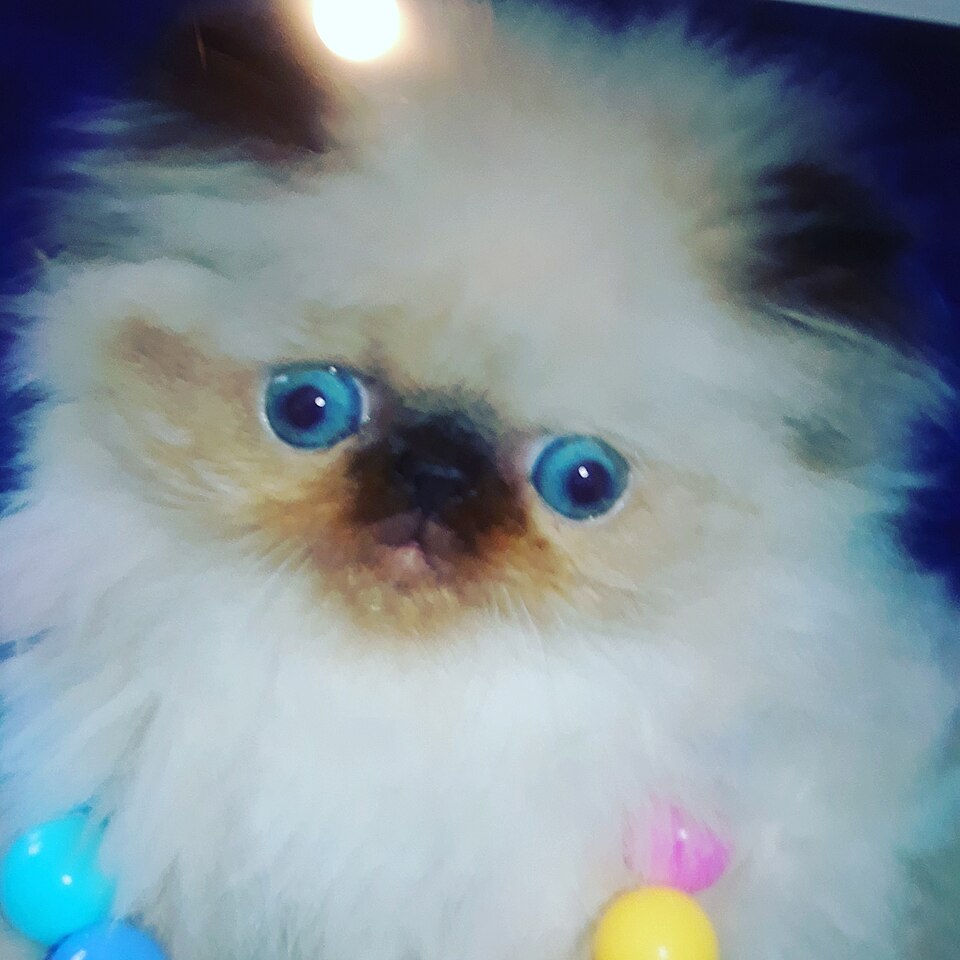
Princess’s blue eyes stand out against her mask. Don Ramey Logan, Wikimedia Commons[7]

In the front view of Princess, the darkest patch lies between her blue eyes. Fur Bear, looking up in the next photograph, shows the dark ears and cheeks above a pale chest. The breed standard calls the pointed area on the face the mask. On a standing cat, follow the color down the legs to the feet and along the tail, then compare those areas with the body. An older cat’s body coat can darken, but the standard still calls for a visible contrast between the body and the points.[1][2]
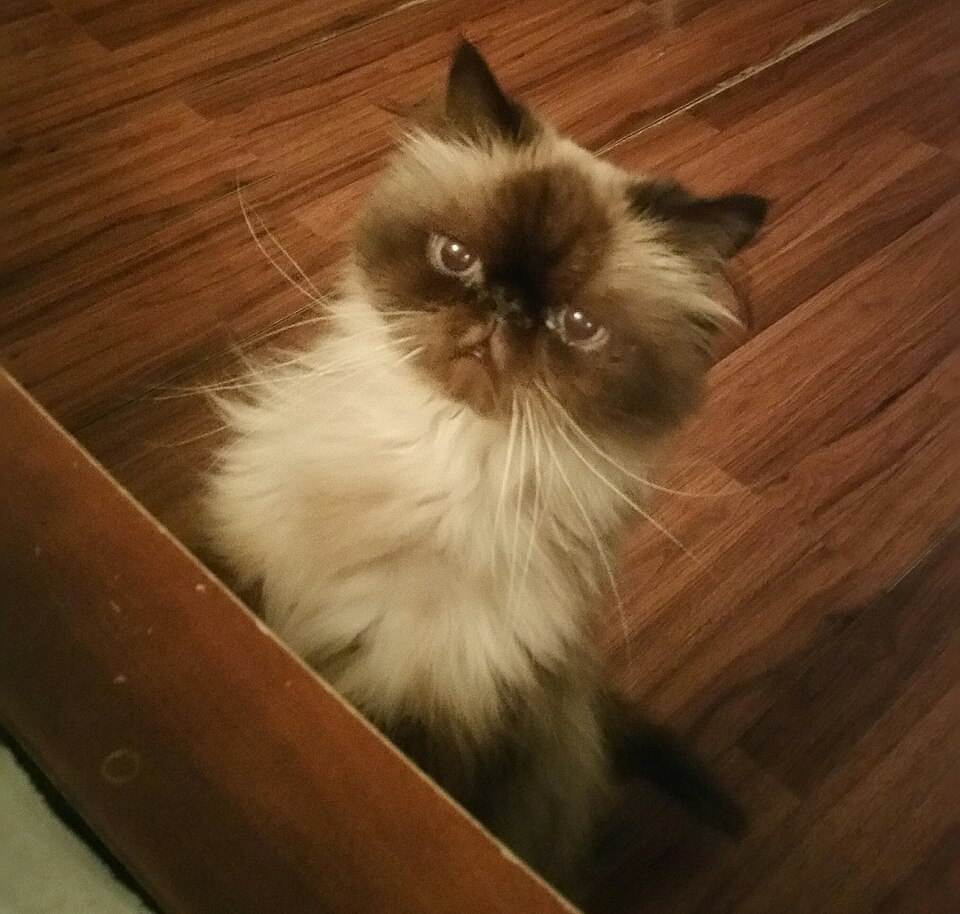
Fur Bear’s dark ears contrast with a pale ruff. Sheepwalrus, Wikimedia Commons[8]

The word “point” tells you where the color appears. Its shade and markings can vary. In CFA’s standard, a seal point has deep seal-brown ears, mask, legs and feet against a body ranging from pale fawn to cream. A chocolate point has warmer, milk-chocolate points and an ivory body. A lynx point has tabby markings, including an M on the forehead and stripes across the cheeks. To recognize a color pattern, take in the whole mask and the markings on the other points. A small patch beside the nose gives you little to go on.[2]
Check the eyes during daily grooming
A Himalayan’s dry chest fur fans outward and can hide tangles underneath. Choose a quiet time each day and start where your cat is comfortable being touched. Part the coat into small sections and feel through each one as you comb, especially under the chin and down the chest. If the comb catches, stop and part the hair to see what is holding it. Pulling on the whole tuft can tug at the skin. As you work, keep track of the areas you have reached and the spots that tend to tangle, even when the coat looks fluffy on the surface.[1][4]
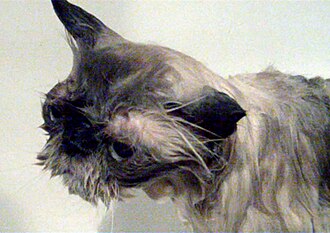
Bluna’s wet cheek fur falls into strands. StelePrezer, Wikimedia Commons[9]

Bluna’s wet fur lies flat against the cheeks and gathers into tufts under the chin. During routine care, pay attention to where your own cat’s fur gets damp. Once you know the usual outline of the mask, it is easier to notice changes along the short stretch from the inner corner of each eye to the side of the nose. Gently wipe away tear residue on the fur. If discharge increases or keeps building up after cleaning, note when it started and whether it affects one eye or both, and contact your veterinarian. In a Royal Veterinary College study of Persian cats’ medical records, eye discharge and coat problems were both common findings. Mention either change specifically when you call.[1][4]
Give a quiet cat something to chase
TICA describes a cat that enjoys a quiet rest and may suddenly get up to chase a ball. Make room for both kinds of company. When your cat settles beside you, let it enjoy the quiet. When its eyes follow a moving toy, draw the toy along the floor in short bursts, pausing so the cat can stalk, pounce and catch it. Leave a familiar resting spot within reach when the game ends. Knowing how your cat usually plays also makes it easier to notice a day when it shows less interest.[1][5]
Start at your cat’s resting spot and trace the routes to water, food and the litter box. In a home with several cats, it matters where those routes lead. Two water bowls side by side can both be out of reach if one cat sits in the doorway, even when each cat has a bowl of its own. Put another water bowl or resting place along a different route so each cat can choose. Leave a sheltered spot where a cat can spend time alone and decide when to come out for company or play.[5]
How do you read a Himalayan’s PKD1 report?
The Himalayan’s Persian ancestry makes one health record worth asking about when you bring a cat home. The UC Davis Veterinary Genetics Laboratory lists the Himalayan among the breeds for which its PKD1 test is appropriate. In this inherited form of polycystic kidney disease, multiple cysts can develop in both kidneys. Cysts often appear before a cat’s first birthday, while kidney failure typically occurs much later. There is good reason to ask for the report even when the cat seems bright and eager to play.[6]
First check which cat gave the sample, then read the test name and result. The lab uses N for the usual version of the gene and P for the disease-causing variant it tests for. N/N means the lab found no copy of that variant. N/P means it found one copy, enough to cause this autosomal dominant form of the disease. If the report belongs to a parent, keep a record of which parent was tested. If your own cat’s result is N/P, take the report to your veterinarian to discuss how to assess kidney function now and what follow-up to plan. The DNA result tells you what the cat inherited. Clinical tests show how well the kidneys are working today.[6]
References
-
[1] The International Cat Association. Himalayan.
-
[2] The Cat Fanciers’ Association. Persian.
-
[3] 小猪盖被. October 17, 2026. 波斯猫:一张圆脸背后的历史、性格与健康功课.
-
[4] Royal Veterinary College, VetCompass. Persian cats.
-
[5] Feline Veterinary Medical Association. August 28, 2025. New Feline Veterinary Medical Association Position Statement Reimagines Life for Indoor Cats.
-
[6] UC Davis Veterinary Genetics Laboratory. Polycystic Kidney Disease (PKD1).