The Norwegian Elkhound—officially designated Norwegian Elkhound Grey (Norsk Elghund Grå) by the Fédération Cynologique Internationale (FCI)—originated in Norway and stands among Europe’s oldest Nordic spitz hunting breeds.[1][2][3] Canine skeletons closely matching today’s Elkhound have been unearthed in Stone Age strata at Norway’s Viste Cave and alongside Viking weapons, reflecting millennia spent sailing, guarding remote farms, and tracking moose and bears across rugged northern terrain.[1][2] Although it bears little resemblance to sleek, drop-eared scenthounds, both the American Kennel Club (AKC, recognized in 1913) and The Royal Kennel Club place the breed in the Hound Group for its trailing-and-baying work, while the FCI classifies it in Group 5 (Nordic hunting dogs, Standard No. 242).[1][2][3]
Built for endurance in harsh weather, the Norwegian Elkhound is a sturdy, close-coupled medium dog that appears square in profile. Under the AKC standard, adult males ideally stand about 20.5 inches at the shoulder and weigh 55 pounds, while females stand around 19.5 inches and weigh 48 pounds.[1] It carries a broad, wedge-shaped head free of loose skin, dark brown oval eyes, high-set pointed prick ears that pivot with attention, a deep chest, and a thickly haired tail curled tightly over the centerline of the back.[1] Its signature coat is silver-gray to wolf-gray with darker shading on the muzzle and ear tips and lighter tones on the chest, legs, and underside of the tail—distinct from the separately classified Black Norwegian Elkhound.[1][2][3]

A Grey Norwegian Elkhound showing its square build, dark mask, and curled tail. Canarian, Wikimedia Commons[5]

Handling the Thick Double Coat and Heavy Shedding Seasons
Anyone bringing home a Norwegian Elkhound should prepare for serious undercoat shedding. The AKC standard describes a weather-resistant “two-ply” coat consisting of a soft, dense, woolly undercoat beneath coarse, straight outer guard hairs—longest on the ruff, hindquarters, and underside of the tail, and short and even across the head, ears, and fronts of the legs.[1] Breeders routinely warn newcomers that seasonal coat blows send silver “tumbleweeds” of undercoat drifting across floors, while the outer guard hairs shed more lightly.[1] Fortunately, upkeep is straightforward when kept regular: the AKC recommends a slicker brush and five minutes of daily “back-brushing” (brushing opposite the lie of the coat) through heavier shedding months to lift loose undercoat before it drops indoors, tapering to about two minutes a day during quieter periods to keep the coat healthy and protect your vacuum.[1] Thanks to the harsh outer coat, Elkhounds rarely carry a doggy odor and generally need only two or three baths a year—which also helps release dead hair so fresh coat grows in cleanly—and the natural double coat should never be shaved, clipped, or artificially thinned, preserving its built-in insulation and weather protection.[1]

A Norwegian Elkhound by a river showing its dense double coat and silver ruff. Dmitry Guskov, Wikimedia Commons[6]

Understanding Alert Barking Through Training and Environment
The breed’s voice deserves just as much forethought as its coat. Historically, Norwegian Elkhounds ranged miles ahead of hunters for days at a time to locate moose, then circled and dodged charges while using a loud, resonant bark to hold the quarry at bay and signal the hunter’s approach.[1][2] That reporting instinct—combined with a vigilant watchdog temperament and a confident, alert personality—means Elkhounds are naturally vocal, quick to announce footsteps in hallways, passersby outside a fence, or wildlife moving across a yard.[1]
Managing this instinct works best through environmental setup and constructive training rather than suppression. Start by limiting constant visual triggers: frosted window film or curtains on street-facing windows, avoiding leaving the dog unattended along busy fences, and offering quiet enrichment such as scent work or food puzzles during downtime cut down repetitive alert barking. Meeting the physical and mental drive of a long-distance trail hound is equally important, since boredom amplifies vocalizing; the AKC notes that many Elkhounds love swimming (a natural part of trailing moose across Nordic terrain) and enjoy agility and herding trials, while cautioning owners never to let this independent explorer roam parks or neighborhoods off-leash.[1] In training, teach clear alternative cues such as “quiet” or “go to your mat” with positive reinforcement—acknowledging an initial alert calmly, then rewarding the dog for settling on its bed—while keeping sessions short and varied, because quick-witted Elkhounds rapidly tune out monotonous drills, even though they housebreak cleanly and learn household manners quickly.[1]
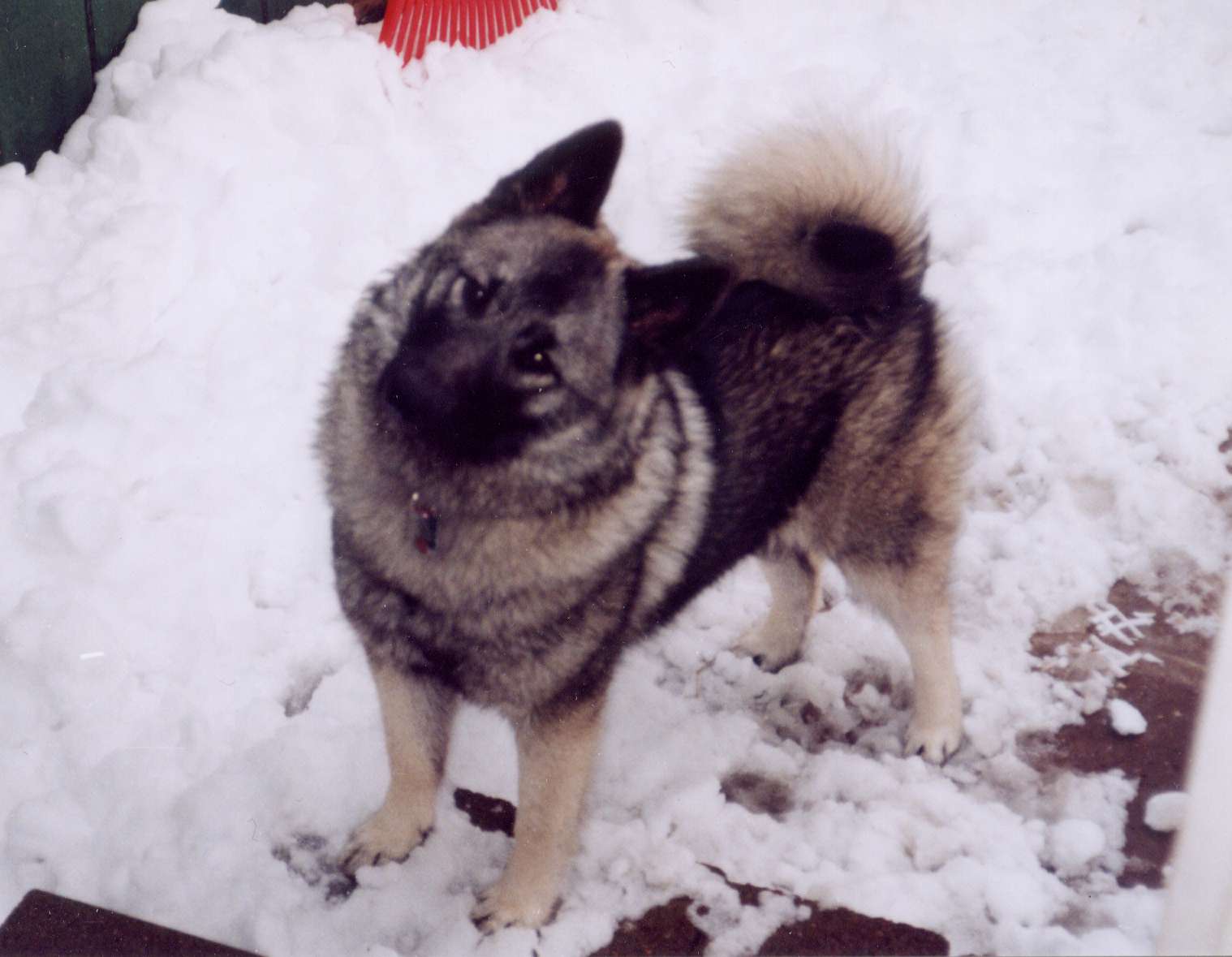
A female Norwegian Elkhound in snow displaying its winter coat and prick ears. Valich, Wikimedia Commons[7]

Weight Checks, Health Screening, and Household Fit
Norwegian Elkhounds are typically long-lived and resilient, with an average life expectancy of 12 to 15 years and routine senior monitoring for cancer and heart conditions.[1] The AKC lists two core recommended screenings: Hip Evaluation and Ophthalmologist Evaluation.[1] Eye health warrants special attention: a 2014 genetic study in PLOS ONE sampling Norwegian Elkhounds from Finland, the US, and the UK identified a missense mutation (p.A387T) in ADAMTS10 responsible for primary open-angle glaucoma in the breed, with a 25.3% carrier frequency among unaffected dogs tested—underscoring the value of specialist eye exams and DNA screening alongside attention to rare progressive retinal atrophy or kidney history in consultation with a veterinarian.[1][4] Because most Elkhounds are enthusiastic eaters eager to charm extra treats, the AKC offers a handy weight check: the area just behind the ribcage should sink slightly inward as the dog eats, while a rolling motion along the back or sides at a trot signals excess weight.[1] Overall, the breed suits active, noise-tolerant homes with space or good sound insulation, readiness for seasonal shedding and daily brushing, and commitment to leashed outings and positive guidance—whereas tight apartments with strict noise rules or households expecting minimal fur should consider carefully.[1][2]
References
- American Kennel Club. Norwegian Elkhound Dog Breed Information.
- The Royal Kennel Club. Norwegian Elkhound Breed Information.
- Fédération Cynologique Internationale. Norsk Elghund Grå / Norwegian Elkhound Grey (FCI Standard No. 242).
- Ahonen SJ, Kaukonen M, Nussdorfer FD, et al. A novel missense mutation in ADAMTS10 in Norwegian Elkhound primary glaucoma, PLOS ONE 2014;9(11):e111941.
- Canarian. File:NorwegianElkGrey1.jpg, Wikimedia Commons.
- Dmitry Guskov. File:Norwegian Elkhound 1.jpg, Wikimedia Commons.
- Valich. File:Norwegian Elkhound (female2).JPG, Wikimedia Commons.