The World Cat Federation (WCF) calls the shorthaired variety the Kurilian Bobtail Shorthair, abbreviated KBS. One detail in its breed standard is easy to miss. The length it gives, 3 to 8 centimeters, is for the tail itself, measured without the fur. The tail has one or more bends or kinks, and the hair covering it is longer than the hair on the body. Together they give the tail its pom-pom outline. From the outside, the tips of the fur tell you little about where the tail actually ends. [1]
The Kurilian Bobtail in Profile
Watch a Kurilian Bobtail standing naturally, side on. The back forms a slight arch, the rump sits a little higher than the shoulders, and the hind legs are longer than the front legs. Sturdy limbs and rounded paws complete the impression of a compact, muscular cat. Two cats whose tails look equally round can have quite different tail shapes under the fur. A single bend or a series of kinks both fit the WCF description. At home, let your cat walk past you. You can see how it usually carries its tail without taking hold of the tip or trying to straighten it. [1,2]
When the cat turns toward you, look at the shape of its face. The WCF describes a trapezoidal head with gently rounded contours, broad cheekbones, a fairly wide muzzle and a well-developed chin. The ears are wide at the base, and the eyes are set well apart at a slight slant. In the portrait of Julapp below, the tabby markings on either side of the nose draw the eye to the pale muzzle. Look at how the eyes sit above the cheekbones and how the cheeks frame the muzzle. Those relationships are easier to carry over to another Kurilian Bobtail, since the breed comes in many coat colors. [1,8]
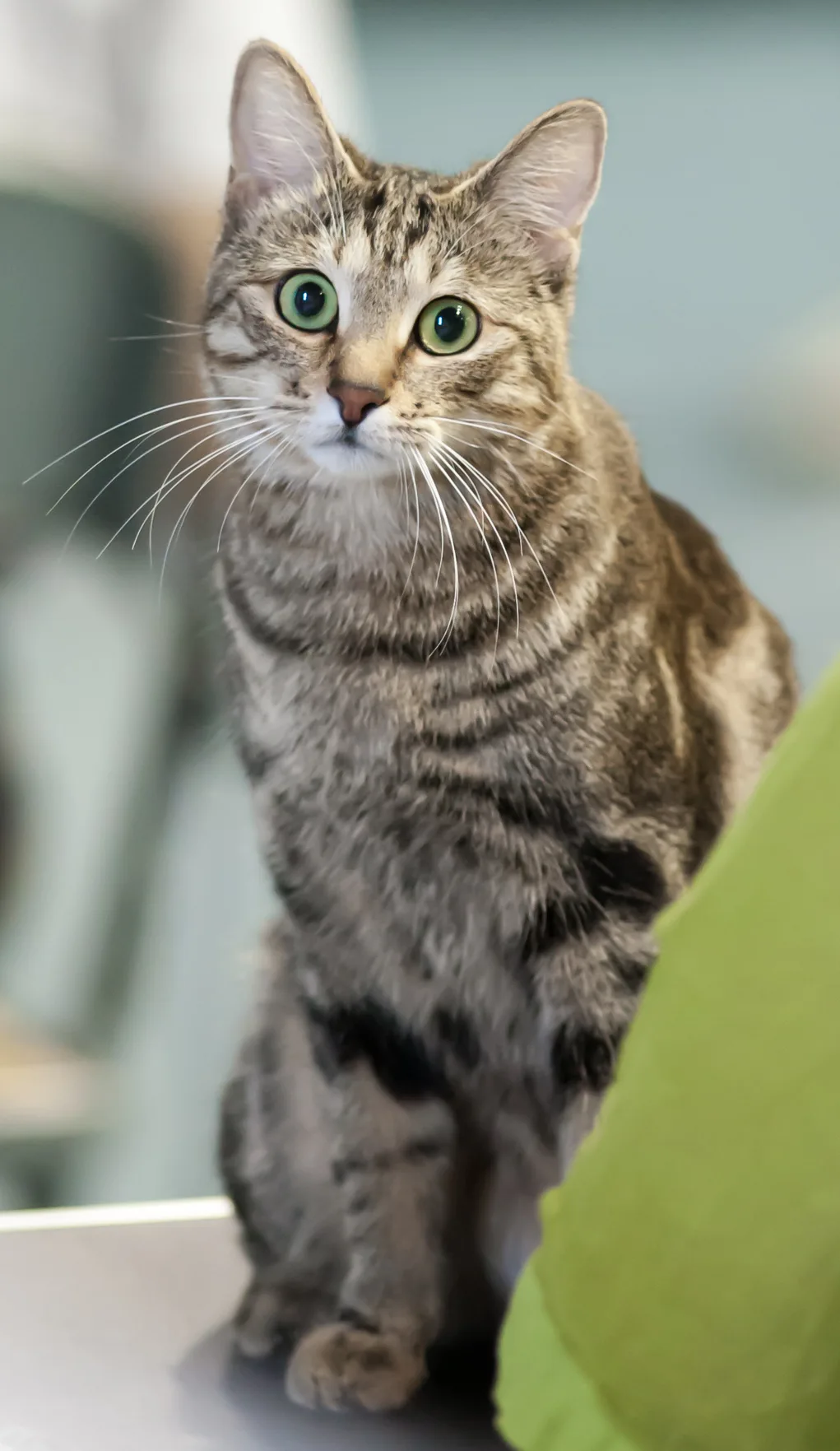
Julapp shows the shorthair’s facial features. Heikki Siltala, catza.net[8]
Brushing the Coat Your Cat Has
On a shorthair, the contrast between the body coat and the longer tail fur is particularly clear. The WCF describes a well-developed outer coat with little undercoat. The International Cat Association (TICA) describes both shorthaired and semi-longhaired Kurilian Bobtails, so a cat listed as a Longhair can have the same pom-pom tail. In the photograph of Nipa, long hair falls from the neck into the space between the front legs, giving the chest a broad outline. On Wilma, pictured farther down, the fur fans out at the cheeks and makes the face look rounder. Both are longhairs. Looking at where the coat grows long on your own cat will show you where to spend time with the comb. [1,2,9,10]
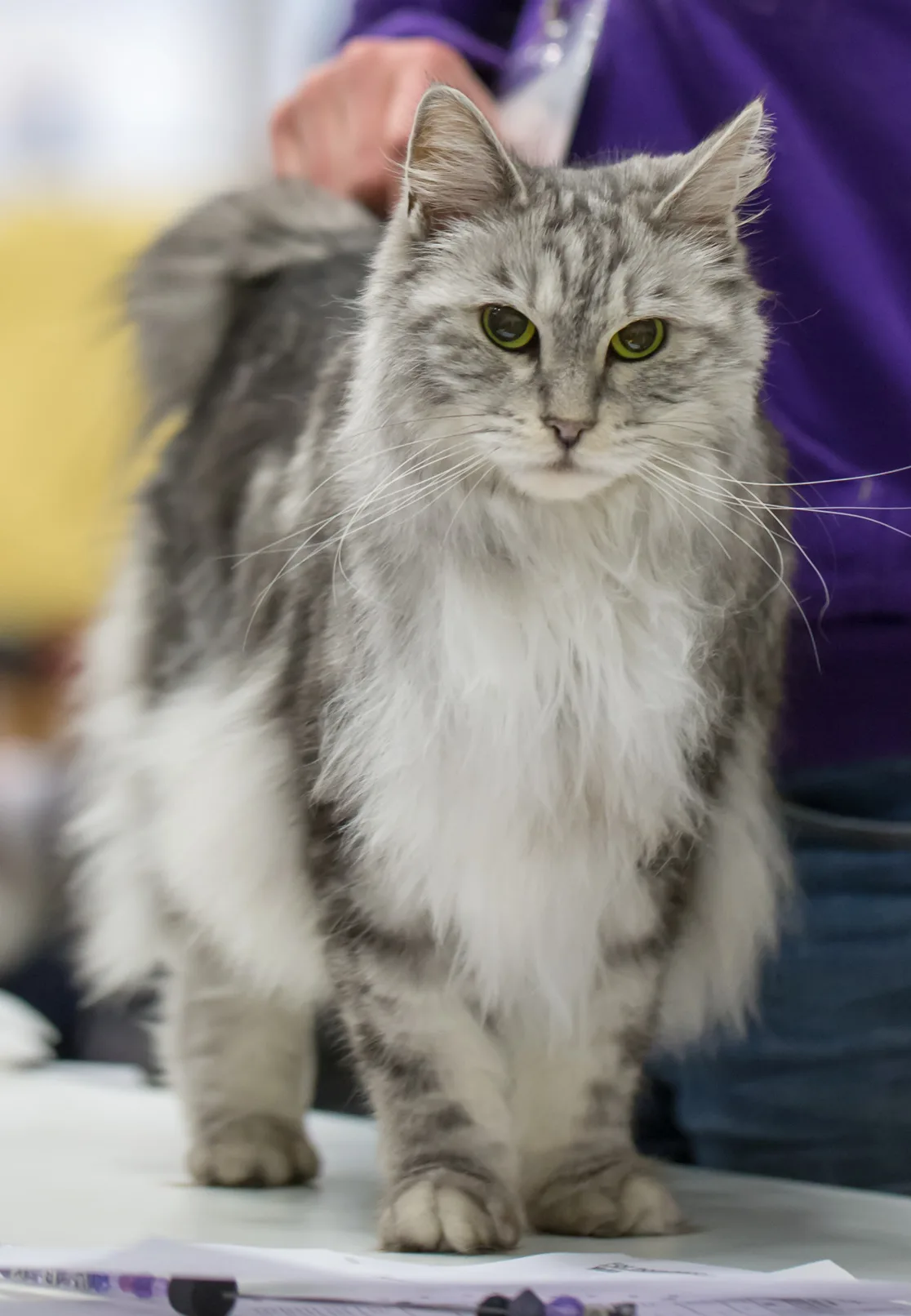
Nipa stands facing the camera. Heikki Siltala, catza.net[9]
TICA suggests weekly brushing as a starting point. For the first session, choose a moment when your cat comes over and settles beside you. Try a few gentle strokes along the back in the direction the hair grows, then work through the chest and sides. Use a light touch on the longer tail hair and let it fall around the tail’s natural bends. Continue for a little while if the cat stays. If it walks away, end the session there. The next time you brush, notice whether the comb still passes easily through the areas you worked on. That gives you a way to adjust the interval while letting the cat decide how long each session lasts. [1–3]
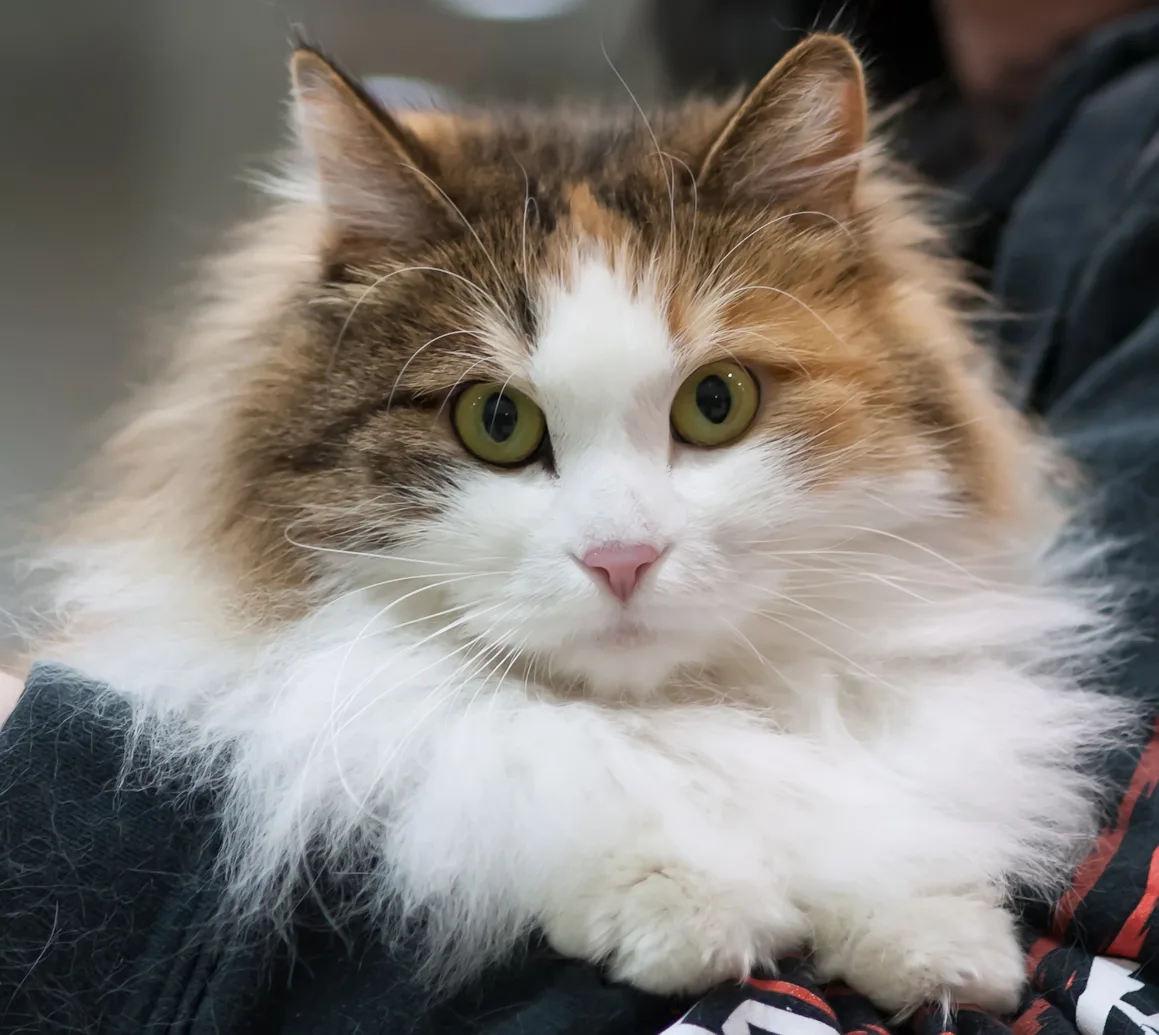
Wilma’s long fur frames her cheeks. Heikki Siltala, catza.net[10]
Routes Your Cat Can Choose
TICA describes Kurilian Bobtails as cats that enjoy high places. When setting up a room, start with a perch you think your cat might use. Crouch down and trace the approach. Where can the cat step up? Is the landing steady? How can it get down when it wants to leave? A sturdy low stool beside a window perch can provide an intermediate step. Leave a quiet, sheltered resting place nearby so a cat that enjoys watching the household can also retreat from it. Once the room is ready, the routes your cat takes again and again will tell you which heights work for it. [2,3]
The Feline Veterinary Medical Association identifies safe hiding places, separate access to everyday resources and opportunities for hunting-style play as basic needs of indoor cats. These apply to Kurilian Bobtails too. Follow the paths from your cat’s sleeping place to its water, food and litter box, paying particular attention to doorways and narrow halls. Two cats may each have a water bowl yet still have to pass through the same doorway to reach either one. If one cat often sits in that doorway, the more timid one may struggle to get a quiet drink. Moving a bowl to a spot it can reach independently gives it another route to water. [3]
You can build a chase into that same space. A little clear floor beside a cardboard box gives you room to flick a wand toy into view and draw it back around a corner. Pause long enough for the cat to crouch, fix its gaze and give chase, then let it pounce and catch the toy. Some days it may choose to watch the whole thing from its perch. Let the game end there. Offering play at fairly regular times and letting the cat come down when it chooses puts the association’s advice about predictable interaction into practice. [3]
Which Tail Changes Need Veterinary Attention?
The tail shape a Kurilian Bobtail is born with has a genetic basis. A 2022 study of domestic cats found that a variant of the HES7 gene associated with short, kinked tails was common among the Kurilian Bobtails sampled. The UK’s Governing Council of the Cat Fancy (GCCF) considers the welfare implications of distinctive physical traits when assessing breeds. For a cat at home, a genetic finding alone cannot tell you how likely it is to develop pain or difficulty toileting. What you can observe is how comfortably your cat moves, whether it passes urine and stool, and whether any of that has changed. [4,5]
When your cat first comes home, a short side-view video of it walking or climbing onto a favorite perch can give you a record of its usual movement. Contact a veterinarian promptly if the tail gets caught in a door, a tail the cat could previously lift suddenly hangs limp, or you notice a wound or obvious pain at the base. An injury near the tail base can affect the nerves involved in urination and bowel movements. If your cat repeatedly strains in the litter box and passes no urine, seek emergency veterinary care immediately. Tell the veterinarian when the cat last urinated normally, how the injury happened if you saw it, and how the cat usually walks and carries its tail. [6,7]
References
-
[1] World Cat Federation. Kurilian Bobtail Shorthair (KBS). January 1, 2010.
-
[2] The International Cat Association. Kurilian Bobtail.
-
[3] Feline Veterinary Medical Association. New Feline Veterinary Medical Association Position Statement Reimagines Life for Indoor Cats. August 28, 2025.
-
[4] Anderson H, et al. Genetic epidemiology of blood type, disease and trait variants, and genome-wide genetic diversity in over 11,000 domestic cats. PLOS Genetics. 2022, 18(6), e1009804.
-
[5] Governing Council of the Cat Fancy. Unrecognised Breeds.
-
[6] VCA Animal Hospitals. First Aid for Tail Injuries in Cats.
-
[7] VCA Animal Hospitals. Emergencies in Cats.
-
[8] Heikki Siltala. CH Rakushka Island Julapp (KBS n 09 22), photo 208073. May 25, 2013.
-
[9] Heikki Siltala. GIP Cherrytail's Coupe de Ville (Nipa), KBL ns 22, photo 220072. April 12, 2014.
-
[10] Heikki Siltala. GIC,IP Arabescka SuperBob (Wilma), KBL f 03 23, photo 168109. January 29, 2011.