The World Cat Federation (WCF) calls its standard for the shorthaired variety LaPerm Shorthair. One detail in the standard is easy to check at home. Can you gently part the coat along the cat’s back? The ideal short coat is light and springy, standing away from the body in loose waves or curls. Even a freshly combed coat will have an uneven outline. Britain’s Governing Council of the Cat Fancy (GCCF) describes a LaPerm coat that you can part with your fingers all the way to the skin. Taken together, the descriptions give you a practical guide to grooming. Once neighboring locks separate easily, you can leave the curls as they are. [1][2]
The Tail Helps Distinguish the Two Coat Lengths
Both the GCCF and the Cat Fanciers’ Association (CFA) use the name LaPerm and describe longhaired and shorthaired varieties. Follow the line of the back to the tip of the tail. On a shorthair, the tail hair stands out on all sides like a bottlebrush, and the body coat feels a little firmer. A longhair’s tail fans out into a plume, and a mature cat may develop a ruff around the neck. The curls are often more pronounced at the base of the ears and along the sides of the neck than on the back. A single cat can have small curls, waves and longer, looser locks. [1][2][3]
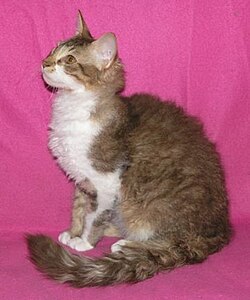
The longhair’s tail forms a plume. Bebopscrx, Wikimedia Commons[6]

The WCF shorthaired standard describes a medium-sized, muscular cat with round paws and hind legs slightly longer than the forelegs. The head forms a wedge with gently rounded contours. The ears follow its outline, tilting slightly out and forward. The muzzle is broad, with full whisker pads and long whiskers extending to either side. The standard allows a wide range of colors and patterns, with any amount of white. In this portrait of a black LaPerm named Kururu, the pale whiskers stand out against the dark cheeks, making it easy to see where they emerge. [1][3]

Kururu’s long whiskers stand out. Takashi(aes256), Wikimedia Commons[7]

Stop When the Comb Passes Easily
On the standing tortoiseshell-and-white LaPerm below, dark tufts turn upward along the back while longer white hair hangs down from the belly. To decide whether a coat like this needs another pass, set the comb down and use the pads of your fingers to part a small lock. A natural curl bends, but the locks beside it still come apart. If several locks cling together and your fingers catch in the same place each time, that spot deserves attention. Judging by the tousled outline alone can lead you to comb the same free-moving section several times. [2][3]
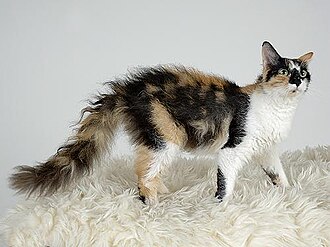
Locks lift along the back. Bebopscrx, Wikimedia Commons[8]

A wide-toothed comb is useful to keep at home. The GCCF recommends regular combing, with more frequent attention for longhairs. The CFA specifically recommends a comb with rotating teeth. Curls hold on to some of the hair a cat has shed, and the turning teeth help lift it out while easing the pull on hair that is still attached. If you feel resistance, pause. Gently tease the tangled locks apart with your fingers before passing the comb through again. On a longhair, feel the ruff and the bases of the ears to get to know the natural curl there. Once the comb passes and the lock springs back as you let go, move on to the next section. [2][3]
Let the coat guide how often you comb it. The WCF notes that a shorthair’s coat length varies with the seasons and that the curls develop gradually, sometimes taking two or three years to mature. A longhair’s coat can also change in fullness with age and season. An adult cat’s photograph tells you little about where your kitten needs combing today. Get to know which areas usually part at a touch and which begin to catch as the hair grows longer. Those are good places to check first next time. [1][2]
Give a Curious Cat Somewhere to Retreat
The GCCF describes LaPerms as curious about what is happening around them and fond of playing with people. Give that curiosity room at home with a sturdy perch where the cat can watch from above and a quiet hiding place away from the activity. Leave enough floor space to draw a toy along the ground and pause it behind cover. That gives the cat a chance to crouch, wait, chase and catch it. If the cat chooses to stay on the perch and watch, you can end the game there. [2][4]
The Feline Veterinary Medical Association identifies needs shared by indoor cats. They include safe hiding places, resources in separate locations, opportunities for hunting-style play, predictable interactions with people and surroundings that take the cat’s senses into account. In a home with several cats, trace the routes each one uses. If one cat settles in a doorway, can another still reach water, use a litter box and get to a quiet resting place? Putting resources in different locations gives the cats choices that extra bowls lined up in one corner cannot offer. Grooming can follow a familiar rhythm, too. Begin when the cat approaches, give it room to leave and keep its hiding place available for rest. [4]
What If Your Cat Keeps Licking One Patch Bare?
When you part the curls, take a look at the skin underneath. Seasonal changes can affect the fullness of the whole coat. A patch that grows thinner as the cat repeatedly licks it follows a different pattern. According to the Cornell Feline Health Center, both itch and pain can prompt repeated licking. Contact a veterinarian if the licking causes hair loss or breaks the skin. Note when you first saw the change, record where the cat keeps licking and take a photograph with the locks parted. Those details give the veterinarian a clearer picture of what happened than saying the curls have looked thinner lately. [1][5]
If you are asking a breeder about a kitten’s health background, the GCCF offers a specific line of inquiry. It permits LaPerm outcrosses with certain other breeds and recommends genetic testing appropriate to the outcross parent’s background. Ask which lines the litter’s parents come from and which tests they have had as a result. For a cat already losing hair in one spot, the veterinary visit starts with the symptoms you can describe. Even after a recent move or change in routine, the veterinarian will need to investigate physical causes of itching or pain before deciding whether stress is playing a part. [2][5]
References
-
[1] World Cat Federation. LaPerm Shorthair. 2010-01-01.
-
[2] The Governing Council of the Cat Fancy. LaPerm.
-
[3] The Cat Fanciers’ Association. LaPerm.
-
[4] Feline Veterinary Medical Association. New Feline Veterinary Medical Association Position Statement Reimagines Life for Indoor Cats. 2025-08-28.
-
[5] Cornell Feline Health Center. Cats that Lick Too Much.