A cat with upright ears can be a Foldex. The Canadian Cat Association (CCA-AFC) registers the Foldex as a distinct breed developed by crossing the Scottish Fold with the Exotic Shorthair. Its breed description includes cats with straight ears as well as those with folded ears. A round face and folded ears are features you can see. To establish whether a particular cat is a Foldex, look to its pedigree and registration records.[1][2]
Betty-Ann Yaxley first exhibited the Foldex at a cat show in 1993. Jeanne Barrette continued developing the breed, and the Canadian Cat Association accepted it as an experimental breed in November 1998 and as a new breed in August 2006. The association maintains a dedicated Foldex standard and judges longhairs and shorthairs separately. The International Cat Association (TICA) made a separate decision at its 2025 annual meeting. It immediately ended experimental status for a group of breeds that did not meet its registration rules, including the Foldex. That decision applied to TICA. The Canadian association maintains its own registry.[1–3]
The Foldex standard calls for a single forward fold
Start at the rounded tip of the ear and follow its outline down towards the base. The Canadian show standard describes small ears set low and wide apart, each folding forwards and down once. Judges deduct points if the ears lie so tightly against the head that they look like a cap. Between the ears, the head is broad and round. The eyes are large and widely spaced, and the nose is short and broad. The standard also specifies open nostrils and deducts points for nostrils as narrow as pinholes.[2]
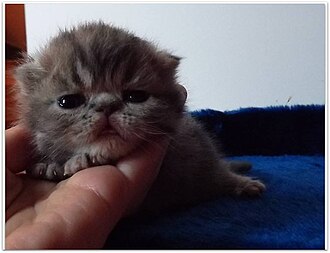
Dark stripes mark Belisario’s forehead. AliciaPSF, Wikimedia Commons[10]

The photographer identifies both Belisario and Bebeto as Foldex cats. Belisario is a blue spotted tabby, while Bebeto is a cream spotted tabby. The front views show how clearly the forehead markings stand out on each kitten and how the cheeks frame the face. Looking beyond the head, the standard describes a broad chest, a compact body and firm, rounded paws. The shorthair has a dense coat that stands away from the body, and the longhair has a full plume of fur on the tail. Foldex cats come in a range of colours and patterns.[2]
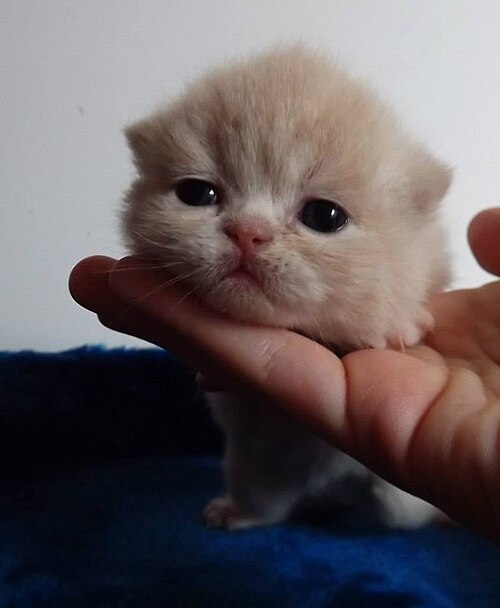
Bebeto’s cheeks frame his face as a kitten. AliciaPSF, Wikimedia Commons[11]

Let your cat choose a route to the window
The Canadian Cat Association describes the Foldex as curious, active and fond of company. At home, give your cat a choice about how close to be. A quiet bed in a room where people spend time offers a place to watch the household. A hiding place gives the cat somewhere to retreat whenever it wants. Let it approach for a stroke and walk away when it has had enough. If several cats share your home, spread out food, water, litter boxes and resting places so one cat can reach a drink without having to squeeze past another.[1][4]
Give your cat room to choose during play, too. Move a toy along the floor and allow time for the cat to crouch, stalk and pounce. If the windowsill is a favourite spot, a low, stable step offers a choice between one jump and two shorter ones. Over time, you will get to know the usual route. A cat that used to spring onto the sill each day may now pause beneath it or pass up even the low step. Note when that change began. Describing what you saw gives your veterinarian more useful information than coaxing the cat with a toy to see if it will jump again.[4][5]

Young Bebeto stands with his forelegs and chest in view. AliciaPSF, Wikimedia Commons[12]

What connects the ear fold to the joints?
The connection comes from the Scottish Fold side of the Foldex pedigree. Genetic research in Scottish Folds linked the folded ear to a dominant variant of the TRPV4 gene. The variant affects how cartilage and bone develop. In the outer ear, the visible result is a fold in the cartilage. The same disorder, called osteochondrodysplasia, can also affect the tail and the parts of the limbs nearest the paws, damaging joints. The Canadian Foldex standard itself calls for a flexible tail and directs judges to withhold awards when fused vertebrae make part or all of the tail stiff.[2][5]
The tightness of an ear fold cannot tell you how much pain a cat feels. In a small study of Scottish Folds, all 12 folded-ear cats tested carried the variant. Only one showed clinical signs of the disorder at examination. Those findings describe the cats examined and cannot establish a Foldex cat’s lifetime risk. If you repeatedly notice a limp, stiff steps or a marked decrease in jumping, record a short video of your cat getting up and walking of its own accord. Tell your veterinarian when the change began so they can assess pain and joint movement and decide whether imaging would help.[5][6]
A short muzzle raises a separate concern. Researchers studying domestic cats compared facial proportions with owners’ accounts of how their cats breathed. Shorter muzzles were associated with more noticeable breathing noise during sleep and greater difficulty breathing after activity. A front-view photograph shows the shape of the face, but it cannot show how hard the cat is working to breathe. Tell your veterinarian if your cat repeatedly struggles to breathe after ordinary play or if its breathing starts to sound distinctly different during sleep.[7]
Registration tells you how an association classifies a cat. Breeding for a particular feature raises a further question. What does keeping that feature cost the cat? In its account of unrecognised breeds, the UK’s Governing Council of the Cat Fancy identifies skeletal disease in the Scottish Fold parent breed as a welfare concern. The Feline Veterinary Medical Association opposes breeding cats with inherited structural abnormalities such as those of the Scottish Fold, or with severe shortening of the skull that compromises function. For a Foldex already sharing your home, those concerns translate into everyday questions. Can your cat walk comfortably to the litter box, play freely and breathe easily afterwards?[8][9]
References
-
Canadian Cat Association. Breed Descriptions — Foldex.
-
Canadian Cat Association. FOLDEX. Breed standard, p. 1.
-
The International Cat Association. 2025 Annual Meeting Minutes, p. 2, item 8.
-
Feline Veterinary Medical Association. New Feline Veterinary Medical Association Position Statement Reimagines Life for Indoor Cats. 2025.
-
Gandolfi B et al. A dominant TRPV4 variant underlies osteochondrodysplasia in Scottish fold cats. 2016.
-
Farnworth MJ et al. Flat Feline Faces: Is Brachycephaly Associated with Respiratory Abnormalities in the Domestic Cat (Felis catus)?. 2016.
-
Governing Council of the Cat Fancy. Unrecognised Breeds.
-
Feline Veterinary Medical Association. 2024 Responsible Breeding in Feline Medicine.
-
AliciaPSF. Bebé de Gato FoldEx.jpg.
-
AliciaPSF. BebéDeGatoFoldex (CreamSpottedTabby).jpg.
-
AliciaPSF. Joven Gato FoldEx ("Bebeto Del Laberinto").jpg.

