On Swiss mountain farms, the Greater Swiss Mountain Dog hauled carts of meat and dairy goods along mountain roads to market. Back in the pasture, the dog worked livestock, turning on slopes to move the herd along. Pulling a load took strength. Herding on a hillside also took nimble feet. If you are thinking of bringing a Swissy home, picture an ordinary walk. Who will teach a dog strong enough to haul a cart to match the pace of the person holding the leash? [1]
Seen from the side, the Swissy has the build for draft work. Its shoulders are muscular, its front legs thick and straight, its loin broad, and its thighs strong. The belly slopes up only slightly. The American Kennel Club (AKC) gives an adult male’s height as about 65–72 cm at the shoulder and its weight as about 52–64 kg. An adult female stands about 60–69 cm and weighs about 39–50 kg. When you meet a puppy, measure that adult height against your own leg. That is where the top of the shoulder will come to. Now picture the dog at the door, head held higher still, waiting for you to clip on the leash. [1][6]

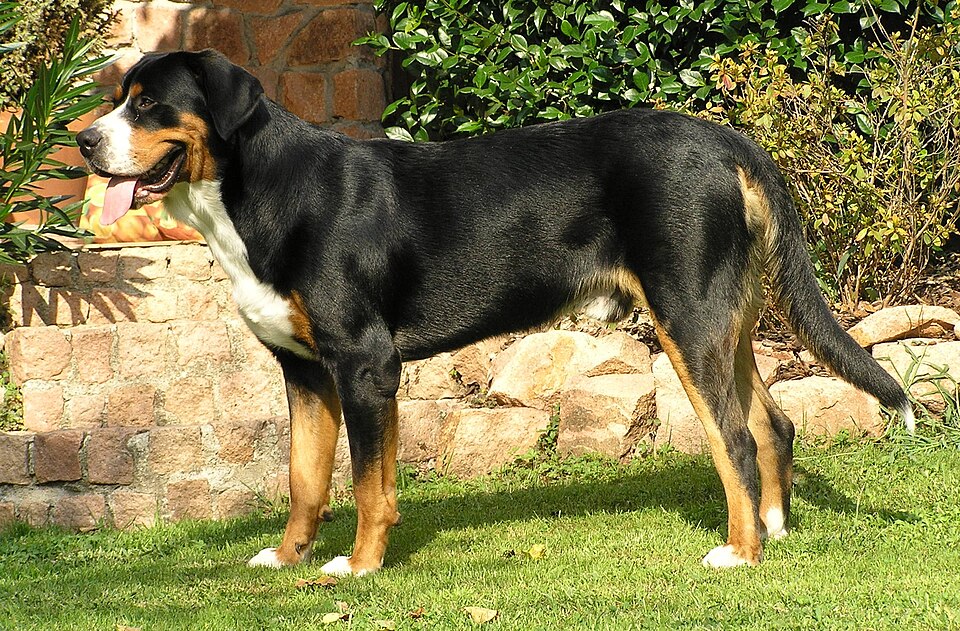
A Greater Swiss Mountain Dog stands in profile. KIKKUZZO88 and Pleple2000, Wikimedia Commons[6]
Look at Mocha, the adult female in the next photograph. A narrow white blaze runs down the middle of her black forehead and widens at the muzzle. She has a rust-colored spot above each eye, rust on her cheeks, and triangular ears that lie against the sides of her head. On the body, the white chest and toes stand out against the black coat. To recognize a Swissy, look at where the colors fall, how short and dense the outer coat is, and how substantial the body is beneath it. Those details tell you more than the three colors alone. [1][2]

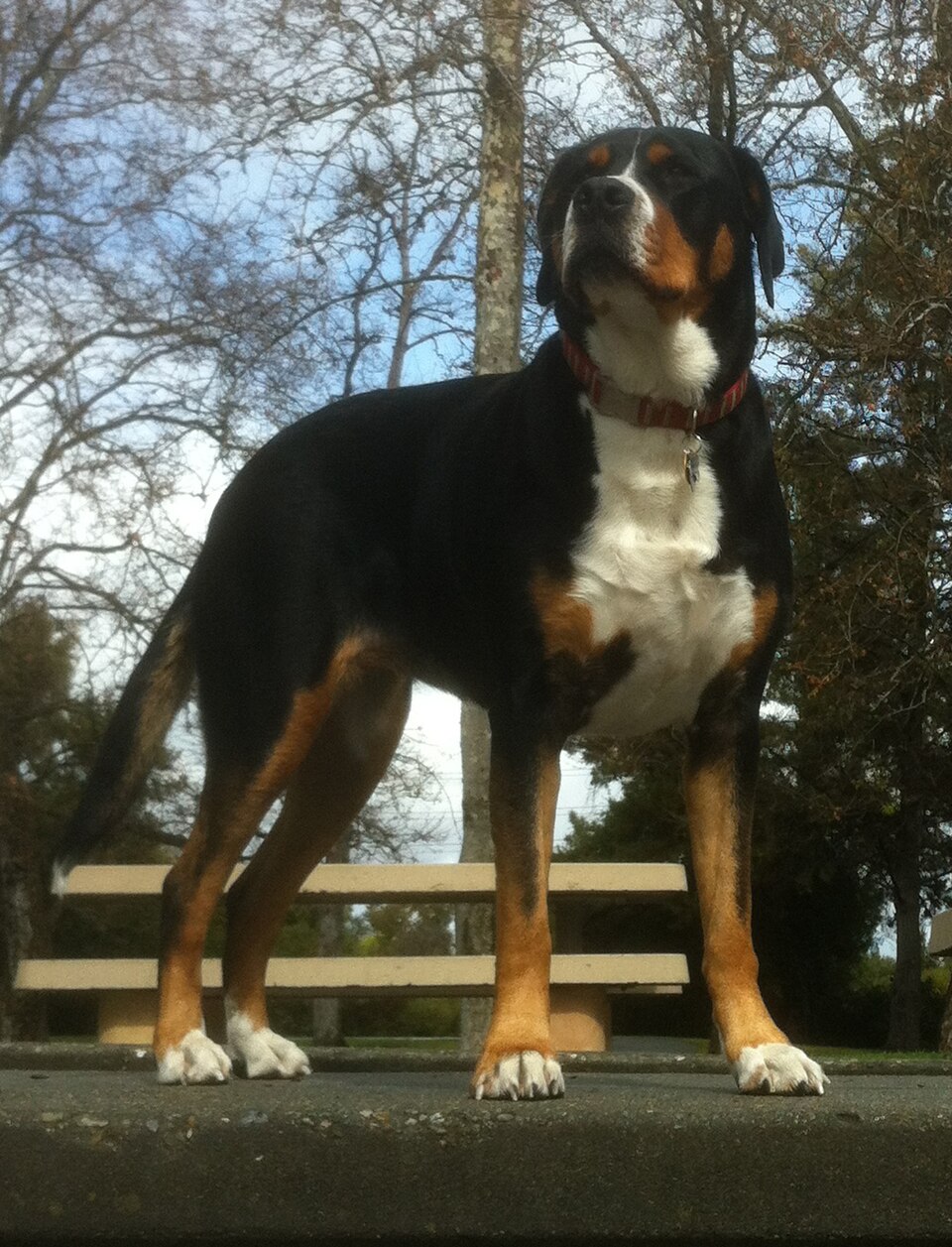
Mocha has a white blaze and rust-colored brows. Ayputs, Wikimedia Commons[2]
A route that fits your family’s walking pace
Think of the hours these dogs once spent on foot alongside people and livestock. The AKC describes the breed’s exercise needs as moderate and gives a walk around the block or an outing in the woods as examples. If you like walking and taking a dog hiking on weekends, you and a Swissy have a starting point. If you get most of your exercise by cycling or training for marathons, set aside time for a separate walk. Choose a pace the dog can comfortably keep and a distance that suits it, even on a day when your own training plan calls for more miles. [1]
Climate matters when choosing a route. A Swissy’s size, black coat, and dense undercoat make it prone to overheating during prolonged activity in hot sun. In summer, take the main walk early in the morning or in the evening. Choose a shady route where you can turn back readily, with somewhere cool to rest at home. Think through a weekday. Who can take the dog out before an early shift? Where can it cool off when the afternoon sun reaches the yard? In a hot climate, access to an air-conditioned room during the day matters more than the size of the yard. [1]
Start with a few steps on a slack leash
A cart moves when the dog leans into the harness and keeps walking. On a family walk, a Swissy can learn much the same lesson if pulling brings the person along. The AKC’s breed guide cautions that a harness designed for pulling can encourage a Swissy to lean in harder. Start while your puppy’s strength is still easy to manage. Pick a quiet stretch where you can stop whenever you need to. When the leash hangs in a curve and the puppy takes a few steps beside you, offer a small treat right by your leg. Then walk on together. [1][3]
Suppose your puppy spots a tree and hurries toward it until the leash goes tight. Stop where you are. Wait for the puppy to turn back or step closer so the leash hangs loose again. Praise it, then walk to the tree together and let it sniff. The tree itself is the reward. Catch the puppy getting it right, too. If it stays beside you as you approach the next tree, take it straight over for a sniff. That gives the puppy a reason to keep the leash loose from the start. A short stretch of pavement gives you time for all those stops and sniffs. Once it feels easy, try a busier corner. [3]
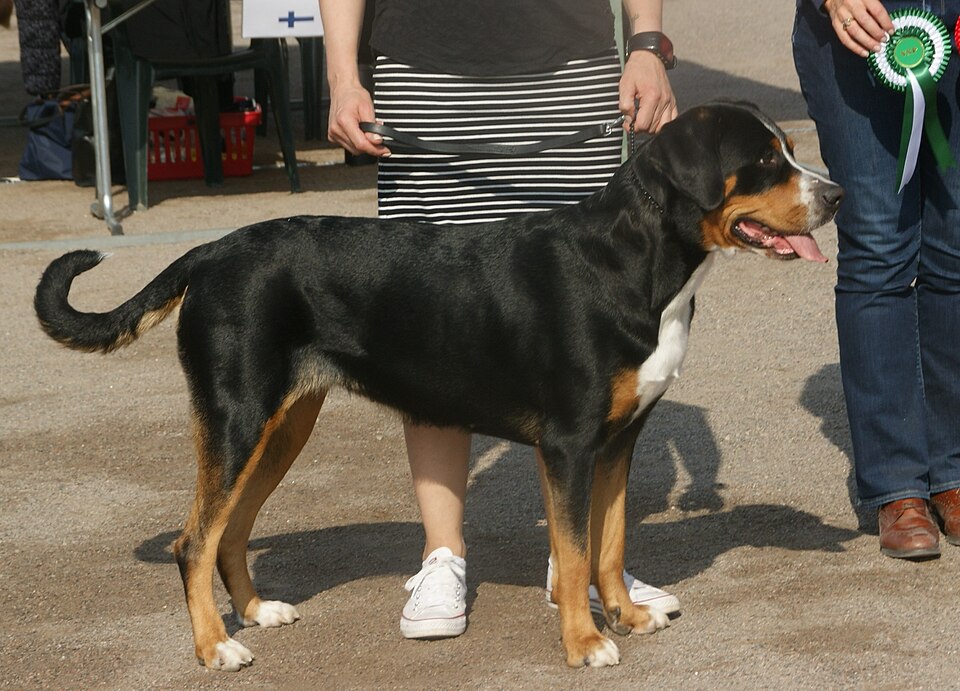
A Greater Swiss Mountain Dog stands beside its handler. Canarian, Wikimedia Commons[4]

Notice how far up the handler’s leg the dog’s shoulders reach. When deciding who will take the walks, allow for the strength that comes with that adult frame. If several adults will share the job, go out together and take turns holding the leash. Agree on when to stop and when to move again. If one person stops whenever the leash tightens and another lets the dog pull all the way home when time is short, the dog encounters two different rules on the same leash. Make time for puppy classes and early socialization, too. A young Swissy can get to know unfamiliar people and places while it is still small enough for you to guide it away easily. [1][3][4]
The undercoat beneath the short outer coat
In the side view, the black outer coat lies smooth along the dog’s back. Most of the time it takes little upkeep beyond bathing and brushing as needed. Set aside more time when the dog sheds its undercoat, usually twice a year. The surface can still look smooth while tufts of soft hair underneath are ready to come out. During a heavy shed, bathe and blow-dry the coat, then work out the loose hair with a tool suited to the undercoat. Routine care also includes nail trims, ear cleaning, and brushing the teeth. Reward your puppy for letting you briefly handle a paw or look inside an ear. Those early lessons make it easier to care for a dog this size when it is grown. [1][6]
Swissies are often willing to work for food. That helps with leash practice, but it is easy for several people to underestimate how much they have fed the dog between them. Before the first walk, set aside a little of the day’s food for training. If someone else takes the evening walk, they can use what is left of that portion. The AKC flags overfeeding and obesity as concerns for the breed. When asking a breeder about a puppy’s family history, request the hip, elbow, shoulder, and eye evaluation records for both parents. Check which dog each result belongs to. [1]
Everyone in the household should recognize one emergency. Greater Swiss Mountain Dogs are at risk of bloat. If the stomach expands and twists, the condition can quickly become life-threatening. If your dog suddenly retches repeatedly without bringing anything up, go to an emergency veterinarian immediately, especially if the dog is also restless or drooling, or its belly looks swollen. Before bringing home a dog that may grow to weigh more than 50 kg, save the emergency clinic’s address. Work out who could drive at night and how you would get the dog into the car. Like finding someone who has time to walk at the dog’s pace each day, that is an arrangement you can make before the dog arrives. [1][5]
References
-
[1] American Kennel Club. Greater Swiss Mountain Dog.
-
[2] Ayputs. Greater Swiss Mountain Dog - Adult Female. Wikimedia Commons, 2012.
-
[3] American Kennel Club. How to Stop Your Dog From Pulling on the Leash.
-
[4] Canarian. Greater Swiss Mountain Dog 2018. Wikimedia Commons, 2018.
-
[5] Cornell University College of Veterinary Medicine. Gastric dilatation volvulus (GDV) or “bloat”.
-
[6] KIKKUZZO88 and Pleple2000. File:Swissy-2009-11-02.jpg. Wikimedia Commons, 2009.