For centuries, Afghan Hounds accompanied hunters in the mountain kingdoms of Asia. As a sighthound, the Afghan could pick out moving prey across a wide field of vision and accelerate into pursuit. Its large paw pads cushioned the impact of each stride on rough ground, and its thick, silky coat protected it in the harsh mountain climate. Much of what catches the eye in an Afghan today makes sense in that setting. For a family considering one, the coat and the powerful runner underneath it each make a claim on the week.[1]
On a seated Afghan, the long hair frames the head and falls over the chest. Seen in profile, fine strands follow the cheek and hide the outline of the ear. When the dog stands, the coat falls so far down either side that it can be hard to see how long the legs are. The American Kennel Club (AKC) describes a tall, lean, agile hound that can reach 27 inches (about 69 centimetres) at the shoulder. Prominent hip bones are characteristic of the breed. A judgment about an individual dog’s weight also needs to take its diet and activity into account.[1]
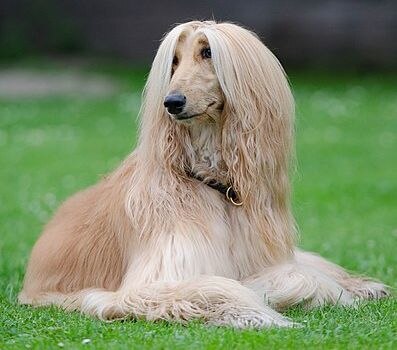
Figure: A seated Afghan Hound. Weaveravel, Wikimedia Commons[2]

Where could the dog stretch out and run several times in an ordinary week? Short walks alone fall short of the exercise this athletic breed needs. The AKC describes several chances a week to run at full speed in a large enclosure as ideal. A patch of green close to home may be convenient for a walk on leash. For a free run, the dog also needs room to gather speed and a secure boundary. Counting the journey to and from a suitable field gives a family a better sense of how often it could get there on a working week.[1]
Walk the perimeter of a prospective field. An Afghan’s height and strength make it an able jumper, so look for a high, secure fence all the way around, including at the gate when it closes. On open ground, keep the dog on leash even when the surroundings seem quiet. By the time a person notices what made the dog turn its head, the hound may already be ready to chase. For families who enjoy running, the AKC notes that some owners take mature Afghans on longer runs on leash. The individual dog’s maturity and fitness matter when planning those outings.[1]
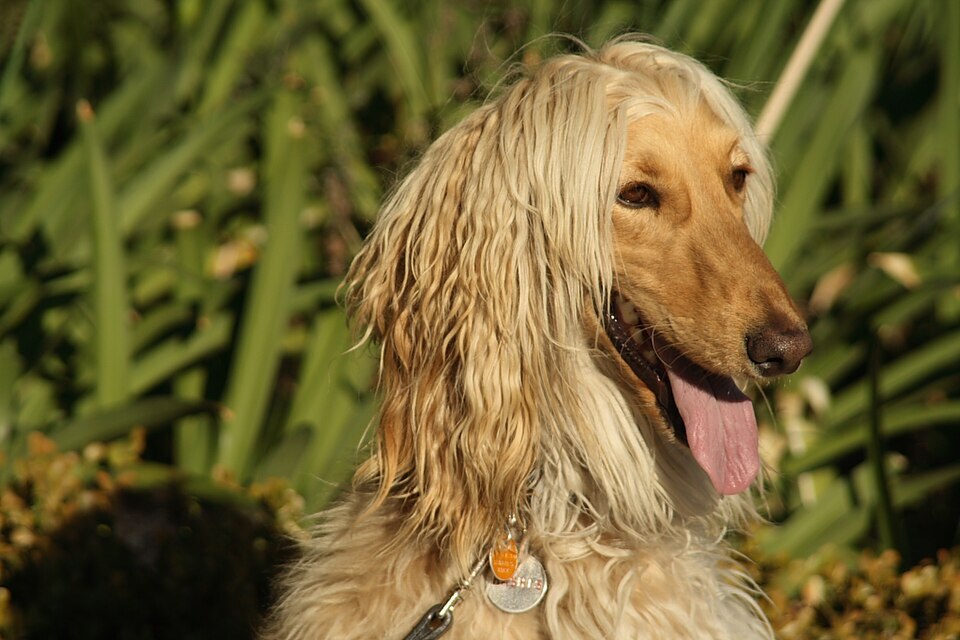
Figure: The Afghan Hound’s ear coat. Flickr user Esparta, Wikimedia Commons[3]

The most useful early cues are ones everyone in the household can use. Coming when called brings the dog within reach to clip on a leash. Sitting and waiting make it easier to open a gate and go through together. Practice in an enclosed space gives these words a familiar place in the routine of going out and coming home. An Afghan that usually turns at the sound of its name can still break into pursuit when something moves. A secure field gives the family room to work on recall without staking the dog’s safety on its response.[1]
An Afghan may seem reserved on a first meeting. The breed has an independent streak, yet with familiar people an Afghan can be affectionate, deeply loyal and occasionally quite silly. How warmly a dog greets a stranger tells a family little about the relationship that might develop. For an adult Afghan, a strong attachment to a previous owner can make changing homes difficult. Find out who used to take the dog out, which cues it knows and whose hands it is used to during grooming. Those details give the new household something familiar to build on while the dog settles in.[1]
The easiest commitment to underestimate is the coat that has yet to grow. An Afghan puppy wears short fuzz, with tufts of facial hair nicknamed “monkey whiskers.” At this stage the coat is fairly easy to tend. Through adolescence, the long, silky hair that people associate with the adult becomes a regular part of caring for the dog. A family meeting a puppy can look at an adult Afghan to get a better idea of the work ahead. Once hair hangs from both ears, across the chest and down the sides, who will sit down with the dog and brush through each area?[1]
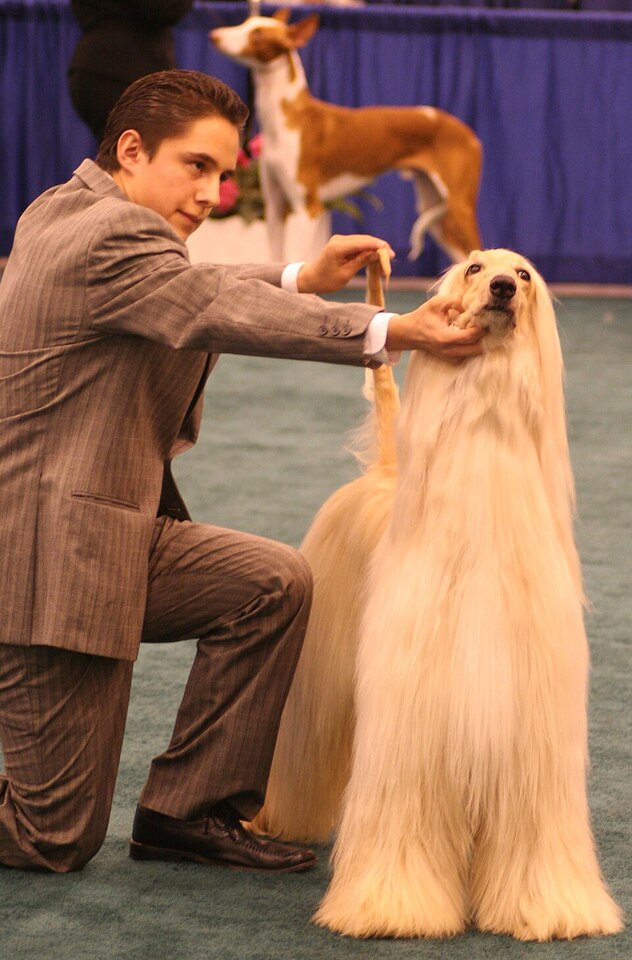
Figure: An Afghan Hound in full coat. Flickr user Ed Schipul, Wikimedia Commons[4]

The AKC puts brushing alone at several hours a week. The work is easiest to picture after a run outdoors. A coat can look smooth on the surface while bits of grass cling to the strands underneath. Brushing lifts out that debris and separates tangles before they tighten into mats. The dog also needs regular baths with shampoo and conditioner, along with tooth brushing and nail trims. When mapping out a week, allow time for both ends of an outing. Someone has to get the dog to the field, and someone has to work through the long coat back at home.[1]
Two health concerns are worth discussing with a veterinarian in advance. Like other sighthounds, Afghans naturally carry little body fat and can be sensitive to anesthesia. If surgery is planned, speak with a veterinarian familiar with sighthounds about the arrangements for that dog. Afghans are also deep-chested and can develop bloat. Sudden swelling of the abdomen can be life-threatening and calls for immediate contact with an emergency veterinarian. Everyone who cares for the dog should know where to go. Alongside the everyday arrangements for running and brushing, knowing who can get the dog to urgent care makes the family’s plan more concrete.[1]
References
-
[1] American Kennel Club. Afghan Hound.
-
[2] Weaveravel. File:Afghan dog - cropped.jpg. Wikimedia Commons.
-
[3] Flickr user Esparta. File:Afghan Hound blond portrait.jpg. Wikimedia Commons.
-
[4] Flickr user Ed Schipul. File:Afghan hound dogshow.jpg. Wikimedia Commons.